
Turn it off!
Turn off the big screen and get down at the children’s eye level and look at them.

Engage them!

Engage them!
Get their attention with a finger play or a cheer.
*Teacher: Hocus pocus. (Pretend to wave a magic wand.)
Children: Everybody focus. (Children make imaginary goggles and put them around their eyes.)
Wait.
*Teacher: Hocus pocus. (Pretend to wave a magic wand.)
Children: Everybody focus. (Children make imaginary goggles and put them around their eyes.)
Wait.
Sit quietly and smile and wait.
*Close your eyes and pretend to wave a magic wand. Say, “Abracadabra. I will open my eyes when all my friends are sitting quietly.”
Lower your voice.
*Close your eyes and pretend to wave a magic wand. Say, “Abracadabra. I will open my eyes when all my friends are sitting quietly.”
Lower your voice.
By simply talking slowly with a quiet voice you will remind the children that it’s time to listen.
*Lip sinc a song or finger play like “Itsy Bitsy Spider.” Anything different or original will give children “pause.”
Busy Hands
*Lip sinc a song or finger play like “Itsy Bitsy Spider.” Anything different or original will give children “pause.”
Busy Hands
Give them something to do with their hands. Demonstrate how to cross your fingers and put your “listening hands” in your lap.

Pretzels and Applesauce

Pretzels and Applesauce
If children are sitting on their bottoms they will be less likely to squirm around. Remind them that their legs should look like pretzels and they should make a bowl of applesauce with their hands.
Hint! I explain that the doctor said it’s important to sit with their legs like pretzels. If the “doctor says” they are more likely to respond. (This is true because orthopedists warn sitting on the knees can be harmful.)
Body Check.
Hint! I explain that the doctor said it’s important to sit with their legs like pretzels. If the “doctor says” they are more likely to respond. (This is true because orthopedists warn sitting on the knees can be harmful.)
Body Check.
Remind children to listen with their eyes, ears, and bodies.
*Teacher: Are your eyes looking at me?
Children: Check!
Teacher: Are your ears ready to listen?
Children: Check!
Teacher: Are your bodies sitting quietly?
Children: Check!
Teacher: Are you ready to learn?
Children: Check!
Breathe
*Teacher: Are your eyes looking at me?
Children: Check!
Teacher: Are your ears ready to listen?
Children: Check!
Teacher: Are your bodies sitting quietly?
Children: Check!
Teacher: Are you ready to learn?
Children: Check!
Breathe
Tell children to slowly breath in and out their noses. It’s surprising how this will calm them – and they won’t be able to talk!
Signs
Signs
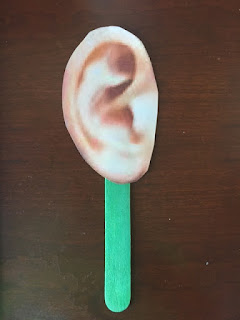
Run off a copy of a giant ear and tape it to a stick. When you hold up the ear children know they need to listen with big ears!
Repeat

Repeat
Practice giving directions ONE time. Invite another student to repeat what you have said.
Close Your Eyes
Close Your Eyes
Have children close their eyes as you give directions. Who can open their eyes and repeat what you said?
*Occasionally, have children close their eyes when you read a story. Can they make pictures in their brain?
*Invite children to sing songs or say nursery rhymes with their eyes closed.
*Occasionally, have children close their eyes when you read a story. Can they make pictures in their brain?
*Invite children to sing songs or say nursery rhymes with their eyes closed.