photo 3am_dj_home_zps919fb85e.png photo 3am_dj_about_zps7cce4c75.png photo 3am_dj_website_zps73051235.png photo 3am_dj_ss_zps6759ec2a.png photo 3am_dj_bs_zps43e27832.png

Friday, August 14, 2015

WRITING ROUND THE MULBERRY BUSH

Many, many years ago when I was doing a workshop there was a younger teacher sitting next to an older teacher.  The younger teacher said to her friend, "Tell Dr. Jean how you teach your kids handwriting.  Your kids are the best writers in the school."

The older teacher smiled and said, "We write round the mulberry bush."  She then went on to tell me how they practice making strokes for weeks before she teaches them how to form letters.  She demonstrated how they learn to go from top to bottom and left to write as they sing the song.  They do a different stroke for each verse.
Note!  I think a key to this is "purposeful practice for automaticity."  By repeating this every day children are able to master these basic strokes.

Now that I know the developmental stages for writing I've tweaked what she taught me a bit.  These are the stages according to most experts:

1st  vertical line
2nd  horizontal line
3rd  circle
4th  cross
5th  square
6th  diagonal
7th  X
8th  triangle


I would have the children draw and sing as they copy what I do on the board. 

Here we go round the mulberry bush, the mulberry bush, the mulberry bush.
Here we go round the mulberry bush so early in the morning.
(Pick up your pencil and place it at the top left corner.)

This is the way we wash our clothes, wash our clothes, wash our clothes.
This is the way we wash our clothes so early Monday morning.  (Make vertical lines.)
(I explain how people used to scrub their clothes on a wash board.)

This is the way we iron our clothes...so early Tuesday morning.  (Make horizontal lines.)
(Some children don't know what an iron is, so this is a good chance to explain and demonstrate.)

This is the way we scrub the floor...so early Wednesday morning.  (Draw circles.)
(Explain when you scrub you go around in circles with the brush.)

This is the way we mend our clothes...so early Thursday morning.  (Make a cross.)
(Show a button that has been sewn on with a vertical and horizontal stitch.)

This is the way we sweep the floor...so early Friday morning.  (Diagonal lines.)
(Pretend to hold a broom and sweep in a diagonal fashion.)

This is the way we bake our bread...so early Saturday morning.  (Make X.)
(Pretend to hold a rolling pin and show how you move it from top to bottom in a slanted way.)

This is the way we smile and sing...so early Sunday morning.  (Draw a smiley.)

Thursday, August 13, 2015

BIG SKY WRITING

Occupational therapists are some of the smartest people I know. I’m always picking their brains for ideas that will help children learn. One thing they’ve taught me is to practice making big strokes, shapes, and letters in the air before asking children to do it on paper. Think outside the box with these strategies to help children at all age levels. Even second graders would enjoy writing their spelling words on their “palm pilot” or tummies.

Sky Writing (aka "invisible writing") - Keep arm stiff and extend index and middle fingers. Make lines, circles, slants, pushes and other strokes in the air.
Note! The teacher will need to reverse movements if doing it in front of the class.


Air Writing (Lisa Callis)

Go from large to small as you practice air writing letters, numerals, shapes, etc.

  1. Stick out one arm and write with your finger.
  2. Hold your shoulder with the opposite hand as you write with one finger.
  3. Hold your elbow and write.
  4. Hold your wrist and write.
  5. Hold finger and write.
Writing Wand - Staple ribbon to a straw or tape tissue paper to a craft stick to make a writing wand. 
Noodles – Cut swim noodles into 8” sections and let children use these to write in the air.

Tummy Writing - Have children lie on their tummies and extend their index finger above their head. Practice making shapes, letters, etc. on the floor. (This technique will help children start writing “at the top.”)
*Let children practice cutting, drawing, and reading on their tummies to give them control as they build upper body strength.

Body Parts - Let children suggest different body parts, such as elbows, noses, toes, etc. to write with.

Palm Pilot - Hold up one palm. Write on it with the index finger from the other hand. Be sure and “erase” in between letters!

Back to Back - Children stand in a circle and then turn right so they are all facing in the same directions. The teacher begins by making a letter, shape, numeral, etc. on the first child’s back. The first child draws the same thing on the second child’s back. Continue around the circle as every has a turn.

Wet Sponge - Let children dip a small piece of sponge in water and write with it on a chalk board.

Rainbow Writing - Make a large letter or shape on a chart. Children trace around it with different colors of crayons or markers.


Wednesday, August 12, 2015

HANDWRITING - AKA Writing by HAND

Isn’t it interesting that “handwriting” is barely mentioned in most state standards? Brain research emphasizes the role of speaking and writing in terms of learning, but is typing a key really as powerful as actually writing a letter? This is an excellent article where neuroscientists and psychologists point out that the act of actually “forming letters with a writing implement provides indispensable cognitive advantages over its digital shortcut…”

http://www.nytimes.com/2014/06/03/science/whats-lost-as-handwriting-fades.html

You’ve watched your own students compose letters and you know how totally focused they are. You can almost see their brains firing away as they wiggle their tongues and try to reproduce letters. Studies are showing what you’ve known all along - much more of the brain is activated when children actually write by hand. Additionally, research is suggesting that writing by hand might also enable them to express more ideas.

Everything old is new again!! Traditional tasks like writing spelling words, working out math problems by hand, and copying sight words on paper might actually improve retention better than typing on a keyboard. Imagine that!!!!

The very phrase ACTIVE LEARNING reinforces the importance of handwriting in the curriculum. Handwriting, like any skill, takes time and it takes practice. All children are different and they grow up in different ways and at different times. Some might have better large motor skills and be able to swing through the monkey bars. Other students may have better small motor skills and be more adept at handling writing instruments. Whatever the range of abilities, it is important to provide children with an opportunity to learn and to give them the tools and activities where they can grow.

Isn’t that an appropriate mantra for early childhood teachers? Over the next few days I will share activities where you can “water” those little hands and get them ready to write and bloom.                                                      PENCIL GRIP
Helping children develop the correct pencil grip when they begin to write is critical. These are some of the ideas teachers have shared that might work for you. 

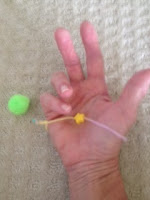
Pompom - Give children a pompom or cotton ball to hold in their hand when they write. Demonstrate how to put pinky and ring man to “sleep” on the pompom before picking up the pencil.

Writing Bracelet - String a bead or jingle bell to a piece of yarn or string to make a bracelet. Make it loose enough so it can slide easily on and off a child’s wrist. While writing the child wears the bracelet and holds the bead in her hand. 


Silly Band - Give children a silly band (or rubber band) to go around their wrist. Pick up your pencil and then slip the end of the silly band around the pencil. Explain when you go in the car you wear your seat belt, and when you write you need to put a seatbelt around your pencil. Then you’ll have mom and dad in the front seat and the kids in the back seat! 

                                    
Bird’s Beak - Point the pencil away from you. Make a bird’s beak by opening and closing your index finger and thumb. Use your beak to pick up the point of the pencil and then flip it back.

Clothespin
- A spring clothespin attached to the end of a pencil will also increase children’s control.

Song - Sing this song to the tune of “Where Is Thumbkin?”
Where is Pointer?
On the top.
Ready to write.
Start at the top.
Where is Thumbkin?
On the side.
Ready to help
Your pencil glide.
Where is Tallman?
On the bottom.
Keeps the letters
Where you want ‘em.

Tuesday, August 11, 2015

KEEP YOUR SUNNY SIDE UP!

In a world with so much negativity, it’s heartwarming to join hands with other teachers and focus on the positive side of our profession like we did last week in Austin. 

Class Pledge 
The teacher who shared this said she ended every class by having the students repeat:
I believe that I’m smart.
I am important.
My future is bright.
I CAN learn, so I WILL learn.
I will be the best ME that I can be!


Fiddlesticks! (Lindsay Kate)
Write sight words on one end of a jumbo craft stick and color the other end a different color. (Some will be blue, green, red, etc.) Put the sticks in a cup with the word up.
Rules: Children take turns drawing a word and saying it out loud. If they get the word right they get to keep the stick. If they get the word wrong they have to put the stick back in the cup.
*Designate a certain color as the “fiddlestick” color. Whenever a student draws a word with that color they have to put all their sticks back into the cup and say, “Ah! Fiddlesticks!” as they put them back. The game never ends.
Hint! Change the color so the kids can’t memorize which words are on a color.
*Change the game for letters, vocabulary, math facts, etc.   

                        
Giant Beads (Desirae Team)
Cut pool noodles into discs. Students can thread the disks on a shoelace or twine.

Squish “O’s” (Alisha Greif)
Let children squeeze pool noodles cut in disks for a fine motor activity.
*These can also be used when studying the letter “o” or the number “0.”

Noodle Game (Rachel Nolen)
Cut noodles in half and use to bat a balloon.
1. Children can bat a balloon individually.
2. Bat a balloon back and forth with a friend.
3. Bat the balloon with 2-3 friends and try to keep the balloon up.
4. Bat the balloon while music plays. Stop and go to the music.
5. Bat the balloon around the circle as you say the ABC’s, count, etc. Start over if the balloon drops.
Note!  I think this would be great fun for a kid or adult party.


Crocodile Hand Pencil Grip (Rachel Blunt)
Place the pencil on the table with the point facing the student. Ask, “Which hand wants to grab the pencil?” Now, have them grab the pencil with their other hand. The hand that wanted to grab the pencil first becomes the crocodile and eats the point of the pencil. Then the other hand gets jealous and flips the pencil over (so it sits in the spot between the thumb and pointer finger). Voila! Correct grip!

Batman Match (Mary Herman)
Make a Batman game by having children match upper and lowercase letters or numbers with bat shapes.

Sound Effects (Nubia Polanco)
When teaching students to write letters or shapes make sound effects.
Use the same sound for linear lines, and a different sound for curves, and when to stop writing.

Ready to Learn (Amy Calabrese)
The children love the “Little Red Box” song so use it for a transition by changing the words with the student’s name who is sitting and “ready to learn.” Soon they will all come as you sing their name.

Little Red Number Box (Sarah Wilson)
Put magnetic numbers in a metal tin and then sing the song as you pull out a number. Then count to that number.
For example: I wish I had a little tin box to put a 6 in. I’d take it out and count 1, 2, 3, 4, 5, 6 and put it back in.

Dream Sprinkles (Sarah Wilson)
For naptime pretend to sprinkle glitter on the kids’ heads after they lie down as you wish them sweet dreams. They don’t get dream sprinkles until they are lying down quietly.

Quiet Spray (Micaela Fuller)
Use body spray as you line up to leave the room. The students will be so busy smelling that they’ll become quiet.

Money Bags (Suzanne Carver)
Use a gallon zip bag and draw a circle with a marker in the bottom right corner. Put 3 quarters, 2 dimes, 1 nickel, and 4 pennies in the bag. As you call out different amounts the children drag the coins down to the circle.

Water Cycle Song (Suzanne Carver)
Tune: “If You’re Happy and You Know It”
Water travels in a circle, yes it does! (clap, clap)
It goes up as evaporation,
Forms a cloud as condensation,
Falls to the ground as precipitation,
Yes it does!

Down Down Baby (Suzanne Carver)
*You can watch a YouTube video of this patty cake activity.
Down, down, baby,
Down by the roller coaster.
Sweet, sweet, baby
I’ll never let you go!
Shimmy, shimmy, coco, pop.
Shimmy, shimmy, pow.
Shimmy, shimmy, coco, pop.
Shimmy, shimmy, pow.
Grandma, grandma got sick in bed.
She called the doctor and the doctor said,
Let’s get the rhythm of the head, ding-dong! (Wiggle head from side to side.)
(repeat)
Let’s get the rhythm of the hands, clap-clap! (Clap hands.)
(repeat)
Let’s get the rhythm of the feet, stomp-stomp! (Stomp feet.)
(repeat)
Let’s get the rhythm of the hotdog, hotdog! (Swivel hips)
(repeat)
Put it all together and what do you get?
Ding-dong, clap-clap, stomp-stomp, hotdog!
Put it all backwards and what do you get?
Hotdog, stomp-stomp, clap-clap, ding-dong.

Expository Song (Suzanne Carver)
Expository, expository,
Gives us facts not just a story!
Subtitles, pictures,
Charts with labels.
Graphs, diagrams,
And sometimes tables!
Expository, expository,
Gives us facts not just a story!

Narrative Song (Suzanne Carver – sing loud and dramatically)
Nar – ra – tive! Nar – ra – tive!
Setting,
Character,
Problem,
And plot!
This is what a narrative’s got!

Marjorie Green sent me this article from the St. Louis Post that explores the correlation between social and emotional development and long term academic and life success. It’s a little disturbing to read because it will “hit home” with you about children with emotional issues bigger than you can handle. We’ve all had one or two in our classroom and we want to believe and hope we can “save” them, but at what price to the other students? Clearly, this school is doing everything right and has the best support for children, but sometimes it just isn’t enough. But, what’s going to happen to those children? What in their short time on earth has triggered all this anger and outrageous behavior? It makes me sad! But is the glass half full or half empty? I wish the article had included some success stories of children they had helped.

http://graphics.stltoday.com/apps/teaching-grit/

Books Make Me Happy!
And this shirt makes me happy!! Wouldn’t it make a great caption for a bulletin board?


Monday, August 10, 2015

AWESOME AUSTIN!

Yee haw! Yippee ti yi yo! 
I was at Region 13 Service Center last week and I also did Summer Camp in Austin. Take a look and I bet you’ll find at least one or two ideas you’d like to try in your classroom this year.

Guess My Socks (Jackie Foshee)
This activity is similar to a yes/no chart. Wear silly socks that coincide with a current theme or holiday. (Jackie said she gets many of hers in the dollar bin at Target. She also said she had to wear long pants so they didn’t “peek.”) Draw a T-Chart that says, “Guess My Socks.” Give children two options and let them vote. Once all of the children have voted and written down their name do a big reveal. (If children have not signed the chart they will race to write their name before the big reveal.) Follow up by counting the names on both sides and comparing the numbers. 

                           
Theme Books (Beth Cordier)
Let children make books for whatever theme you’re studying. Make a word wall with words from the theme. (Put magnetic tape on the back so children can take them off and copy them.) Children choose a different word for each page and illustrate it. Older children could write sentences with the words.
For example: Fall Theme
Page 1 “Leaves”
Page 2 “Rake”
Page 3 “Squirrel”
Page 4 “Pumpkin”

Be an Author
I’m not sure who “donated” this idea, but I thought it was brilliant. Beginning the first day of school give children blank books. Explain that they are “authors” and encourage them to write. It’s open-ended, challenging, and could be a real springboard for writing.

Ring, Ring (Denise Wertz)
Get the children quiet with this idea.
Teacher says: Ring, ring!
Children respond: Hello!
*Keep doing this until all the children join in and are paying attention.


Bacon and Eggs (Janet Toles)
Use this technique to help children sit quietly. (Janet said she had a little boy who had a difficult time settling down to read, but this worked like a charm.)
Bacon (Stand and put hands and arms straight above your head.)
And Eggs (Arms down with hands touching in front of the body.)
(Repeat “bacon and eggs” two more times.)
Sizzle! (End with your arms by your sides as you wiggle and sit down.)

Welcome Step Book for Parents (Kristine White)
Prepare a book for parents with important information.
Welcome – All about the teacher
Contact Information – email, phone, conference schedule
Daily Schedule
Weekly Folders – expectations for the parents
Morning Procedures and Afternoon Dismissal

texaskindergartenteachers
Here’s a new facebook page you’ll want to check out.

I Know an Old Lady (Naomi Matthys)
In the song instead of saying, “perhaps she’ll die” or “perhaps she’ll cry”
lightly slap both cheeks as you sing, “Oh, me, oh, my!” End with, “She’s full, of course!”

I Know an Old Farmer (Angie Olivarez)
Make an old farmer with overalls for the boys to use when retelling “Old Lady” stories. They can say, “I know an old man who swallowed a…”

Laminate Samples (Paula Robbins)
Get free laminate samples from Lowe’s or Home Depot. Write numbers or math facts on them. Students hang links to find the answer.
*You can also put a capital letter on one and a lowercase letter on one and then link them together.
*Use these for opposites, rhyming words, compound words, etc.

whatworksclearinghouse
This site focuses on high quality research as they answer the question “What works in education?” You can find information on the research for different programs, products, practices, and policies in education.

Lady Bug Dress (Kati Barnett)
Isn’t this the cutest dress ever! Here’s where Kati said she found it:
modcloth.com – type heelandathens.com into the search bar.


Sunday, August 9, 2015

SAY SOMETHING NICE

Before I started student teaching I was scared to death.  My mother was a  genius even though she never attended college.  She said, "Just be sweet and love them!"

As you begin the school year, I have a little advice that you never learned in college. SAY SOMETHING NICE to each parent about his or her child. We are all anxious when we let our children go, and a compliment or kind word about a child can plant seeds for a positive relationship with families.

When I taught I made a point of calling each parent during the first two weeks of school. “I just wanted to tell you how happy I am to have (child’s name) in my room. I know we’re going to have a great year.” A personal email or text would have the same positive effect.

You’ve all heard, “People don’t care how much you know until they know how much you care.” Finding a special characteristic in each child and communicating that to parents is a simple act of kindness that will let them know how much you do care!


Here's a "Sunday" thought to start your school year.


When I am introduced as a teacher, I am usually asked what I teach.  When I say, “Kindergarten,” I generally hear a very flat, “Oh.”  I have never been certain whether that is an expression of pity or perhaps disinterest.  Always I wish I had time to explain to them like this: 


            Yes, I teach kindergarten.  Where else would a handsome and very young man
            put his arms and me and ask, “Do you know I love you?”

            Where else could I see a fashion show daily and keep up on the latest trends for
            the very young?

            Where else could my limited wardrobe be complimented or my earrings thought
            beautiful?

            Where else could I have the privilege of wiggling loose teeth and receive the
            promise that I may pull them when they’re loose enough?

            Where else could I guide a chubby little hand that some day may write a book
            or an important document?

            Where else could I walk around the room and have little warm hands reach up
            to touch me?

            Where else could I forget my own aches and pains because of so many cut
  fingers, scratched knees, bumped heads, and broken hearts that need care?

            Where else could my mind stay so young as with a group whose attention
            span is so short that I must always keep a bag of tricks up my sleeve?

            Where else could I feel so close to my Maker as I do each year because of
            something that I have done to help one of His little children learn and grow.
           
            Yes, I teach kindergarten and I love it!

Blessings for a wonderful year!!!  I love you all!!!
Hands up if you're ready to go back to school after Summer Camp in Austin!
Don't you love the "kiss your brain" shirt Angel brought me!!!  
I can't believe Donna came all the way from Alaska!!!  
I think we need to do Summer Camp there next year.  

Saturday, August 8, 2015

SCHOOL GLUE


Just think if you were a little kid and you had never held a bottle of glue before. Wouldn’t it be fun to squeeze it all out? Remind children, “We just need to use a baby dot of glue. Not a mama dot or papa dot. Just a tiny, little baby dot.” (Be dramatic with this and say “baby dot” in a high little voice.) Demonstrate how to put a dot on a sheet of paper. “What does that look like? A little bug? A cookie crumb?” Put food coloring in a bottle of glue and use it at a center for children to practice making “baby dots.”

If you use glue sticks, you will also need to demonstrate how to use them. “If you barely touch the page you can’t see anything. That means nothing will stick to it. Press it gently down and then look to make sure you can see something. That means your paper will stick.”

School Glue
(Tune: “This Old Man”)
School glue, school glue,
Just a little dot will do.
Put a dot and spread it around.
It will hold your paper down.

School glue, school glue,
Don’t use more than a dab or two.
When it dries up, it will disappear.
Your work will look good never fear.