photo 3am_dj_home_zps919fb85e.png photo 3am_dj_about_zps7cce4c75.png photo 3am_dj_website_zps73051235.png photo 3am_dj_ss_zps6759ec2a.png photo 3am_dj_bs_zps43e27832.png
Showing posts with label Writing. Show all posts

Tuesday, June 23, 2026

GREAT TEACHERS 120

KISS PRINCIPLE - KEEP IT SIMPLE!

Quiet Creatures (Jennifer Olayo)
You’ll need a large pompom, small pompom, googly eyes, and a foam heart or flower to make a quiet creature. Glue the small pompom to the large one for a nose. Add eyes and stick the heart on the bottom for feet. Children take out their quiet creatures during quiet activities. If they talk they lose their creature. When they finish they can whisper quietly to their creature.


Birthday Do Dah (Mary Lehman
(Tune: “Camptown Racers”)
Our friend name is age years old
Do dah, do dah. (Wave scarf up and down on “do dah.”)
Our friend name is age years old
Oh, do dah day.
Let’s all shout “hooray!”
It’s a special day.
Our friend name is age years old
Oh, do dah day.
*Take scarves, streamers, or just wave your hand as you “do dah” the person’s age.

Ear on the Door (Shannon Kennady)
Put a big ear on the door and when children start to tattle say, “Tell it to the ear.”

Tattle Stopper (Linda Rossiter)
Pick up some old tax forms at the library. When children start to tattle hand them a form and tell them to fill it out and then bring it back to you.

*You'll have to save this idea for December!
Letters to Santa (Shannon Kennady)
Have children write letters to Santa and then let older students (class buddies) respond to them. Put the letters in the freezer and then take them out and return them to the children. Explain that the letters are cold because they just arrived from the North Pole!

If You Can Hear Me (Susan Paulus)
If you can hear me, clap once.
If you can hear me, clap twice…
*Continue until all children are engaged and listening.

Transitional Breathing
(Katie Saucier)
Smell the roses – hold a pretend bouquet of flowers and smell them.
Blow out your candle – hold up one finger like a birthday candle and blow it out.

Flip Book
Make a flip book as shown. Draw an egg, tree, cave, or other animal home on the front flip. Open and draw a critter that you would find in that habitat. Hold up to the light to see your little critter in its home.


Sentence Structure (Lisa Ruff)
Make the love sign with your hand. Your thumb is the capital.
Your pointer finger asks if it makes sense.
The little finger is a reminder for the punctuation mark at the end.
Check to make sure you LOVE your sentence. You need all three fingers to love it!


Hall Chant (Melanie Griffin)
Teacher: Are your hands ready for the hall?
Students: Yes, yes, yes they are. (Put hands behind back.)
Teacher: Are your feet ready for the hall?
Students: Yes, yes, yes they are. (Stomp feet.)
Teacher: Is your mouth ready for the hall?
Students: Mmm, mmm, mmm. (Mouth closed.)

Sunday, June 14, 2026

GREAT TEACHERS 111

I’m sharing more good news and good ideas with you today!

Sharing Good News (Jessica Williams)
Write children’s names on craft sticks and place in a jar that says “Good News.” The teacher starts every morning by sharing her own “good news.” The children clap or cheer for her. Next, she pulls a stick and the class sings, "Tell me something good!" That child shares their good news and then the class does a cheer. The teacher pulls the second stick and they sing, "Tell me something good" and then cheer. Do three children each day and then put those who have had a turn in an envelope and start all over again when everyone has had a turn.


Whisper and Release Questioning Strategy (Mary Claire Porter)
When the teacher asks a question have the children blow their answer into their closed fist. When the teacher says, “What is it?” they “release” their answer by opening their hand and saying the answer out loud.


Name Bingo
Play BINGO using children’s names and googly eyes. Write children’s names on sentence strips and give them googly eyes. “I spy the letter R. “ If children have an “R” in their name they cover it up with a googly eye.


Category Game
The children repeat after the teacher:
“Pink is a color.” (Children repeat.)
“Purple is a color.” (Children repeat.)
“A square is a color.” (Children yell NO!)
Adapt for shapes, objects in a house, rhyming words, numbers, and other categories.


Eating the Alphabet (Yolanda Coppedge)
You will need upper and lowercase magnetic letters, a bowl, spoon, and alphabet cards. Each child uses the spoon to scoop out a letter. They have to name the letter, make the sound, and say something that starts with the sound before matching it to the alphabet card.

ABC Tune (Marina Attix)
Did you know that you could sing the ABC’s to the tune of “Mary Had a Little Lamb.” It’s great because L M N O P don’t end up sounding like “a lemon and a pea.”


Class Pictionary
Each day choose a different letter of the alphabet and write it on a large sheet of paper. Let the children cut out objects or draw pictures of things that start with that sound. Be sure and label their pictures. After introducing all 26 letters, put the pages together to make a BIG BOOK PICTIONARY for your classroom. Don’t forget to add a page for illustrators and the publisher (school, city, and state). You could also let the children dedicate the book and make a page that says “The End.”


Silly Band Writing
This is the coolest idea with silly bands. Explain that when you go for a ride in the car you have to wear your seat belt. When you write you have to put a seat belt on your pencil. Put a silly band on your wrist, hold your pencil, and then loop the silly band around the pencil. It will stabilize the pencil and make it easier for the children to write.
*A teacher also suggested holding the lid of the marker in your hand when you draw to get the correct grip.


Who Stole the Sound? (Candice Hall)
Adapt “Who Stole the Cookie?” to letters. Write letters on cookie shapes and place them in a bag. Pass the bag around and as children pull out a letter say:
Who stole the letter sound from the cookie jar?
Child’s name stole the letter sound from the cookie jar!
Who me?
Yes, you!
Couldn’t be.
Then who?


Monday, June 8, 2026

GREAT TEACHERS 105

SONG CATCHER was a popular movie in 2000 about a musicologist who discovered a treasure of traditional English ballads that had been preserved in the mountains of Appalachia for over a hundred years. Her goal was to "catch" the songs, preserve them, and share them with the outside world.

I liked to think of myself as a TEACHER IDEA CATCHER. As I traveled across the United States I would invite teachers to share their ideas so I could keep them alive for you on my blog.


Focus Finger Play (Pat Kesler uses this before handwriting. It wires up the brain!)

Two tall telephone poles (Fists touching with index fingers pointing up.)

Across them a wire was strung. (Touch middle fingers.)

Two little birds hopped on ((Put thumbs up on middle fingers.)

And sung and sung and sung. (Swing fingers.)


Facebook (Ruth Lefko )


Take two boxes and write "Facebook In Box" on one and "Facebook Out Box" on the other. Provide children with scrap paper, pencils, and markers. Children fold a sheet of paper in half and draw their face or a picture on the front. Inside they write a note to the teacher or a friend and place it in the "In Box." The messages are delivered and then the teacher or friend write a reply and place it in the "Out Box." What a great idea to encourage writing!


Short Vowels (Joanne Poland)
Here’s an active way to help children remember short vowel sounds.at the chair – children stand at their chairs as you emphasize the short /a/
edge of the chair – children sit on the edge of their chairs = short /e/
in the chair – children sit in the chair – short /i/
on the chair – children stand on the chair – short /o/
under the chair – children crawl under the chair – short /u/

Name Game (Kristin Murray)
Put stickers on unifix cubes and write the letters in the children’s names.
-Count how many letters in each person’s name.
-Pair children up and see who has more, less, or the same.
-Graph names. Whose name is shorter, longer, or the same as the teacher’s name?


A Fuzzy Little Caterpillar
(Leanne Hutchison, Jackson, TN)
(Tune: "I Had a Little Turtle")
A fuzzy little caterpillar wiggled right by me. (Wiggle index finger.)
He wiggled long. (Wiggle finger away.)
He wiggled short. (Wiggle finger close.)
He wiggled right at me. (Wiggle finger at your face.)
I put him in a box. (Cup hands.)
"Don't go away I said!" (Point finger.)
But when I opened up the box
There was a butterfly instead! (Clasp thumbs and wiggle fingers like a butterfly.)

*You can adapt this song for "I had a little tadpole...I put him in a jar... Don't go away I said. . But when I opened up the jar a frog hopped out instead!"

Word Bags
Prepare bags with different multi-sensory materials similar to those below. Children choose a bag, take it to their desk, and then spell words (sight words, vocabulary, spelling) using the material in the bag.
*Wikki sticks
*magnetic letters
*colored pencils for rainbow words
*alphabet stickers
*alphabet blocks
*dry erase board


Chant Sight Words (Becky Ashton, Indianapolis, IN)
HE - muscles up and say "h"
muscles up and say "e"
flex muscles and say "HE"
SHE - flick hair on "s"
flick hair on "h"
flick hair on "e"
hands on hips and say "SHE"

Yummy Words (Sarah Kilfoil)
Let each child select a favorite word - yummy word! It can be a favorite food, something they like to do, etc. Place the words in a pocket chart or word wall and use for attendance.

Back to Back
This is a great brain break that a teacher in Indianapolis demonstrated with us. Every child needs a partner and touches body parts as the teacher calls out:
back to back (touch backs)
shoulder to shoulder (touch shoulders)
elbow to elbow
knee to knee
head to head
wrist to wrist
feet to feet
hip to hip
Continue calling out vaious body parts...
End with "bottom to chair" as children sit down!

Can You Dig It? (Rachel Lawrence)
Hide magnetic numerals in a sand table. Each student is given a sheet with math facts appropriate to their level. During math centers they have to do their facts and then dig out the answers (magnetic letters) in the sand.
*You can also hide letters and have children spell words.

Shape Crackers (Pamela Pounds)
Send a note to parents the first week of school asking them to send crackers to help the children learn their shapes. (Ritz - circles, Club crackers - rectangles, Doritos - triangles, Wheat Thins - squares, and Town House crackers - ovals.)
*Give children two crackers and ask them to describe how they are different.
*Have children eat one half of a cracker.
*Give children a square cracker and challenge them to nibble it into a circle.
*Give children two like crackers. Ask, “Are they the same amount?” Next, have them break one of the crackers into little pieces. Ask, “Are they the same amount now?” You’ll be surprised at their response. (This is called conservation of quantity and is an experiment Piaget used to demonstrate developmental stages.
*Give children a sheet of paper. Pass out a square cracker to each child and tell the children to draw what it looks like on their paper. Next, give them a circle shaped cracker and ask them to draw it. Continue with other shapes. It’s a fun way to practice pre-writing skills.

Wednesday, May 13, 2026

SUMMERTIME READING

Whether you teach summer school, work at a camp, or have children at home, a major goal will be to encourage them to read and write this summer. Here are some ideas to share with parents to help their children FALL IN LOVE WITH READING!


Explore Your Library
The library is a magical place that will open a world of books to children. When children get to choose their own books, it’s a powerful hook to get them to read. Most libraries have summer reading programs, as well as puppet shows and special events.
*Hint! Let children decorate a cloth bag to store books from the library. Keep it in a special place to encourage children to be responsible.

Noises Off
Have a quiet time each day when all devices are TURNED OFF. If you don’t make this a priority and routine, it won’t happen. Not only should you expect your children to read, you need to enjoy a book and be a good model for them. In the book THE SMARTEST KIDS IN THE WORLD, an interesting finding was that parents who read with their children and modeled reading had a positive impact on academic success.

Rabbit Trap
“If you want to catch a rabbit, you have to have a rabbit trap.” And, if you want children to read, you have to create a unique place where they will want to read.
*Let children decorate a cardboard appliance box to be a “book clubhouse.”
*Put pillows and stuffed animals in a small plastic pool so they can “dive in” and read.
*Make a tent and let them read with a flashlight.
*Brainstorm other places that would be fun to read.

Treasure Hunt Story
Prepare clues that will lead to a “treasure story.” (This is a special book that you have hidden outside.) For example:
1. A treasure hunt is so much fun. Near the swing is clue number one.
2. Clue number two should be easy, too. At the top of the slide is something for you.
3. Clue number three you will find in a tree.
4. Now it’s time for clue number four. Look for it by the storage door…
Tape the clues around your yard or playground ending with the spot where the “treasure story” is hidden. Encourage the children to help you read the clues and follow the directions. Find a shady spot outside and enjoy reading the book.

Paper and Pencils
*How about a spiral notebook or diary where you encourage children to write each day?
*Give children paper and envelopes to send letters to relatives and school classmates.
*Involve children in making shopping lists, chore charts, and other print activities.
*What child won’t want to write if you give them sticky notes to make labels and reminders?
*Clipboards and markers are good for a car trip or walk in the neighborhood.


Busy Box 
Fill a shoebox or plastic tub with scrap paper, pens, pencils, markers, hole punch, scissors, glue stick, stickers, lunch bags, envelopes, silly putty, etc. When you have to fix dinner or need a break, get it out and encourage children use their imaginations.

Chalk Talk
Chalk can provide endless writing and reading opportunities.
*Children can decorate a paved surface for a birthday, Father’s Day, or other event.
*Children can practice writing words or drawing shapes.
*Draw a hopscotch design with chalk on a paved surface. Write letters or numerals in each section for the children to identify as they hop and play.

Reading and writing should be a JOY, not a chore. The trick is finding the right book that they will WANT to read and finding something they WANT to write about.
Happy reading and writing!!

Sunday, May 3, 2026

SUMMER FUN JOURNAL

You will need a pocket folder for each child for this summer writing activity. Remind the children what wonderful writers they have become and how important it is for them to keep writing over the summer. Explain that many famous writers started keeping diaries and journals just like them when they were young. Motivate them to make their own “Summer Fun Journal” so they can record all the special things they will be doing over the summer.


Provide the children with markers, crayons, construction paper, and other art media to decorate the front of their pocket folders. (You might suggest they title it “Summer Fun.”) Run off copies with the attached writing prompts or create your own based on the interests of your students. You might even want to ask your class to brainstorm topics for these journals.

Hint! Be sure and include some blank paper at the end.

*Encourage students to add photos, brochures, or other special keepsakes.

*Add a line for the date on each page.

*Tell your students you’d love to see their journals when the come back for the new school year.

Note! For younger children encourage parents to have their children illustrate the topic and then dictate sentences for their parents to write.


Here are some summer writing prompts.

I like summer because

My favorite book is

This is one of my chores

My family is going

This is what I like to do outside

These are my favorite summer foods

My goal for this summer is

These are my friends

I wish

When it’s hot I

These are games I like to play

This is what I like to wear in the summer

This is my favorite place to play

These are my favorite toys

My worst day ever

My best day ever

I can’t wait for school to start because


FREE Summer Journal
Carolyn Kisloski created this free download a few years ago and it’s a wonderful way to encourage children to write over the summer.


https://www.teacherspayteachers.com/Product/Summer-Writing-Prompts-Journal-2521920

Saturday, April 11, 2026

THE WRITING PROCESS

How about some tips for encouraging all those budding authors in your classroom?

Who Knows the Writing Process?
(Children repeat each line to this chant as you open your arms wide and clap as you step from side to side.)
Chorus:
Who knows the writing process?
I know the writing process.

First step. (Hold up one finger.)
Brainstorm. (Hands on the side of your head and shake down.)
Chorus

Second step…(Hold up 2 fingers.)
Write it down…(Pretend to write with index finger on palm.)
Chorus

Third step…(Hold up 3 fingers.)
Edit your work…(Shake finger.)
Chorus

Fourth step…(Hold up 4 fingers.)
Publish your work…(Brush hands together.)
Chorus
Oh, yeah! (Hands on hips with an attitude.)


Handy Edit
Teach children how to edit their work with this “handy” idea.
(Make a fist with your right hand to begin.)
1. If you started your sentence with a capital letter you can stick up your thumb.
2. If you read the sentence and it makes sense you can stick up your index finger.
3. If you remembered to put punctuation at the end you can stick up your pinky finger.
4. Then you can say, “I love my sentence.” (Turn your fist over and you will be making sign language for “love.”)


Chew and Write
Give children a piece of sugarless gum. Once they write their name they can open the gum and start chewing. They are allowed to chew the gum as long as they keep on writing!


Colorful Details
Encourage students to add color and detail to their illustrations by asking them to use as many colors in their books as they are in age.

Friday, April 3, 2026

SENSES

Senses are like pathways to the brain, and children can learn about them with this song.


Senses (Tune: BINGO)
There are five senses that we use to help us learn each day.
See (Point to eyes.)
Hear (Point to ears.)
Smell (Point to nose.)
Taste (Point to mouth.)
Touch (Hold up hands.)
See, hear, smell, taste, touch,
We use them every day.


https://www.youtube.com/watch?v=4-jMyDR6kSQ


Sense Walk
*Go on a walk and have children touch various objects. “How does it feel?”
*Have them close their eyes and try to identify objects by their sense of touch.
*Take a listening walk where children close their eyes and try to identify different sounds in the environment.


Descriptive Writing 

Give children a clipboard and encourage them to explore the playground as they fill in the blanks (write or draw pictures). Let children share their findings with classmates and then put their pages together to make a class book.


Friday, March 20, 2026

SPRING INTO WRITING

Spring is the perfect time to "grow writers"!

Spring Acrostic

After a spring walk, have children write the word spring vertically down the left side of their paper. Can they write a word (or sentence) for each letter that is a sign or symbol of spring? 


Hint! With younger children do this as an interactive writing activity.


Spring Poem
Have children fill in the words to create their own poem or a book.


SPRING
Spring looks like____.
Spring smells like ____.
Spring sounds like ____.
Spring feels like ____.
Spring tastes like ____.
I like spring!


Web
Brainstorm spring vocabulary words and then encourage children to make a web using words or drawings.


I Want to Go Out and Play Book
(Writing an opinion)
Give each child a sheet of paper and ask them to draw a picture of why they like to go outside. Ask them to write (or dictate) a sentence about their drawing. Make a cover that says, “I Want to Go Out and Play.” Put their pages together, hole punch, and insert book rings.


Sit and Write

(Descriptive writing)
Each child will need paper, a clipboard or cardboard to write on, and a pencil or crayon. Have children spread out in a comfortable area and write stories, poems, or descriptions of what they see.

Thursday, March 19, 2026

SPRING PENCIL WALK

Here's a "Spring Pencil Walk" that I hope your children will enjoy. Story symbols can help children develop top to bottom and left-to-right orientation. They’re also an engaging way to develop small motor skills. These stories should be told multiple times so children can practice the pre-writing strokes and feel more competent. You might want to do the same story every day for a week as you invite the children to recall what will come next.

Hint! Demonstrate these stories on the board or a large chart so children will be able to copy what you do on white boards or clip boards.

A SPRING WALK
Let’s put a green dot at the top of the page to show us where to start. And let’s put a red dot down here at the bottom to show where our story will stop. Pick up your pencil and let’s use it to tell a story.

It’s a beautiful spring day, so let’s go for a walk.

The grass is growing nice and tall.

The sun is shining in the sky.

The clouds are rolling around.

The insects buzz up and down.

The little rabbits hop around.

The kites are flying in the air.

All of a sudden, the wind starts to blow.

The wind is blowing in every direction.

Better run home as fast as we can!

Home at last!

https://drive.google.com/file/d/0B1SnEagA4jljc0J0SF95WHZnS2s/view?usp=sharing

*Make a tape of the story to put in a listening center.


A Walk in the Zoo
Here's another pencil story about a walk in the zoo. Can you guess what the different symbols represent?


https://drive.google.com/file/d/0B1SnEagA4jljY0FscXBmekxxSDg/view?usp=sharing


Pencil Power
To help children have better control of their pencil give them a silly band or rubber band to wear on their wrist. Loop the end of the pencil through the band so it doesn't flip flop around.


Sunday, March 8, 2026

WHAT'S A NOUN?

Every sentence has a noun, so let's find out more about them!

(TUNE: She’ll Be Coming Round the Mountain)
A noun is a person, place, or thing. Yee haw! (Fist in air.)
A noun is a person, place, or thing. Yee haw!
A noun is a person. (Point to a person.)
A noun is a place. (Point to a place in the room.)
A noun is a person, place, or thing. (Point to a place.)


Wacky Sentences
Write nouns and picture clues on 5 index cards and verbs on 5 index cards. Place them in lunch bags labeled “nouns” and “verbs.” Children choose a noun card and a verb card and write a sentence using the words.
Hint! They love to use nouns with their teacher’s name, principal, and other stars.

Noun Sort
Fold a sheet of paper into fourths. Write “people, animals, places, things” in the sections. Give children old newspapers and catalogs and ask them to cut out pictures of people, animals, places, and things and glue them in the appropriate section. Can they label their pictures?


Noun Hunt
Give children a clip board and challenge them to find all the nouns they can in the classroom. They can write the words or draw pictures.
*For homework ask them to make a list of the nouns in their home.

Noun Names
Make name cards for the students in your class from 8” sentence strips. Write each child’s name and glue their picture on the card. Use these for writing prompts in a center.

Tuesday, March 3, 2026

KNOCK! KNOCK!

Here's a silly poem my daughter wrote that you can share with your class.

Knock! Knock!
By Dr. Holly

Knock! Knock! Who can it be?
Little mousie, squeak! squeak! squeak!

Knock! Knock! Who’s at the door?
Boom! boom! boom! It’s a dinosaur!

Knock! Knock! Who is that?
It’s a drummer—rat-a-tat-tat!

Knock! Knock! Guess who?
Baby crying—boo-hoo-hoo!

Knock! Knock! Who’s there?
Grrr! Grrr! It’s a grizzly bear!

Knock! Knock! Who can it be?
It’s a cowboy—How-dy!

Knock! Knock! Who’s there?
Granny in her underwear! (or rocking chair if it’s less scandalous)

Knock! Knock! Who’s at the door?
Big strong lion—roar! roar!

Knock! Knock! Guess who?
Opera singer—la da de do!

Knock! Knock! Who is that?
Purr, purr, my big fat cat!

Knock! Knock! Guess who?
Mr. Robot—Hello. How are you.

Knock! Knock! Who can it be?
A librarian—shhh! Quiet please!


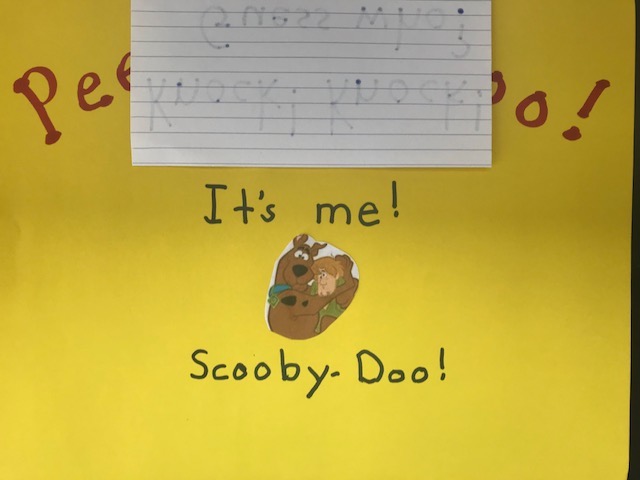
Peek a Boo Class Book
Let children come up with their own “knock, knock” rhymes. Write the first line on the front of a 3"x 5" index card. Tape at the top to a sheet of paper and then have the children draw the answer to the rhyme underneath.


SPRING RIDDLES
Alex May (webmaster) has created some new riddles for you!

http://bit.ly/drjeanSpringRiddles

And here's a link for the cards:

http://bit.ly/SpringRiddles

Friday, February 27, 2026

PUNCTUATION PAYS

What Is a Sentence (Tune: “Where Is Thumbkin?”)
What is a sentence?
What is a sentence?
A complete thought.
A complete thought.
It starts with a capital letter.
And ends with a punctuation mark.

Punctuation Sticks
Use jumbo craft sticks or paint sticks for this activity. Draw a “.” “?” and “!” on the end of each stick with a marker. Write simple sentences on the board. Take one stick at a time and place it at the end of a sentence. Children practice reading with that expression.


ABC?
Say the abc’s according to the punctuation marks.
A B C.
D E F ?
G H I J!
K L M ?
N O P !
Q R S T.
U V W?
X Y Z!


Statements and Questions
Seal envelopes and cut in half as shown to make a puppet. Make a period on one side and a question mark on the other side. If the teacher says a question the children hold up the question mark. If the teacher makes a statement they hold up the period.


Glass Pebbles
Let children use glass pebbles to find punctuation in books and magazines.
*Can they tally how many periods, exclamation, and question marks they find on a selected page?


Thursday, February 26, 2026

PICNIC BOOK

Sometimes children like big books and sometimes they like little books. This book is so much easier to make when you tell the story about going on a picnic.

Make a picnic book by telling this story:

Let’s go on a picnic. First we need a picnic basket.
(Fold the paper in half.)

Next, we need hotdogs.
(Fold the paper in fourths.)

We also need hamburgers.
(Fold the paper into eighths.)

We’ll need a picnic bench to sit at.
(Open so it’s folded in half. Bring one bottom flap to the fold. Turn
over and bring the other bottom flap to the fold.)

A picnic is more fun if we share it with a friend. (Tear down middle crease
until you reach the fold.)

Now all we need is a book to write a story about our adventures on our picnic.
(Hands on top of bench, bend down, and fold around to make a book.)


Use for: letter books, word families
reading the room, writing the room
fact families
shape or color books
unit or theme
spelling words (picture/sentence)
friends’ names and phone numbers
opposites, story elements
original stories

Hint! Let children decorate an individual cereal box to store their picnic books.


Picnic Books - https://bit.ly/drJPicnicBks

Narrated version: https://bit.ly/drJPicnicNar