photo 3am_dj_home_zps919fb85e.png photo 3am_dj_about_zps7cce4c75.png photo 3am_dj_website_zps73051235.png photo 3am_dj_ss_zps6759ec2a.png photo 3am_dj_bs_zps43e27832.png
Showing posts with label Punctuation. Show all posts

Thursday, June 25, 2026

GREAT TEACHERS 122

JUST A-SWINGING IN VICKSBURG, MISSISSI[[I 2013


What Is a Sentence (Jennifer Williams)
(Tune: “Where Is Thumbkin?”)
What is a sentence?
What is a sentence?
A complete thought.
A complete thought.
It starts with a capital letter.
And ends with a punctuation mark.


Show Me Punctuation
(Jennifer Williams)
Teach children the following motions for punctuation marks.
. Hand out like “stop.”
? Shrug shoulders.
! Show muscles.
Teacher says a sentence, and the students show the correct punctuation.
I like to ride my bike. (Hand out STOP.)
Do you like to ride a bike? (Shrug shoulders.)
That’s a big snake! (Show muscles.)


Book Sort (Sheila Scott)
Use pictures from old book order forms to do the following:
*Children cut out pictures of books and sort into genres.
*Put books in ABC order.
*Make predictions about books.


Full body Listening (Gloria Pettitt)
Teacher says, “1, 2,3, eyes on me!”
“Full body listening!” 1. Feet on floor
2. Hands in lap.
3. Mouth closed.
4. Ears open.
5. Eyes on speaker.
Students show the action or point when saying the steps.


Envelope Puppets (Cybil Richmond)
Cut envelopes in half so you can insert your hand to make a puppet. Use in science to identify living/nonliving things, biotic/abiotic factors, physical/chemical properties, etc.

Sparkle Spelling Game (Gloria Pettit)
Students stand in a circle. The teacher says a spelling word. The students go around the circle saying one letter each. After they spell the word, the next student says the word. The next student gets “sparkled” (all students yell “sparkle” and that student sits down). Keep going until only one student is left.

Memory Game (Beverly Buice)
“I’m going on a grip and I’m going to take…”
The first student names something that starts with A. The next student repeats the sentence and the first answer. Then the second student adds something that starts with B. This continues until you get to Z. This game helps students develop listening skills, sequential order, and their memory.

Graphic Organizer Puzzle (Ashley Salina)
Make a puzzle out of a math mat to demonstrate parts and the whole.


Punch Out Spelling (Suzanne Artman)
Cross over and punch letters to spell a word. Clap hands at the end while saying the word as you clap the syllables. Kids then say the number of syllables. (say, spell, say)

Friday, February 27, 2026

PUNCTUATION PAYS

What Is a Sentence (Tune: “Where Is Thumbkin?”)
What is a sentence?
What is a sentence?
A complete thought.
A complete thought.
It starts with a capital letter.
And ends with a punctuation mark.

Punctuation Sticks
Use jumbo craft sticks or paint sticks for this activity. Draw a “.” “?” and “!” on the end of each stick with a marker. Write simple sentences on the board. Take one stick at a time and place it at the end of a sentence. Children practice reading with that expression.


ABC?
Say the abc’s according to the punctuation marks.
A B C.
D E F ?
G H I J!
K L M ?
N O P !
Q R S T.
U V W?
X Y Z!


Statements and Questions
Seal envelopes and cut in half as shown to make a puppet. Make a period on one side and a question mark on the other side. If the teacher says a question the children hold up the question mark. If the teacher makes a statement they hold up the period.


Glass Pebbles
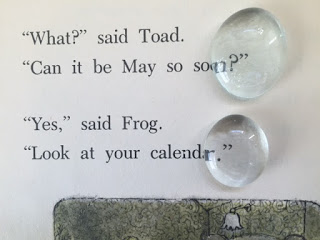
Let children use glass pebbles to find punctuation in books and magazines.
*Can they tally how many periods, exclamation, and question marks they find on a selected page?


Wednesday, January 15, 2025

PUNCTUATION WITH A PUNCH!

These movements will make learning about punctuation more fun!

Capital
Capital letters are at the beginning of a sentence. They tell you to “GO.” Have children stand every time you come to a capital letter.

Period
Periods tell you when to stop. Sit down when you come to a period.

Whoa!
Sit like cowboys and cowgirls by straddling chairs. When you come to a period, children pretend to pull back on the reins as they say, “Whoa!”

Question Mark
When you come to a question mark, put your index finger on your head and shrug your shoulders.

Exclamation Point
Put your fist in the air for an exclamation mark.

Comma
Hop for a comma.

Quotations
Two fingers in the air and wiggle.

*Let children come up with their own movements for punctuation.


ABC?
Say the abc’s according to the punctuation marks.
A B C?
D E F G.
H I J! K L M N.
O P Q?
R S T!
U V W.
X Y Z!

*Write nursery rhymes and other familiar poems with unusual punctuation.

Punctuation Detectives
Use glass pebbles to highlight punctuation.


Twist the end of a pipe cleaner and use to find punctuation marks.

Saturday, January 11, 2025

HANDY EDIT

Children can learn how to edit their work with this “handy” idea.

(Make a fist with your right hand to begin.)

1. If you started your sentence with a capital letter you can stick up your thumb.

2. If you read the sentence and it makes sense you can stick up your index finger.

3. If you remembered to put punctuation at the end you can stick up your pinky finger.

4. Then you can say, “I love my sentence.” (Turn your fist over and you will be making sign language for “love.”)

The Writing Process
Motivate children to write by having them stand and echo this chant. Spread your arms wide as you clap and step from side to side to the beat.


Chorus:
Who knows the writing process?
I know the writing process.

First step. (Hold up one finger.)
First step.
Brainstorm. (Hands on the side of your head and shake down.)
Brainstorm.

Chorus

Second step. (Hold up 2 fingers.)
Second step.
Write it down. (Pretend to write with index finger on palm.)
Write it down.

Chorus

Third step. (Hold up 3 fingers.)
Third step.
Edit your work. (Shake finger.)
Edit your work.

Chorus

Fourth step. (Hold up 4 fingers.)
Fourth step.
Publish your work. (Brush hands together.)
Publish your work.
Chorus

Oh, yeah! (Hands on hips with an attitude.)

Thursday, January 26, 2023

PUNCTUATION PAYS

These movements will make learning about punctuation more fun!


CapitalCapital letters are at the beginning of a sentence. They tell you to “GO.” Have children stand every time you come to a capital letter.

Period
Periods tell you when to stop. Sit down when you come to a period.

Whoa!
Sit like cowboys and cowgirls by straddling chairs. When you come to a period, children pretend to pull back on the reins as they say, “Whoa!”

Question Mark
When you come to a question mark, put your index finger on your head and shrug your shoulders.

Exclamation Point
Put your fist in the air for an exclamation mark.

Comma
Hop for a comma.

Quotations
Two fingers in the air and wiggle.

*Let children come up with their own movements for punctuation.


ABC?
Say the abc’s according to the punctuation marks.


Punctuation Detectives
Use glass pebbles to highlight punctuation.


Twist the end of a pipe cleaner and use to find punctuation marks.

Sunday, June 26, 2022

PD #10 POINTERS


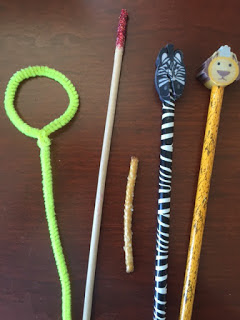
I’ll get to the POINT! Pointers are a fun way to engage students’ attention. Make some of these before the school year begins and you can pull them out of your “bag of tricks” when needed.

What? craft sticks, chop sticks, googly eyes, fake jewels and fingernails, E6000 (or other craft glue)

Why? Children love anything novel and different. These pointers just add some “hands-on” to the task at hand.

When? Small group, independent

How? Take a look at the list below and choose your favorite.

*Use to track print from left to right.

*Identify key details in a picture.

*Point out letters, words, punctuation, etc. in print.

*Touch shapes, numbers, etc.

*Space between words with pointers.


Magic wand – dip the end of a chopstick in glue and roll in glitter

Finger nail – glue a fake fingernail to a craft stick

I Spy – glue a googly eye to a craft stick

Jewel – glue a fake jewel to a craft stick

Witches’ finger – great fun

Magnifying glass - pipe cleaner formed in a circle


Swizzle stick – buy these at a dollar store

Pretzel stick – point and then eat

Seasonal – glue small seasonal toys or stickers to craft sticks or purchase seasonal pencils

Bugles - point, read, and eat!!!


Giant Pointers

Glue a toy to the end of a cardboard pants hanger or decorate a butterfly net.


Smart Center

This was one of those simple, yet clever ideas that a teacher shared years ago. She said she had a center called the "smart center" with an old pair of glasses and a hand pointer. Children wore the glasses and walked around the room and pointed to words, shapes, colors, letters, etc. to show how "smart" they were. The only rule was you had to use a whisper voice. The teacher who shared this said the kids LOVED this center. She said nobody paid any attention to them, but they thought they were smart just the same!


Friday, December 10, 2021

STICK IT TO ME

Here are some simple teaching tools with jumbo craft sticks.  They are inexpensive and won't take you five minutes to make.

Comprehension Sticks
Write “Who?” “What?” “Where?” “When?” “Why?” on sticks and insert them in a sock. Throw the sock over your shoulder before reading a book to prompt the children to be active listeners. After reading the story, let children choose a stick and tell that part.


*You could also write “author, illustrator, title, beginning, middle, end” or “characters, setting, problem, resolution.”


Punctuation Sticks
Draw a period, exclamation point, and question mark on the end of jumbo craft sticks. Children take turns choosing a stick and placing it at the end of a sentence as friends read with appropriate expression.


Fiddle Stick
Each child will need a jumbo craft stick and a 20” piece of string.
Tie one end of the string to the middle of the craft stick. (Put a piece of tape on it to secure it.) Children can calm down and release wiggles by winding up the string and then unwinding it.


Tuesday, January 26, 2021

ACTIVE LEARNING - PUNCTUATION WITH A PUNCH!

These movements will make learning about punctuation more fun!


Capital
Capital letters are at the beginning of a sentence. They tell you to “GO.” Have children stand every time you come to a capital letter.

Period
Periods tell you when to stop. Sit down when you come to a period.

Whoa!
Sit like cowboys and cowgirls by straddling chairs. When you come to a period, children pretend to pull back on the reins as they say, “Whoa!”

Question Mark
When you come to a question mark, put your index finger on your head and shrug your shoulders.

Exclamation Point

Put your fist in the air for an exclamation mark.

Comma
Hop for a comma.

Quotations
Two fingers in the air and wiggle.

*Let children come up with their own movements for punctuation.


ABC?
Say the abc’s according to the punctuation marks.


Punctuation Detectives
Use glass pebbles to highlight punctuation.
                                                              

Twist the end of a pipe cleaner and use to find punctuation marks.


Tuesday, August 13, 2019

ACTIVE LEARNING #13 - PUNCTUATION WITH A PUNCH!

These movements will make learning about punctuation more fun!
Capital
Capital letters are at the beginning of a sentence. They tell you to “GO.” Have children stand every time you come to a capital letter.  

Period
Periods tell you when to stop. Sit down when you come to a period.

Whoa!
Sit like cowboys and cowgirls by straddling chairs. When you come to a period, children pretend to pull back on the reins as they say, “Whoa!”

Question Mark
When you come to a question mark, put your index finger on your head and shrug your shoulders.

Exclamation Point
Put your fist in the air for an exclamation mark.

Comma
Hop for a comma.

Quotations
Two fingers in the air and wiggle.

*Let children come up with their own movements for punctuation.


ABC?
Say the abc’s according to the punctuation marks.
                                          
A B C? 
D E F G.
H I J! K L M N.
O P Q? 
R S T!
U V W. 
X Y Z!

*Write nursery rhymes and other familiar poems with unusual punctuation.

Punctuation Detectives

Use glass pebbles to highlight  punctuation.


Twist the end of a pipe cleaner and use to find punctuation marks.


Thursday, March 7, 2019

PUNCTUATION PAYS

Your students will be excited to read aloud with these activities.

Whoa!

Sit like cowboys and cowgirls by straddling chairs. When you come to a period, children pretend to pull back on the reins as they say, “Whoa!”
                       
Walk and Read
Capital - Capital letters are at the beginning of a sentence. They tell you to “GO.” Have children stand every time you come to a capital letter.
Word Walk – Step in place for each word.
Period - Periods tell you when to stop. Sit down when you come to a period.
Question Mark – Shrug shoulders.
Exclamation Point – Jump.
Comma - Hop for a comma.
Quotations -Two fingers in the air and wiggle.


*Children can also take a small step in place for every word they read.

Correct the Teacher 
Write the morning message and other things on the board and read without proper punctuation. Let children correct you!

*Write nursery rhymes and other familiar poems with unusual punctuation.

                   
*Read a story in a monotone voice without pausing to help children realize the importance of punctuation.   


Punctuation Sticks 
Use jumbo craft sticks or paint sticks for this activity. Draw a “.” “?” and “!” on the end of each stick with a marker. Write simple sentences on the board. Take one stick at a time and place it at the end of a sentence. Children practice reading with that expression.


ABC? 
Say the abc’s according to the punctuation marks.
A B C.
D E F ?
G H I J!
K L M ?
N O P !
Q R S T.
U V W?
X Y Z!


Statements and Questions
Seal envelopes and cut in half as shown to make a puppet. Make a period on one side and a question mark on the other side. If the teacher says a question the children hold up the question mark. If the teacher makes a statement they hold up the period.
                                         

Glass Pebbles
Let children use glass pebbles to find punctuation in books and magazines.
*Can they tally how many periods, exclamation, and question marks they find on a selected page?


What Is a Sentence (Tune: “Where Is Thumbkin?”)
What is a sentence?
What is a sentence?
A complete thought.
A complete thought.
It starts with a capital letter.
And ends with a punctuation mark.