photo 3am_dj_home_zps919fb85e.png photo 3am_dj_about_zps7cce4c75.png photo 3am_dj_website_zps73051235.png photo 3am_dj_ss_zps6759ec2a.png photo 3am_dj_bs_zps43e27832.png
Showing posts with label puppets. Show all posts

Sunday, August 23, 2026

COLOR FARM

This is a song your students will enjoy singing, but there are many skills “camouflaged” here. *This song reinforces the concept that when you put letters together you make a word.
*Children can learn to read the color words.
*More advanced children can learn to spell the color words.

The Color Farm
(Tune: “BINGO”)
There was a farmer had a cat
And Black was her name-o
B-L-A-C-K (Clap on each letter.)
B-L-A-C-K
B-L-A-C-K
And Black was her name-o.

Dog – BROWN
Cow – PURPLE
Horse – GREEN
Duck – ORANGE
Bird – BLUE
Chick – YELLOW
Pig – RED

English


Puppets
Let the children make stick puppets that they can hold up as you sing.


Write the color word and put a picture clue by it on a sentence strip. Pass these out for the children to hold up as you sing.


Cut a 7” circle out of the top of a file folder. Add ears, tails, and other features for each animal. Children hold it up around their face as you sing.

Hint! Make up additional verses for other colors. For example, a pink flamingo, tan turtle, grey goat, white sheep, etc.


Word Puzzles
Materials: sentence strips, envelopes, markers


Directions: Write sight words on sentence strips. Cut between the letters to make a puzzle. Place the puzzle pieces in an envelope. Make a balloon the appropriate color on the front of the envelope. Children remove the letters and try to put them together to make the word.
Hint! Write the word on the back of the envelope so children can self-check.

Pull and Read
Materials: sentence strips, envelopes, markers
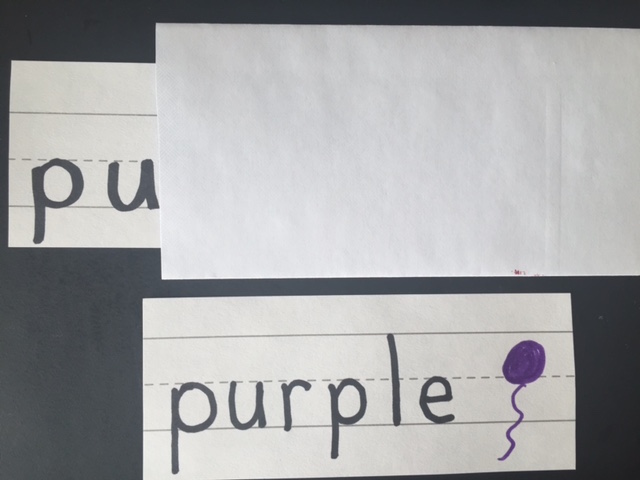

Directions: Write sight words on 10” sections of sentence strips with a black marker. Draw a small balloon the appropriate color at the right end of each word. Seal a letter size envelope and then trim off the left end. Insert the sight words in the envelope. Children pull out one letter at a time and try to blend the sounds and identify the color word. They can self-check with the balloon at the end.


Configuration Puzzles

Write color words on the board. Invite children to trace around the outside shape of each word. Erase the letters inside the outlines. Can children identify the word from the shadow? 


.

Saturday, August 15, 2026

LETTER LAND

All aboard for Letter Land! The few days I’ll be sharing alphabet activities on my blog because this time of year the ABC’s seem to be the starting line in most pre-k and K classrooms.


I have been at this rodeo a LONG time and I want you to know there is NO one correct way to introduce letters or teach children to read. Just take a look around you and you’ll see people of all ages who know HOW to read and they learned TO READ with a variety of different approaches, materials, and reading programs.

Many people ask me questions about how to introduce letters. Should you do capital letters first? Is there a specific order you should follow? There is NO definitive research to support one particular strategy. Children come to you with so many varied experiences and skills that one size will not fit all. There are two principles that I think are important.

First, make it authentic! Teach letters in context and connect with children’s names, units of study, nursery rhymes, and other interests. For example, a trip to the pumpkin patch would be the perfect time to talk about Pp. Talk about the letter Jj when you say Jack and Jill. If your football team is the Falcons discuss the letter Ff.

Second, make it playful and challenging. Use hands-on activities, songs, movements, and games to stimulate multiple senses. Blocks, play dough, puzzles, and magnetic letters are much more REAL than a worksheet or computer game.

Finally, remember that children take it in and take it in and take it in – and then something comes out! They don’t all learn in the same way at the same time, so you have to provide a variety of opportunities to learn. The key is to keep it fun and make them feel successful.

I've got some simple tools that will provide children with multiple experiences in learning letters. Purposeful practice for automaticity (aka repetition) is important for skill mastery so you will want to do these activities many times.

Note! Although I’ll be focusing on alphabet letters, please “harvest” these ideas and make them work for the age and interests of your students. For example, if your children are proficient with alphabet knowledge, use these ideas for sight words. For younger children adapt these activities for learning colors and shapes.


LETTER PUPPETS

Envelope Puppets
Seal an envelope and cut it in half as shown. Write the uppercase letter on one side and the lowercase letter on the other side. Sing the “Hokey Pokey” with the letter puppet.


You put your (letter) in,
You take your (letter) out,
You put your (letter) in
And you shake it all about.
You make the (letter sound)
And then you put it down.

*Listen up! Tell children when you say words starting with that sound they can hold up their puppet. When you say a word that doesn’t start with that sound they should keep the puppet in their lap.

*Have children write a letter on one side and draw an animal that begins with that sound on the reverse side.


*I Have - Who Has Alphabetical Order?
Seal 13 envelopes, cut them in half, and then write the letters of the alphabet on the envelopes. Pass out one or two envelopes to each child and have the child with A say: I have A. Who has B?
The child with B says: I have B. Who has C? And so forth.

*Let children hold up their letter as you sing different alphabet songs.

*Use these puppets to make CVC words.

Paper Plate Puppets
Staple two paper plates together 3/4 of the way around. Write a large uppercase letter on one side and a lowercase letter on the other side. Or, just write the uppercase and lowercase together on one side. Children wear these on their hands and hold them up when their letter is sung in an alphabet song.


*You can also use these to make CVC words or sight words.


http://bit.ly/drjeanLetterLand

Friday, June 26, 2026

GREAT TEACHERS 123

HEY, HEY, WHAT DO YOU SAY?  IS THERE A NEW IDEA HERE FOR YOU TODAY?

Puppet Password
Have a class puppet that gives a password every day. For attendance, the children say the password instead of “here.” Select a password that is the subject for the day, such as “Pilgrims,” “winter,” etc. You could also use a sight word or a vocabulary word.
Use this chant to introduce the password:
Mr. Mouse, Mr. Mouse (or whatever your puppet is),
Oh, what do you say?
What is the password for today?

Pretend to let the puppet whisper the password in your ear. 

*You can also let the puppet go home with a student each weekend and come back Monday with a story and pictures. Keep the stories in a class book.

Hot Number!
(Nola Faulkner)
The teacher picks a random number between 1-10. That’s the number that is the HOT NUMBER. Students stand in a circle and one by one count by ones from 1 – 10. The student who says the hot number can jump or cheer and then must sit down. Keep counting from 1-10 until one child is left.

Polite Partner Share (Meghan Burkholder)
Before reading a story, do questioning and partner talk. The kids turn to a partner and say:
Eyes to eyes.
Knees to knee.
It’s nice that you
Are partners with me.

After sharing their thoughts they thank each other. It’s also a great way to practice taking turns when talking.


McDonald’s Cheer (Michelle Sanders)
Ba, da, ba, ba, ba.
I’m loving it! (Arms overhead like the golden arches.)

Fun Rules (Jackie Fursman)
*Hoods cannot be worn unless it rains or snows inside the school.
*You can only run in the school if there’s an elephant or tiger chasing you.
*You can only lie down if “I” do.
*Ask three before me when I’m at the reading table.

1, 2, 3, Show Me! (Joy, Olathe, KS)
Using individual white boards the teacher asks a question and the children write a response. The teacher says, “1, 2, 3, show me!” Children quickly hold up their slate and show the teacher.
Sample questions: Write the number 15. Write the letter Mm. Write 5 tally marks. Write the number that comes between 2 and 4.

Three Star Sentences (Joy, Olathe, KS)
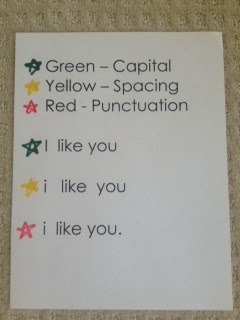
To help kids learn the mechanics of sentence writing they can earn 3 stars. They get a green for using a capital at the beginning; a yellow for spacing between words; a red star for punctuation.


Doubles Don’t Give Me Trouble (Sarah Jackson)
(Tune: “I’ve Been Working on the Railroad”)
1 + 1= 2, 2 + 2 = 4, 3 + 3 = 6, 4 + 4 = 8, 5 + 5 = 10, 6 + 6 = 12
Now I know my doubles,
They don’t give me any trouble!
7 + 7 =14, 8 + 8 = 16, 9 + 9 = 18, 10 + 10 = 20, 11 + 11 = 22, 12 + 12 = 24

Focus Finger Play (Pat Kesler uses this before handwriting. It wires up the brain!)

Two tall telephone poles (Fists touching with index fingers pointing up.)

Across them a wire was strung. (Touch middle fingers.)

Two little birds hopped on ((Put thumbs up on middle fingers.)

And sung and sung and sung. (Swing fingers.)


Push the Wall
One teacher’s occupational therapist suggested that when children are waiting in the hall you tell them to put their hands on the wall and try to “push it down.” This builds upper body strength, releases energy, and focuses children’s attention.


Tummy Reading
Here’s another easy suggestion to help children build upper body strength. Let them do “tummy reading.” Children lay on their tummies and prop themselves up with their elbows as they read. Try it and see how it strengthens those arm and shoulder muscles.

Friday Dance (Tarsha Walker)
Come on, everybody let’s take a chance. (Motion arm “come” as you move from left to right.)
It’s time to do the Friday dance. (Thumb over shoulder as you dance.)
Clap your hands (clap)
And stomp your feet. (stomp)
Come and do the Friday dance with me.
It’s Friday! (Throw arms in the air.)
YEAH!

Bubbles (Erin Yarborough)
To help children remember to walk quietly in the hall, tell them to hold a bubble in their mouths. When you get to your destination they can “pop” their bubbles.


Friday, May 15, 2026

WHAT A NOSE!

Elephants are amazing creatures. I read a book called ELEPHANT BILL about how elephants were used in Burma in WWII - absolutely fascinating! I never knew that elephants have feelings and protect each other's children just like humans.

Here's a silly elephant puppet that my children always enjoyed making. There's nothing like putting a puppet on your hand to tell a story or sing a song.


Materials: old socks, paper plates, crayons, brad fasteners, gray construction paper.

Hint! Ask each child to bring in an old sock. This shouldn't be too difficult because everyone has a lost sock or two.

Directions: Cut 2 ears out of the gray construction paper. Cut a circle large enough for the child’s hand out of the middle of the paper plate. (Color the plate gray if you desire.) Draw a face on the plate as shown. Attach the 2 ears to the sides of the plate with brad fasteners. Insert the hand in the sock and then stick the sock through the back of the plate to create the elephant’s nose.  


What a Nose!

(Tune: "I'm a Little Teapot")
Elephants walk like this and that. (Stick out one arm like a trunk and stomp
from side to side.)
They’re terribly big and terribly fat. (Arms out wide.)
They have no hands. (Hold up hands and shake head no.)
They have no toes. (Point to feet and shake head no.)
But, goodness, gracious, what a nose! (Stick out arm like a trunk.)


One Elephant Went out to Play (Tune: "Five Little Ducks")

One elephant went out to play - (Hold up one finger.)
Out on a spider's web one day. (Roll hands around.)
She had such enormous fun. (Stick arms out wide.)
She called for another elephant to come. (Cup arms by mouth.)
Two elephants went out to play.... (Hold up two fingers.)

*Let children act out this rhyme. The first child chooses the second child. The second child chooses the third child, etc.

*What does "enormous" mean? What are other things that are enormous?

*Could an elephant really play on a spider's web? Why not?


CD Puppet

You can also make an elephant puppet from an old CD. Draw a face on the CD with permanent markers. Tape on construction paper ears and let the children insert their index finger in the hole to make a trunk. (Obviously, my big finger was too large for the hole!)

Note! This is kind of like a history lesson because most kids don't know what a CD is.


.

Thursday, May 14, 2026

MEET ME AT THE ZOO

I love to go to the zoo. I hope I never lose the thrill of seeing the animals and watching what they will do to entertain the people. Whether you take a real trip to the zoo or an imaginary trip on the internet, I've got some activities that children will enjoy. These ideas could also be related to literature, such as making the elephant puppet when you read HORTON HEARS A WHO. Other ideas could be adapted to literature standards (poems or riddles about zoo animals) or informative writing (habitats, body covering, babies, food).

We’re Going to the Zoo
(Tune: “The Bear Went over the Mountain”)
We’re going to the zoo.
Won’t you come, too?

The elephants swing their trunks. (Stick out one arm like a trunk
The elephants swing their trunks. and stomp from side to side.)
The elephants swing their trunks.
And we can do it, too.

*Insert other animal names and these motions:
Kangaroos jump around… (Bend elbows like paws and jump.)
Bears put all fours on the ground…(Put hands and feet on ground and walk.)
Giraffes walk on tippy toes…(Stretch neck and walk on toes.)
Zebras gallop to and fro…(Gallop in place.)
Snakes slither and wiggle…(Wiggle as you go up and down.)
Penguins wobble and jiggle…(Palms out by sides and wobble.)


Guess Who?
Let children take turns pantomiming different zoo animals as their friends try and guess who they are.


Zoo Animal Puppets
Let children create their favorite zoo animal from a lunch bag, paper plate, craft stick, or envelope.


Animal Cheers
Seal of Approval – Extend arms in front of you and cross them over each other. Clap as you make a barking noise.
Elephant Cheer - Stick one arm out straight from under your chin. Put top lips over bottom lip as you blow and make a trumpeting sound.
Snake Cheer – Palms folded together next to your chest. Keeping them together wiggle them out as you make a “Ssssss” sound. Stick your tongue quickly in and out of your mouth.
Tiger Cheer – You’re GGGRRREEEAAATTT! (Stick fist in the air.)


Imagination Bag
Give each child an empty lunch bag. Demonstrate how to open the bag and ask them to do the same. Explain that you are going to take an imaginary trip to the zoo. Ask them to look in their bags to see what they can find. Encourage children to name the animals in their bag as they create an imaginary zoo on the floor in front of them.


Matching Game

Make a matching game where children match up mother zoo animals and their babies. Can they tell you the names for the different animal babies?
*You could also play a memory game with these cards.
Hint! I found my pictures at google images.

Wednesday, January 28, 2026

WILL I SEE MY SHADOW?


Groundhog Day is Monday!


Groundhog Day
– February 2nd
(Tune: “Say, Say, My Playmate”)
February 2nd, (Hold up 2 fingers.)
Is Groundhog Day.
Gather round his hole (Make circular motion.)
To hear what he’ll say. (Place hand by ear.)
Will spring be early
Or late this year?
Watch and listen
To what you’ll hear.


If he sticks his head out (Make a hole with one hand.)
On a sunny day (Stick the index finger from the other hand
His shadow will frighten him (up through the hole and wiggle.)
And he will say,
“I’ll go back in my hole (Tuck finger in your fist.)
And go back to sleep.
You’ll have winter
For six more weeks.”

If he sticks his head out (Make a hole with fist and stick up finger.)
On a cloudy day
He’s not frightened
So he will say, (Wiggle finger.)
“I think I’ll stay out
And the weather should clear.
Spring will be here
Early this year.”
*You can download the book at drjean.org.

Cup Puppet

Let children draw a groundhog or download one off the internet. Staple to a straw. Punch a hole in the bottom of a paper cup and insert the straw in the cup. Raise and lower the groundhog as appropriate in the song.


Sidewalk Shadows

Go outside on a sunny day and have children stand with their backs to the sun. Let them make silly motions and play “Guess what I am?” Give them chalk and let them trace around each other’s shadows.
*Draw shadows at 10, 12, and 2 and compare.

*Play shadow tag where they try to touch each other's shadows.


Where’s the Groundhog?

Cut twenty 4” squares out of heavy paper. Write high frequency words, math facts, letters, numerals, etc. on the cards. Glue a picture of a groundhog on a 3" circle. Have the children sit on the floor in a circle. Mix up the cards and place them face up on the floor. Identify the numeral (etc.) on each card as you place it down on the floor. Tell the children to turn around. Hide the groundhog under one of the squares. Children turn back around and try and guess where the groundhog is hiding. One at a time children call out a number and then “peek” to see if the groundhog is under it. The first child to find the groundhog gets to have a turn hiding it. The game continues as children hide the groundhog and then try to discover his whereabouts.


Dramatize
Invite children to dramatize the groundhog peeping out of his hole. What if it's sunny? What if it's cloudy?

Note! Visit groundhog.org for more great ideas!

Tuesday, January 6, 2026

PUPPET PLAY

There was a time when puppets were as important in our classrooms as smart boards. Something magical happened when the little scrap of cloth or fur went on your hand – it became REAL! Puppets were a vehicle for language, problem solving, creativity, and FUN!

Several years ago I met Jo-Ann Stamile at a conference. She reminded me about the value of puppets with a social skills take home activity she created from old fabric her grandmother left her. I was intrigued and asked if I could share her idea on my blog.


You’ll quickly see from her description how meaningful this would be for ALL children – especially those with special needs. Through the puppets standards would be nurtured (speaking, answering questions), as well as skills from the 21st Century (cooperation, problem solving, etc.). The scenes could easily be adapted for different age levels and situations.

Social Skills Puppet Play Activity Jo-Ann Stamile (Preschool Teacher, Picataway, NJ)
“Puppets are multi-sensory allowing visual, auditory, and kinetic learning. Puppets are a wonderful tool that I use in the classroom. Puppets also foster social interaction, communication, role-playing, imagination, story telling, listening, and so much more.

This Puppet Play Activity Kit goes home with every child in my classroom. Inside the kit, there will be several puppets, along with cards for the children to act out. Each card will have a different scenario on it to reflect the different situations that arise in our classroom.”


Note to Parents:

Start by picking a card. Read the card to your child. Pick out the puppets to go along with the card. Act out the scenario with the puppets.

You may keep the activity home for a few days. Please put this page, along with the puppets and the 9 activity cards back into the container.

Thank you for participating in my Social Skills Puppet Play Activity.

Ms. Jo-Ann


Circle Time
“Meteorologist of The Day”
The Teacher picks a popsicle stick out of the container to be the Meteorologist of the Day, but it’s not your name. How do you react?

Center Time
“Going to a Center that is full”
You want to go to another Center, but there are too many friends already there. How do you react?

“Conflict”
During Center time, you are playing with a toy. Your friend has a toy that you really wanted. What do you do?

“Greeting”
You enter into school. You are greeted by a Teacher. The Teacher says “Good morning” to you. What do you say?

Making Friends
A new friend has started in our classroom. What can you do to help this new friend feel welcome?

Someone Is Sad
During outside playtime, a friend falls down right in front of you and gets hurt. What do you do?

Turn Taking/Sharing

Both of your puppets want to play with the same ball. What do you do?

Clean Up Time
It’s clean up time. You have a lot of toys out. What do you do?

Table Manners
You are sitting down having lunch. You noticed that the milk is at the other end of the table. What do you do?


UP WITH PUPPETS!

Just search "puppets" on my blog and you'll find lots of ideas for using puppets for songs and finger plays. You'll also find puppets that children can create from simple materials.

Friday, October 31, 2025

TEDDY BEAR JUST FOR FUN!

TEDDY BEAR, TEDDY BEAR
(Have the children stand and follow along as you model these movements.)
Teddy Bear, Teddy Bear,
Turn around. (Turn around.)
Teddy Bear, Teddy Bear,
Touch the ground. (Touch ground.)
Teddy Bear, Teddy Bear,
Read the news. (Pretend to read.)
Teddy Bear, Teddy Bear,
Tie your shoes. (Bend down to shoes.)
Teddy Bear, Teddy Bear,
Go upstairs. (Climb stairs.)
Teddy Bear, Teddy Bear,
Say your prayers. (Fold hands.)
Teddy Bear, Teddy Bear,
Turn off the light. (Pretend to switch.)
Teddy Bear, Teddy Bear,
Say, “Good night.” (Place head on hands and close eyes.)

*You can change, “Say your prayers,” to “Comb your hair” if you wish.

Puppet – Give children a copy of a bear to color and cut out. Attach it to a straw or craft stick to make a puppet. Use it to repeat the rhyme.


Positional Words
- Give the children directions for placing their bear on their head, under their chin, behind their back, etc.
*Let them place their bear somewhere in the classroom and then use descriptive words as to the bear’s position.

Skill Game – Cut out bears and shirts. Write uppercase letters on the bears and lowercase letters on the shirts. Children match bears and shirts with clothespins.


*Make similar games for sets and numerals, color words, and so forth.


THE BEAR WENT OVER THE MOUNTAIN

Here's a "treat" for you from Alex May Webmaster Wonder!

Wednesday, September 3, 2025

THE COLOR FARM

This is a song your students will enjoy singing, but there are many skills “camouflaged” here. *This song reinforces the concept that when you put letters together you make a word.
*Children can learn to read the color words.
*More advanced children can learn to spell the color words.

The Color Farm
(Tune: “BINGO”)
There was a farmer had a cat
And Black was her name-o
B-L-A-C-K (Clap on each letter.)
B-L-A-C-K
B-L-A-C-K
And Black was her name-o.

Dog – BROWN
Cow – PURPLE
Horse – GREEN
Duck – ORANGE
Bird – BLUE
Chick – YELLOW
Pig – RED


https://www.youtube.com/watch?v=LlgZjI_K8vA


Activities:
Let the children make stick puppets that they can hold up as you sing.


Write the color word and put a picture clue by it on a sentence strip. Pass these out for the children to hold up as you sing.


Cut a 7” circle out of the top of a file folder. Add ears, tails, and other features for each animal. Children hold it up around their face as you sing.


Hint! Make up additional verses for other colors. For example, a pink flamingo, tan turtle, grey goat, white sheep, etc.


Word Puzzles
Materials: sentence strips, envelopes, markers


Directions: Write sight words on sentence strips. Cut between the letters to make a puzzle. Place the puzzle pieces in an envelope. Make a balloon the appropriate color on the front of the envelope. Children remove the letters and try to put them together to make the word.
Hint! Write the word on the back of the envelope so children can self-check.


Pull and Read
Materials: sentence strips, envelopes, markers


Directions: Write sight words on 10” sections of sentence strips with a black marker. Draw a small balloon the appropriate color at the right end of each word. Seal a letter size envelope and then trim off the left end. Insert the sight words in the envelope. Children pull out one letter at a time and try to blend the sounds and identify the color word. They can self-check with the balloon at the end.


Configuration Puzzles
Write color words on the board. Invite children to trace around the outside shape of each word. Erase the letters inside the outlines. Can children identify the word from the shadow?


Friday, August 22, 2025

LETTER LAND

All aboard for Letter Land! The few days I’ll be sharing alphabet activities on my blog because this time of year the ABC’s seem to be the starting line in most pre-k and K classrooms.


I have been at this rodeo a LONG time and I want you to know there is NO one correct way to introduce letters or teach children to read. Just take a look around you and you’ll see people of all ages who know HOW to read and they learned TO READ with a variety of different approaches, materials, and reading programs.

Many people ask me questions about how to introduce letters. Should you do capital letters first? Is there a specific order you should follow? There is NO definitive research to support one particular strategy. Children come to you with so many varied experiences and skills that one size will not fit all. There are two principles that I think are important.

First, make it authentic! Teach letters in context and connect with children’s names, units of study, nursery rhymes, and other interests. For example, a trip to the pumpkin patch would be the perfect time to talk about Pp. Talk about the letter Jj when you say Jack and Jill. If your football team is the Falcons discuss the letter Ff.

Second, make it playful and challenging. Use hands-on activities, songs, movements, and games to stimulate multiple senses. Blocks, play dough, puzzles, and magnetic letters are much more REAL than a worksheet or computer game.

Finally, remember that children take it in and take it in and take it in – and then something comes out!They don’t all learn in the same way at the same time, so you have to provide a variety of opportunities to learn. The key is to keep it fun and make them feel successful.

I've got some simple tools that will provide children with multiple experiences in learning letters. Purposeful practice for automaticity (aka repetition) is important for skill mastery so you will want to do these activities many times.

Note! Although I’ll be focusing on alphabet letters, please “harvest” these ideas and make them work for the age and interests of your students. For example, if your children are proficient with alphabet knowledge, use these ideas for sight words. For younger children adapt these activities for learning colors and shapes.


LETTER PUPPETS

Envelope Puppets
Seal an envelope and cut it in half as shown. Write the uppercase letter on one side and the lowercase letter on the other side. Sing the “Hokey Pokey” with the letter puppet.

You put your (letter) in,
You take your (letter) out,
You put your (letter) in
And you shake it all about.
You make the (letter sound)
And then you put it down.

*Listen up! Tell children when you say words starting with that sound they can hold up their puppet. When you say a word that doesn’t start with that sound they should keep the puppet in their lap.

*Have children write a letter on one side and draw an animal that begins with that sound on the reverse side.


*I Have - Who Has Alphabetical Order?
Seal 13 envelopes, cut them in half, and then write the letters of the alphabet on the envelopes. Pass out one or two envelopes to each child and have the child with A say: I have A. Who has B?
The child with B says: I have B. Who has C? And so forth.

*Let children hold up their letter as you sing different alphabet songs.

*Use these puppets to make CVC words.

Paper Plate Puppets
Staple two paper plates together 3/4 of the way around. Write a large uppercase letter on one side and a lowercase letter on the other side. Or, just write the uppercase and lowercase together on one side. Children wear these on their hands and hold them up when their letter is sung in an alphabet song.

    
*You can also use these to make CVC words or sight words.

http://bit.ly/drjeanLetterLand


Monday, July 14, 2025

BLOCK CENTER

WHY?

Blocks help children develop concepts of number, size, shape, space, and weight. They also encourage imagination, language, social skills, self-confidence, and motor skills. All you have to do is watch children playing in the block center and you will observe their pleasure and personal satisfaction. Talk about STEM and SEL all rolled into one center!!


The block center should be on a carpeted area with shelves to keep down the noise and contain the materials. Here are some materials you can rotate to encourage children’s creativity.

Materials:

Unit blocks – various shapes and sizes

Cardboard boxes

Alphabet blocks

Wooden dollhouse and furniture

Wooden barn and animals

Plastic dinosaurs and zoo animals

Toy train set, boats, airplanes

Small dolls or action figures

Plastic bins or boxes for accessories

Wooden cars and trucks

Toy street signs

Bristle blocks

Construction hats

Carpenter’s apron

Engineer Planning book

Maps

Paper, pencils

Pattern blocks

*Add construction hats or carpenter’s aprons for children to wear as they build.


Here are three simple rules children need to follow in the block center:

1. Build only as tall as you are.

2. Only knock down what you build.

3. Put the blocks away when you are finished.


JUST FOR FUN!

Name Blocks
Tape children's pictures to unit blocks and use for building, graphing. and other activities.


TP People
Glue full body photos to paper towel rolls and use in the block center or with a puppet theater.

Thursday, May 15, 2025

ELEPHANTS

Elephants are amazing creatures. I read a book called ELEPHANT BILL about how elephants were used in Burma in WWII - absolutely fascinating! I never knew that elephants have feelings and protect each other's children just like humans.

Here's a silly elephant puppet that my children always enjoyed making. There's nothing like putting a puppet on your hand to tell a story or sing a song.


Materials: old socks, paper plates, crayons, brad fasteners, gray construction paper.
Hint! Ask each child to bring in an old sock. This shouldn't be too difficult because everyone has a lost sock or two.

Directions: Cut 2 ears out of the gray construction paper. Cut a circle large enough for the child’s hand out of the middle of the paper plate. (Color the plate gray if you desire.) Draw a face on the plate as shown. Attach the 2 ears to the sides of the plate with brad fasteners. Insert the hand in the sock and then stick the sock through the back of the plate to create the elephant’s nose.

What a Nose!
(Tune: "I'm a Little Teapot")
Elephants walk like this and that. (Stick out one arm like a trunk and stomp
from side to side.)
They’re terribly big and terribly fat. (Arms out wide.)
They have no hands. (Hold up hands and shake head no.)
They have no toes. (Point to feet and shake head no.)
But, goodness, gracious, what a nose! (Stick out arm like a trunk.)

One Elephant Went out to Play
One elephant went out to play - (Hold up one finger.)
Out on a spider's web one day. (Roll hands around.)
She had such enormous fun. (Stick arms out wide.)
She called for another elephant to come. (Cup arms by mouth.)
Two elephants went out to play.... (Hold up two fingers.)

*Let children act out this rhyme. The first child chooses the second child. The second child chooses the third child, etc.
*What does "enormous" mean? What are other things that are enormous?
*Could an elephant really play on a spider's web? Why not?


CD Puppet
You can also make an elephant puppet from an old CD. (Funny, but most kids now don't even know what a CD is!)  Draw a face on the CD with permanent markers. Tape on construction paper ears and let the children insert their index finger in the hole to make a trunk. (Obviously, my big finger was too large for the hole!)

Monday, April 21, 2025

IT'S KINDERGARTEN DAY!


Froebel started the first kindergarten in Germany in 1837, and his birthday was April 21. Kindergarten originated to help children adapt to learning and social interactions in a fun way. Froebel believed in self-directed play, singing, dancing, blocks…a “garden” where children could grow! He’d probably roll over in his grave now if he saw what was going on!!

As I write this I am remembering my kindergarten teacher Mrs. Myers. I LOVED her! I mean, I worshipped her! She was a fairy godmother and the center of my world. She seemed ancient to me at the time, but I’m probably way older now than she was when she taught me. Thank goodness for hair dye and make up!!!

I remember playing “The Farmer in the Dell” and other circle games. I also remember the finger play “Here are grandma’s glasses…” We had sugar cookies with a hole in the middle that we would put on our finger as we ate and we also had orange kool-aid. (Oh, my goodness! The sugar police would get Mrs. Myers for sure!!!) My favorite activity was painting. I especially liked to paint princesses. Back in those days the only princess I knew about was Cinderella, but I longed to be like her. One day as I was at the easel I painted a stripe down my leg. It looked so good I painted another…and another…and another…until my legs had beautiful stripes all over them. Mrs. Myers could have squelched my creativity right then and there, but she just laughed and said, “Don’t do it again.”  Fortunately, my mother had a sense of humor as well!

Another memory I have is learning to tie my shoes. I wore corrective saddle oxfords I feared would come untied at school and then what would I do? Everyone would know that I couldn’t tie shoes!!! Well, one day they came untied and Mrs. Myers said, “You’re a smart girl. Now, you just sit down and figure it out.” And you know what? I did!!!! She knew when to coddle and when to push.

And incredible as it may seem, although all I did was PLAY in kindergarten, I can actually read and write!!

Note! Although I’m focusing on “kindergarten” today, this message holds for all early childhood teachers from preschool through first grade.

WHAT’S THE POINT? By Dr. Jean

If you cover every objective in the curriculum, but don’t have time to play outside or take field trips—
What’s the point of kindergarten?

If you do every page in the workbook, but don’t have time to laugh, do show and tell, or sing a song—
What’s the point of kindergarten?

If you know all your letters and sounds and numbers and sight words, but don’t know how to be a friend or share—
What’s the point of kindergarten?

If you score high on the standardized test, but don’t like school—
What’s the point of kindergarten?

If you master every skill and have 2 hours of screen time, but don’t have time to play in the block center or housekeeping or do puzzles—
What’s the point of kindergarten?

If teachers are so overwhelmed by the demands, expectations, and assessments they are given that they don’t have time to hug, smile, read, cheer, cherish, and look in the eyes of those wonderful little children in their classroom---
Then what’s the point of being a kindergarten teacher?

But we know that five is a magical time, and children only have one chance in a lifetime to be five. SHUT YOUR DOOR and hold hands, sing, dance, paint, tell stories, make believe, play outside, and continue to give children happy memories! And only you can do that because YOU are a kindergarten teacher and YOU are SPECIAL and AMAZING just like the children you teach!

Love always, Dr. Jean


KINDERGARTEN DAY TREATS!!!

Here are some new videos and ideas from Alex May (webmaster)!