photo 3am_dj_home_zps919fb85e.png photo 3am_dj_about_zps7cce4c75.png photo 3am_dj_website_zps73051235.png photo 3am_dj_ss_zps6759ec2a.png photo 3am_dj_bs_zps43e27832.png
Showing posts with label Hands-On. Show all posts

Monday, September 7, 2026

PLAY DOUGH DAY

PLAYING MAKES YOU SMARTER! 

So I guess that means playing with play dough makes kids smarter!


September 16th is National Play Dough Day, but I think every day should be a play dough day in early childhood. Play dough is multi-sensory, engaging, creative, and open-ended. Play dough can be a tool just like a worksheet, video game, or PPT. Play dough also develops small motor skills which help children write. Here are just a few ways to integrate play dough into centers and independent learning in your classroom.
Comprehension
Let children make their favorite character and use it to retell a story.


Draw a scene from a story and add details with play dough.

Make something that you learned from the book.

Phonics
Rhymes – Make two objects that rhyme.


Sounds – Make objects that start with a consonant, blend, or diagraph you are working on.
Vowels- Make an object for a long vowel sound and short vowel sound.


Writing
Make something you like (or don’t like) and write about it.

Make something from a book you have read and write about it.

Make letter plates by writing letters with a permanent marker on plastic plates. Children roll play dough and make the letters on top.


Make letters (or words) using a bubble font. Children roll dough and fill in.


Make something that is a noun. How can you make it plural?

Math
Make objects that match numbers.


Make a set and then decompose it.

Demonstrate more, less, and equal.


Make lines, curves, and shapes.

Science and Social Studies
Reinforce information from a science or social studies unit with play dough. Children could make animals from a habitat, parts of a flower, tools of community helpers, healthy foods…endless possibilities!

Silly Putty
Here’s another idea a second grade teacher shared for keeping those fingers busy! She asks each parent to provide a container of silly putty that the children keep in their pencil box. If they finish their work early, they use the silly putty to create something that relates to a reading skill, math concept, science unit, etc.


Wednesday, August 26, 2026

SHIP SHAPE

How about some ideas for geometry? You can use these activities with young children or school age by adapting the shapes. You might even “spy” some of your state standards here!!!

The Shape Song (Tune: "I'm a Little Teapot")


I am momma circle round like a pie. (Hands over head in a circle.)
I’m baby triangle three sides have I. (Use 3 fingers to make a triangle.)
I am papa square my sides are four. (Draw a square in the air.)
I’m cousin rectangle shaped like a door. (Draw a rectangle in the air and then knock.)

I am brother oval shaped like a zero. (Make oval with arms over head.)
I’m sister diamond with a sparkle and a glow. (Touch thumbs and index fingers and extend.)
We are the shapes that you all know. (Make circles with index fingers and thumbs and
Look for us wherever you go. place around your eyes like glasses.)

Note! Explain that “rhombus” is the correct term for the diamond shape. Sing the song calling sister a “rhombus” instead of a “diamond.”

*Have children draw shapes in the air with elbows, feet, noses, and other body parts.


*Place foam shapes or 3-dimensional shapes in a bottle filled with sand or salt. Children spin it around and try to identify the shapes. Can they draw the different shapes that they spy?


Body Shapes
Divide children into small groups and challenge them to lay on the floor and make various shapes with their bodies. How many friends will it take to make a triangle? A square? A pentagon? Take pictures and make a book.

*Make spyglasses for “spying” shapes by wrapping construction paper around paper towel rolls.

*Cut geometric shapes out of construction paper and let children use them to make a collage. Can they combine simple shapes to make larger shapes?


*Cut sponges into geometric shapes and have children dip them in paint and stamp on paper.


*Download highway shapes (free on the internet).  Children can drive around these with toy cars or they can roll play dough and place it on the shapes.

*Go on a walk and look for shapes in your school and on the playground.

Shape Book
Fold two sheets of paper in half and staple. Children decorate the front of their book with shapes. Next, they walk around the room and draw shapes that they see. Can they label the shapes?
*This would be a good homework activity to help children be more aware of the shapes around their home.

Play Dough Book
Draw lines, curves, and geometric shapes with a marker on file folders. Laminate. Bind file folders with rings to make a book. Children roll play dough and place it on top of the shapes.


Bendables
Offer children pipe cleaners, Wikki stix, etc. and challenge them to make various shapes with the items.

Pretzel Shapes
Give children pretzel sticks and pretzel twists and challenge them to make geometric shapes. How many pretzel sticks will you need to make a hexagon? How many pretzel sticks will you need to make a triangle?

*Challenge them to make letters with the pretzels. This is fun to do with a partner as they take turns making letters and identifying them.


Tuesday, August 25, 2026

1, 2, 3 - COUNT WITH ME!

Counting is a basic strand across math standards. There’s even research that suggests counting with pre-k children can build math concepts they will use later on in kindergarten and primary grades. To avoid rote counting without meaning, let TOUCH AND COUNT be the mantra you repeat and model over and over. Counting will also have more meaning if you tie it into finger plays, songs, and movements.

*Adapt these activities for younger children by just counting from 1-10. Older students can count to 100 and beyond.

Little Red Number Box (Sarah Wilson)
Put magnetic numbers in a metal tin and then sing the song as you pull out a number. Then count to that number.
For example: I wish I had a little tin box to put a 6 in. I’d take it out and count 1, 2, 3, 4, 5, 6 and put it back in.


Move and Count

Have children count as they jump, hop, and do other movements.

*Count the steps to the lunchroom.
*Count how long it takes everyone to sit down quietly.
*Count the number of chairs in the room, tables, toys, girls, boys, dragons (that's a joke!) etc.


Hickory Dickory Dock
Hickory dickory dock. (Palms together and tick tock back and forth.)
The mouse ran up the clock. (Wiggle fingers up in the air.)
The clock struck one, (Clap one time.)
The mouse ran down. (Wiggle fingers down.)
Hickory dickory dock.

Two – “Yahoo!” (Continue clapping the appropriate number of times.)
Three – “Whopee!”
Four – “Do more!”
Five – “Let’s jive!”
Six – “Fiddlesticks!”
Seven – “Oh, heavens!”
Eight – “Life’s great!”
Nine – “So fine!”
Ten – “We’re near the end.”
Eleven – “We’re sizzlin’.”
Twelve – “I’m proud of myself.”


Number Sticks
These math sticks are easy to make and can be used in many ways. You’ll need magnetic numbers and shapes, jumbo craft sticks, and a strong glue (such as E6000). Glue the numbers to the sticks and you are all set!

*Let children hold up the appropriate stick as you do finger plays and counting songs.
*Can they walk around the room and match up their number with classroom print or the appropriate number of objects?


Giant Number Line
Attach a piece of tape to the floor in a prominent place in your classroom. Let children walk on it forwards, backwards, hop, etc. After playing with the line, ask them to sit on the floor. Explain that you’re going to turn it into a number line as you demonstrate writing numbers (0-10) on the tape. 

*Ask one child at a time to walk on the number line as they say each number.
*Call out different numbers and ask random students to stand on those numbers. What is one more? What is one less?
*Give students dot cards (0-10) and ask them to match their card with the number on the line.


Saturday, August 15, 2026

LETTER LAND

All aboard for Letter Land! The few days I’ll be sharing alphabet activities on my blog because this time of year the ABC’s seem to be the starting line in most pre-k and K classrooms.


I have been at this rodeo a LONG time and I want you to know there is NO one correct way to introduce letters or teach children to read. Just take a look around you and you’ll see people of all ages who know HOW to read and they learned TO READ with a variety of different approaches, materials, and reading programs.

Many people ask me questions about how to introduce letters. Should you do capital letters first? Is there a specific order you should follow? There is NO definitive research to support one particular strategy. Children come to you with so many varied experiences and skills that one size will not fit all. There are two principles that I think are important.

First, make it authentic! Teach letters in context and connect with children’s names, units of study, nursery rhymes, and other interests. For example, a trip to the pumpkin patch would be the perfect time to talk about Pp. Talk about the letter Jj when you say Jack and Jill. If your football team is the Falcons discuss the letter Ff.

Second, make it playful and challenging. Use hands-on activities, songs, movements, and games to stimulate multiple senses. Blocks, play dough, puzzles, and magnetic letters are much more REAL than a worksheet or computer game.

Finally, remember that children take it in and take it in and take it in – and then something comes out! They don’t all learn in the same way at the same time, so you have to provide a variety of opportunities to learn. The key is to keep it fun and make them feel successful.

I've got some simple tools that will provide children with multiple experiences in learning letters. Purposeful practice for automaticity (aka repetition) is important for skill mastery so you will want to do these activities many times.

Note! Although I’ll be focusing on alphabet letters, please “harvest” these ideas and make them work for the age and interests of your students. For example, if your children are proficient with alphabet knowledge, use these ideas for sight words. For younger children adapt these activities for learning colors and shapes.


LETTER PUPPETS

Envelope Puppets
Seal an envelope and cut it in half as shown. Write the uppercase letter on one side and the lowercase letter on the other side. Sing the “Hokey Pokey” with the letter puppet.


You put your (letter) in,
You take your (letter) out,
You put your (letter) in
And you shake it all about.
You make the (letter sound)
And then you put it down.

*Listen up! Tell children when you say words starting with that sound they can hold up their puppet. When you say a word that doesn’t start with that sound they should keep the puppet in their lap.

*Have children write a letter on one side and draw an animal that begins with that sound on the reverse side.


*I Have - Who Has Alphabetical Order?
Seal 13 envelopes, cut them in half, and then write the letters of the alphabet on the envelopes. Pass out one or two envelopes to each child and have the child with A say: I have A. Who has B?
The child with B says: I have B. Who has C? And so forth.

*Let children hold up their letter as you sing different alphabet songs.

*Use these puppets to make CVC words.

Paper Plate Puppets
Staple two paper plates together 3/4 of the way around. Write a large uppercase letter on one side and a lowercase letter on the other side. Or, just write the uppercase and lowercase together on one side. Children wear these on their hands and hold them up when their letter is sung in an alphabet song.


*You can also use these to make CVC words or sight words.


http://bit.ly/drjeanLetterLand

Saturday, August 1, 2026

HAPPINESS HANDSHAKES

Handshakes are a “hands” on way to connect with the children physically and emotionally as you start your day.

Handshake Greeting
Have each child stand as you extend your right hand to them. Say, “Good morning child’s name.” Teach the children to look you in the eyes as they shake your hand and say, “Good morning teacher’s name.”

Note! It would be good to have a discussion about this and ask them if they’ve ever seen adults shake hands. Why do we shake hands? Which hand should you use? Put a sticker or stamp on their right hand or tie a ribbon around their right wrist to help them remember. Explain that it’s important to give a firm handshake, smile, and look the other person in the eyes.

Shake a Hand (Tune: “Mulberry Bush”)
Everybody shake a hand, shake a hand, shake a hand.
Everybody shake a hand and walk around the room.
(Walk around the room as you shake hands.)

Everybody give high 5… (High five.)

Hug a hand… (Palms together, wrap thumbs around, and squeeze.)

Knuckle bump… (Make fists and bump knuckles.)

Boogey down… (Wiggle down and up with a friend.)

Smile and wink and walk back to your seat. (Smile and wink.)


Happy Handshakes

Here are some other handshakes your class might enjoy. Choose one and do it every day for a week. After you’ve introduced several you can let a special helper choose the handshake for the day.


Butterfly – Hook right thumbs together. Extend the other four fingers to make the butterfly’s wings. Pretend to flutter the butterfly’s wings as you move your hands in a circular motion.

Squirrel – One friend extends her arm. The other friend quickly runs fingers from the wrist up to the shoulder. Switch places.

Thumb Kiss – Hold up thumbs and touch as you make a smacking sound.

Hamburger – Children bump fists and say, “Burger.” Open fists and wiggle fingers together as they say, “Fries.” Hands in the air and shake fists and hips as they say, “Shake.”

Farmer – The teacher crosses her fingers and points thumbs down to represent the cow’s utter. The child grabs the thumbs and pretends to milk the cow.

Cool Dude – Partners knuckle bump and then open their fist and slide it back as they say, “Pssshhh!”

Double Cross Handshake – Shake right hands and then reach across and shake left hands.

Lumberjack – Partners hold up right thumbs and grab them with the left hand. Partners then clasp right fingers and pretend to saw back and forth.

Builder – Shake hands and move them up and down vertically as you say, “Here’s a hammer.” Move hands horizontally back and forth as you say, “Here’s a saw.” Gently twist wrists as you say, “And here’s a screwdriver.”

Potato – Bump fists as you say, “Baked potato.” Bend index fingers and touch as you say, “Tader tot.” Open fingers and wiggle with your partner as you say, “And fries.”

Ghost – Extend arms and swish back in forth as you say, “Woooo!”

Buzz! Extend index finger and touch to your partner’s index finger as you make a buzzing sound.

Fisherman – Place right hand on each other’s right forearm and tap gently like a fish tail. Bend right arm back as if reeling in a fish as you say, “Good morning!”

Hand Hug – Hold up right palms and touch in the air. Bend thumbs around and gently squeeze.

Spiderman – Partners hold up four fingers and intertwine. Spiders have 8 legs and you have 8 wiggly fingers.

Biker – Children hold out fists and stick up thumbs. The teacher grabs the thumbs and pretends to turn them while making a “Brrrrmmmm” sound. “Now your brain is revved up and you’re ready to learn!”

Body Parts – Call out different body parts and challenge children to greet partners by gently touching elbows, knees, heads, ankles, toes, chins, etc.

Jellyfish – Bump fists and then open and close fingers as you pull them back like a jellyfish.

Bow Wow – Partners bow and then make “w’s” by sticking up three middle fingers. Open mouth and place “w’s” on either side to create the word “WOW!”

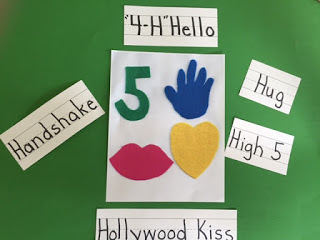
4-H Hello – Children can choose one of these “H’s.”
High Five (High five partner.)
Handshake (Shake hands.)
Hug (Hug each other.)
Hollywood kiss (Air kiss on left and right.)

*They can also choose a homerun, which is all four!

Hint! Cut a hand, numeral “5”, heart, and lips out of fun foam or felt. Place on the floor so the children can stand on the one they’d like.


P.S. Think about saying good-bye to your students at the end of the day with a handshake.

Here’s a video where you can watch me demonstrate some of these handshakes.

https://www.youtube.com/watch?v=lOD5TUqILcQ

Thursday, July 2, 2026

PLAYING WITH LETTERS

PLAYING WITH LETTERS is meant to be a resource that you can use with any reading or alphabet program that your school has selected. The ideas can be adapted for circle time, learning centers, small group instruction, take home activities, brain breaks, or transitions to provide children with learning opportunities throughout the day. Think of these activities as a spoonful of sugar to make those skills and standards “taste” more fun!


https://drive.google.com/file/d/1lG6M8DVJP2umDSVMAdv5uq1vF0l3XjBo/view?usp=sharing

The activities in our book are organized around these categories:

Touch and Tell (Multisensory)

Teaching Transitions

ABC Tools and “Toys”

Let’s Play and Learn Games

Letter Land (Classroom Print &Alphabet Books)

Ready to Write

Letter Centers

Singing Letters and Sounds

Alphabet Poetry Book

NOTE!

Many teachers question how they should introduce letters. Should you do capital letters first? Is there a specific order you should follow? There is NO definitive research to support one particular strategy. Children come to you with so many varied experiences and skills that one size will not fit all. However, there are two principles that we think are important.

First, make it authentic! Teach letters in context and connect with children’s names, units of study, nursery rhymes, and other interests. For example, a trip to the pumpkin patch would be the perfect time to talk about Pp. Talk about the letter Jjwhen you say Jack and Jill. If your football team is the Falcons discuss the letter Ff.

Second, make it playful and challenging. Use hands-on activities, songs, movements, and games to stimulate multiple senses. Blocks, play dough, puzzles, and magnetic letters are much more REAL than a worksheet or computer game.

Finally, remember that children take it in and take it in and take it in – and then something comes out! They don’t all learn in the same way at the same time, so you have to provide a variety of opportunities to learn. The key is to keep it fun and make them feel successful. 

HINT!  You’ll also be able to adapt many of these strategies for other skills, such as sight words, math concepts, etc.

Friday, May 8, 2026

LET'S MAKE SOMETHING!

We are so busy trying to give children things we didn’t have ~
that we are failing to give them what we did have!!!

Isn’t that a profound quote? We are in such a hurry to push children and academics that we often fail to remember that they are just little children. Over the next few days I'll have posts with activities that you can use in your classroom or share with your families.

You will find games, songs, crafts, recipes, and activities to build lasting memories in young children. UNPLUG the electronics and PLUG into good old-fashioned FUN! And, the amazing thing is you will actually be nurturing children’s brains with these multi-sensory activities. You will be engaging the WHOLE child as you develop oral language, social skills, large and small motor skills, and emotional well-being.

Here's a link to download all the activity cards:

file:///Users/jeanfeld/Downloads/ActivityCARDS-DrJeanJuly2015-4.pdf

Special thanks to Carolyn Kisloski (Holding Hands and Sticking Together – ckisloski.blogspot.com) for her magic touch with the graphics and design!


The link goes to the first set of cards called LET'S MAKE SOMETHING!
You'll find some simple craft projects and homemade toys that children can enjoy making and playing.

1. Wonder Watchers

2. Hummers

3. Paper Plate Party

4. Magic Wand

5. Cardboard Rollers

6. Magazine Puppets

7. Box Top Puzzles

8. Sewing Cards

9. Sweet Baby

10. Sock Puppets

11. Flannel Board

12. Art Easel

13. Play Dough

14. Play on with Dough

15. Goop

16. Flubber

17. Giant Bubbles

18. Mud Pies

19. Shaving Cream Painting

20. Silly Putty

Wednesday, April 1, 2026

ENGINEERS

Engineering is the design process used to solve problems and build things. Children are natural engineers as they play with blocks and Legos, create things in art, or build a fort outside with their friends. Here are a few other activities that will give your little “engineers” a job. 


Engineer Planning Book
Write “Engineer Planning Book” on the cover of the notebook. Explain that engineers draw a plan and then try to build their design. Place the book in the block center along with a pencil and encourage children to draw their idea and then try to build it.


Cups and Plates
Little guys to big kids will be challenged to build structures with simple materials like plates and cups.


Lunch Bag City
Buildings and houses from lunch bags are fun to construct and use to create a community, reproduce a scene from a book, or design a city of the future. Take 2 lunch bags and open them up. Fill one with crushed newspaper. Insert the second bag on top and then decorate with markers, construction paper scraps, etc.


Monday, March 9, 2026

SINGULAR AND PLURAL

Standards may come and go, but singular and plural forms of nouns will always be in the curriculum. 

Singular and Plural
Write the name of common classroom objects on the board. Cover the end of a fly swatter with white paper. Write the letter “S” on the paper as shown. Children take turns adding the “s” to the end of the words and saying the plural. Can they use it in a sentence?


Blocks

Cut paper the size of rectangular and square unit blocks. Write common nouns on the rectangles and tape to blocks. Write “s” on a square and tape to a square block. Children read nouns and then add the “s” block and read the plural.


Unifix Cubes
Place sticky dots on cubes and write letters on them. Make a list of common nouns. Children make the words with the cubes and then add “s” at the end and read the word.


Singular and Plura
l (Tune: “This Old Man”)
One is book, 2 are books.
One is cook, more are cooks.
Add an “s” to the end of a word
Makes it plural, haven’t you heard?
One is toy, two are toys.
One is boy, more are boys.
I’ll say a word, then you add an “s.”
You make it plural - do your best!
Car Star
Dog Log
Cat Hat
Ball Wall
Coat Boat
*Let children suggest other words to sing in the song.

T-Chart
Children draw a T-chart on a sheet of paper. On the left side they write the singular form of nouns. On the right side ask them to write the plural form. Can they read the words?


Oops!
Make up inappropriate sentences and when the children hear you say something wrong they can say, “Opps!” Have them repeat the sentence correctly.
Teacher: “We have 12 boy here today.”
Children: “Oops! We have 12 boys here today.”

Friday, February 20, 2026

SELLING WRITING

Good teachers are sales people and they have to SELL children on writing. How empowering to tell a child, "YOU ARE A WRITER!" "YOU ARE AN AUTHOR!"

Here's a great chant where children can move and get their "writing groove" going!

The Writing Process
Children repeat each line to this chant as you open your arms wide and clap as you step from side to side.

Chorus:
Who knows the writing process?
(Children repeat.)
I know the writing process.
(Children repeat.)

First step. (Hold up one finger.)
(Repeat)
Brainstorm. (Hands on the side of your head and shake down.)
(Repeat)
Chorus

Second step…(Hold up 2 fingers.)
(Repeat)
Write it down…(Pretend to write with index finger on palm.)
(Repeat)
Chorus

Third step…(Hold up 3 fingers.)
(Repeat)
Edit your work…(Shake finger.)
(Repeat)
Chorus

Fourth step…(Hold up 4 fingers.)
(Repeat)
Publish your work…(Brush hands together.)
(Repeat)
Chorus

Oh, yeah! (Hands on hips with an attitude.)
(Repeat)


Writer's Wall of Fame
Here’s a simple idea that will save you time and encourage all those little “authors” and “illustrators” in your classroom. All you need is a file folder to make a display pocket for each child. Cut a 1 ¼” border around the top half of the file folder. Let children decorate it with their name and pictures. Open and laminate. Fold in half and staple to a bulletin board or tape to a wall. Children can display their own work by slipping drawings, stories, etc. in the pocket.

Handy Edit
Teach children how to edit their work with this “handy” idea.
(Make a fist with your right hand to begin.)

1. If you started your sentence with a capital letter you can stick up your thumb.

2. If you read the sentence and it makes sense you can stick up your index finger.

3. If you remembered to put punctuation at the end you can stick up your pinky finger.

4. Then you can say, “I love my sentence.” (Turn your fist over and you will be making sign language for “love.”)


Ready for Writing Rap (Traci Wade)
1, 2…sit up, please do.
3, 4…feet flat on the floor.
5, 6…push your chair in quick.
7, 8…lay your paper straight.
9,10…write neatly then.

Chew and Write
Give children a piece of sugarless gum. Once they write their name they can open the gum and start chewing. They are allowed to chew the gum as long as they keep on writing!


Wednesday, December 31, 2025

BRIDGING PLAY AND STANDARDS

Turn WORK into PLAY with learning centers!


Math – paper, pencil, adding machine tape
coupons, calculator, play money
graphs, posters
counting books, shape books

Science – charts, research books, identification books
science magazines, labeled collections
clipboard, pens, notebook

Dramatic Play – shopping list, chalk board
memo pad, pens, pencils
magazines, books
puppets, stuffed animals, babies to “read” to
junk mail, menus, catalogs
class phone book

Blocks – paper and markers to make labels and signs
blue prints, sticky notes
photos of different homes and buildings
block book, alphabet blocks

Art – Rebus direction charts, labels for materials
variety of art media, markers, paint


Table Toys – play dough, letter cookie cutters
play dough book, sewing cards
letter beads to string
paper, hole punch, scissors
letter stencils, colored pencils

Sand and Water
– magnetic letters (hide in sand)
ping pong balls (write letters and
words on them and children
scoop with fishnet)

Playground – letter hopscotch
beach balls with letters
chalk board for keeping score
giant chalk to write with on sidewalk


Here's a poem I found on a paper plate after I did a workshop ten years ago.  Sad, but true today!  

Don’t Take away My Childhood
By Yolanda Richey, 2016


Don’t take away my childhood,
Let me run and play.
Don’t take away my childhood,
Let me learn in my own way.
Give me songs to sing
Give me time to dance.
Don’t take away my childhood,
I only get one chance -
To be a little child
Who loves to learn each day.
So don’t take away my childhood
Because my work is PLAY!