photo 3am_dj_home_zps919fb85e.png photo 3am_dj_about_zps7cce4c75.png photo 3am_dj_website_zps73051235.png photo 3am_dj_ss_zps6759ec2a.png photo 3am_dj_bs_zps43e27832.png
Showing posts with label Multi-sensory. Show all posts

Monday, September 7, 2026

PLAY DOUGH DAY

PLAYING MAKES YOU SMARTER! 

So I guess that means playing with play dough makes kids smarter!


September 16th is National Play Dough Day, but I think every day should be a play dough day in early childhood. Play dough is multi-sensory, engaging, creative, and open-ended. Play dough can be a tool just like a worksheet, video game, or PPT. Play dough also develops small motor skills which help children write. Here are just a few ways to integrate play dough into centers and independent learning in your classroom.
Comprehension
Let children make their favorite character and use it to retell a story.


Draw a scene from a story and add details with play dough.

Make something that you learned from the book.

Phonics
Rhymes – Make two objects that rhyme.


Sounds – Make objects that start with a consonant, blend, or diagraph you are working on.
Vowels- Make an object for a long vowel sound and short vowel sound.


Writing
Make something you like (or don’t like) and write about it.

Make something from a book you have read and write about it.

Make letter plates by writing letters with a permanent marker on plastic plates. Children roll play dough and make the letters on top.


Make letters (or words) using a bubble font. Children roll dough and fill in.


Make something that is a noun. How can you make it plural?

Math
Make objects that match numbers.


Make a set and then decompose it.

Demonstrate more, less, and equal.


Make lines, curves, and shapes.

Science and Social Studies
Reinforce information from a science or social studies unit with play dough. Children could make animals from a habitat, parts of a flower, tools of community helpers, healthy foods…endless possibilities!

Silly Putty
Here’s another idea a second grade teacher shared for keeping those fingers busy! She asks each parent to provide a container of silly putty that the children keep in their pencil box. If they finish their work early, they use the silly putty to create something that relates to a reading skill, math concept, science unit, etc.


Wednesday, August 26, 2026

SHIP SHAPE

How about some ideas for geometry? You can use these activities with young children or school age by adapting the shapes. You might even “spy” some of your state standards here!!!

The Shape Song (Tune: "I'm a Little Teapot")


I am momma circle round like a pie. (Hands over head in a circle.)
I’m baby triangle three sides have I. (Use 3 fingers to make a triangle.)
I am papa square my sides are four. (Draw a square in the air.)
I’m cousin rectangle shaped like a door. (Draw a rectangle in the air and then knock.)

I am brother oval shaped like a zero. (Make oval with arms over head.)
I’m sister diamond with a sparkle and a glow. (Touch thumbs and index fingers and extend.)
We are the shapes that you all know. (Make circles with index fingers and thumbs and
Look for us wherever you go. place around your eyes like glasses.)

Note! Explain that “rhombus” is the correct term for the diamond shape. Sing the song calling sister a “rhombus” instead of a “diamond.”

*Have children draw shapes in the air with elbows, feet, noses, and other body parts.


*Place foam shapes or 3-dimensional shapes in a bottle filled with sand or salt. Children spin it around and try to identify the shapes. Can they draw the different shapes that they spy?


Body Shapes
Divide children into small groups and challenge them to lay on the floor and make various shapes with their bodies. How many friends will it take to make a triangle? A square? A pentagon? Take pictures and make a book.

*Make spyglasses for “spying” shapes by wrapping construction paper around paper towel rolls.

*Cut geometric shapes out of construction paper and let children use them to make a collage. Can they combine simple shapes to make larger shapes?


*Cut sponges into geometric shapes and have children dip them in paint and stamp on paper.


*Download highway shapes (free on the internet).  Children can drive around these with toy cars or they can roll play dough and place it on the shapes.

*Go on a walk and look for shapes in your school and on the playground.

Shape Book
Fold two sheets of paper in half and staple. Children decorate the front of their book with shapes. Next, they walk around the room and draw shapes that they see. Can they label the shapes?
*This would be a good homework activity to help children be more aware of the shapes around their home.

Play Dough Book
Draw lines, curves, and geometric shapes with a marker on file folders. Laminate. Bind file folders with rings to make a book. Children roll play dough and place it on top of the shapes.


Bendables
Offer children pipe cleaners, Wikki stix, etc. and challenge them to make various shapes with the items.

Pretzel Shapes
Give children pretzel sticks and pretzel twists and challenge them to make geometric shapes. How many pretzel sticks will you need to make a hexagon? How many pretzel sticks will you need to make a triangle?

*Challenge them to make letters with the pretzels. This is fun to do with a partner as they take turns making letters and identifying them.


Tuesday, August 18, 2026

SINGING LETTERS AND SOUNDS

Music is the most natural way to learn anything. Mary Ann Wolf (reading researcher) recommends singing alphabet songs with young children. She explains that songs act like an umbrella and “place holder” in the brain. When the letters and sounds make sense to the children, they have a “place” to go.

Hint!
There are many ways to introduce alphabet songs, but it might be helpful to introduce a new song each week. Sing it every morning to start your day, and then use it as a brain break during the day. The next week you can teach the children another song and then review the song you sang the previous week. Write the titles of the songs as you introduce them on a sentence strip and add a picture clue. That way you can let children choose different songs and repeat them.

Visual Connections
As you sing alphabet songs, it will be helpful to connect the visual with the auditory. You can use alphabet cards or point to the letters in your classroom.


LETTER TAILS (Tune: "Gilligan's Island")
This is one of my favorite alphabet books that Barb Smith created several years ago. It's good for letter recognition, phonics, and visual closure (recognizing the whole from the part).

This is a tale about the letter A.
It makes a special sound.
/a/ /a/ /a/ /a/ A!
Let’s learn another sound.

This is a tale about the letter B….

You can download the book here. If you’ll glue the cover to the front of a pocket folder and put the pages in clear sheet protectors the book will last for a long time.


Hint! This is a great book to put in your listening center with the song.
https://www.youtube.com/watch?v=8rEzOQn5ElM 


HAPPY BIRTHDAY LETTERS

Who doesn’t like birthdays? Children will love dancing and singing this song.

Happy Birthday Letters
Yo, A,
It’s your birthday.
Let’s all read
Like your birthday.
/a/ /a/ /a/ /a/ /a/ /a/
Yo, B…etc.

*Have children stand in a circle and act like rappers. When the letter that their name begins with comes up in the song they get to jump in the middle of the circle and dance.

https://www.youtube.com/watch?v=tuyyoj_xvUE


Letter Birthday Hats
Let the children make birthday hats from sentence strips and wear them as you sing “Happy Birthday Letters.” (Our old stick pony is modeling the birthday hat for you.)

Birthday Cake
Draw a birthday cake on a magnetic board and sing the letters as you place them on the cake:

Yo, M, it’s your birthday.
Let’s all sing like your birthday
/m/ /m/ /m/ /m/ /m/ /m/
/m/ /m/ /m/ /m/ /m/ m/

Here’s a link so you can download the birthday cake.

https://drjeanandfriends.blogspot.com/search?q=letter+tails

Rapper Necklace
Cut letters out of heavy cardboard. Let children decorate them with fake jewels, glitter, or stickers. Punch holes in the letters and tie on string. Children can wear these as you sing this song.

Sunday, August 16, 2026

MAKE AND READ ALPHABET BOOKS

IF THEY MAKE IT, THEY WILL WANT TO READ IT!

Home School Alphabet Book
This book will provide a hands-on activity that will encourage parents to talk to their children about school and alphabet letters. Write different letters of the alphabet on cardstock. Give each family a letter and ask them help their child draw pictures or cut out pictures of things that begin with the letter. Put their pages together to make a book for your class.


I Can Read!
Take 26 large sheets of paper (12” x 16”) and write a different letter on each page. Put pages between construction paper to make a book called “I Can Read My ABC’s.” Hole punch and bind with book rings. Invite children to bring in words from food labels, stores, catalogs, etc. that they can read. As childrenbring in their words, help them match up the first letter with the same letter in the book and glue their word on that page. 


Alphabet Art
Write large letters of the alphabet on paper. Give each child a letter and challenge them to create a picture around their letter. “What does your letter look like? Does it remind you of something? Can you use your crayons to turn it intothat object? Try to ‘camouflage’ it so no one knows what your letter is.” Put their drawings together to make a book.


*Challenge older children to turn their letter into an object that begins with the sound their letter makes.

Alphabet in My Mouth
Use the words and tune to “He’s Got the Whole World in His Hands” to make thisbook.

I’ve got the whole alphabet in my mouth.
I’ve got the whole alphabet in my mouth
And I can read.

I’ve got A /a/ /a/ in my mouth.
I’ve got B /b/ /b/…

First, take a close up photo of each child with their mouth wide open and their tongue stickingout. Next, cut letters out of construction paper and glue to the tongue on theirpicture. Write words for each page to go with the picture, such as “I’ve got A /a//a/ in my mouth.”

AlphaBODY Book
Challenge children to make letters with their bodies. Or, divide children into small groups and ask them to make letters.


Themes
Make alphabet books that relate to different themes, seasons, holidays, or concepts you are working on. For example:

Pets Foods We Like
Insects Friends Oceans
Transportation Scary Things
Things We Love ABC’s of Spring
Our Country Sports


CLASSROOM ALPHABET
Instead of putting up the traditional alphabet cards, use one of these ideas to create a unique alphabet.

Children’s Photos
Use children’s first or last names to make an alphabet. If several children have names that begin with the same sound, then group them together. If you don’t have names for letters, then use the school helpers’ names or other common objects.


Sign Language

Cut hands out of felt and glue them to make the manual signs for letters.


Real Objects
Glue small objects that begin with letters to make alphabet cards.


Environmental Print
Use labels from food products or clothes to make an alphabet.
Hint! Give each child a letter and ask parents to send in environmental print for that letter.


Giant Letters
Cut out giant cardboard letters for the first letter in each child’s name. Let them decorate these at home with their families. They could use family photos, pictures of things that are important to them, or drawings to decorate their letters.

EASY PEASY ABC MATERIALS

These tools are easy to make and will add hands-on fun to your curriculum. Wouldn't they be perfect for a learning center?

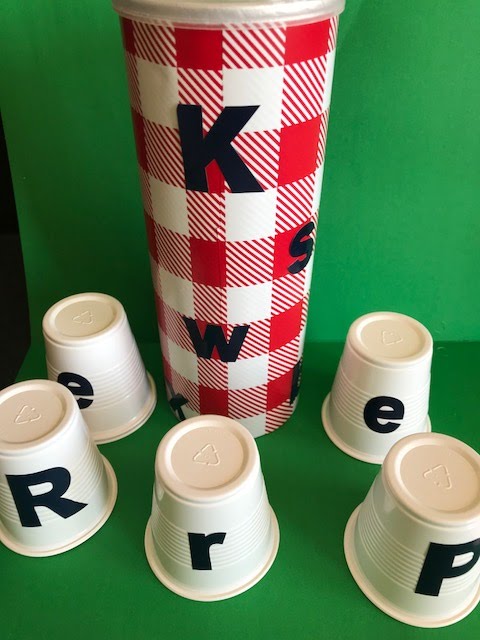
ALPHABET CUPS
Write letters on the sides of bathroom cups. Let children explore and experiment building with the cups.


*Make a matching game where they match upper and lowercase letters.
*Challenge children to make words (or their names) with the cups.

Hint! Store in a Pringle’s can.


PLAYFUL AND CHALLENGING PLAY DOUGH

Write letters on clear plastic plates, plastic placemats, sheet protectors, or leftover laminating film with a permanent marker. Make play dough from the recipe below. Children roll play dough and place it on top to make the letter. Can they make objects that begin with that letter? 


Homemade Play Dough
2 cups flour
2 cups
2 TB cream of tartar
2 TB vegetable oil
2 cups water
Food coloring

Mix ingredients together in a pan until smooth. Cook over medium heat, stirring constantly until the mixture forms a ball and sticks to the spoon. Cool and knead. Store in zip baggie

* Add unsweetened Kool-aid, vanilla, cinnamon, or other spices to give it an aroma.
Hint! You can even find a gluten free play dough recipe online.


Alphabet Cookies
*Let children press magnetic letters in play dough to make alphabet cookies.


Play Dough Pictionary
Each child will need a small ball of dough to play this game. Call out a letter. Children try and make something from their dough that begins with that sound. Take turns trying to guess what friends molded.


LETTER POPS
You will need jumbo craft sticks, magnetic letters, and E6000 glue (or similar craft glue) to make letter pops. Glue the magnetic letters to the jumbo craft sticks and you’re all set to begin.


Song Props
Pass out the sticks and have children hold up their letter as you sing ABC songs.

Letter Hunt
Ask children to walk around the room and match their letter on classroom print. Can they match their letter to an object in the room that begins with the sound?

Library Pointers
Place the letter pops in a can in the classroom library. Children choose a letter and then match it up with that letter in a book.

Making Words

Let older children get together with friends and make words with their letter pops.

Match Up
Make a set of letter pops with uppercase letters and a set with lowercase letters. According to the number of children in your classroom, use the appropriate number of uppercase and lowercase letters. Distribute uppercase letters to half the class and matching lowercase letters to the other half. Children can walk around the room and match up.

Thursday, August 13, 2026

SCHOOL GLUE

Just a dot! Not a lot!


Just think if you were a little kid and you had never held a bottle of glue before. Wouldn’t it be fun to squeeze it all out? Sometimes we forget that children need directions on how to use school materials. Tell children, “We just need to use a baby dot of glue. Not a mama dot or papa dot. Just a tiny, little baby dot.” (Be dramatic with this and say “baby dot” in a high little voice.) Demonstrate how to put a dot on a sheet of paper. “What does that look like? A little bug? A cookie crumb?”

*Put food coloring in a bottle of glue and use it at a center for children to practice making “baby dots.”

If you use glue sticks, you will also need to demonstrate how to use them. “If you barely touch the page you can’t see anything. That means nothing will stick to it. Press it gently down and then look to make sure you can see something. That means your paper will stick.”

School Glue
(Tune: “This Old Man”)
School glue, school glue,
Just a little dot will do.
Put a dot and spread it around.
It will hold your paper down.
School glue, school glue,
Don’t use more than a dab or two.
When it dries up, it will disappear.
Your work will look good never fear.


Lotty Dotty
Write letters, numbers, words, etc. by making dots with a water-based marker. Put a drop of glue on top of each dot. Dry. The marker will bleed into the glue to create a textured figure. Children can trace over the dots with their finger as they say the letter, number, or word.

Hint! Let children make rubbings of lotty dotty letters and words by placing a sheet of paper on top and rubbing with the side of a crayon. Can they connect the dots and write the letter or word?


Glue Ghosts
Someone taught me how to make these years ago and I wanted to pass on the idea to you.  (Save it for October.)  Children squirt glue in the shape of a ghost on wax paper. Add googly eyes and let dry overnight. When they are dry, peel off the wax paper, punch a hole, and tie on a string for a necklace. If you didn't want to make ghosts, they could do aliens or other creatures. My kids loved these!

Thursday, July 2, 2026

PLAYING WITH LETTERS

PLAYING WITH LETTERS is meant to be a resource that you can use with any reading or alphabet program that your school has selected. The ideas can be adapted for circle time, learning centers, small group instruction, take home activities, brain breaks, or transitions to provide children with learning opportunities throughout the day. Think of these activities as a spoonful of sugar to make those skills and standards “taste” more fun!


https://drive.google.com/file/d/1lG6M8DVJP2umDSVMAdv5uq1vF0l3XjBo/view?usp=sharing

The activities in our book are organized around these categories:

Touch and Tell (Multisensory)

Teaching Transitions

ABC Tools and “Toys”

Let’s Play and Learn Games

Letter Land (Classroom Print &Alphabet Books)

Ready to Write

Letter Centers

Singing Letters and Sounds

Alphabet Poetry Book

NOTE!

Many teachers question how they should introduce letters. Should you do capital letters first? Is there a specific order you should follow? There is NO definitive research to support one particular strategy. Children come to you with so many varied experiences and skills that one size will not fit all. However, there are two principles that we think are important.

First, make it authentic! Teach letters in context and connect with children’s names, units of study, nursery rhymes, and other interests. For example, a trip to the pumpkin patch would be the perfect time to talk about Pp. Talk about the letter Jjwhen you say Jack and Jill. If your football team is the Falcons discuss the letter Ff.

Second, make it playful and challenging. Use hands-on activities, songs, movements, and games to stimulate multiple senses. Blocks, play dough, puzzles, and magnetic letters are much more REAL than a worksheet or computer game.

Finally, remember that children take it in and take it in and take it in – and then something comes out! They don’t all learn in the same way at the same time, so you have to provide a variety of opportunities to learn. The key is to keep it fun and make them feel successful. 

HINT!  You’ll also be able to adapt many of these strategies for other skills, such as sight words, math concepts, etc.

Wednesday, June 24, 2026

GREAT TEACHERS 121

"Ooookkkaaalllahhhoommmaaaa!!!" 2011

Back to Back
Every child needs a partner and touches body parts as the teacher calls out:
back to back (touch backs)
shoulder to shoulder (touch shoulders)
elbow to elbow
knee to knee
head to head
wrist to wrist
feet to feet
hip to hip
Continue calling out vaious body parts...
End with "bottom to chair" as children sit down!

Can You Dig It? (Rachel Lawrence)
Hide magnetic numerals in a sand table. Each student is given a sheet with math facts appropriate to their level. During math centers they have to do their facts and then dig out the answers (magnetic letters) in the sand.

*You can also hide letters and have children spell words.

Spelling Trays (Rachel Lawrence)
Prepare "spelling trays" in plastic drawers. Children choose a tray and then take it to their desk and spell words using one of the materials below:
*Wikki sticks
*magnetic letters
*puzzle letters
*black light pens (security pen with black light key chain)
*alphabet stickers
*alphabet blocks
*dry erase board

Let’s Look Important! (Diane Ringer)
Use this idea instead of criss cross applesauce.
Would you like to know how to look important? Put your right hand over your heart like this. (Demonstrate)
Put your left hand across your chest and fold your arms like this. (Demonstrate)
Lift up your chin and smile importantly. Now look at all my important people!

Song Requests
(Heather Cline)
Make a box for song requests. Children write their favorite song on a sheet of paper and put it in the box. Pull requests each morning and sing.

End of Day Chant (Linda Wood)
Sit in a circle criss cross applesauce and start the chant with this rhythm:
Slap knees two times
Clap two times
Snap two times
Clap two times
“Linda, Linda, what do you say?
What did you like at school today?”
The child has to tell what they liked best that day. It’s a good way to remember what they learned as you reinforce oral language.

A Fuzzy Little Caterpillar (Leanne Hutchison)
(Tune: "I Had a Little Turtle")
A fuzzy little caterpillar wiggled right by me. (Wiggle index finger.)
He wiggled long. (Wiggle finger away.)
He wiggled short. (Wiggle finger close.)
He wiggled right at me. (Wiggle finger at your face.)
I put him in a box. (Cup hands.)
"Don't go away I said!" (Point finger.)
But when I opened up the box
There was a butterfly instead! (Clasp thumbs and wiggle fingers like a butterfly.)

*You can adapt this song for "I had a little tadpole...I put him in a jar... Don't go away I said. . But when I opened up the jar a frog hopped out instead!"

Surprise Can (Julie Wiegman & Anne Greer)
Each week place a different letter on top of a paint can. (You can purchase an empty paint can at Lowe's or Home Depot.) Select one child each night to take home the surprise can. Ask parents to assist their child in finding four items at home that begin with the letter. Put the four itmes in the can along with clues about each object. At school the next day, the child (with help from the teacher) gives clues as classmates try to guess what the objects are. Example: This is something that is a fruit. This is round and red. It grows on a tree. A-Apple!

Friday, June 19, 2026

GREAT TEACHERS 116

Met some great teachers and gathered some fantastic ideas on St. Louis in 2014! 

Noodle Sensory Fun (Kyle Kranes)
Cut fun noodles into sections and let the children roll on their back, arms, legs, belly. It’s a great cool down and brain break – and perfect for sensory kids.


Line Up Call Back (Jeana Rhoades)
I say “line.”
You say “up.”
Line (teacher)
Up (Children)
I say “sit.”
You say “down.”
Sit (teacher)
Down (Children)
“Happy” – “Monday” etc.

Name Game Line Up (Heather Barrio)
Play the name game to transition to go home, outside, etc. The teacher picks a student to stand up. That student picks a friend to line up, and the game continues until one person is left. The last child gets to pick me!!! This activity helps children learn their classmates’ names. If a student says, “I don’t know her name.” Explain that they should say, “What’s your name, friend?” This also helps shy students engage with the group.

Vowel Flip Book (Krystal McVicker, American International School, Vietnam)
Make a flip book with 5 flaps. Write the vowels on the top of the outside. Children draw or cut out pictures with short vowel sounds and glue them under the correct vowel flap. 


*Another teacher shared that they use flip books to reinforce beginning reading and sight words like “the,” “a,” “I,” etc. Write “the” on the front of all four flips. Children open and draw a picture under each flap. Then they can read “the house,” “the sun,” and so forth.

Virtue Book
(Jane Lake)
After studying virtues, make a booklet for each word and then let children illustrate it or cut pictures out of magazines. You could also call it a “Good Manners Book” or “My Best Behavior Book.”
Examples of virtues could be: be kind, think of others, love everyone, listen and watch, be eager and excited, share with others, try my best, be ready.

Fantastic Friends
(Jane Lake)
At the beginning of the year (or for Valentine’s Day) make a book about friends.
1. A good friend is…
2. I’m a good friend when…
3. What friends like to do together…
4. Symbols of friendship…
5. Names of my friends…

Eye Ball Stories
(Penny Salvato)
*I cracked up with this one! 
Penny makes "eye" pointers for her children.  She tells them that she collected the eyeballs on the playground from kids who played too rough!!!


Friday, April 3, 2026

SENSES

Senses are like pathways to the brain, and children can learn about them with this song.


Senses (Tune: BINGO)
There are five senses that we use to help us learn each day.
See (Point to eyes.)
Hear (Point to ears.)
Smell (Point to nose.)
Taste (Point to mouth.)
Touch (Hold up hands.)
See, hear, smell, taste, touch,
We use them every day.


https://www.youtube.com/watch?v=4-jMyDR6kSQ


Sense Walk
*Go on a walk and have children touch various objects. “How does it feel?”
*Have them close their eyes and try to identify objects by their sense of touch.
*Take a listening walk where children close their eyes and try to identify different sounds in the environment.


Descriptive Writing 

Give children a clipboard and encourage them to explore the playground as they fill in the blanks (write or draw pictures). Let children share their findings with classmates and then put their pages together to make a class book.


Thursday, April 2, 2026

BLOCK BOOK AND PLAY DOUGH BOOK


These books are a perfect way to integrate literacy in practical ways in learning centers. Children will be engineers and mathematicians as they develop small motor skills and eye-hand coordination.


BLOCK BOOK
1. Cut small squares and rectangles similar to unit blocks out of construction paper.
2. Arrange on file folders to make structures similar to the ones shown.


3. Punch holes and bind together to make a book.
4. Place in the block center and challenge children to look at the designs and then make them with the blocks.
5. Can they look at the design and then turn it over and make it without looking?


PLAY DOUGH BOOK
1. Write “Can you make lines?” at the top of one folder.
Make lines similar to the one shown.

2. Draw curves on another folder and write “Can you make curves?” at the top.

3. Make shapes (square, rectangle, circle, triangle) on another folder and write “Can you make shapes?”

4. Draw simple objects (nest and eggs, hotdogs, bunny, etc.) on the last folder and write “What else can you make?”

5. Punch holes in the folders and attach with book rings.

6. Place the book in a center with play dough and challenge the children to roll the dough and place it on top of the lines and shapes.