photo 3am_dj_home_zps919fb85e.png photo 3am_dj_about_zps7cce4c75.png photo 3am_dj_website_zps73051235.png photo 3am_dj_ss_zps6759ec2a.png photo 3am_dj_bs_zps43e27832.png
Showing posts with label Senses. Show all posts

Friday, April 3, 2026

SENSES

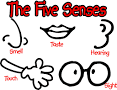
Senses are like pathways to the brain, and children can learn about them with this song.


Senses (Tune: BINGO)
There are five senses that we use to help us learn each day.
See (Point to eyes.)
Hear (Point to ears.)
Smell (Point to nose.)
Taste (Point to mouth.)
Touch (Hold up hands.)
See, hear, smell, taste, touch,
We use them every day.


https://www.youtube.com/watch?v=4-jMyDR6kSQ


Sense Walk
*Go on a walk and have children touch various objects. “How does it feel?”
*Have them close their eyes and try to identify objects by their sense of touch.
*Take a listening walk where children close their eyes and try to identify different sounds in the environment.


Descriptive Writing 

Give children a clipboard and encourage them to explore the playground as they fill in the blanks (write or draw pictures). Let children share their findings with classmates and then put their pages together to make a class book.



Saturday, May 17, 2025

ANIMAL CRACKERS

Some things like animal crackers never go out of style!

Animal Crackers
By Dr. Holly
Lions, and tigers, and bears, oh, my!
In my box that’s what I spy.
Take them out.
Should I run?
No, I’ll eat them!
Yum! Yum! Yum!

Descriptions
Pass out an animal cracker to each child. Encourage them to write descriptive sentences about their cracker. I see… I smell… I feel… I hear… I taste!


Tag Along Book
Cut the front and back off a box of animal crackers. (Be sure and leave the string attached.) Cut paper the size of the box. Give each child a sheet and ask them to draw a zoo animal or write a description of a zoo animal. Put their pictures between the front and back of the box and staple to make a book.
Hint! This is called a tag along book because they can hold it and it will tag along with them!

Math
Use zoo animal plates for simple addition. Children make sets in each ear and then join them together and count the sum. You can use math counters, buttons, popcorn, or cereal.


Vocabulary
What does it mean to be a carnivore? Herbivore? Omnivore? What are you? Do some research to find out eating habits of different zoo animals.

Sorting
Use animal crackers, toy animals, or pictures to sort zoo animals. Ask children what sorting rule they used. Can they think of another way to sort the animals?

Put Me in the Zoo
Do a language experience chart where children fill in the sentence:
If I were in the zoo I would be…
Let them draw pictures of which animal they would like to be. Why did they choose that animal?

Zoo Treats
You will need graham crackers, animal crackers, and peanut butter to make this snack. Children put a small amount of peanut butter on the graham cracker and stand animal cookies up on it.
*You can using icing or honey for children with peanut allergies.

Friday, March 21, 2025

SPRING INTO WRITING

Spring is the perfect time to "grow writers"!

Spring Acrostic

After a spring walk, have children write the word spring vertically down the left side of their paper. Can they write a word (or sentence) for each letter that is a sign or symbol of spring? 


Hint! With younger children do this as an interactive writing activity.

Spring Poem
Have children fill in the words to create their own poem or a book.


SPRING
Spring looks like____.
Spring smells like ____.
Spring sounds like ____.
Spring feels like ____.
Spring tastes like ____.
I like spring!


Web
Brainstorm spring vocabulary words and then encourage children to make a web using words or drawings.


I Want to Go Out and Play Book
(Writing an opinion)
Give each child a sheet of paper and ask them to draw a picture of why they like to go outside. Ask them to write (or dictate) a sentence about their drawing. Make a cover that says, “I Want to Go Out and Play.” Put their pages together, hole punch, and insert book rings.


Sit and Write
(Descriptive writing)
Each child will need paper, a clipboard or cardboard to write on, and a pencil or crayon. Have children spread out in a comfortable area and write stories, poems, or descriptions of what they see.

Wednesday, January 24, 2024

LISTEN UP!


Bill Cosby had it right when he said that children were "parent deaf." Sometimes they are "teacher deaf" as well. K.J. is often so busy saying, "What?" that it seems he doesn't bother to listen at all. There is a funny story called BENDEMOLENA (THE CAT WHO WORE A POT ON HER HEAD). Do you have any students that seem to be wearing pots on their heads?


*Try lowering your voice. Remind children to listen with their eyes, ears, and bodies. (You might need to have a class discussion about what that means.)


*Make a copy of a giant ear and tape it to a stick. When you hold up the ear children know they need to listen with big ears!

*Focus children’s attention, and then practice giving directions ONE time. If children need a prompt, invite another student to repeat what you have said.

*Occasionally, have children close their eyes when you read a story. Can they make pictures in their brain? Can they identify story elements? Can they retell the sequence?

*Sing songs or say nursery rhymes with your eyes closed.


Here are some other activities to encourage children to listen up!

Mystery Sounds - Ask children to close their eyes. Walk around the room making different noises (open the door, ring a bell, sharpen a pencil) while children identify what you are doing.


Sound Walk - Take the children on a “silent” nature walk. Challenge them
to remember all the sounds that they can hear. Make a list of all the sounds when you return to the classroom.


Story Sounds - Invite the children to add sounds as you read a story. Prompt
them before you read by telling them to roar for the dinosaur, squeak for the mouse, or snap for rain.


Animal Sounds - Learning animal sounds is a natural way to develop language
and listening skills. Sing songs such as “Old MacDonald” and play “Guess Who I Am?” where children make animal noises for their friends to identify.


Name That Tune
Demonstrate how to play this game by humming the tune to familiar songs. Let children take turns humming tunes as their classmates guess the name of the song.


Gossip - Have children sit in a circle. Whisper a simple message in the first child’s ear. That child passes the message to the person sitting next to them and so on around the circle. The last child repeats what she heard, which is usually far from the original whisper.


Perfect Pitch - Hum a note and ask children to join in. Vary the pitch from high to low. You can also use a xylophone or other class instrument to play this game.


To Grandmother’s House We Go -Place 5-10 objects on a table or shelf in a far corner of the room. Have your class sit with you in the opposite corner of the room. Take a basket or grocery sack and that they are going to get to take turns going to grandmother’s house. “We’re going to pretend that grandmother lives over there in the other side of the room.” One at a time select a child to go to grandmother’s. Give her the bag and name one thing that you want her to get for you at grandmother’s. Explain that you’ll only tell her one time, so she’ll have to listen very carefully. Instruct the rest of the class to sit quietly so they can remember to see if she gets the right thing. The child skips across the room, selects the named object, puts it in the bag, and returns to the teacher. Cheer if she remembers the correct object.

*Start with one object and make it increasingly difficult by adding more objects or descriptive words. For example, “Bring me something that is red and grows on a tree.” “Bring me the book, the block, and the blue crayon.”

Friday, March 17, 2023

GREEN


The world is turning GREEN this time of year. Here are some ways to celebrate the color with a poem, reading, math, science, and art.

Green by Dr. Holly
Green grass,
Green trees,
Green pickles,
Green peas.

Green grows
And green makes
Green lizards,
Green snakes.

Green leaves
Pop out in the spring;
Green is such
A lovely thing!

Color Recognition (Visual Skills)
Sing this song to the tune of “Do You Know the Muffin Man?”
Do you see the color green, the color green, the color green?
Do you see the color green somewhere in the room?
Each child gets up and touches an object that is green. (Adapt the song for other colors, beginning sounds, etc.)

Hint! Cover a cardboard roller from a pants hanger with green paper to make a green pointer!


Remember (Listening Skills and Model Writing)
Read the poem to the children one time. Ask them to recall the different objects in the poem that are green. Write their responses on the board. Read the poem a second time and see how many more objects they can remember. Read over the list together.

If I Were Green (Oral Language)
Have children close their eyes and pretend they are green. What are they? Write this sentence at the top of a sheet of paper and run off a copy for each child. “If I were green I would be ________.” (Younger children can dictate their responses, while older children complete their own sentences.) Put their papers together to make a class book.


“Eye” Can Graph (Math Comparisons)
Pass a small mirror around the classroom. Encourage each child to look at their eyes and describe what color they are. Make a bar graph by cutting out eyes from construction paper. Let each child color in a section by the color of their eyes. What color do the most people have? What color do the least number have? Have children go home and look at their parents’ eyes. Are they the same color as their eyes?


Natural Green (Science Investigation)
Ask the children to think about all of the things in nature that are green. Write their list on the board as they call out objects. “Are all of these the same shade of green?” Take the class on a nature walk and have each child collect one “specimen” that is green. Bring their objects back in the classroom and compare. Are they all the same? Have children describe their differences. Can they sort the objects? Did they collect plants or animals? What animals are green? What time of year do you see the most green?

Green Collage (Creativity)
Provide children with green paint, green crayons, green markers, and green paper. Invite children to create a “green collage” on a piece of cardboard or a paper plate.

Scratch and Sniff Green (Word Recognition)
Give each child a heavy piece of paper. Write the word “green” on their paper with school glue. (An adult will need to do this for younger children.) Let each child take a spoonful of lime jello and sprinkle it over the glue. (Model how to shake it around and then dump off the excess.) After it dries, children can “scratch and sniff” the word green.

Sunday, March 12, 2023

PIGGY BACK "BINGO"

Piggyback tunes have been used forever because once the melodies are in the brain you can easily change the words. Here are a few new learning opportunities for this familiar tune.

Vowels
There are some letters you should know and they are the vowels.
A – E – I – O – U
A – E – I – O - U
A – E – I – O - U
And now you know the vowels.


Senses
There are five senses that we use to help us learn each day.
See (Point to eyes.)
Hear (Point to ears.)
Smell (Point to nose.)
Taste (Point to mouth.)
Touch (Hold up hands.)
See, hear, smell, taste, touch,
We use them every day.


Zip Code
There is a zip code where we live and we know our zip code.
3 - 2 – 1 – 5 - 5
3 - 2 – 1 – 5 - 5
3 - 2 – 1 – 5 – 5
Now we know our zip code.

Word Families
There is a word family you should know and ILL is it’s name-o.
WILL
FILL
HILL
They end in ILL you know.


Number Bonds

There are some facts that you should know and they all equal seven.
2 + 5
3 + 4
6 + 1
7 + 0


Name Bingo
Play BINGO using children’s names and googly eyes. Write children’s names on sentence strips and give them googly eyes. “I spy the letter R. “ If children have an “R” in their name they cover it up with a googly eye.

P.S.  Here's the link to the "BINGO" tell and draw story I shared yesterday.

https://drive.google.com/file/d/0B1SnEagA4jlja1pwNjBaOUpBeGc/view?usp=sharing&resourcekey=0-7DpioTdxWfUkhbTcBUSdBw

Sunday, January 22, 2023

STEM on WITH A SCIENCE FAIR


WANT SOMETHING FUN TO STEM THIS WEEK?


What do you need to do ahead of time?

Run off copies of my discovery bottles from my website (February, 2017).

https://drjean.org/html/monthly_act/act_2017/02_Feb_css/


Send home a letter to your parents similar to the one below along with directions for one of the bottles:

Dear Parents,

We are excited that your child is going to participate in his or her first SCIENCE FAIR this week. Please help your child make a “discovery bottle” using the attached directions. You are welcome to look on the internet to find another bottle that you’d like to make. (Just search “discovery bottles” or “sensory bottles” for more ideas.)

Water bottles are perfect for this project. Soak the bottle in warm water or blow with a hair dryer to remove the label. The only difficult part is removing the sticky glue left on the bottle. (I’ve found the easiest thing to do is just put a piece of clear packaging tape over the sticky part.) You’ll find most of the materials for making these bottles in a junk drawer or in your kitchen cabinet.

Please send the bottle back to school this Friday. For our science fair we’ll let each child “show and share” how they made their bottle. We’ll create a special science center so the children can revisit the bottles and discover and explore over the next few weeks.

We hope you’ll stop by and see all of the creative ways children can recycle bottles and LEARN!

Note! The only thing you’ll need to do is glue the lids on with E6000 or a similar glue. Shake, rattle, and roll those bottles!


Of course, you'll want to award a "participation" ribbon to each child!

Thursday, June 16, 2022

OUTDOOR SCIENCE

Make your playground or backyard your very own science lab.

Discovery Walks
Go on a walk and have children touch various objects. “How does it feel?”Have them close their eyes and try to identify objects by their sense of touch.

*Take a listening walk where children close their eyes and try to identify different sounds in the environment.


Dirt Detectives
Use magnifying glasses and sticks to dig in the dirt. What is dirt composed of?


Human Sun Dial
Have one child face north at 9:00 in the morning. Mark where they are standing and draw their shadow with chalk. Have the child stand in the same spot and record their shadow at various times in the school day.

*Play shadow tag where children try to step on each other’s shadows.


Cloud Watch
When there are cumulus clouds in the sky, have the children lay on their backs and look for animals and other objects in the sky.

*Let them draw pictures of clouds with white paint and a Q-tip on blue paper.


Melt Down
Give each child a paper cup with an ice cube in it. Who can make their ice cube melt fastest?
*Color the ice cubes with food coloring.

*Draw with ice cubes on the sidewalk.


Sit and Watch
Children can use a hula hoop or 7' piece of string for this activity. Lay the hula hoop on the ground (or make a circle with the string) and sit inside. Encourage children to sit quietly and use their senses to observe their habitat.

*Give them paper and a pencil to draw or write observations.

Wednesday, June 23, 2021

FIVE SENSES AND PARTS OF A FLOWER

Senses are like pathways to the brain, and children can learn about them with this song.

Senses (Tune:  BINGO)
There are five senses that we use to help us learn each day.
See (Point to eyes.)
Hear (Point to ears.)
Smell (Point to nose.)
Taste (Point to mouth.)
Touch (Hold up hands.)
See, hear, smell, taste, touch,
We use them every day.
 

Sense Walk
*Go on a walk and have children touch various objects. “How does it feel?”
*Have them close their eyes and try to identify objects by their sense of touch.
*Take a listening walk where children close their eyes and try to identify different sounds in the environment.

Descriptive Writing
Give children a clipboard and encourage them to explore the playground as they fill in the blanks (write or draw pictures). Let children share their findings with classmates and then put their pages together to make a class book.


Parts of a Flower  (Tune: “Head, Shoulders, Knees, and Toes”)
Flower (Hands around face.)
Stem (Point to neck.)
Leaves (Stick out arms.)
And roots (Touch feet.) –
Leaves and roots.
Flower, stem, leaves, and roots –
Leaves and roots.
All it takes is sun (Hands up in circle over head.)
And showers (Wiggle fingers down.)
And a seed (Hold out palm.)
Grows into a flower. (Spread fingers of right hand up through left fist.)
 

Flip Book
Make a flip book where children can label the parts of a flower. To make a flip book fold a sheet of paper into eighths. Open and fold in half. Cut down the three creased lines to the middle to make flips. Turn vertically as shown. Write “Flower," "Stem," "Leaves," "Roots” on the four sections from the top to the bottom. Open and draw the appropriate part of the plant under each label. Don’t forget to draw the seed!
  

Eating Plants
Discuss what parts of a plant you eat. What roots do you eat? What leaves? What stems? What flowers? What seeds?
*Divide a sheet of paper into fourths and label, “seeds,” “roots,” “stems,” “flowers.” Have children write or draw different foods they eat from each category.