photo 3am_dj_home_zps919fb85e.png photo 3am_dj_about_zps7cce4c75.png photo 3am_dj_website_zps73051235.png photo 3am_dj_ss_zps6759ec2a.png photo 3am_dj_bs_zps43e27832.png

Friday, July 19, 2019

DIY GIVE ME A CHEER

You’ve never downloaded my cheer cards? Well, today is the day!

These cheer cards can be used to focus children’s attention and put a smile on their faces. Every child in your classroom can feel good with these cheers. 


What? cheer cards, Cheerios box or Cheer detergent box, heavy paper, scissors

Why? attention grabbers, positive self-esteem, classroom family

When? Large group, small group, all day long

How? Copy the cheer cards below on heavy paper. Cut apart. Introduce one new cheer each day. Use the cheer throughout the day. At the end of the day take a Cheerios box or a Cheer detergent box and say, “We’ve learned a new cheer. Let’s save it in our “cheer box.”

Hint! You can also tape these cheers to a bulletin, classroom door, or the front of your desk.

*When you want to encourage a child, have her reach into the “cheer box” and lead the class in that cheer.

I have two different sets of cheer cards so you can choose the one that you like best.

http://www.drjean.org/html/monthly_act/act_2004/06_june/06_2004_pdf.html


Here are two videos where you can watch me demonstrate many of the cheers.

                               
https://www.youtube.com/watch?v=iWPA-jYdWe8

Thursday, July 18, 2019

DIY CLOTHESPIN CLIP

How about another tool that can be used in multiple ways throughout the school year.

Clip It

What? jumbo craft sticks, clothes pins, markers

Why? letters, sight words, names

When? Learning center, independent

How? Write the letters of the alphabet on the clothespins. Write words on the craft sticks. Children match letters and clip them on the stick to make the words.


Have children write the words after they make them with the clothespins.

*At the beginning of the school year use children’s names and pictures for this activity.


Teddy Bear Clip

Clothespins are a natural way to develop small muscles and pincer grip. Use this game pattern for skills you’ll want to reinforce in a learning center.

What? heavy paper, clothespins, markers

Why? color words, upper and lowercase letters, pictures and sounds, sets and numerals, math facts and answers, etc.

How? Cut bears out of different colors of paper. Cut shirts out of white paper and write color words on them. Children match bears with the appropriate color word and chip them on the bears.


*Younger children can use this game for matching like colors.

* Write uppercase letters on the bears and lowercase letters on the shirts.

*Write math facts on the bears and answers on the shirts.
                                                        
*Put pictures that rhyme for the children to match.

*Match antonyms or synonyms.

https://www.drive.google.com/file/d/0B1SnEagA4jljTTAxcXBUZzU1dHc/view?usp=sharing

Wednesday, July 17, 2019

DIY POETRY SONGBOOK

If I were in charge of the world, this is something that I would put in each child's hands. It's so simple and inexpensive, but it could give a lasting memory to a child.  This idea could be adapted for any age group or skill level.

On a personal note!  I have a friend with Alzheimer's who has a difficult time carrying on a conversation.  Another friend took her out to lunch, and I asked, "What did you talk about?"  She replied, "Oh, we don't talk.  I put on the 50's radio station and we sing!"  And that's why we must sing with children and teach them poems.  Those songs and rhymes will stay tucked in their brain, and they might give them a smile and a few minutes of happy memories one day!

What?  pocket folders with 3 prongs, copies of poems and songs, markers, art media

Why?  love of reading, oral language, phonological awareness, social skills, reading skills

When?  large group, small group, independent, home/school

How?  Purchase a pocket folder for each child.  This will be a good project for them to decorate the first week of school.  Think of 4 or 5 simple songs, nursery rhymes, or poems that you would like to introduce the first month of school.  (I would not put illustrations on these because the children will be able to make a personal connection with their own drawings.)  Run off copies of these and insert them in the pocket folder.  Each week introduce one of the songs using the strategies below.  As the year progresses add new songs or rhymes that would engage the children or relate to a theme or season.

Hint!  Some good songs might include: “Twinkle Little Star,” “BINGO,” “Baa Baa Black Sheep,” “The Itsy Bitsy Spider,” “The Farmer in the Dell,” “London Bridge,” “Yankee Doodle,” “Jack and Jill,” “Mary Had a Little Lamb,” “Row, Row, Row Your Boat,” “The Alphabet Song,” or “Rain, Rain, Go Away.”


Monday - Introduce the poem as a shared reading experience. Reread the poem several times using one of these strategies:


     Shadow Reading– Teacher reads a line and then students repeat.

     Magic Word– Choose a “magic word” (high frequency word) in the text. Every time you   come to that word, the children get to clap, jump, snap, etc.

     Say What?Read the wrong way and have children correct you by shouting out, “Say what?”

     Missing Word – Omit a word and have the children fill it in.

     Read with me IF you…like chocolate ice cream
     like broccoli have a dog
     can ride a bike are wearing red

     Stand and Read – Children stand and take a small step to the right for each word. At end of the line jump “down” to the next line. Everyone moves back to the left and quickly moves to the right with every word until the end of the next line. Repeat until the end of the poem.

     Take a Turn- Divide children into groups and each section reads a different line. For example: Let boys and girls alternate reading lines.
               
Tuesday
Let children use pointers to find letters or words they can recognize, point out words that rhyme, punctuation, etc.  Have children illustrate the poem or song as an independent activity.

Wednesday - Use the poem for skill work during small group. Highlight parts of speech, sight words, etc.

Thursday - Children bring notebooks to large group and reread this week’s rhyme and review previous poems.

Friday - Children read poems independently or with a buddy.

Weekend Homework - On Friday, let children take home their poetry notebooks. Ask children to read the poem to someone in their family over the weekend. Encourage parents to sign their name and write their comments and compliments on each poem.


Carolyn has created the COOLEST alphabet poems that are just right for your poetry songbook.  What a great way to start your year!


Tuesday, July 16, 2019

DIY FLIP THE PANCAKE

Here’s another self-check game that can be used at the beginning of the year for learning friends’ names and later on for phonics and math.


What? spatula or pancake turner, corrugated cardboard, fun foam, markers, students’ pictures

Why? names, letters, sounds, math facts, contractions, antonyms, etc.

When? Small group, center

How? Cut 3 ½” circles out of cardboard or fun foam. Write uppercase letters on one side and lowercase letters on the other. Place the circles on the floor or a table. Children name the letter on one side, and then flip it over to self-check.

*Write words on one side and glue matching pictures on the back.

*Write children’s names on one side and glue their picture on back.


*Put pictures on one side and initial consonants or vowels on back.

*Write questions on the front and the answer on the reverse side.

*Write antonyms on opposite sides.

*Write two words on the front and the contraction on the back.

*Write the word in Spanish on one side and the English translation on the back.

Monday, July 15, 2019

DIY MY MESSY HOUSE

This game can be adapted to a variety of skills. It’s an activity your students will WANT to do over and over.

What? colored construction paper or card stock, spring clothespins, markers, scissors, string

Why? sight words, letters, numerals, shapes, etc.

When? Small group, learning center, partner

How? Cut clothes out of construction paper and write skills on them. Tie a string (clothesline) between two chairs. Spread the clothes on the floor as you say, “My house is so messy. Who can help me clean it up?” Children take turns choosing an item, identifying the information, and then hanging it on the clothesline.


https://www.drive.google.com/file/d/0B1SnEagA4jljSDk1Z2ZjUldqSlU/view?usp=sharing

*Put days of the week on the clothes for the children to hang up in order.

*Write numbers (1-10 whatever you are working on) for the children to put in order.

*Write words in Spanish on some clothes and words in English on others. Children hang up the ones that go together.

Sunday, July 14, 2019

DIY LETTER AND NUMBER STICKS

If you’ve never made these, then today is the day!!! They are a hands-on way children can connect to abstract sounds and numbers and can be used in a multiple of ways.

Letter Pops

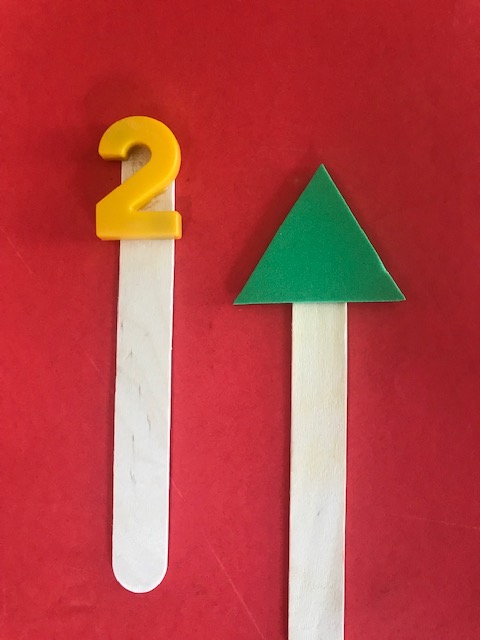
What? jumbo craft sticks, magnetic letters, E6000 glue (or similar craft glue)

Why? letter recognition, phonics, print knowledge

When? Large group, small group, independent

How? Glue the magnetic letters to the jumbo craft sticks.

*Children can use these to match letters on classroom print. They can also find objects in the room beginning with that sound.

*Let children hold up letter pops as you sing alphabet songs.

*Children can get together with friends and make words with their letter pops.
                                                                      

*Place the letter pops in a can in the classroom library. Children choose a letter and then match it up with that letter in a book.

*Play “Letter Pokey” which is similar to the “Hokey Pokey.”

*Match upper and lowercase letters.


Shape and Number Sticks

What? jumbo craft sticks, magnetic numbers and shapes, E6000 or similar glue.

Why? number and shape recognition, counting songs and finger plays

When? Large group or small group

How? Glue magnetic numbers and shapes to jumbo craft to use with the activities below.


*Pass out numeral sticks to children. Can they walk around the room and match up their numeral with classroom print?

*Can children get in order from 0-9?

*Ask children to walk around the room and find a number less than theirs. Can they find a number that’s greater? Can they find a number that’s the same?

*Let children hold up appropriate sticks as you sing or say rhymes.

*Call out a number. Students have to find a friend whose stick added to theirs makes the sum. Record the different combinations.

*Pass out shape sticks for children to match in the classroom. Are the shapes flat or solid?


You'll find dozens of fun strategies to help kids PLAY and LEARN letters in our new packet.


http://drjean.org/html/songs/Playing-index.php

Saturday, July 13, 2019

DIY JUMBO CRAFT STICKS

Jumbo craft sticks fit my criteria of cheap, simple, and easy. They are inexpensive, virtually indestructible, and can be transformed into a game or management tool in five minutes. In a plastic/screen world, sticks provide a natural element and something children can hold in their hands.


Comprehension Sticks


What? jumbo craft sticks, markers, sock

Why? story elements, comprehension

When? Large group or small group

How? Write “Who?” “What?” “Where?” “When?” “Why?” on sticks and insert them in a sock. Throw the sock over your shoulder before reading a book to prompt the children to be active listeners. After reading the story, let children choose a stick and tell that part.


*You could also write “author, illustrator, title, beginning, middle, end” or “characters, setting, problem, resolution.”
                                        

Punctuation Sticks

Why? recognizing punctuation marks, reading with expression

When? Large group, partner reading

How? Draw a period, exclamation point, and question mark on the end of jumbo craft sticks. Children take turns choosing a stick and placing it at the end of a sentence as friends read with appropriate expression.


*Write simple sentences.  Place sticks at the end for the children to read.
                                                     

*Can children read these with appropriate expressions? 


*Let children use the sticks as they read with a buddy.


Blending Sticks

Why? blending sounds, sound segmentation

When? Small group

How? Color 1/3 of the stick green, 1/3 yellow, and 1/3 red as shown. Call out sounds for children to touch. Have them blend the sounds as they sweep their finger from left to right and say the word.
      
     /c/ (touch green) /a/ (touch yellow) /t/ (touch red) = cat

     Where do you hear the /i/ in dig? (touch yellow)

     Where do you hear the /t/ in talk? (touch green)


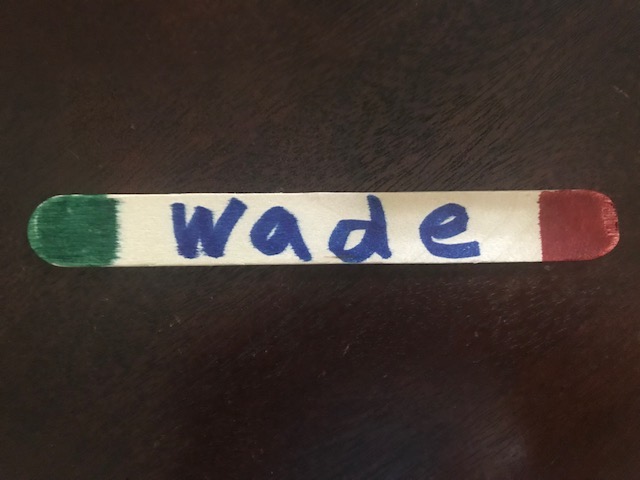
Pick Me! 

Why? choosing random helpers

When? Large group

How? Color one end of a jumbo craft stick green and the other end red. Let each child write their name in the middle of the stick. Place the sticks in a cup with the green end on top. When there is a special job to be done, the teacher chooses a stick. After that child has had a turn, her stick goes back in the cup with the red end on top. When all the sticks are red on top and everyone has had a turn, flip them over and start again.