photo 3am_dj_home_zps919fb85e.png photo 3am_dj_about_zps7cce4c75.png photo 3am_dj_website_zps73051235.png photo 3am_dj_ss_zps6759ec2a.png photo 3am_dj_bs_zps43e27832.png

Tuesday, October 19, 2021

METEROLOGIST OF THE DAY

One of the favorite jobs in my classroom was the "meteorologist."  Each day the weather boy/girl would spin to the weather and we would sing the appropriate word:


Weather Song (Tune: “My Darlin’ Clementine”)

Sunny, sunny, sunny, sunny,
It is sunny in the sky.
S – u – n – n – y Sunny
It is sunny in the sky.
Cloudy…
Rainy…
Windy…
Snowy…

Hint! Insert other words children suggest such as “foggy,” “snowy,” and so forth.
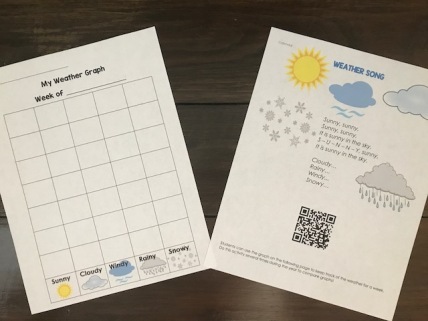

Links to the weather graphs and song:

https://drive.google.com/file/d/12vKwCKjuTAXzMOcZmNSLUjOpFdrfl61W/view?usp=sharing

https://drive.google.com/file/d/16mbrPFgAGXyzuCNtj7MxQKjQ0r_PvY-Z/view?usp=sharing

Weather Words

Write weather words on a language experience chart and point to the letters as you sing.
*Challenge children to come up with synonyms for different types of weather. For example, sunny could be bright, hot, cloudless, etc.


Thermometer
Place a thermometer outside your classroom window so children can learn how to read the calendar and judge appropriate clothing for outdoor play.

                                           
Wind Tester
Make a wind tester by stapling a strip of tissue paper to a straw. Hold it up to see if the wind is blowing. What direction is the wind blowing from?
*How else can you tell if the wind is blowing?


How Can You Find Out?

Brainstorm different ways to find out about the weather. For example, look on-line, look at the newspaper, watch the weather report on television, look out the window, etc. 


Monday, October 18, 2021

CHILDREN COME AND CHILDREN GO

Either in a traditional classroom or online, you will have children move and leave your group or come and join you. These songs and activities are sure to make them feel special.  Sometimes the "little things" that you do can have a huge impact on children and their emotional well being.

Good-Bye Song to Sing When Children Move Away
(Tune: “Good Night, Ladies”)
Good-bye, child’s name.
We’re sad to see you go.

Hint! Make a book for children when they leave.  Let each child draw a picture or use class photos to make the book.


Class Video
Make a video of students saying good-bye and giving the departing child a special wish.


Autograph Shirt
Invite the child who is leaving to bring a large white T-shirt.  Friends can sign their names and draw pictures with permanent markers.


Welcome New Students
Welcome new students by singing their name in this song to the tune of "Good-Night, Ladies."

Welcome, child’s name.
We’re glad you’re in our room.


Name Song  (Tune:  "Where Is Thumbkin?")
Here's a fun twist to a name song to introduce children to their new friend.  
All: Where is Sam?
Where is Kim?
Sam and Kim sing: Here we are. Here we are.
All: How are you today?
Sam and Kim: Very well, we thank you.
All: Run around, then switch spots.
(Sam and Kim run in a circle and switch spots.)


Poster
Cover a table with bulletin board paper.  Put out markers and crayons and invite the class to make a poster for their new classmate.


Special Buddy
Each day assign a student to be a "special buddy" to the new student to help them know what to do, where to go, what the rules are, and so forth.

Sunday, October 17, 2021

"SCARED" OF VOCABULARY

When teaching vocabulary to children, experts suggest using interesting words and building bridges between children’s experiences and words. What a perfect time of year to enrich children’s vocabulary with “spooktacular” and “bootiful” words.
Note! These activities can be used for Halloween words, Thanksgiving words, autumn words, or any unit of study.

Brainstorm
Brainstorm “spooky” words, Halloween words, or other seasonal words. How many words can they come up with? Write them on the board as children call them out.
*Older children could brainstorm as a small group activity.

Dramatize Words
Call out nouns or adjectives like “skeleton,” “mummy,” “spooky,” “haunted,” for the children to dramatize. Encourage them to use their faces, hands, and whole bodies.

Pantomime
Write seasonal words on index cards and put them in a sack. Children choose a word and pantomime while their friends try to guess.


Seasonal Alphabet
Write the letters of the alphabet on a sheet of paper. Can they think of a seasonal word for each letter? Example: A - apples, B – bats, C – candy, D – Dracula…

Picture Words
Challenge children to turn words into pictures they represent.


Grow a Sentence
Write a simple sentence on the board. Can children add words to the sentence to make it grow?
I see a pumpkin.
I see a big pumpkin.
I see a great big enormous pumpkin.
I see a great big orange enormous pumpkin.
I see a great big orange enormous pumpkin on the porch.
I see a great big orange enormous pumpkin on the front porch.
I see a great big orange enormous pumpkin on the front porch smiling….

Build a Pumpkin
This is similar to hangman, but you will be drawing a pumpkin, which is much happier than a noose! Put blanks on the board for the number of letters in a word. As children call out letters write them on the appropriate place on the line. If the letters are not in the word make a “bone pile.” For each letter you put in the bone pile draw part of a jack-o-lantern. Start with the pumpkin shape. Add a stem. Add a mouth, nose, eyes, etc.

Saturday, October 16, 2021

DICTIONARY DAY

Did you know that October 16th is Dictionary Day? It's actually Noah Webster's birthday and a perfect day to let each child make her own personal dictionary. 


Materials: pocket folder, prepared pages with alphabet letters, markers

*Here’s a link where you can download the pages with letters: 

http://www.drjean.org/html/monthly_act/act_2007/02_Feb/pg01.html 


My Personal Dictionary
Ask students to tell you what they know about dictionaries. Brainstorm the many uses of dictionaries. Model looking up words and reading definitions. Explain that each of them will get to create their own dictionary that they can use to help them the rest of the school year. First, let the children decorate the outside of their pocket folder. Insert the alphabet pages. As you add new words to the word wall or have new spelling words, ask the children to write them in their dictionary. These would also be a meaningful way to introduce vocabulary words. Encourage students to use their dictionaries when they write independently.


Hint! You might want to go ahead and type your core sight words on the pages before running them off.

Here are some other activities you can play with their dictionaries.

*Play “mystery word” where you give clues about words.
Can you find a word that starts with /m/ and ends with /d/?
Can you find a word that is the opposite of “fast”?


*Play the “rhyme” game.
Can you find a word that rhymes with “bike”?
Can you find a word that rhymes with “log” and is a pet?

*How many one letter words can you find? How many two letter words? Three letter words?

*Ask children to clap out the syllables in words.

*Can they match up words in their dictionaries with words in the classroom?

*Sort words that refer to people, things we do, describing words, etc.

*Have children find a word that starts with each letter in their name.

*Have children make up sentences (oral or written) with the words.

*Ask children to illustrate words or find magazine pictures that match the words.

*Demonstrate how to use the dictionary on the internet. How is it like their dictionary? How is it different?


SEASONAL DICTIONARY
Add a separate page each month with seasonal and holiday words children might want to use in their stories and journals.

Homework Hint! Let the children take home their dictionaries one night a week and do some of the above activities with their parents.

Friday, October 15, 2021

SCHEMAS AND OUTSIDE PLAY AT SYC

Life is full of surprises, and a beautiful "surprise" happened recently when we moved to Greenville, SC. One of our neighbors invited us for dinner and we were talking about our lives and careers. My neighbor mentioned that her daughter worked at a "mostly outdoor" school in Ohio, and we were immediately connected!

I want you to meet her daughter, Dawn Nauman, because what she is doing is exciting, and inspirational, and an endorsement of what early childhood education should be!

Drum roll.....Here's Dawn from the School for Young Children in Columbus, Ohio!


Children thrive on repetition. In the twos classroom, we sing the same song every time we meet, we might read the same book ten times in a row. In the threes, a child might always play with the trains to start the day, or always may be at the playdough table. A child in the fours might need the exact bike they want and a few spins around the playground to get started. Classroom schedules are comfortable repetitious time periods where kids learn to know what to expect and to understand boundaries. Familiar toys, familiar peers and familiar play themes, all those repetitious acts make up play in early childhood. And play is how kids learn. So how does taking a familiar program and becoming intentionally outside during a pandemic feed a child’s need for repetition and learning? It takes it up a notch, in an extremely valuable way.

I remember being at a play-based conference session with the SYC staff a few years ago where a facilitator described a childhood of roaming natural landscapes with her peers and playing in creeks, woods, and fields without a “toy” in sight. She talked about her play-based center which she focuses on loose parts and outdoor time and how that fits into the schemas of childhood. This year I’ve been thinking back to that conference, and that session, and the concept of schemas in early childhood and how the schemas haven’t changed with a change in plans and location but how they have been practiced in some ways in a richer environment. If you aren’t familiar with schemas, there’s a great article on tinkergarten.com. They describe schema as “repeatable behavior … that you can notice in your child's play during early childhood. No matter where you are in the world, these same schemas are exhibited by kids. Experts believe that when kids repeat these patterns in different situations, kids develop physically and cognitively. In turn, they are better able to understand, navigate and interact with their worlds, resulting in transformative learning.” https://tinkergarten.com/skills/behavioral-schema

This year at SYC, repeating patterns in different situations is the name of the game due to so much time with outdoor learning. Think schema combined with problem solving on the fly every day. Kids have the opportunities laid out before them to assess, take a risk, practice their ideas and take time to work them out. When they want to transport something from one side of the playground to another in the fall, they use a wagon or wheelbarrow (or as one of our kids calls it, a wheelie barrel). In the winter they moved loose parts with sleds. If a kid in the morning fours class always plays on the climber, but one day finds it awfully slippery, they might tape it off and put out signs for the next class. (These kids take their repetitive behavior/ problem solving skills with a side of practical literacy). While we can afford many opportunities for children to experience these same patterns in an indoor classroom, changes in natural settings create wonder, unexpected challenges and rewards for those who experience them.

The common behavioral schema in childhood are:

Transporting


Rotation/Circulation


Trajectory

Positioning

Enveloping/Enclosing


Connecting


Transforming


Pandemic SYC is still rooted in supporting social and emotional growth in children. Being outside provides opportunities for kids to build self confidence each time they assume the challenge of dressing for the elements (and undressing for toileting). They learn caution and to trust their judgement on slippery or muddy surfaces. They learn flexibility when a play area changes with the elements and adjustments need to be made to their play ideas. They learn to use their voice when they need help negotiating changes. Community is built in an expansive space that provides room for everyone to join in. Ultimately, teachers recognize that the social and emotional work we do with children has not changed as the play area has expanded, however the opportunities for that work has. We see the same struggles and growth with communicating with peers, setting limits and articulating needs that we see in a largely indoor environment replayed outside. However, this year, the outside has become the added teacher with challenges and rewards abundant for every child.


Did Dawn spark your interest?  You can email her Dawn@syccolumbus.org.

Thursday, October 14, 2021

MIND MAPPING MATH

Graphic organizers (aka mind maps) are a visual way of putting information in the brain. Graphic organizers are frequently used in reading, but they can also be used to reinforce math skills and help children understand how things fit together. Here are three good reasons to give them a try:
     1. They encourage children to “think outside the box.”
     2. They are much more open-ended and challenging than a worksheet.
     3. They can be done independently or with a partner or small group.

Some common graphic organizers used in the classroom include the attribute web, Venn diagram, T-chart, and tic-tac-toe frame. First, I would model using the graphic organizer with a large group, and then I would assign it for an independent or center activity.

Hint! After completing a graphic organizer invite children to explain what they did. This will enable you to “understand” their thinking process and will help make learning more meaningful. (Remember, writing and talking are two powerful ways to store things in the brain!)

Attribute Web
Have children write a numeral in the middle and then web different ways to represent that number.


Venn Diagram
Write numbers made with a straight line on the left, numbers made from curves on the right, and numbers made from lines and curves in the middle.


*Put a number in the middle. Write numbers larger on the left and smaller on the right.


T-Chart
Write odd numbers on the left and even numbers on the right.
Write “tens” on the left and “ones” on the right.


Tic-Tac-Toe
Write a number in the middle and facts that equal that number in the other sections.

Write “10” in the middle and other teen numbers around it.

Can you think of other ways to turn mind maps into math maps?

Wednesday, October 13, 2021

MORE, LESS, EQUAL

More?  Less?  Equal?

Divide children into partners and give them manipulatives and a sack with three index cards on which you have written “greater than,” “less than,” and “equal.” One child makes a set with the manipulatives. The second child draws a card from the bag and then makes a set according to the directions on the card.


Squish
SQUISH is a similar game that can be played with play dough. One child squishes the dough and makes a set. The second child selects a card and then must squish the play dough to make a set “greater,” “less than,” or “equal.”


Dealer’s Choice
Remove the face cards from a deck of playing cards. Draw three sections on a sheet of construction paper and write “high,” “low,” and “equal.” Children turn over two cards at a time and place the cards in the appropriate pile.

*This is a fun game to play with a friend.


The Price Is Right!
Cut pictures of items from a toy catalog or flyer. Cover up the price. Let children estimate how much each item costs. Show the actual value and determine who guessed more, less, or the closest amount.


Paper Clip

Make a number line on a sentence strip. Use a paper clip to slide to different numbers and the children can see what comes before and after.


Counting on a Shoestring
Write numerals 0-20 on a cotton shoestring with a permanent marker. Insert a bead. Children move the bead as they count. They can clearly see what is one more and one less.