photo 3am_dj_home_zps919fb85e.png photo 3am_dj_about_zps7cce4c75.png photo 3am_dj_website_zps73051235.png photo 3am_dj_ss_zps6759ec2a.png photo 3am_dj_bs_zps43e27832.png
Showing posts with label Coronavirus Holiday. Show all posts

Wednesday, May 6, 2020

HOME SCHOOL SURVIVAL KIT

Several weeks ago Toni Mullins (aka Teacher Toni) contacted me about a special project she was working on.  She GENEROUSLY offered to share tips for teaching children at home, as well as her FANTASTIC book full practical ideas.  We have to remember that we are trained educators, but most parents don't have some of these skills. I'll let Toni tell you a little more about it...


Post Promise: In this post you will find my TOP FIVE tips for how to manage teaching your K-2 child at home. If you haven’t implemented these ideas, they have the power to transform your home-school experience. Don’t miss the FREE Home-School Survival Kit included below that can help you implement these ideas as soon as today.
I won’t waste your time talking about all of the chaos right now, (we are all getting our fill of that on social media). Instead I am here to provide you, with some my most essential advice for helping our students learn during this unprecedented time. As a Kindergarten teacher, I’ve dug deep into my own practice and pulled out the most essential concepts that I use each day to handle my job. Specifically, these tips are for Primary Students (grades Kindergarten, First and Second) and should help you find some stability, peace and even enjoyment in your new role as a child’s main source of Education.

Empowerment & Joy
In a World filled with uncertainty, one idea stands true and enduring: growth and learning are the key to happiness. Anything that does not grow is essentially dead. Our minds are constantly shifting, learning and re-creating knowledge and this stimulating process is proof that we are indeed, alive.
Now, I want you to think of the child (or children) who you are now charged with home-schooling. They, as a budding flower, are in the most essential time-frame in their educational experience. There is no time more important than now to instill a love of learning in your little one. You have been provided a unique opportunity to impact a child (maybe your own child) in ways no other era has been able to. This is your chance to take on a new, vital role that you can be proud of.
Let me assure you of this: there is a unique sense of joy that can be found in teaching that drives millions of people to this career. Search for that feeling and let it drive you. I know this may not be your thing but you’ll drown in the trenches if you don’t find happiness in this journey. Our students can sense our feelings and often respond to it in that manner. So, your job is to find some joy in what you are doing with your child. I hope these five tips can assist you in this process.  

Tip #1: Create a Schedule, but keep it flexible.
Routines make us feel safe and productive.  We all need something repetitive and normal in our day to make us feel in control of something, and this even more true for our children. Our kids need the security of a daily schedule.   If you haven’t already, don’t wait another day; make a daily schedule for your child and use it consistently. This doesn’t have to be time-slotted or fancy, it just needs to exist.
When you begin this schedule and do it consistently (just as we do in the classroom), you’ll see many benefits, such as:

-Less resistance to tasks
-More engagement
-Mood improvement
-Quicker transitions between tasks
-More free-time (you’ll finish things at a quicker pace.)

Keep it Flexible. In the classroom, I’m a stickler when it comes to my daily schedule. I have a set amount of time for each activity and any interruptions can reap havoc on my plan. Your day doesn’t have to be this way though. Don’t let the schedule stress you out! Instead, use it as a loose guide to what needs to be accomplished. Time frames aren’t important, only the tasks that need to be completed are.
To help you, I have created a FREE Daily Schedule Card system that you can use with your child. These are perfect for Primary students because they have picture cues for our non-readers.  There are 36 cards included and there are also editable cards in case you need more.  
To use this flexible system:
-Print out your needed cards. (Edit those that may need it.)
-Place on a ring or on display. At the beginning of each day (depending on your needs) rearrange, add or take away cards to accommodate your goals. Flip each card as it is completed as to mark off that task for the day. (My own daughters like to flip their cards after completing tasks, sort of like a challenge.)
 

Tip #2: Create Designated Learning Areas

Teachers are masters of creating meaningful learning spaces. As a new home-school teacher it is important for you to know that your child is accustomed to having specific learning areas at school. You don’t need a full classroom to achieve this, but you do need to be thoughtful about how you choose and organize the spaces your child will be using to do school-related work and activities.
An ideal learning area should:
-Be quiet and free of distractions. Turn off the TV, put technology out of sight and close a door to prevent excess noises.
-Be organized with supplies at hand. Looking for a pencil in the middle of a teaching session can be detrimental, trust me. I have included a free set of home-school supply labels to help with this step in the Home-School Survival Kit.
-Have visual cues to segment learning areas. Most classroom teachers use signs to label and organize various learning areas. These serve as a visual cue for students to understand that area’s purpose. You can do this at home to, to help your child understand what each area in your home is going to be used for. I have included an array of signs in the free download that you can use for this purpose.

Tip #3: Use a Behavior Management Plan
I’ve seen numerous posts from parents frustrated with their child’s behavior during their home-school work. “How do teachers deal with this?” you might ask. Well, not all Teachers are good with behavior management, but the ones who are have a great plan in place. If your child lacks focus, attention and makes you want to seek early-retirement from this home-school gig- you NEED a behavior management plan. Don’t think your home discipline is equivalent to school discipline- we teachers use tricks of the trade to keep your child engaged.
My best advice for this section is to find what works for your child. No plan fits all students (or the Teacher), it just isn’t that easy. What I do suggest is a positive behavior system. This is a system that commends positive behaviors rather than focusing on negative ones. Most parents naturally discipline in a way that corrects their child’s mistakes- but in the classroom most Teachers agree that encouraging and recognizing positive behaviors is most effective.
In today’s download, I am sharing my favorite positive behavior tool. In my classroom, I use a wide plethora of tricks, games and incentives to keep my students engaged and under control- but what I’ve found works best is a “Sticker Card” system.
It works like this:
-Each student is provided a blank sticker card.
-Before beginning, I explain the rules and emphasize their importance. (Don’t skip this step, it is VITAL to this system.)
-When they exhibit positive behaviors, students earn stickers on their card. (Alternatively, you can just put a smiley face in marker.)
-When the card is filled, they get a pre-determined prize. You can also track the number of cards filled and have a bigger reward when your student reaches that long-term goal.
I have included this system, complete with editable rules, pro-tips and sticker card templates in the Home-School Survival Kit included below.

Tip #4: Utilize Brain Breaks
During your at-home learning, don’t fail to give your child a proper amount of cognitive breaks (we call them brain-breaks in the classroom.) This may sound like a waste of time, but trust my years of experience with working with young children- they have to have breaks between learning tasks. It is for their sanity and yours too.
What is a brain break? It is a short (less than five minutes) break placed between learning tasks to give students a mental transition and opportunity to rest their cognition. In the classroom, this can be singing a song, doing a quick dance or even a couple minutes of physical exercise. Without this break, our students can lack focus and mental clarity on the next task at hand.
To use them effectively, plan them strategically as a transition between two different tasks or after a certain amount of work is completed. In my Kindergarten classroom, I give my students scheduled breaks after about 20-25 minutes of instructional time. You can increase or decrease this time depending on the child’s age.
In the free download you’ll find a compilation of my most adored Dr. Jean brain breaks. Just open this on a laptop or device and you’ll have a library of brain breaks that your child will love! I have also included several “Brain Break” schedule cards in the download to help you mark the times when this is most appropriate.

Tip #5: Schedule Screen Time
Have you ever had a day of Facebook binging and felt like a big, lackluster blob afterwards? It is because our screens drain our brains of engagement and focus. This isn’t productive or helpful time and leaves us feeling what I can only describe as “disoriented.” Can’t we decide that long, unmarked periods of useless technology time could be ever-more damaging to our children? Yes! This is one of the many reasons we need to limit screen time during these long days at home.  
Years of research have proven that too much technology use can be damaging to their brains, but technology time can also be ruining your learning goals for the day. If your child is only focused on when they can get more tech-time, whines when you put away the iPad and is lackluster during all of your work time together- you need to limit and schedule their screen time. This may be a daunting task if your child is accustomed to technology freedom, but after a week or so of intentional technology time- you’ll see the benefits.  
Be very thoughtful about when and how long your child is spending on their technology each day. My top recommendations here are:
-No free-play screen time during the instructional day. They’ll either rush through tasks to get to their screen time or be resilient and annoyed when having to separate from their screen time to do another task.
-Don’t replace play time with screens. Play is the work of children; they need real play time to stimulate their brains and form new knowledge. Technology time and play time should be two separate areas in their day. There should be no exceptions to this rule.
-Embrace their boredom. Don’t feel guilty when your child is bored and in turn provide them technology as a distraction. From boredom flows ideas and creativity- concepts every child will need in their life to achieve anything. Think of meaningless technology instead as an enemy to these concepts, a barrier that could prevent your child from learning real-world concepts. This should make it easier when they meet you with defiance about new technology limits. This is what’s best for them, whether they realize it or not.

Get your FREE Home-School Survival Kit Here!
I hope these tricks-of-the-trade will help you find new joy in your home-school experience. You can download your free Home-School Survival Kit with all of these mentioned resources here.

Saturday, April 11, 2020

RECYCLED PLASTIC EGGS

I know your kids haven't even hunted for these eggs yet, but there are tons of learning activities that you can do with them at home next week.  

P.S.  Here's a video I did a few years ago where I demonstrate how to recycle the plastic eggs..

https://youtu.be/reJQsv0H5oM


Reading Games
Write an upper case letter on one half with a permanent marker and the lower case letter on the other half.


Give children small pictures of objects to put into appropriate eggs.

Put antonyms on eggs for children to match.
                 
Write synonyms on eggs.

Write two letter words on eggs. Children make words and then read them. Can they use the word in a sentence?


Write onsets (consonants or blends) on one half and rimes (word endings) on the other half. Children twist around and read words. You could also ask children to write the words.


Make puzzles of sight words and put them in the eggs. Children put the letters together, read the word, and then write the word.


Make puzzles of simple sentences and challenge children to put the words together and read the sentence.
                                 

Math
Write numerals or number words on the eggs. Children fill with the appropriate amount of beans or paper clips.

Children match up dots or number words with numerals.

Place a certain number of small objects in the eggs (2-10). Children dump out the objects and then write all the combinations they can make.

Give children a variety of objects. Ask them to predict if each object will fit in an egg or if is too big. Sort the objects after testing if they will fit.
                                                 

Reinforce place value by writing numerals 1-9 on the eggs. Children put the eggs together and then say the numeral.


Science
Let children draw pictures of all the animals that come from eggs.

Place objects in the eggs, such as popcorn kernels, cotton balls, bells, etc. Children shake the eggs and predict what is inside.
*Make two eggs with like objects for children to match the sounds.

Musical Instrument
Put dried beans in the eggs and tape to a plastic spoon to make maracas.
                           

Yummy Snack
Put small crackers, raisins, cereal, grapes, or other healthy snacks in the eggs.


Sand and Water
Place eggs in a water table or sand box for pouring and measuring.

Thursday, April 9, 2020

HOME TEACHING GRID

Friends, I hope you can join me today 
at 10 for Facebook Live.
 I'm doing "Little Lessons for Online Learning."
(Simple things that you or families can do with their children.)

Carolyn Kisloski and I have created several packets with monthly "Happies," centers ideas, science units, etc.  Carolyn is not only my friend, she's a gifted teacher and writer!  Find information here.


You are going to be THRILLED with these FREE HOME TEACHING CALENDARS that she is making.  They are going to save you a TON of time and they are going to be so MEANINGFUL to your children and families.  Every day there is a reading, writing, phonics, math, science activity with links to the songs and projects.  There's even "specials" every day for art, PE, etc.  If I were a teacher or a parent I would be so grateful to have something like this.


I'll let her tell you a little more about them...

Oh my goodness OF COURSE you can share the grids!  I can send you my new one each week to share, too! 
Here is how I use the grids:

I wanted to have all of the subject areas and everything parents would need for one week in one spot for easy access.  I made a grid with a lesson for each subject for each day.  I included a link to a song or story if needed.  I post the grid on Sunday night and then again on Wednesday, so parents can complete the activities with their child on their schedule, since every family is doing their best and has very different schedules.  If they print the grid, the child can color in a square when an activity is completed so they can see how much they get done in the week!  Each week I will put in new activities, links, and extra pages.  Another nice thing about this is that all children need to complete these activities is paper or a journal to write in.

                               
LETTER TALES (Tune: "Gilligan's Island")

This is one of my favorite alphabet books that Barb Smith created several years ago. It's good for letter recognition, phonics, and visual closure (recognizing the whole from the part).


Here’s a YouTube video of this song:


P.S.  I is inchworm and N is nanny goat.

Sunday, April 5, 2020

SUNNY NEWS SUNDAY!

Today's blog will be a bit different because I've had so many requests for information about helping children cope and understand what's going on in the world right now.

First, I'd like to share a new video that Alex May (my webmaster extraordinaire) made for a song called "Color Train." A teacher wanted a video of the song to help her students learn to spell the color words and so Alex kindly created this:


I've been amazed by some of your beautiful expressions and the outpouring of love to your children.  I wish I'd thought of this one!


This a video that Osseo Fairchild Elementary School in Wisconsin created for their students. It brought tears to my eyes. Don't you know that some of their kids will watch it hundreds of times? Every time they are sad or lonely they have a "place" to go visit their friends and teachers.


I was also touched by this letter that Dawn Willis (Coles Ferry Elementary, Lebanon, TN) sent to her children.


Here's a video that Katie Mac from the Story Shack made to help children understand what's going on and why they can't go to school.

               
https://youtu.be/NHpzWpxAURc


COVID-19 Coronavirus Pandemic: Considerations for Early Childhood Professionals
This edwebinar sounded very interesting. Even though it was presented a week ago you should be able to view the recording. 


Tuesday, March 24, 2020 @ 2:00 pm - 3:00 pm EDT

Presented by Andrew Roszak, J.D., M.P.A., EMT-Paramedic, Executive Director, Institute for Childhood Preparedness

WATCH THE EDWEBINAR RECORDING


And finally, here's my "Coronavirus Avengers" video I made for kids several weeks ago that some of you might have already seen. Not very professional, but created out of love!


Saturday, April 4, 2020

HOME LEARNING WITH SEESAW


This is a post from my good friend Betsy Cruz.  I met her over a year ago at the SCKA Conference and she told me a little bit about Seesaw.  It's almost too good to be true.  Oh, yeah, and it's FREEEEEE! 
Seesaw The Learning Journal is a free app, available on all platforms, that allows students to share their learning in creative ways. Students can show what they know with photos, drawings, audio or video recordings, notes, and links to projects, all of which are compiled in a digital portfolio. My students use it frequently in many ways. They take photos of their writing and record their voices reading it, record themselves explaining how they solve a math problem, take a picture of a leaf they found and use drawing tools to label it, etc.


Now, as my school has gone to remote learning, I have turned to my old friend, Seesaw, to reach out to students at their homes. Seesaw made their class app available for home learning, (with private home learning codes), and Seesaw offers wonderful remote learning resources. https://web.seesaw.me/remote-learning. In addition to student generated projects, Seesaw also allows teachers to create and assign activities with specific tasks for their students. Teachers can share activities to the extensive Seesaw Library, which all teachers can access to find and assign activities to students.

Knowing that my school was going to distance learning, I thought it was time that I started creating activities for my students, and to share with other teachers. I knew students would be using much more technology than might be best for little ones. So, I wanted to create some activities that combined technology with the philosophy of Dr. Jean activities, which
emphasize hands-on, real experiences, language, music, art, developing social skills, etc. (I could go on and on!)

I have made several activities, using Dr. Jean as inspiration. They are based on Dr. Jean songs, finger plays, or blog ideas. For the student task, I tried to create multiple options, such as draw a picture, write about it, record thoughts and knowledge, etc.

In “Coronavirus Avengers”, students watch Dr. Jean’s video, take a selfie and use drawing tools to make themselves Coronavirus Avengers. They also have the option to draw what they think coronavirus looks like.


https://app.seesaw.me/#/activities/library?profile=pub.person.684f8024-6991-4770-820f-035208495ed6&promptId=prompt.6c1f7e19-6c43-4512-b7e2-c14ed152dcef

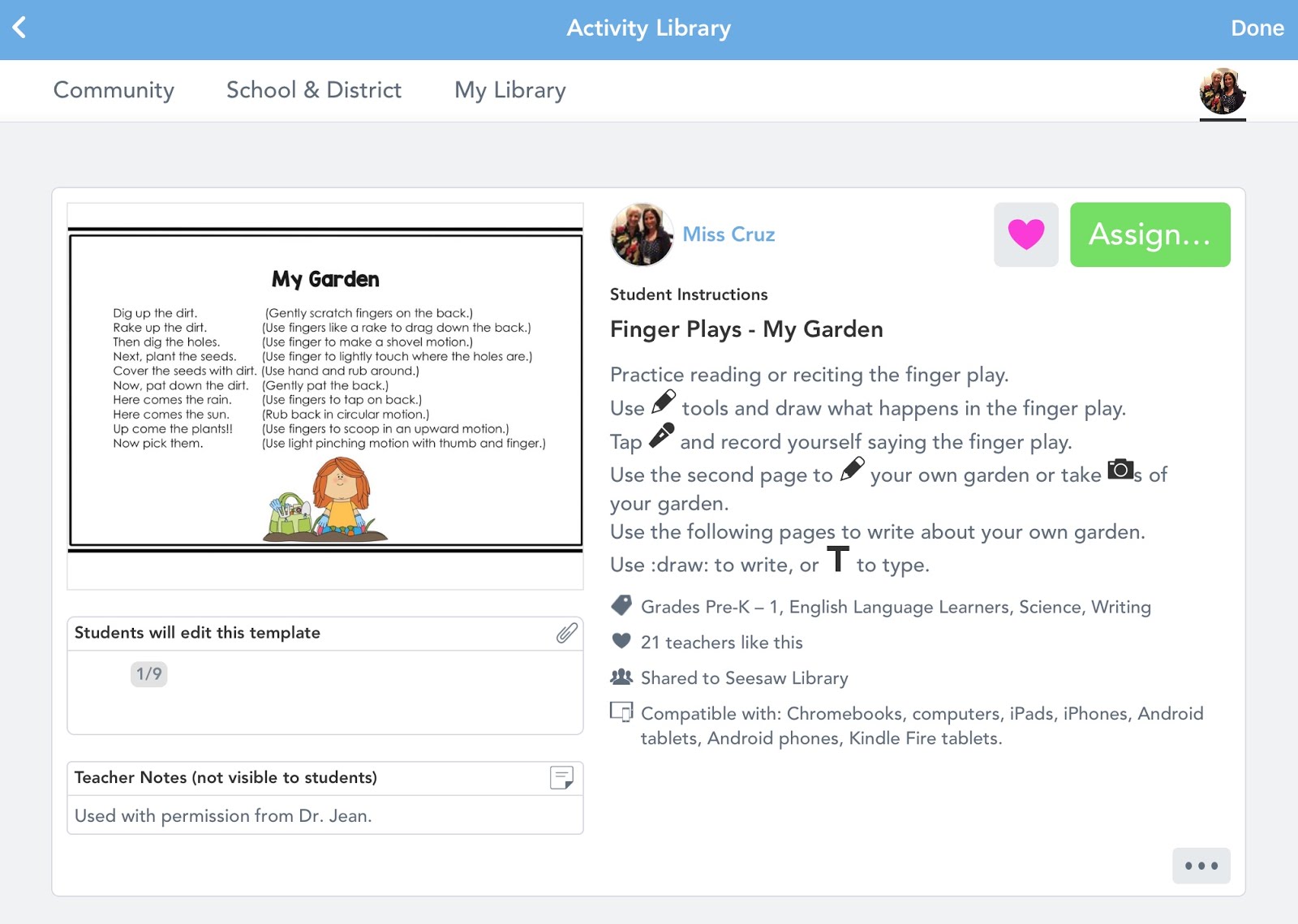
In “Finger Plays – My Garden” students record themselves reciting the finger play, have the option to draw their own garden or take a photo of their garden at home, and then write about their garden. Teaching these finger plays during a circle time video chat is a tip I just learned from Dr. Jean!


https://app.seesaw.me/#/activities/library?profile=pub.person.684f8024-6991-4770-820f-035208495ed6&promptId=prompt.e20ebb0a-33bf-4657-aa15-f8d180c88b02

“Spring – O” gives students a board with pictures of signs of Spring that students mark with a drawing tool as they find them. Then they have the option on pages that follow to take photos or draw pictures of what they found. They can also write about or record their voices talking about what they found. 


https://app.seesaw.me/#/activities/library?profile=pub.person.684f8024-6991-4770-820f-035208495ed6&promptId=prompt.4c443a8d-307b-4feb-ac40-64ad52bc2975

In times like these, I am very grateful to be able to collaborate with educators around the world. Seesaw and Dr. Jean have been a great part of that. You can sign up for Seesaw at web.seesaw.me or by clicking “try” from one of my activities.


Friday, April 3, 2020

CALMING CONNECTIONS

If you missed my "LITTLE LESSONS FOR ONLINE LEARNING"
FB LIVE YESTERDAY YOU CAN CHECK IT OUT TODAY

bit.ly/drjeanLittleLessons

Today I'm thrilled to share some positive strategies from my friend Barbara Gruener for STAYING CALM!!!


Raise your hand if you’re feeling a little bit frazzled by the frantic and somewhat chaotic changes that this pandemic is causing. Okay, maybe a lot. How about frightened? Irritable? Angry? Sad? Agitated? Confused? Our list of emotions could go on and on as evidenced by this Emotions Wheel from the work of psychologist Rubin Plutchik. 


Good news; it’s completely normal to be a twisted bundle of emotions right now. Use that wheel to learn more about your own feelings to help the children in your care understand, accept, navigate and manage theirs during the shelter-in-place mandate that has temporarily closed our schools, cancelled events, and demanded we stay home unless it’s essential travel.

Let’s look at some ways that we can comfort ourselves and calm our children during these trying times of uncertainty, unrest and turbulence.

1. Put your own mask on first. As soon as I typed the word turbulence, I thought immediately of that counterintuitive request that the airlines make, to put our own oxygen masks on before helping the young children traveling with us. This metaphor for life speaks volumes to me, because children take their lead from the adults that co-regulate them. If we want calm from them, then we need first and foremost to model calm. How does that look, sound, and feel right now? Maybe it’s deep breathing or the practice of mindfulness. Maybe it’s meditative coloring. Perhaps it’s listening to soothing music. It might even be dancing or escaping in video games. Whatever the medium, we set the example through a time-honored tradition called Show And Tell. Start by showing them what self-regulation looks like, then explain to them why it’s important for all of us. Modeling self-care works the same way. Show your children that self-care isn’t selfish and tell them that it’s not meant to be a reactive luxury, but instead a proactive necessity.

2. Name ‘em and claim ‘em. These days inside with our loved ones may get tricky; never before in our lifetime have we gotten to go through something like this. Expect those aforementioned feelings to get raw and uncomfortable. Model owning those feelings by naming them and claiming them: Mommy feels really sad right now; what do you think might help her as she walks through this big feeling? Or Daddy is really frustrated at the moment; maybe some recess would help his brain process this feeling before we continue. Our children benefit greatly from knowing that all feelings matter and that these feelings all visit their grown-ups, too. Use a kid-friendly feelings chart so that your children can put faces with their feelings. Come to my office and you’ll find the ceiling tiles have been replaced with feeling tiles, to give children the vocabulary to express what they’re experiencing.


Be careful not to label emotions as good or bad; instead, try thinking about them as big or small, easy or hard, comfortable or uncomfortable, weak or strong even. Need something more tangible? Try labeling them as cotton (soft) or sandpaper scratchy). Know that if we are not given a safe place to emote, unexpressed feelings can easily become undesirable behaviors.

3. Lean in and lean on. Ok, so I’ve named it and claimed it; now what do I do with it? Our knee-jerk reaction to an uncomfortable feeling might be to ignore it or to run away from it. But chances are good that it’s not going away. In fact, not only will it find you again, but often times when it does, it’s even bigger and stronger than before. Encourage your littles to lean in to their feelings (and the discomfort they might bring) and lean on you to walk them through it. It might go something like this: Sarah, it looks like you’re really sad that you can’t play with Jímena right now. I’m really sad, too, because we can’t see Grandma and Grandpa right now either. What do you think we could do together while sad is choosing us? Use an inquiry statement here rather than a suggestion to help avoid the temptation to fix the feeling for them. Nothing’s broken; they just need time to let the emotion of the moment run its course. As you teach them to lean into the pain and lean on a trusted peer or adult for support, you’re empowering them to process their feelings on their terms, in a way which is helpful for them. While you’re working together through using the strategy that they find helpful, feel free to share what might work for you, to give them yet another tool for their emotional-regulation toolbox.

4. Use empathy statement to normalize and validate. Researcher and author Brené Brown says that the skill of empathy is a powerful catalyst simply by “… listening, holding space, emotionally connecting and communicating that incredibly healing message of ‘You’re not alone.’” Empathy begins with understanding what someone is feeling. Imagine the emotion beneath their experience. If you can, ask them what they’re feeling, to check it out. From cognition, empathy then moves to embracing those needs and feeling moved to alleviate their suffering, the affective domain known as compassion. Then, a chance to walk the talk, to show kindness, to let people know we see them, hear them, understand them, feel with them, and want to help. So rather than asking someone to stop crying, fussing at them to quit being so mad or insisting that there’s nothing to be scared about, try empathy statements like this: I hear you. Tell me more. Help me understand. I get it. That must feel scary. What’s the trickiest part? What might help you right now? Who could help you? How can I help? Step into their stories and walk alongside of them. When words fail, encourage them to draw it out or act it out for you. Got the angries? Try a few of these mindfulness strategies.

5. Connect with consistency. We all crave connection, probably now more than ever; I know that when our adult son came by yesterday, it was physically and emotionally painful to not wrap him up in one of our usual bear hugs. But distancing physically doesn’t keep us from connecting spiritually. Never underestimate the power of virtual (and real-life) connection catalysts like these:

  *Eye contact. Smiles. Sign Language.
  *Heart-to-heart phone calls. Texts. Emails.
  * Zoom. FaceTime. Google Hangouts.
  *Hand-drawn pictures. Love Letters for Grandfriends.
  * Thank-you notes for the people who serve.
  *Meditation and prayer. Yoga. Mindful breathing.
  *Chalk the walk for passersby.
  * Bear hunts and/or scavenger hunts.
  *Dance parties. Music lessons; ukulele anyone?
  *Create kindness from the kitchen.

Remember that children also crave consistency, so set some for-now normal routines and habits. Hold a family or class meeting to decide how your morning ritual will look. Check in every so often to make sure it’s working for everyone. Look at your schedule to see when it’ll work best to break for snacks and meals. Close the books and take some virtual field trips. Pencil in brain breaks and boosts. Allow for some down time to restore the rhythm of rest. Block off intentional time (think recess!) for meaningful movement and socializing. Look at your evening routines and tuck-in time traditions. The more predictable your schedule can be, the calmer it will feel for the littles in your care.

6. Reframe for the win. Keeping a growth mindset through all of these firsts will feel like a huge win-win. Instead of looking at it as We’re stuck at home for another month, try thinking we get to stay home for now. Turn but We can’t see our friends into let’s look for creative ways to get together virtually. Help This is too hard for me morph into Who can help me to understand it a little bit better? Rather than I’m just not cut out for this stay-at-home thing, think I’m getting better every day. Let I can’t control this become But I can control this. Continue to calmly reassure everyone that this is temporary. Breathe. Be a little kinder. Lavish grace without limits. Apologize. Forgive. Love unconditionally.

You’ve got this, dear caregivers, and when it’s over (and it will eventually end!), you’ll take the lessons we’re learning together with you into the future as you continue to foster calming connections that keep everyone feeling happily safe and secure. 


About the author: In her 36th year of growing alongside students, staff, and stakeholders in Texas, Barbara Gruener, B.S., M.S., M.S., is a nationally-recognized school counselor, a speaker and The Corner on Character blog and What's Under Your Cape? SUPERHEROES of the Character Kind.

Attachments area