photo 3am_dj_home_zps919fb85e.png photo 3am_dj_about_zps7cce4c75.png photo 3am_dj_website_zps73051235.png photo 3am_dj_ss_zps6759ec2a.png photo 3am_dj_bs_zps43e27832.png
Showing posts with label Conferences. Show all posts

Friday, September 27, 2024

PARENT CONFERENCES

Whenever your parent conferences are scheduled, I've got tips to make it a positive experience for you and your families. I used to dread conferences because many of the parents didn’t want to talk about their child. They wanted to talk about the neighbor’s kid or their “ex” or whatever. Once I started using this questionnaire my conferences became much more meaningful for me and the parents.

A week before conferences I’d ask the children, “Would you like me to give your parents some homework? Well, here is something they need to fill out and bring to our conference next week.”

Note! If parents show up without the form, simply smile and say, “I’ll give you a few minutes to fill this out before we get started.”

CONFERENCE QUESTIONNAIRE

Please fill out this form and bring it to your conference on __________________at _________________.

Child’s name__________________________

1. My child’s favorite activity at school is________________

2. My child expresses concern about_____________________

3. My child’s strong qualities are__________________________

4. Areas I feel my child needs to work on are_____________

5. Something I would like to see my child do at school is _______

6. Is there any special information about your child that you think we should know about?


Cheers and Goals

Here’s another idea for conference time. Ask parents to write down three things positive (cheers) about their child and three goals that they have for their child. This will give the teacher insight as to what is important to parents. It will also provide the teacher with the opportunity to say, “This is what I can do at school to help your child accomplish these goals. What can you do to help at home?”


Student Led Conferences
I must admit I never did these, but many schools are now using this approach and find if very successful. You can find videos and other useful information about student led conferences on the internet.

Conference Tips
Sit beside the parent at a table, rather than behind a desk.

Keep the conversation focused on the child.

Have samples of the child’s work to share with the parents. Focus on the total child, including intellectual, physical, social, and emotional development.

If there is a problem, brainstorm solutions and develop a plan for action.

End the conference on a positive note by reassuring the parents and thanking them for their support.

Provide an interpreter for parents who do not speak English.

Follow-up with the parents after the conference.

Wednesday, September 13, 2023

LET'S HAVE A CONFERENCE

Ready or not, it will be time for parent conferences before you know it! I used to dread conferences because many of the parents didn’t want to talk about their child. They wanted to talk about the neighbor’s kid or their “ex” or whatever. Once I started using this questionnaire my conferences became much more meaningful for me and for the parents.
A week before conferences I’d ask the children, “Would you like me to give your parents some homework? Well, here is something they need to fill out and bring to our conference next week.”

Note! If parents show up without the form, simply smile and say, “I’ll give you a few minutes to fill this out before we get started.”

CONFERENCE QUESTIONNAIRE


Please fill out this form and bring it to your conference on __________________at _________________.

Child’s name__________________________

1. My child’s favorite activity at school is________________

2. My child expresses concern about_____________________

3. My child’s strong qualities are__________________________

4. Areas I feel my child needs to work on are_____________

5. Something I would like to see my child do at school is _______

6. Is there any special information about your child that you think we should know about?

https://drive.google.com/file/d/0B1SnEagA4jljYWFnNXNybFdyZVE/view?usp=sharing


Cheers and Goals
Here’s another idea for conference time. Ask parents to write down three things positive (cheers) about their child and three goals that they have for their child. This will give the teacher insight as to what is important to parents. It will also provide the teacher with the opportunity to say, “This is what I can do at school to help your child accomplish these goals. What can you do to help at home?”

Student Led Conferences
I must admit I never did these, but many schools are now using this approach and find if very successful. You can find videos and other useful information about student led conferences on the internet.


Conference Tips
Sit beside the parent at a table, rather than behind a desk.

Keep the conversation focused on the child.

Have samples of the child’s work to share with the parents. Focus on the total child, including intellectual, physical, social, and emotional development.

If there is a problem, brainstorm solutions and develop a plan for action.

End the conference on a positive note by reassuring the parents and thanking them for their support.

Provide an interpreter for parents who do not speak English.

Follow-up with the parents after the conference.

Wednesday, November 9, 2022

CHORES FOR KIDS

It can be a "chore" to get children to do chores, but housekeeping jobs help children feel "worthy" and a valuable part of the family unit.  Chores can also be a powerful way to develop "task initiation and task completion" (aka the executive function).


Parent Conferences
One teacher explained that when she had parent conferences she emphasized the importance of having children do chores and take responsibility for helping their family. There are several good websites with ideas for chores children can do:

www.webmd.com/parenting/features/chores-for-children


www.focusonthefamily.com/...kids-to.../age-appropriate-chores

parenting.blogs.nytimes.com/.../age-appropriate-chores-for-children      

We often “assume” that children know how to do a task and then we get frustrated when they don’t do it correctly. That’s why it’s important to model expectations and demonstrate specific steps. Here's an activity that would be perfect for a learning center or housekeeping area.

Setting the Table
Bring in some plastic plates, utensils, and cups and demonstrate how to set the table. You might want to trace around the items on a paper placemat so the children can match one to one.


Training Tools
Go to the dollar store and purchase a dustpan, broom, duster, etc. Demonstrate how to use these and then invite children to help you keep the classroom clean.

*These are perfect props for your dramatic play center

Teeny Tiny Duties
Let children share the chores that they have at home. Make a list of these tasks on the board. Ask children to choose three or four that they could do to help at home and make a job chart. Tell them to hang it on the refrigerator and keep track for a week. Demonstrate how to make a check mark each day when they complete the task.


Friday, September 9, 2022

LET'S HAVE A CONFERENCE

Ready or not, it will be time for parent conferences before you know it! I used to dread conferences because many of the parents didn’t want to talk about their child. They wanted to talk about the neighbor’s kid or their “ex” or whatever. Once I started using this questionnaire my conferences became much more meaningful for me and for the parents.

A week before conferences I’d ask the children, “Would you like me to give your parents some homework? Well, here is something they need to fill out and bring to our conference next week.”

Note! If parents show up without the form, simply smile and say, “I’ll give you a few minutes to fill this out before we get started.”

CONFERENCE QUESTIONNAIRE

Please fill out this form and bring it to your conference on __________________at _________________.

Child’s name__________________________

1. My child’s favorite activity at school is________________

2. My child expresses concern about_____________________

3. My child’s strong qualities are__________________________

4. Areas I feel my child needs to work on are_____________

5. Something I would like to see my child do at school is _______

6. Is there any special information about your child that you think we should know about?

https://drive.google.com/file/d/0B1SnEagA4jljYWFnNXNybFdyZVE/view?usp=sharing


Cheers and Goals
Here’s another idea for conference time. Ask parents to write down three things positive (cheers) about their child and three goals that they have for their child. This will give the teacher insight as to what is important to parents. It will also provide the teacher with the opportunity to say, “This is what I can do at school to help your child accomplish these goals. What can you do to help at home?”


Student Led Conferences
I must admit I never did these, but many schools are now using this approach and find if very successful. You can find videos and other useful information about student led conferences on the internet.


Conference Tips
Sit beside the parent at a table, rather than behind a desk.

Keep the conversation focused on the child.

Have samples of the child’s work to share with the parents. Focus on the total child, including intellectual, physical, social, and emotional development.

If there is a problem, brainstorm solutions and develop a plan for action.

End the conference on a positive note by reassuring the parents and thanking them for their support.

Provide an interpreter for parents who do not speak English.

Follow-up with the parents after the conference.


CHECK OUT MY VIDEO
WINNING WAYS WITH FAMILIES

Thursday, September 8, 2022

DISTURBED! DO NOT TEST!

"The primary purpose of being four is to enjoy being four—
of secondary importance is to prepare for being five.” 
Jim Trelease (Author of THE READ ALOUD HANDBOOK)
and I would add to that...
The primary purpose of being in kindergarten is
to enjoy being in kindergarten.
The secondary purpose is to prepare for first grade.

Doesn't that quote make you pause and think, WHY AM I DOING THIS? Many of you are so busy assessing and collecting data that you don't have time to TEACH! If I were in charge of the world I’d just give all children “A” for effort and say that they were performing at “99%” of their ability. But, I’m not in charge of the world, so here are some suggestions for gathering informal data that will provide a more personal/individualized record of children's growth and development. 

Portfolio 
Individualize children’s growth by collecting samples of their work each month and saving them in a portfolio. You can use clasp envelopes or gallon zip bags and date each month. Collect a writing sample, self portrait, small motor activity, math page, etc.


Four Square Assessment 
At the beginning of each month, have children fold a piece of paper into fourths. Ask them to write/draw the same thing in each square every month. You might have them draw a picture of themselves, write their name, write letters of the alphabet, numbers, shapes, write a story, etc. Adapt to your age level and standards. Date and save for a “reliable” picture of the child’s progress throughout the year.


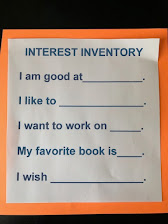
Interest Inventory 
In addition to saving writing samples and self-portraits in a “portfolio” each month, have children complete an “interest inventory” by filling in sentences similar to the ones below: 

I am good at______.
I like to _____.
I want to work on _____.
My favorite book is _____.
I wish _____.


Hint! Younger children could just dictate their responses to an adult.


Color Coded
This isn't very high tech, but it's very visual and can be very meaningful. Find an assessment with basic skills you will be focusing on during the year such as upper and lowercase letters, numerals, shapes, sight words, sounds, math facts, etc. Each month assess children and color in the squares they have mastered with a different color of crayon. For example, color what they know in September in red, October - orange, November - brown, etc. It will give a "colorful" picture of the child's learning journey.


Observations

Write down what you observe children doing as they play with classmates, complete assignments, cooperate in group activities, and every day routines.

Hint!  Add photos for a visual "insight" into how children are performing.


I AM PROUD!
Let children decorate a folder with their name. Store these in a special tub in the classroom. Encourage the children to save work that they are "proud" of in their folder.
              

Hint! If you did this with an illustration and writing sample at the beginning of each month they could “revisit” past work and see how they are improving.

One teacher told me she made a sign that said “Testing! Do Not Disturb” and put it on her door when she didn’t want any visitors to see how much fun her class was having. Another teacher told me she wrote: “Disturbed! Do Not Test!” and put it on her door!


P.S. The Massachusetts Department of Early Education provides an excellent overview of the WHAT and WHY for childhood assessment:

http://resourcesforearlylearning.org/fm/early-childhood-assessment/


Friday, July 8, 2022

PD #22 READING CALENDARS


 Click to view video for PD #22


In the book THE SMARTEST KIDS IN THE WORLD, one key finding was the impact parents have on their child’s academic success. When parents are interested in what their children are learning at school and talk to them about it, the results are amazing. Parents who model reading and read to their children also contribute to school success.

One teacher said she tells her parents, “All the children in my classroom need a laptop this year. Two laptops would be even better. These are not the kind of laptops that you plug in. They are the kind that come with two knees and are just right for talking and reading and loving!”

Check out these monthly reading calendars that will engage families at home. Run them off and you’ll be set for the year.


Hint! Save these to review with your parents at conference time.


Brown Bag Special
Many parents work and can’t volunteer in the classroom so this is a perfect opportunity to get them involved. When you have things that need to be cut out or if there is something you’d like downloaded from the internet, put it in a large grocery bag that says “Brown Bag Special.” Children whose parents agree to help take the bag home for their parents to do the project.


Tuesday, April 12, 2022

IDEAS FROM THE PAST

Remember the good old days when you got to go to conferences without a mask? What great memories I have of singing, dancing, and learning new ideas from all of you. Maybe you shared one of these terrific tips!


End of Day Chant (Linda Wood)
Sit in a circle criss cross applesauce and start the chant with this rhythm:
Slap knees two times
Clap two times
Snap two times...
Child's name, child's name, what do you say?
What did you like (or learn) at school today?


*The child has to tell what they liked best that day. It’s a good way to recall what they learned as you reinforce oral language.


Focus Finger Play (Pat Kesler uses this before handwriting. It wires up the brain!)

Two tall telephone poles (Fists touching with index fingers pointing up.)

Across them a wire was strung. (Touch middle fingers.)

Two little birds hopped on ((Put thumbs up on middle fingers.)

And sung and sung and sung. (Swing fingers.)


Push the Wall
One teacher’s occupational therapist suggested that when children are waiting in the hall you tell them to put their hands on the wall and try to “push it down.” This builds upper body strength, releases energy, and focuses children’s attention.


Tummy Reading
Here’s another easy suggestion to help children build upper body strength. Let them do “tummy reading.” Children lay on their tummies and prop themselves up with their elbows as they read. Try it and see how it strengthens those arm and shoulder muscles.


Finger Math Game (Karen Rosenkranz)
This “show me” game can be used for math facts 1-10. The teacher says a number like “5” and holds up one finger. The children show 4 fingers to make "5". The teacher can easily see who knows the facts.


Noodle Sensory Fun (Kyle Kranes) 
Cut fun noodles into sections and let the children roll on their back, arms, legs, belly. It’s a great cool down and brain break – and perfect for sensory kids. 


Noodle Writing
Give children sections of noodles and let them use these to do invisible writing in the air.  They can make shapes, write letters, write numerals, spell words, and so forth.


Eye Ball Stories (Penny Salvato) 
Note!  If you read this far down on my blog today you're going to love this story.  I don't know if Penny is still teaching, but I'd love to be a kid in her class because she's got such a wonderful sense of humor.  

Penny said before making eye pointers she uses two stories to explain how she collected the eyeballs to make the pointers. 

1. When kids play rough on the playground and lose an eye I collect them. 
2. I also collect eyes from “bad” kids and put them on sticks.

Sunday, September 26, 2021

TEACHCON!

Are you ready for TEACHCON?! 


I'm excited to join the TeachCon team to bring you professional development led by nationally recognized presenters!

The best part?!? You don’t have to leave your home! Join us on October 18th - 20th for this FREE virtual event! Virtual spots will fill FAST so grab your seat today!
Registration is now open at esgiteachcon.com

Monday, September 13, 2021

PARENT CONFERENCES ARE AROUND THE CORNER!

Before you know it, it will be time for parent conferences. I used to dread conferences because many of the parents didn’t want to talk about their child. They wanted to talk about the neighbor’s kid or their “ex” or whatever. Once I started using this questionnaire my conferences became much more meaningful for me and the parents.

A week before conferences I’d ask the children, “Would you like me to give your parents some homework? Well, here is something they need to fill out and bring to our conference next week.”

Note! If parents show up without the form, simply smile and say, “I’ll give you a few minutes to fill this out before we get started.”

CONFERENCE QUESTIONNAIRE

Please fill out this form and bring it to your conference on __________________at _________________.

Child’s name__________________________

1. My child’s favorite activity at school is________________

2. My child expresses concern about_____________________

3. My child’s strong qualities are__________________________

4. Areas I feel my child needs to work on are_____________

5. Something I would like to see my child do at school is _______

6. Is there any special information about your child that you think we should know about?


https://drive.google.com/file/d/0B1SnEagA4jljYWFnNXNybFdyZVE/view?usp=sharing


Cheers and Goals
Here’s another idea for conference time. Ask parents to write down three things positive (cheers) about their child and three goals that they have for their child. This will give the teacher insight as to what is important to parents. It will also provide the teacher with the opportunity to say, “This is what I can do at school to help your child accomplish these goals. What can you do to help at home?”


Student Led Conferences

I must admit I never did these, but many schools are now using this approach and find if very successful. You can find videos and other useful information about student led conferences on the internet.

Conference Tips
Sit beside the parent at a table, rather than behind a desk.

Keep the conversation focused on the child.

Have samples of the child’s work to share with the parents. Focus on the total child, including intellectual, physical, social, and emotional development.

If there is a problem, brainstorm solutions and develop a plan for action.

End the conference on a positive note by reassuring the parents and thanking them for their support.

Provide an interpreter for parents who do not speak English.

Follow-up with the parents after the conference.


Monday, June 1, 2020

GOOD IDEAS #1

It's June!  It's June!  The lovely month of June!
If you didn't get to attend the virtual GYTO Conference here is the 
playlist for the songs I sang.


Each day in June I'm going to "revisit" my favorite blog ideas from the past 10 years.  
You might not get to go to a conference this summer, but I'll 
still have a TON of great ideas for you every day!
I'll also give you suggestions for adapting them to the virtual classroom.

ALPHARDY VIDEO

You are going to LOVE this video that some teachers in Iowa created to go with my "Alphardy" song.  Share it with your families or keep it for when school begins again.  Online or in person - it's a great active learning song!

https://www.youtube.com/watch?v=ur5E1Btt6qI


Thank you so much Suzy Nordhus and the Northwood Preschool Center 
(Ames Community School District).


Sticky Notes in the Traditional Classroom
Use sticky notes to encourage writing and reinforce functional print. “Get a sticky note and write it down so you don’t forget.” “Put a sticky note on your desk about riding home with your aunt.” “Put a sticky note in the book when you find the solution.”


VIRTUAL CLASSROOM
Include sticky notes in your supply list.  Children can use these to quietly answer questions and then hold them up for the teacher to do a quick check.
*Phonics (write the beginning sound, vowel sound, etc.)
*Math (teacher holds a dot card and children write the number, math facts, number stories, etc.)
*Spelling (spell sight words, vocabulary, spelling words, etc.)
*Review (answer questions about a unit of study)
*Feelings (draw how you feel)
*Doodles (children can draw if they are restless)


VIRTUAL CLASSROOM MEMORY MAKERS 
This idea came from Margaret Moogan, a PreK teacher in the Passaic School District.  I thought it was such a sweet way to end her school year so I'll let her tell you about it.

An idea I will doing next week is showing the children about 10 photos that we have of them in the classroom before March 13th. They miss their friends so much. I thought it would be fun to do a scavenger hunt or a detective game, i.e. find the blue counting bears, what photo is Rachel in, what is she doing, what do you think they are "cooking" in the house area, what are they building in this picture, name your friends in this picture, etc.  If I get a good response, I will do it again with another set of pictures.


Friday, September 13, 2019

LET'S HAVE A CONFERENCE!

If you missed my FB Live video on 
WINNING WAYS WITH FAMILIES
yesterday here's a link so you can catch it this weekend.

Ready or not, it will be time for parent conferences before you know it!  I used to dread conferences because many of the parents didn’t want to talk about their child. They wanted to talk about the neighbor’s kid or their “ex” or whatever. Once I started using this questionnaire my conferences became much more meaningful for me and for the parents.

A week before conferences I’d ask the children, “Would you like me to give your parents some homework? Well, here is something they need to fill out and bring to our conference next week.”

Note! If parents show up without the form, simply smile and say, “I’ll give you a few minutes to fill this out before we get started.”

                                  CONFERENCE QUESTIONNAIRE

Please fill out this form and bring it to your conference on __________________at _________________.

Child’s name__________________________

1. My child’s favorite activity at school is________________

2. My child expresses concern about_____________________

3. My child’s strong qualities are__________________________

4. Areas I feel my child needs to work on are_____________

5. Something I would like to see my child do at school is _______

6. Is there any special information about your child that you think we should know about?


https://drive.google.com/file/d/0B1SnEagA4jljYWFnNXNybFdyZVE/view?usp=sharing

Cheers and Goals
Here’s another idea for conference time. Ask parents to write down three things positive (cheers) about their child and three goals that they have for their child. This will give the teacher insight as to what is important to parents. It will also provide the teacher with the opportunity to say, “This is what I can do at school to help your child accomplish these goals. What can you do to help at home?”


Student Led Conferences
I must admit I never did these, but many schools are now using this approach and find if very successful. You can find videos and other useful information about student led conferences on the internet.

Conference Tips
Sit beside the parent at a table, rather than behind a desk.

Keep the conversation focused on the child.

Have samples of the child’s work to share with the parents. Focus on the total child, including intellectual, physical, social, and emotional development.

If there is a problem, brainstorm solutions and develop a plan for action.

End the conference on a positive note by reassuring the parents and thanking them for their support.

Provide an interpreter for parents who do not speak English.

Follow-up with the parents after the conference.

Thursday, September 7, 2017

PARENT CONFERENCES

Before you know it, it will be time for parent conferences. I used to dread conferences because many of the parents didn’t want to talk about their child. They wanted to talk about the neighbor’s kid or their “ex” or whatever. Once I started using this questionnaire my conferences became much more meaningful for me and the parents.

A week before conferences I’d ask the children, “Would you like me to give your parents some homework? Well, here is something they need to fill out and bring to our conference next week.”

Note! If parents show up without the form, simply smile and say, “I’ll give you a few minutes to fill this out before we get started.”

CONFERENCE QUESTIONNAIRE

Please fill out this form and bring it to your conference on __________________at _________________.

Child’s name__________________________

1. My child’s favorite activity at school is________________

2. My child expresses concern about_____________________

3. My child’s strong qualities are__________________________

4. Areas I feel my child needs to work on are_____________

5. Something I would like to see my child do at school is _______

6. Is there any special information about your child that you think we should know about?
                                       
https://drive.google.com/file/d/0B1SnEagA4jljYWFnNXNybFdyZVE/view?usp=sharing

Cheers and Goals
Here’s another idea for conference time. Ask parents to write down three things positive (cheers) about their child and three goals that they have for their child. This will give the teacher insight as to what is important to parents. It will also provide the teacher with the opportunity to say, “This is what I can do at school to help your child accomplish these goals. What can you do to help at home?”
            
Student Led Conferences
I must admit I never did these, but many schools are now using this approach and find if very successful. You can find videos and other useful information about student led conferences on the internet.

Conference Tips
Sit beside the parent at a table, rather than behind a desk.

Keep the conversation focused on the child.

Have samples of the child’s work to share with the parents. Focus on the total child, including intellectual, physical, social, and emotional development.

If there is a problem, brainstorm solutions and develop a plan for action.

End the conference on a positive note by reassuring the parents and thanking them for their support.

Provide an interpreter for parents who do not speak English.

Follow-up with the parents after the conference.