photo 3am_dj_home_zps919fb85e.png photo 3am_dj_about_zps7cce4c75.png photo 3am_dj_website_zps73051235.png photo 3am_dj_ss_zps6759ec2a.png photo 3am_dj_bs_zps43e27832.png
Showing posts with label STEAM. Show all posts

Friday, September 23, 2022

STEAM ON WITH LEAVES

Take advantage of the science lab on your playground with these leaf activities.


Leaf Hunt
Give each child a lunch sack and let them collect 2 or 3 leaves from the ground. Bring these back in the classroom and sort by shape, color, etc. You could also graph the leaves by shape. (Whenever you collect items outside emphasize the importance of taking things from the ground. Return the objects to where you found them after exploring with them in the classroom.)

Science Center
Let children investigate leaves in the science center with a magnifying glass or microscope. Ask children to draw the enlarged leaf.
Hint! You can also take a photo of a leaf with your phone and enlarge it to show the veins and details.

Research
Check out a leaf identification book from the library or look online. Can children match up their leaves to identify which tree they came from?

Leaf Rubbings

Lay a sheet of paper on top of a leaf. Remove the paper from an old crayon and rub the side over the leaf to make a print.Hint! Use rubber cement to glue the leaf to the table. It will be easier for the children to make a rubbing, and you can just rub off the rubber cement after the activity.


Leaf Book
Let each child find a "favorite" leaf. To preserve, place the leaf in a sheet of newspaper and put a book on top overnight. Place the leaf in a zip baggie. Encourage children to dictate or write a sentence about their leaf. 


*Put several baggies together to make a book.

I Wonder Why?

Brainstorm why leaves turn colors and fall off trees in the fall. Have children go home and do a little research with their parents and report results in class the following day.

Deciduous Trees (Sandra Kelley)
Tune: "Do Your Ears Hang Low?"
Do your leaves fall down?
Do they tumble to the ground?
Do you lose your leaves in the fall?
Then you are deciduous that we know
because in the fall your leaves all go!

*What's the difference between deciduous trees and evergreen trees? Take a nature walk and ask children to identify both types of trees.

Wednesday, March 9, 2022

MARCH ENGINEERS

Hop on the STEAM bandwagon with these activities. Students could do these independently, with a study buddy, or in a small group.


Flying Objects
Let children design kites, paper airplanes, or other objects that will fly.
Hint! There are lots of good websites and videos where you can learn how to make paper airplanes.


Egg Drop
Give children a lunch bag and ask them to collect recycled materials at home. Divide them into small groups and give each group a raw egg. Can they design a container (using the recycled materials, tape, etc.) that will protect the egg if they drop it?


Stand on a chair and drop the egg.
What happens if you drop the egg from the top of the climber on the playground?
*Let students predict which group’s container will be the most effective.


Leprechaun Trap
Challenge children to use recycled materials to create a trap for leprechauns. They could do this at home with their parents or as a small group project.
*Encourage them to explain their contraption.
*Write creative stories about what they would do if they caught a leprechaun.
*Let them create a leprechaun trap with unit blocks or Legos.

Tuesday, March 8, 2022

WANTED: ENGINEERS

Engineering is the design process used to solve problems and build things. Children are natural engineers as they play with blocks and Legos, create things in art, or build a fort outside with their friends. Here are a few other activities that will give your little “engineers” a job.

Engineer Planning Book
Write “Engineer Planning Book” on the cover of the notebook. Explain that engineers draw a plan and then try to build their design. Place the book in the block center along with a pencil and encourage children to draw their idea and then try to build it.


Cups and Plates
Little guys to big kids will be challenged to build structures with simple materials like plates and cups.


Lunch Bag City
Buildings and houses from lunch bags are fun to construct and use to create a community, reproduce a scene from a book, or design a city of the future. Take 2 lunch bags and open them up. Fill one with crushed newspaper. Insert the second bag on top and then decorate with markers, construction paper scraps, etc.


Monday, September 24, 2018

"TREE" RIFIC IDEAS!

Here's a simple craft activity that you can tie into science (seasons), reading (letters and word families), and writing.  It's good for small motor skills as well as cutting.

Directions:  Tear or cut 3 or 4 strips half way down from the top of the bag as shown.  (You might want to draw these lines for younger children.)  Open the bag and twist in the middle to make a tree.  


Seasonal Trees
*Tear red, yellow, and orange scrap paper and glue them on the strips to make an autumn tree.
*Pink and white tissue paper can be waded up to make blossoms on a spring tree.
*What fruits and nuts grow on trees? Let children make their favorite fruit tree.

Letter Tree
*Write letters (or use letter stickers) to make a "chicka chicka boom boom boom" tree.
*Make a word family tree by writing all the words they can make from a specific rime.

Family Tree
*Let children make a family tree by writing names of family members on their tree.

Spooky Old Tree
Twist the strips of paper as shown to make a spooky tree.  Let children cut bats, cats, and other spooky things to go on their tree.


*Use these trees to prompt descriptive writing or poems.


Fall Centerpiece

If you're entertaining this fall here's a centerpiece will get rave reviews.  All you need is a large paper grocery sack.  Wad and crush the sack until it is soft and pliable.  Next, make a large tree using the same process you did with the lunch bag.  Use silk leaves, small pumpkins, and other seasonal objects to decorate your tree.  Taaa daaa!!

Sunday, September 23, 2018

A LITTLE "STEAM" WITH LEAVES

Take advantage of the science lab on your playground with these leaf activities.                                   
Leaf Hunt  
Give each child a lunch sack and let them collect 2 or 3 leaves from the ground. Bring these back in the classroom and sort by shape, color, etc. You could also graph the leaves by shape. (Whenever you collect items outside emphasize the importance of taking things from the ground. Return the objects to where you found them after exploring with them in the classroom.)

Science Center 
Let children investigate leaves in the science center with a magnifying glass or microscope.  Ask children to draw the enlarged leaf.
Hint!  You can also take a photo of a leaf with your phone and enlarge it to show the veins and details.

Research 
Check out a leaf identification book from the library. Can children match up their leaves with those in the book to identify which tree they came from?

Leaf Rubbings 
Lay a sheet of paper on top of a leaf. Remove the paper from an old crayon and rub the side over the leaf to make a print.Hint! Use rubber cement to glue the leaf to the table. It will be easier for the children to make a rubbing, and you can just rub off the rubber cement after the activity.
              
Leaf Book 
Let each child find a "favorite" leaf. To preserve, place the leaf in a sheet of newspaper and put a book on top overnight. Place the leaf in a zip baggie. Encourage children to dictate or write a sentence about their leaf.
                                 
*Put several baggies together to make a book.

I Wonder Why? 
Brainstorm why leaves turn colors and fall off trees in the fall. Have children go home and do a little research with their parents and report results in class the following day.

Deciduous Trees (Sandra Kelley)
Tune: "Do Your Ears Hang Low?"
Do your leaves fall down?
Do they tumble to the ground?
Do you lose your leaves in the fall?
Then you are deciduous that we know
because in the fall your leaves all go!

*What's the difference between deciduous trees and evergreen trees? Take a nature walk and ask children to identify both types of trees.

Sunday, August 6, 2017

ENVIRONMENTAL PRINT

Environmental print is one way young children “read pictures” and develop visual literacy. Using environmental print at the beginning of the school year is a great way to help children make print connections, develop visual memory skills, and motivate them to read.

Mother Hubbard’s Cupboard


Ask children to save food wrappers from snacks and their lunches. Glue wrappers to sheets of paper and write this rhyme at the top of each page:
 Old Mother Hubbard
 Went to her cupboard
 To get her poor dog a bone.
 But when she got there
 The cupboard was bare
 And so the poor dog had…(Children read food logo.)
                              
What’s for Breakfast?

Ask children to bring in the box from their favorite cereal. Cut the front section off and on a sentence strip write: “Child’s name eats name of cereal.” Glue to the bottom of the cereal box. Put all the boxes together and make a book. Write “What’s for Breakfast?” on the front cover. Hole punch and put the boxes together with book rings.
*You can also make a book with sacks from fast food restaurants.  
          
Clothes 

Read sayings on T-shirts, sports jerseys, shoes, and other clothing the children wear to school.


We Can Read Bulletin Board

Ask children to bring logos from food boxes, magazines, toys, clothing and household products. Make a poster or bulletin board that says: “We Can Read!” Let children glue their logos to the poster. Read over the words together.


Read at Home Book

Cut 9” x 12” sheets of construction paper in half. Let each child choose 4 or 5 different colors and staple them together to make a book. Write “I Can Read” on the front and let the children decorate with their name and picture. Send the book home with a note to the parents about helping their child recognize different logos, signs, and words on products and in the home and as they drive down the road. Encourage parents to help their child cut out words they can read from boxes, magazines, and advertisements. Ask children to bring their books back to school to “read” with classmates.
                             
I Like

On Monday send home a sandwich bag with a note asking parents to help their child look for words she can read on food labels, toys, advertisements, and other products around their house. Children cut these out and bring them to school Friday in the sandwich bag. On Friday, encourage the children to “read” the labels that they have brought to class. Write the words “I” and “like” on index cards for each child. Model how to place the cards on the floor with a label from their bag. Point to the words as you read, “I like logo.” Ask the child to read it for you as you point to each word. Comment, “Look at you reading!!!!”


Block Engineers

Cut store logos from Sunday advertisements. Tape to wooden blocks and make your own mall in the block center.


Out the Door
Last January when I was in Pleasanton, TX, Nadine Barrow shared this idea. She posts words and environmental print on the inside of her door. Students have to read two of the words before exiting the classroom.

Thursday, January 5, 2017

STEM CUPS??? YES, INDEED!

Now, who would think to use cups for STEM?  Look at see!

Construction Cups
*Let children be engineers and design structures with plastic cups. How many can they use? How high can they build? What worked? What didn’t work?
                    
*Divide children into groups of two or four. Give each group cups and paper plates and see what they can come up with. Let each group report on what they created. Talk about 21st Century skills! Collaboration, communication, problem solving, and creativity at its finest!
                                               
Touch and Tell
Insert a cup in a sock. Put an unusual item down in the cup. Children reach in the sock and try to identify the object by touch.
                 
*Make several of these and number each one. Have children draw a picture or write a sentence about each object.

Sequence
Sequence pictures of plant growth, life cycle, seasons, and so forth.
            
Hairy Creatures
Let children draw silly faces on small bathroom cups. Fill the cups with soil and sprinkle grass seed on the top. Water, set in the sun, and before long you’ll have a hairy creature!
                                     
Instruments 
Give each child a cup and play some catchy music. Have them gently tap the cup on their desk to the beat of the music.

*Give them two cups that they can tap together to make music. 

*Tap out syllables in words with cups.

Clucker Cup 
Take a nail and poke it through the bottom of a cup. (An adult will need to do this.) Thread a 2’ piece of string through the hole and tie a paper clip to the end in the cup. Hold the cup upside down and dip the string in water. With your index finger and thumb, gently pull down on the string. You can make a long squeaking noise or jerk it to sound like a chicken.
                     
Phone
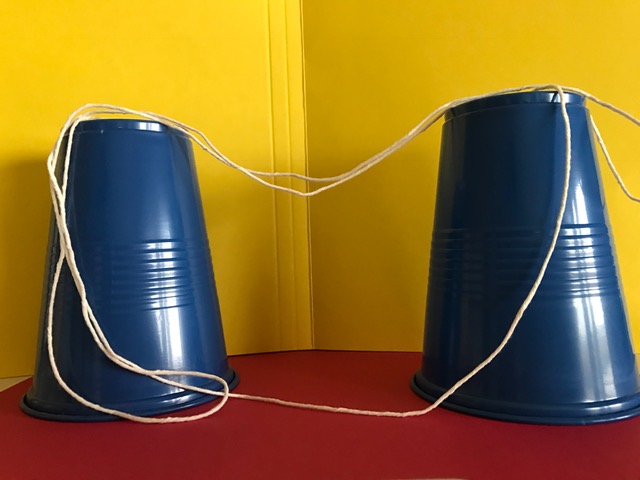
Punch holes in the bottoms of two cups. Take an 8’ piece of string and thread each end through the bottom of a cup. Tie paper clips to the ends of the strings in the cups. Each friend takes a cup and pulls the string taut. One child talks in a cup while the other child holds the cup to her ear and listens.
                                            
Fence Art 
You’ve all seen this where the children stick cups in a chain link fence to make a design. This is great for holidays and other special celebrations.

*You could also challenge children to make patterns in a fence with cups.

Pop Up Puppet
This is cute for a groundhog or a bunny. Poke a hole in the bottom of a cup. Draw a groundhog, bunny, or other creature that lives underground on a piece of paper. Cut out and attach to a straw. Turn the cup upside down and insert the straw through the hole in the cup. Move the straw up and down so the critter can pop out of the hole.
                        
Is your cup “overflowing” with ideas???

Can’t wait to see you for LIVE AT FIVE this afternoon!


Saturday, December 17, 2016

OLD MAN WINTER

December 21st is known as the winter solstice or the first day of winter. It is the shortest day and longest night of the year. Although your students will probably have sugar plums dancing in their heads this week, you might want to add a touch of science to your lesson plans with these ideas.
                                                              
Science – Ask your students what causes winter. (Accept their answers without judging.) Have one child pretend to be the sun and stand in the middle of the circle. Use a globe to demonstrate how the earth rotates around the sun. It takes 365 days or one year for the earth to go all around the sun. Demonstrate how the earth tilts on its axis away from the sun to cause winter. Why? What happens when the earth tilts toward the sun?
                    
Signs of Winter – Brainstorm signs of winter. What happens to the temperature in winter? What happens to the plants? What happens to animals?

Vocabulary – Make an attribute web of winter words. Include winter clothing, sports, holidays, etc.

Animals Adapt – How do animals adapt in the winter? What animals hibernate?
What animals migrate?
                                             
Habitats – Some habitats are very cold in the winter with ice and snow. Other habitats are warmer in the winter. Use a map of the United States and have children identify their state. Do they have ice and snow in the winter? Can they find a state where it’s warm and sunny in the winter? What do they think causes the difference?

Internet Search – Visit a weather site, such as weather.gov, to compare regional weather.

Nature Walk – Go on a nature walk and look for signs of winter. Let each child take a digital photograph of a sign of winter. Put these together to make a class collage.
                                                                         
Trees – Explain that evergreen trees stay green all winter. Deciduous trees lose their leaves in the winter. Can they find evergreen and deciduous trees on the playground? Can they find them in their yard at home?

Make a Book – Staple two sheets of paper and let children use descriptive writing to make a book called “Winter Is…”

Creative Writing – Invite children to write a story about “Old Man Winter.” I found this great writing paper free at www.teach-nology.com.

Read a Book – What’s your favorite winter book to read to your class?
                                  
                       Wishing you happy winter days!!!

Friday, November 25, 2016

STEM ALL YEAR!

Carolyn Kisloski and I have been working on units that integrate Science, Technology, Engineering, and Mathematics.  (They are actually STREAM packets because they also include Reading and Art.)  I'll let Carolyn tell you how she uses them throughout the school year.


Dr. Jean and I just finished putting together our STEM All Year Packet! This bundle includes 9 STEM packets- everything you need for a year of STEM- and more! It has 440 pages of activities, challenges, anchor charts, book ideas, writing prompts, 10 Prezis (each with songs, anchor charts, videos, activities, and games to go with the packet topic), and downloads for 13 of Dr. Jean's songs. My children sing Dr. Jean's songs all the time. And when they know those songs, I know they know what we've learned!

                                   
https://www.teacherspayteachers.com/Product/STEM-All-Year-Bundle-2882250

I start the year with I am a Scientist, because it gives my students a great overview of what it means to be a scientist.


I use the activities in the Colors packet right along with I am a Scientist, in the beginning of the year. It's a great introduction to science activities using what they know and a great review of colors in September and October.
                              

In October and November, I like to talk about Living and Nonliving Things. This is a fun unit for the children, and I've found that it actually works well with our fiction and nonfiction reading and writing units. We talk a lot about stuffed animals vs real, live animals, and make the connections with fiction and nonfiction stories. I also like working on the Living and Nonliving Unit in October because we do many activities with apple and pumpkin life cycles, so this unit fits in perfectly.
                                                      

I love teaching The Five Senses in December. The holidays are such a fun time for the children to realize how important their senses are! There are so many wonderful smells, fun things to see, different textured items to touch- as well as different temperature items (hot chocolate and snow, for example!), happy holiday songs to hear, and of course... plenty of great opportunities to taste different things. I teach this unit with Mr. Broom. He is a favorite every single year.
                      

January is a perfect time for Healthy Body! Healthy Me! for all of us- for the kids and for me! This is one of my favorite units. We visit this unit all year long, actually.
                                                      

In February, I begin our Birds and Bird Nests Unit.


March is all about The Water Cycle, Water, and Clouds. I love this unit. I sort of love the water cycle way too much for some reason. It's so much fun to teach. My children love learning the songs and can teach anybody all about the water cycle and clouds when they are done with this unit!
                             

We Go Green in April for Earth Day. This is a really important unit that gets the children thinking about our earth and keeping it safe and clean. I love teaching the children this unit, because they are at such a great age where they take it to heart and want to make a difference. Having fun activities to remember will hopefully help them remember what they learn for the rest of their lives!
                                                        

May is a great time for Bugs and Insects. The children LOVE to find bugs- and are so interested to learn all about them. Sometimes I'll do some of the activities from this unit in September- like when I find a centipede or fun looking bug in the classroom, and we need to study that. It's a great time to play a Bug Game during center time when this happens to reinforce any skill we are working on. By May, the bugs are out in full force and we have fun taking magnifying glasses outside and finding all we can find.
                                                                              

O.K. Time to turn off the computer and hit those big sales today! Happy shopping!