photo 3am_dj_home_zps919fb85e.png photo 3am_dj_about_zps7cce4c75.png photo 3am_dj_website_zps73051235.png photo 3am_dj_ss_zps6759ec2a.png photo 3am_dj_bs_zps43e27832.png
Showing posts with label ASL. Show all posts

Wednesday, August 19, 2026

ALPHARDY

It really doesn’t matter how you say it, but you’ll find this song one of the most meaningful tunes you can do with your students. I’ve had countless teachers tell me that they do this song every morning at circle time with their students. By repeating the song daily and adding motions and sign language children are able to make the connections between letters and sounds. This is also helpful for children who have trouble articulating some of the sounds.

Alphardy (“Jeopardy" Tune)
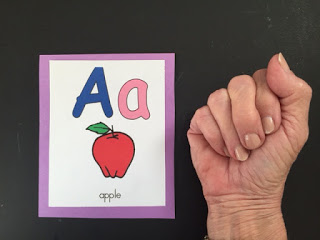
A for apple /a/ /a/ /a/ (Pretend fist is an apple.)
B for bounce /b/ /b/ /b/ (Bounce a ball.)
C for cut /c/ /c/ /c/ (Open and close index and middle fingers as if cutting.)
D for dig /d/ /d/ /d/ (Pretend to dig.)
E – elbow (Point to elbow.)
F – fan (Fan self with hand.)
G – gallop (Gallop in place.)
H – hop (Hop on one foot.)
I – itch (Scratch self.)
J – jump (Jump up and down.)
K – kick (Little kicks with foot.)
L – love (Hug self.)
M – munch (Move mouth as if eating.)
N – nod (Nod head.)
O – opera (Extend arms and sing dramatically.)
Q – quiet (Index finger on lips.)
R. – run (Run in place.)
S – sew (Pretend to hold a needle and sew.)
T – talk (Open and close fingers like a mouth.)
U – upside (Lean over.)
V – volley (Hands in air and pretend to volley a ball.)
W – wiggle (Wiggle all over.)
X – x-ray (Make “x” with arms.)
Y – yawn (Extend arms and pretend to yawn.)
Z – zigzag (Make an imaginary “z” in the air.)
Letter sounds are all you need.
Put them together and you can read! (Hold palms together and open like a book.)


I love this video with the manual signs for letters that Mariela Anderson recorded.

https://www.youtube.com/watch?v=p3JKf4vCeKA


*You can download this book at drjean.org.
http://www.drjean.org/html/monthly_act/act_2005/03_Mar/Alphardy


Alphardy Poster
Run off this chart for each student and glue to a file folder. Children can use this for choral singing or for independent work at the listening center. If you give them a pretzel stick or Bugle for a pointer they’ll get a little snack at the end of the song!


Letter Office
Children will enjoy making their very own letter office and then using it for the activities below. First, tape two file folders together. Let children decorate the outside, and then glue a copy of alphabet letters on the inside.


Sing and Track
Have children point to the letters as you sing various alphabet songs. (“The Alphabet in My Mouth,” “Who Let the Letters out?” or “Letters You Should Know” all work well.)

I Spy!
Play “I Spy” and other games where children have to identify letters. Can they find the letter that makes the sound at the beginning of “hop”? Can they find the letters in their name? What comes between G and I? Can they match up magnetic letters with the letters in their office?

Partner Play
Use the offices for working with a friend. Read the capital letters, lowercase, consonants, vowels. Read loud, soft, fast, slow, backwards, and other variations. Let friends take turns calling out letters (or sounds) for their partner to identify.

Family Time
Invite children to take their letter offices home and play games with their parents.

*Take turns naming letters and touching them.

*Sing Alphabet songs and track the letters.

*Look around the house for letters that match.

*Find letters in family members’ names.

Thursday, June 11, 2026

GREAT TEACHERS 108

These ideas are almost like seeds that you can take and grow into your own activities. 


Advisors and a WAITING Chair (Melanie Goodwin)
Two children are selected to be “advisors” for the day. During guided reading/workstations students ask a partner or one of the “advisors” before sitting in the “waiting chair” to ask the teacher. “Ask three, then me!” They have to wait until the teacher can get to them and often leave because they figure it out while waiting. This really helps eliminate disruptions during guided reading!


Mr. Tuttles (Karen Campbell)
Take a mirror and put a hat/head on top and add arms and legs to create “Mr. Tuttles.” Children tell Mr. Tuttles their tattles!


End of Year Gift (Julie Bright)
Ask each child to bring in a pillowcase. Use a T-shirt transfer to put this saying on the pillowcases:
Now I lay me down to sleep.
I’ll count hands instead of sheep.
Of all the friends I made
In (teacher’s name) first grade.
The students use fabric paint to put their handprint and write their name on all their friends’ pillowcases.


Insects (Katheryn Lambert)
(Tune: “Head, Shoulders, Knees and Toes”)
Head (point to head)
Thorax (point to chest)
Abdomen, abdomen (rub torso).
Head, thorax, abdomen, abdomen.
Two antennae (wiggle index fingers by temples)
And six legs (three fingers extended on each side)
Head, thorax, abdomen!
*Use the concept of two antennae and six legs to discuss symmetry and odd and even numbers. “We know our insects need six legs. Should I use one leg on this side and 5 legs on the other? No! It would be all lopsided!”


Swat (Whitney Rhyne)
Write letters, words, etc. on chart paper or board. Have 2 children come up at a time to race and find the letter the teacher calls out. Each child is given a fly swatter and the first one to “swat” it wins a point for their team.


Who Let the Letter Out?
(Whitney Rhyne)
Have the class squat down as you begin they song. They get to “pop up” when the letter that their name begins with comes up in the song. This is great for beginning sounds and teaches the kids what letters their friends’ names begin with.


Friendship Tools
(Liz Watras)
Use sign language (aslpro.com) to teach children these words:
Ask
Trade
Wait
Share
Include
Stop
When they have a problem they can use the tools and signs to work through the conflict.


Donut Vowels (Robin Davis)
Make donuts out of foam and decorate with markers. Write letters on each side of the donut. Next, put a vowel in the middle of a small paper plate. Children place the donut hole over the vowel and sound out the word.


Buddy Time (Robin Davis)
Put matching pompoms in a can and let each child draw a pompom. They match pompoms to find their buddy.


Tablecloths (Angie Barnett)
You can use flannel back tablecloths for everything. They are sturdy and won’t slip on the carpet. Just have the kids take off their shoes.
Keypad – If you draw a keypad children can jump their phone number, cafeteria number, or use for number recognition.
Popcorn Words – Write words or letters on popcorn shapes. Children jump around identifying letters or words.
Keyboard – Make a keyboard and use for letter recognition or spelling words.
Graph – Draw out a bar graph and use or comparisons.


Hall Chant (Theresa Malone)
My hands are hanging by my side
I’m standing straight and tall.
My eyes are looking straight ahead.
I’m ready for the hall.


Itsy Bitsy Spider (Sharon Howard)
After singing the “Itsy Bitsy Spider” let children change what kind of spider it is. It could be happy, mad, mean, angry, silly, pretty princess, etc. Then children decide how that spider would go up the waterspout.


Bread and Butter (Sharon Howard)
When you walk down the hall and go around a post or pole say this chant to the tune of “Frere Jacques”:
Bread and butter
Bread and butter
Toast and jam
Toast and jam
Peanut butter jelly
Peanut butter jelly
Cheese and ham
Cheese and ham

Sunday, June 7, 2026

GREAT TEACHERS 104


I have so much fun going through ideas teachers have shared with me at my workshops. See if you can make a “fist list” of three new things you’d like to try this week.


Rainbow Clap(Kammi O'Hara) 

Start on one side of your body and clap in an arch over to the other side.


Spiderman(Jessica Schmidt)

To focus children’s attention in the hall say, “Spiderman.” When the children hear that they need to "glue" themselves against the wall.

Silence (Karen Reindl) 

Tell the kids you're going to play "silence." 
"Let's shake it out!" 
Stand tall and still and hold up one hand. Slowly put up one finger at a time. However, if they make noise before that stop until they are silent again. When you get to 5 or 10 everyone can clap.


Self-Regulation(Sarah Mumaw-Flury) 

To discourage children from shouting out the answer, have them whisper their answer to the question in their hand and then hold it up. When the teacher says, “Release!” they open their hand and say/whisper the answer. 


First Thing on Your Paper(Christine Williamson) 

The first thing I do is always the same. 

Pick up a pencil and write my name!


Word of the Day(Mairin Born)

Put a sight word each week (or day) in a clear nametag pocket. All week the kids must name the word or turn it into a sentence as a "ticket" to talk to the teacher.

Hint! Use shapes or letters for younger students.


Class Names(Tune: "Ten Little Indians")

Aiden, Grayson, Hugh, Jack 
Jacob, Jayden, Mac, Maddie 
Nicholas, Oliver, Samuel Willa 
These are the kids in our class. 

*Sing this song all year to learn each other's names, alphabetical order, etc. With different class sizes, just adjust the names to fit by either singing quickly in a row or drawing out one name a little longer. 


Stress Button
(Christine Burchfield)

Put a piece of Velcro on a poker chip for children to keep in their pocket. They can rub the Velcro on the chip to calm down.
*Place Velcro strips on the side of their desk to rub and relax. (Pam Armon)


N.A.P.(Joy & Dawn)

Teach children to say “N.A.P.” when they make a mistake or bad things happen.
N – not
A – a
P – problem


Useful Signs(Miranda)

Teach children signs for white and chocolate milk, as well as specials like art, music, PE, etc.


Daily Song List

Make a song list for each day of the week with a different good morning song, calendar song, phonics song, movement song, and good-bye song.


15 Minutes of Walking/Exercising

Whether or not you have a Fitbit, try building 15 minutes of walking each day as you count, sing letter songs, say days of the week, months, spell words, and review other information.

Sunday, April 19, 2026

GOT A MINUTE?

If you've got 2 or 3 minutes after you've read a story or taught a lesson, these are some quick ways to assess learning and recall information. These ideas can be adapted for fiction or non-fiction literature, math, science, or social studies. All your students will be engaged and can reflect on what they've learned. That's a win/win!!

Sign Language
Teach children sign language for “yes” (make a fist and nod it up and down) and “no” (extend middle and index finger from thumb and open and close. As you ask questions, children respond with the appropriate sign.


Schema
Teach sign language for "connection" (thumbs make circles with index fingers and join like a chain). Discuss that when they connect what is in the book with what is in their brain they make a "schema." If they've made a "schema" they can show you with their hands. Call on random students to explain how they connected personally with the book.


Show Me
You will need two index cards. Write “yes” on one and “no” on the other. Children place these on the surface in front of them. As the teacher asks questions, the children hold up the appropriate word.

Envelope

Seal an envelope and cut it in half. Write “yes” on one side and “no” on the other side.

Stump the Teacher
Explain to the children that they get to be the teacher and ask you questions. Remind them to think about what they want to ask you before raising their hand. They must also know the answer to the question they are going to ask.

Tuesday, November 11, 2025

ASL

I know you probably get tired of hearing me promote ASL, but now more than ever it can be a powerful way to engage children and activate their senses. I’m excited that Mariela Andersen has interpreted some of my favorite videos. 


ASL – Dinosaur Boogie

http://bit.ly/drjeanASLDino


ASL – Wiggle Willie

http://bit.ly/drjeanASLWiggle


ASL – Alphardy

http://bit.ly/drjeanASLAlph


ASL – Macarena to 100

http://bit.ly/drjeanASLMac100


ASL – Today Is Sunday

http://bit.ly/drjeanASLSunday


Mariela Andersen

"Being able to provide equal access for Deaf and Hard of Hearing children through ASL means the world to me! I am so thankful to be able to support them in their most natural language. I hope that anybody who lives or works with Deaf and Hard of Hearing children chooses to learn sign language to be able to connect with them on a deeper level." 

Google "Mariela Andersen" to learn more about her and her books.

Friday, November 7, 2025

DON'T FORGET YOUR MANNERS!

Manners can take you a long way in this world - although they are not included in most state standards! Manners are part of the “hidden curriculum” that we can nurture daily in little ways. This is a perfect time of year to talk about thanking others and what it means to be polite. Here’s a simple echo song to encourage children to use their “magic words.”

I Have Manners (Tune: “Are You Sleeping?” - Children repeat each line.)
I have manners,
I have manners,
Every day,
Every day.
If I want something
If I want something
“Please,” I’ll say.
“Please,” I’ll say.

I have manners,
I have manners,
Every day,
Every day.
When someone is nice
“Thanks,” I’ll say.
“Thanks,” I’ll say.

*Role play when to say, “please,” “thank you,” “you’re welcome,” and “excuse me.”

*Teach children these signs and use them as prompts:
Please - palm open on chest and circle around
Thank you - fingers on chin and then down to palm

*Let the children use puppets to model what to do in similar situations:

How do you greet a new student?
How do you call a friend and invite them for a play date?
What do you do when someone pays you a compliment?
What do you do when someone gives you a gift?
What do you do when someone has a book that you want?
Table Manners
There are several good books about manners, but I liked to use a stuffed animal to demonstrate negative behavior. I’d ask the children to help me show the toy the correct thing to do.
“Coco always chews with his mouth open. Who can show Coco the correct way to chew your food?”
"Coco just grabs food that he wants. What is the polite thing to do when you want someone to pass you food?”
“Coco eats his food and then runs out to play. What should Coco say before he leaves the table?”


Animal Sounds

Don't forge to thank my webmaster Alex May for this new video.  He's really getting good with AI!


Thursday, October 23, 2025

VOWEL FAMILY

Here's a song that introduces the long and short sounds for the vowels. Making manual signs for the letters or holding up letters will help add the visual connection as you sing.

The Vowel Song (Tune: “Are You Sleeping?”)
A makes two sounds. (Echo each line.)
/A/ and /a/.
/A/ for apron, /a/ for apple.
/A/ and /a/.
/E/ and /e/ - eagle and elephant…
/I/ and /i/ - ice cream and inchworm…
/O/ and /o/ - open and octopus…
/U/ and /u/ - ukulele and uncle…

The long vowel sounds are easier for children to remember because "they just say their name." Here's a song that will help put those short vowel sounds in the brain. Of course, the letter U will be their favorite!

The Vowel Family (Tune: "BINGO")
https://www.youtube.com/watch?v=Eihx8_jXrOo

Aunt Aggie had an allergy
and she would always sneeze-o (Pretend to sneeze.)
/a/a/a/a/a/ /a/a/a/a/a/ /a/a/a/a/a/
And she would always sneeze-o.

Grandpa Eddie stayed in shape
and he would exercise-o (Pretend to lift weights.)
/e/e/e/e/e/ /e/e/e/e/e/ /e/e/e/e/e/
He liked to exercise-o.

Baby Izzi had chicken pox
and she would always itch-o. (Scratch body.)
/i/i/i/i/i/ /i/i/i/i/i/ /i/i/i/i/i/
And she would always itch-o.

Cousin Otto’s throat was sore
And this is what he’d say-o. (Put hand on throat.)
/o/o/o/o/o/ /o/o/o/o/o/ /o/o/o/o/o/
And this is what he’d say-o.

Uncle Unk wore underwear
and it did stink-o. (Hold nose.)
/u/u/u/u/u/ /u/u/u/u/u/ /u/u/u/u/u/
And it did stink-o.

Let the children use the attached sheet to make vowel puppets. Tape the letters to craft sticks or glue to an envelope that's been cut in half.


https://drive.google.com/file/d/0B1SnEagA4jljRjhzN3oxNFliSEU/view?usp=sharing


Five Little Vowels (Adapted from "Monkeys and the Alligator")
Five little vowels swinging from a tree (Hold up 5 fingers.)
Teasing Mr. Alligator, “Can’t catch me! (Point finger.)
You can’t catch me!”
Along came Mr. Alligator quiet as can be (Open and close arms.)
And snatched that A right out of the tree.
/a/ /a/ /a/ /a/ /a/ /a/ /a/ /a/ /a/ (Make sign language A with hand.)

E…I…O…U

*Draw a tree on a magnetic board and remove magnetic letters as you say the chant.

Thursday, October 16, 2025

VOCABULARY VITAMINS

Research continually highlights the relationship between vocabulary and comprehension as children progress in school. We know that:

- Rapid vocabulary acquisition occurs in pre-literate years (before children can read)


- Vocabulary is strongly related to reading and thus school achievement

- Systematic and direct instruction can increase children’s vocabulary

Here are some simple, meaningful strategies to add to your “vocabulary vitamin” bottle.

Attendance
Have a class puppet that gives a password every day. For attendance, the children say the password instead of “here.” Use this chant to introduce the password:
Liberty, Liberty (or whatever your puppet is named),
Oh, what do you say?
What is the password for today?


Hint! Tally the number of times children use the word during the day.

Visor
Write the vocabulary word on an index card and tape it to a visor. One child is selected to be the “supervisor” of the day and wear the visor. The “supervisor” stands at the door every time you leave and classmates must say the word before they can exit.

Name Badge
Put the word in a name badge and wear it (or let a student wear it) all day.
When the teacher says:
“Right now! Right now! Right now! Right now!
Whisper the password out right now.”
Children say the word.
Children then find a partner and use the word in a sentence.

Say, Spell, Sign
Look at the dictionary on aslpro.com to learn how to sign vocabulary words.
1. Children say the password.
2. Children fingerspell the password.
3. Children sign the password.

Monday, September 8, 2025

ALPHARDEE OR ALPHARDY???

It really doesn’t matter how you say it, but you’ll find this song one of the most meaningful tunes you can do with your students. I’ve had countless teachers tell me that they do this song every morning at circle time with their students. By repeating the song daily and adding motions and sign language children are able to make the connections between letters and sounds. This is also helpful for children who have trouble articulating some of the sounds.

Alphardy (“Jeopardy" Tune)
A for apple /a/ /a/ /a/ (Pretend fist is an apple.)
B for bounce /b/ /b/ /b/ (Bounce a ball.)
C for cut /c/ /c/ /c/ (Open and close index and middle fingers as if cutting.)
D for dig /d/ /d/ /d/ (Pretend to dig.)
E – elbow (Point to elbow.)
F – fan (Fan self with hand.)
G – gallop (Gallop in place.)
H – hop (Hop on one foot.)
I – itch (Scratch self.)
J – jump (Jump up and down.)
K – kick (Little kicks with foot.)
L – love (Hug self.)
M – munch (Move mouth as if eating.)
N – nod (Nod head.)
O – opera (Extend arms and sing dramatically.)
Q – quiet (Index finger on lips.)
R. – run (Run in place.)
S – sew (Pretend to hold a needle and sew.)
T – talk (Open and close fingers like a mouth.)
U – upside (Lean over.)
V – volley (Hands in air and pretend to volley a ball.)
W – wiggle (Wiggle all over.)
X – x-ray (Make “x” with arms.)
Y – yawn (Extend arms and pretend to yawn.)
Z – zigzag (Make an imaginary “z” in the air.)
Letter sounds are all you need.
Put them together and you can read! (Hold palms together and open like a book.)


I love this video with the manual signs for letters that Mariela Anderson recorded.

https://www.youtube.com/watch?v=p3JKf4vCeKA


*You can download this book at drjean.org.
http://www.drjean.org/html/monthly_act/act_2005/03_Mar/Alphardy.


Alphardy Poster

Run off this chart for each student and glue to a file folder. Children can use this for choral singing or for independent work at the listening center. If you give them a pretzel stick or Bugle for a pointer they’ll get a little snack at the end of the song!


http://www.drjean.org/html/monthly_act/act_2005/03_Mar/pg04a.html


Letter Office
Children will enjoy making their very own letter office and then using it for the activities below. First, tape two file folders together. Let children decorate the outside, and then glue a copy of alphabet letters on the inside.


Sing and Track

Have children point to the letters as you sing various alphabet songs. (“The Alphabet in My Mouth,” “Who Let the Letters out?” or “Letters You Should Know” all work well.)

I Spy!
Play “I Spy” and other games where children have to identify letters. Can they find the letter that makes the sound at the beginning of “hop”? Can they find the letters in their name? What comes between G and I? Can they match up magnetic letters with the letters in their office?

Partner Play
Use the offices for working with a friend. Read the capital letters, lowercase, consonants, vowels. Read loud, soft, fast, slow, backwards, and other variations. Let friends take turns calling out letters (or sounds) for their partner to identify.

Family Time
Invite children to take their letter offices home and play games with their parents.

*Take turns naming letters and touching them.

*Sing Alphabet songs and track the letters.

*Look around the house for letters that match.

*Find letters in family members’ names.

Monday, May 5, 2025

WE SAY THANK YOU TO YOU!

Everybody likes to be appreciated!

Here are some simple ideas you can use to thank parent volunteers and school helpers at the end of the year.

Sing and Sign Thanks
Teach children this song to the tune of “Happy Birthday.” Use a sign language dictionary to learn appropriate signs.

We
Say
Thank you
To
You
(Repeat twice)
We say thank you
For helping.
We say thank you to you!


Elvis Thank You
Get out your microphone. (Hold a fist by your mouth.)
Wiggle your hips.
(Pretend to twirl your microphone around.)
Thank you! Thank you very much!


Pictures and Letters
Integrate writing by having the children make thank you cards with various art media.


"Thumb" Body Thanks You!


Gift Certificates
Kudos Bar – “Kudos to you!”
Snickers – “Nuts about you!”
100 Grand – “A million thanks for all you did!”
M & M’s – “You’re marvelous and magnificent.”
Mint – “You ‘mint’ the world to us.”
Hershey’s Kisses – and Hugs, too!
Lifesavers – “You were a lifesaver this year!”
Apple – You’re the “apple” of our eyes.
Ice Cream Cone Coupon – You’re the best scoop! Thanks!


Friday, February 14, 2025

PEACE AND LOVE TO YOU TODAY

I am jealous of you today. I really am! Of all my classroom memories one of my favorites was watching the children open up their little valentines. "Look, I got a Minnie Mouse!" "See what Jamie gave me!" They were so thrilled. It's a reminder of what I always say about children being happy with plain vanilla. They don't need the world's fair or another toy or video game.

Peace and Love to YOU!
You can do this for your students and tell them to pass it on.
Peace (Make sign for peace.)
Love (Make sign for love.)
You (Point to someone.)


Love It Cheer
Make a heart with your hands (index fingers touching at the top and thumbs at the bottom) and extend from your heart.


Air Hug (Jane McPartland)
Say, “Give me an air hug.” Students open arms and pretend to squeeze.

Air Kisses (Beth Jenkins)
Kiss your fingertips numerous times as you scan the class. Blow kisses to all the children. Cross your arms across your chest and rub your arms as you say, “Feel the love.”

Thumbs Up Statements
Have students repeat positive comments as they stick up their thumbs.

I am a kind friend.
I am caring.
I am responsible.
I am polite.
I am a hard worker.
I am a helper.


Tuesday, January 28, 2025

ASL - SIGN TO LEARN

You know I LOVE sign language! I’m certainly no expert, but if I can do it, anybody can do it. Let me give you a few reasons why I’m such a believer that sign language is the perfect  vehicle for active learning.

It’s quiet.

It’s multi-sensory.

It’s engaging. (All I have to do is sing a song in sign language and I have children’s undivided attention.)

It’s good for differentiated instruction and for children who are non-English speakers. 

It’s free and it’s simple.

It’s like bubblegum. Bubblegum? Yep! We need to figure out how to stick things in the brain, and sign language can provide that connection.

Sign language can be a powerful tool for classroom management.

Sign language can be a strategy to teach children how to communicate with friends and work through conflicts.

Sign language can be a creative vehicle for reinforcing state standards.

It’s a great learning tool for teaching letters, high frequency words, vocabulary, etc.)


SIGN LANGUAGE CENTER
Make a SIGN LANGUAGE CENTER with a pocket folder. Glue a copy of manual signs for letters on the inside of the folder. Write alphabet letters on index cards and place in the pocket. Children choose a card and then try to reproduce that sign.  For older children, write sight words or spelling words on index cards for them to practice spelling manually.
    

Friday, October 25, 2024

GOT A MINUTE?

If you've got 2 or 3 minutes after you've read a story or taught a lesson, these are some quick ways to assess learning and recall information. These ideas can be adapted for fiction or non-fiction literature, math, science, or social studies. All your students will be engaged and can reflect on what they've learned. That's a win/win!!

Sign Language
Teach children sign language for “yes” (make a fist and nod it up and down) and “no” (extend middle and index finger from thumb and open and close. As you ask questions, children respond with the appropriate sign.


Show Me
You will need two index cards. Write “yes” on one and “no” on the other. Children place these on the surface in front of them. As the teacher asks questions, the children hold up the appropriate word.


Envelope
Seal an envelope and cut it in half. Write “yes” on one side and “no” on the other side.


Stump the Teacher
Explain to the children that they get to be the teacher and ask you questions. Remind them to think about what they want to ask you before raising their hand. They must also know the answer to the question they are going to ask.


Schema
Teach sign language for "connection" (thumbs make circles with index fingers and join like a chain). Discuss that when they connect what is in the book with what is in their brain they make a "schema." If they've made a "schema" they can show you with their hands. Call on random students to explain how they connected personally with the book.


Thursday, August 8, 2024

ALPHARDEE or ALPHARDY???

It really doesn’t matter how you say it, but you’ll find this song one of the most meaningful tunes you can do with your students. I’ve had countless teachers tell me that they do this song every morning at circle time with their students. By repeating the song daily and adding motions and sign language children are able to make the connections between letters and sounds. This is also helpful for children who have trouble articulating some of the sounds.

Alphardy (“Jeopardy" Tune)
A for apple /a/ /a/ /a/ (Pretend fist is an apple.)
B for bounce /b/ /b/ /b/ (Bounce a ball.)
C for cut /c/ /c/ /c/ (Open and close index and middle fingers as if cutting.)
D for dig /d/ /d/ /d/ (Pretend to dig.)
E – elbow (Point to elbow.)
F – fan (Fan self with hand.)
G – gallop (Gallop in place.)
H – hop (Hop on one foot.)
I – itch (Scratch self.)
J – jump (Jump up and down.)
K – kick (Little kicks with foot.)
L – love (Hug self.)
M – munch (Move mouth as if eating.)
N – nod (Nod head.)
O – opera (Extend arms and sing dramatically.)
Q – quiet (Index finger on lips.)
R. – run (Run in place.)
S – sew (Pretend to hold a needle and sew.)
T – talk (Open and close fingers like a mouth.)
U – upside (Lean over.)
V – volley (Hands in air and pretend to volley a ball.)
W – wiggle (Wiggle all over.)
X – x-ray (Make “x” with arms.)
Y – yawn (Extend arms and pretend to yawn.)
Z – zigzag (Make an imaginary “z” in the air.)
Letter sounds are all you need.
Put them together and you can read! (Hold palms together and open like a book.)

I love this video with the manual signs for letters that Mariela Anderson recorded.

https://www.youtube.com/watch?v=p3JKf4vCeKA


*You can download this book at drjean.org.
http://www.drjean.org/html/monthly_act/act_2005/03_Mar/Alphardy.


Alphardy Poster
Run off this chart for each student and glue to a file folder. Children can use this for choral singing or for independent work at the listening center. If you give them a pretzel stick or Bugle for a pointer they’ll get a little snack at the end of the song!


Letter Office
Children will enjoy making their very own letter office and then using it for the activities below. First, tape two file folders together. Let children decorate the outside, and then glue a copy of alphabet letters on the inside.


Sing and Track
Have children point to the letters as you sing various alphabet songs. (“The Alphabet in My Mouth,” “Who Let the Letters out?” or “Letters You Should Know” all work well.)

I Spy!
Play “I Spy” and other games where children have to identify letters. Can they find the letter that makes the sound at the beginning of “hop”? Can they find the letters in their name? What comes between G and I? Can they match up magnetic letters with the letters in their office?

Partner Play
Use the offices for working with a friend. Read the capital letters, lowercase, consonants, vowels. Read loud, soft, fast, slow, backwards, and other variations. Let friends take turns calling out letters (or sounds) for their partner to identify.

Family Time
Invite children to take their letter offices home and play games with their parents.

*Take turns naming letters and touching them.

*Sing Alphabet songs and track the letters.

*Look around the house for letters that match.

*Find letters in family members’ names.