Looking for something cheap, simple, and easy to do in your traditional classroom or to share with your families? A bag of large, dry lima beans, a permanent marker, an Altoids tin, and you are all set to reinforce phonics, sight words, and math concepts.
First, use permanent markers to write the consonants in blue and the vowels in red on the beans.
*Use for making CVC words.
*Use for word families.
*Use for writing word wall words.
*Use for practicing spelling words.
*Use with a friend. One person makes a word and the other person must read it.
*Put the letter beans in alphabetical order.
*Draw ten beans from the tin. How many words can you make with the ten beans? Write them down.
Write numerals in black and math signs in green.

*Put beans in numerical order.
*Sort odd and even numbers.
*Use for greater than and less than.
*Use for addition and subtraction problems.
*Use for place value.
*Make sets.
*Represent number bonds.
Math Bags

Here's another simple activity with lima beans. Draw a line down the middle of a plastic bag with a permanent marker. Insert beans in the bag. Ask the children to count the beans in the bag. Slide the beans from one side to the other to make different combinations. Can they write down the different combinations?
Subitizing is the ability to recognize numbers without counting. Dot cards can contribute to children’s understanding of number concepts, counting, composing and decomposing numbers, and a variety of standards. Take a look at all the ways you can use dot cards in your classroom.
Hint! Start with dot patterns up to 6 and then extend it to 10 when they are ready.
*Make sure to download dot cards on card stock or heavy paper.
One to One
Children match up pompoms, beans, erasers, pebbles, and other small objects with dots on cards.
Dot Flash
The teacher quickly holds up a dot card and then places it face down. The children hold up that number of fingers on their chest. Ask, “How did you know it was that number?”
Clip It
Children use the appropriate number of paper clips or clothespins to attach to the dot cards.
Copy Cat
The teacher holds up a dot card. The children try to reproduce the pattern with their own counters.
Sorting
Sort dot cards by amount.
Sort odd and even cards.
Line Up
Students line up the dot cards in numerical order from largest to smallest or smallest to largest.

Matching
Match dot cards with dots on dice.
Match dot cards with ten frames with the same amount.
Make puzzle games where children match dots with numerals or words.
Partner Count
Cards are placed face down on the table. One card is turned over and the first child to say the number gets to keep the card. The partner must count the dots to verify it’s correct.
*To make the game more challenging, ask them to say one more than the quantity of dots, one less, two more, etc.
Memory
Run off two sets of dot cards. Place them face down on the floor. One child at a time turns over two cards. If the cards match they make keep them and take another turn. If the cards don’t match, they are turned back over and the next child takes a turn.
Top It
You will need several sets of dot cards for this game. Shuffle the cards and lay them face down in a pile. One child at a time chooses a card. The child with the largest number of dots wins both cards. If they turn over the same amount they continue to draw cards until one player has a higher number.
It Adds Up
Two children have a set of cards and face each other. They each turn over a card and add up the amount. The first child to correctly say the answer gets to keep the cards.
*Tally to keep score.
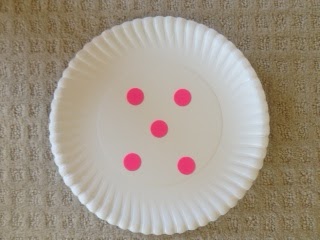
Paper Plates
How about making some dot plates?