photo 3am_dj_home_zps919fb85e.png photo 3am_dj_about_zps7cce4c75.png photo 3am_dj_website_zps73051235.png photo 3am_dj_ss_zps6759ec2a.png photo 3am_dj_bs_zps43e27832.png

Tuesday, April 21, 2015

POETIC ART

Poems are a perfect partner for creative activities in your classroom.  Take a look...

Illustrations – After listening to a poem, have children close their eyes  and make a picture of it in their heads. Then let them draw that picture on paper with crayons, markers, or colored pencils.
*Let children illustrate poems with water colors, chalk, or other media.

Collage – Let children choose a favorite poem and make a collage with magazine pictures, photographs, natural objects, or art media.

Pennants and Banners– Cut pennant and banner shapes out of construction paper and let children write or illustrate poems on them.

Puzzle Poems– Cut cardboard or tag board into 12” squares. Let children write original poems or copy poems on the cardboard. Then give them makers and crayons to illustrate their poems. Finally, have them cut the square into puzzle shapes. Store in a zip bag. Let children exchange puzzles and put them together and read.

Poetry Quilt - Give each child a square and let them write an original poem or rhyme on the square. Let them decorate a frame around their poem with crayons. Glue the children’s squares to a large sheet of bulletin board paper. Be sure to leave at least an Inch between the squares. Take 12” pieces of yarn and tie them in bows. Glue the bows between the squares so it will look like a quilt. 

                                
Puppets, Sculptures, and Bookmarks – Let children use a “scrap box” or “junk box” to create other “artful” objects for poems.

Monday, April 20, 2015

WE'RE POETS AND WE KNOW IT!

Ask the children, “What do poets do?” As they respond comment, “You know, we can do that, too. We can all write poems and be poets!!!” Here are some simple activities to start your students on the road to writing poetry. 

ACROSTIC
An acrostic is an easy way to begin writing poetry. Model how to do this on the board by writing a word vertically. Have children to think of a word that begins with each letter. Read over what you have written, and you have a poem.
Name Acrostic – Children think of a word that describes them for each letter in their name.
Holiday or Season- Write the holiday or season and then add an adjective that begins with each letter.
Non-fiction – Write a vocabulary word from a unit or theme and then
challenge children to write a word that begins with each letter. 

                    
BLANK POEM
Write several lines of poetry, leaving blanks at the end of each line. Encourage the children to fill in words that rhyme. Have them help you sound out the words as you write them. For example:
I saw a pig
Who could ______.
I saw a cat
Who could ______.
I saw a sheep
Who could ______.
And I can rhyme
Any time!

*Use similes for blank poems. For example, children could fill in the line to “Hungry as a _____. Quiet as a______. Sleepy as a ______. Mad as a _______. Good as _______. Sweet as ______.” And so on.

PREDICTABLE POEMS
Give children predictable sentences similar to the ones below. All children have to do is fill in a missing word, and they’ll have a poem.
Hint! They can use words that rhyme, nonsense words, or words that don’t rhyme.
I like_____.
I like _____
I like _____.
Do you like____?

I can _____.
I can_____.
I can_____.
Can you_____?

*I know….I wish….My mom is…Dogs can….Spring is….Green is…. And so forth!
*Write predictable poems using the five senses. It looks like…It sounds
like…It tastes like… It smells like…It feels like…It’s a ….

Sunday, April 19, 2015

POETRY POWER

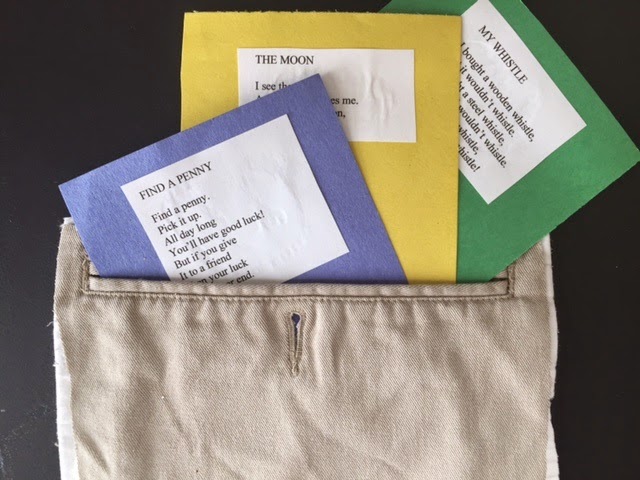
Cut a pocket off an old pair of pants and staple it to a bulletin board.  Store favorite poems in the pocket so the children can read them over and over.  Take a look at some other ways you can reinforce reading skills with poetry. These activities are much more multi-sensory and engaging than a worksheet or computer program!!!

Syllables – After reading a poem with your students, read it again clapping the number of syllables in each word. You could also snap, stomp, hop or make other movements for the syllables.

Rhyming Words – Following a reading, mention that you heard words that sounded alike at the end. Repeat two of the words that rhyme. Let’s read the poem again and see if you can listen for other words that rhyme. As children find words that rhyme, highlight them on the poem with highlighting markers or tape. Write sets of words that rhyme on the board. Underline the letters that are the same. Have children think of other words that have the same sound at the end. Write the rhyming words on the board as the children call them out.

Alliteration – Read poems that have strong alliteration. Ask children to identify words with the same beginning sound. Highlight the words in the poem or list them on the board. Can children add other words to the list that begin with the same sound?

Sound Scramble – Just for fun, choose an initial consonant sound and alliterate each word in a rhyme. For example: Bumpty Bumpty Bat Bon Ba Ball. Bumpty Bumpty bad ba breat ball…

Decoding Skills – As you come to unknown words in poems, stop and model how to sound them out by blending the sounds.

Predicting – Before reading a poem, encourage the children to look at the title or illustrations and predict what the poem might be about.

High Frequency Words
– Highlight word wall words that are in poems. Pass out flash cards with words and challenge children to match them with words in the poem.

Parts of Speech – Ask children to identify verbs, nouns, and other parts of speech in poetry.

Comprehension – After reading a poem, ask appropriate questions that will develop comprehension skills. Is there a main character? What was the setting? When did the poem take place? What happened at the beginning? Middle? End? Was there a problem or resolution? What will happen next? What was the main idea?

Genres of Literature
– Help children recognize different types of literature through poetry. Could the poem really happen or is it pretend? Poems and books that are pretend are called “fiction” and those that are real are called “non-fiction.” Is the poem humorous or serious? Does it tell a story (epic) or is it just a rhyme?

Mental Imagery
Being able to visualize what is happening in a story, poem, or text is a strategy for improving comprehension. Have children close their eyes as you read different poems to them. Encourage the children to make a picture in their brains to go along with what they hear. After listening to the poem, encourage the children to discuss the pictures that they made in their heads.

Saturday, April 18, 2015

A POEM

A Poem
By Dr. Holly

A poem, a poem
Is a very special thing.
It takes the words
And makes them sing.

A poem is a present,
A poem is a treat
With words piled like ice-cream
In your bowl to eat!

A poem, a poem
Is a treasure and an art
So always carry one
With you in your heart.

Let children make a pocket and keep their favorite poem in it. Encourage them to exchange poems with classmates and read to each other.
Hint! To make a poetry pocket seal an envelope, cut it in half, punch holes and tie on a string. Children can decorate these and then wear them around their neck.

Here are some other ideas for celebrating poetry month in your classroom:

A Poem a Day
Choose a poem and read it to your class at the beginning of each day. You can read it and “let it be.” Or, you could use the poem to introduce vocabulary or to spark a discussion. 

*Assign each child a different day to be responsible for bringing in the poem. This would be a good activity for children to do with their parents.

Poetry Club
Write “Poetry Club” on the poster board and decorate with glitter and glue. Explain that anyone who stands up in front of the class and recites a nursery rhyme or poem can be a member of the poetry club. (You might want to model reciting a poem for them.) After they’ve recited their poem, let them sign their name on the poster.
*Design a membership card for the poetry club and run off on cardstock.
Present one to the children after they’ve recited a poem.

Poetry Café’
Plan a poetry party for your students called the “Poetry Café.” Involve children in planning refreshments, making decorations, writing invitations, etc. Encourage each child to learn and practice reciting a poem. Explain that in the coffee houses instead of clapping, the audience would “snap” their fingers for the poets.

Friday, April 17, 2015

BLOOMING WITH POEMS!


When your give children a song and rhyme, 
                               You give them a gift that will last for all time! 
It’s true! We keep songs and poems that we learn when we are young in our hearts and minds all of our lives. Some of the first words we heard were lullabies and lap rhymes that our parents said to us as infants. April is National Poetry Month, so over the next few days I’ll explore ways you can integrate poetry with standards.

Here are eight great reasons for using poetry in your classroom:
1.  Poetry develops oral language.
2.  Poetry develops auditory memory.
3.  Poetry helps children make print connections.
4.  Poetry develops phonological awareness (rhyme, rhythm, alliteration).
5.  Poetry enhances fluency.
6.  Poetry develops vocabulary.
7.  Poetry sparks children’s interest in reading.
8.  Poetry helps children fall in love with language.

Although we teach in an educational system that is skill-based, it is O.K. to include something in your curriculum just because it brings you JOY!

Say them, read them, sing them, chant them, clap them, snap them, but above all, ENJOY them!


Thursday, April 16, 2015

NATIONAL HIGH FIVE DAY!

It’s April 16th and it’s National High Five Day! Start the day by greeting each other with a high five. 
                                  
Teach children how to give themselves a “high five” for a job well done. Hold up both palms facing each other in front of your chest. Pretend to wave with one hand. “Hi 5!” Get it?

Pat on the Back
Trace around each child’s hand on construction paper and let them cut it out. Write a positive comment about each child on the hand and tape it to their back at the end of the day. Parents will be proud when they see their child’s “pat on the back.”

Pickle Tickle Partner Game

Up high. (Give a high five up in the air.)
Down low. (High five down by knees.)
Cut the pickle. (One child touches fingertips horizontally as the other child pretends to slice in between.)
Give a tickle. (Gently tickle each other.)

High Five to Martha Tavarez
Oh, how I loved the teachers in El Paso that I met last week at their Great Beginnings Conference! Martha Tavarez, a kindergarten teacher at Barron Elementary, told me about a book that she made with her class called “How to Cheer Up a Friend.” She sent the book to Scholastic and she’s a finalist for the prize given for the best book created by children for children. Good luck!!!

Here’s a link so you can find out more about “Kids Are Authors.”
http://www.scholastic.com/bookfairs/articles/kidsareauthors

Wednesday, April 15, 2015

DO YOU COMPREHEND?

Comprehension is the reason for reading…Good readers are both purposeful and active. (National Institute for Literacy.)

Good readers are always looking for information and trying to make connections. Talking, writing, dramatizations, and art are just a few of the ways children can demonstrate what they have read (or heard as young learners).

Who? What? Where? When? Why?

Sing this song to the tune of “Ten Little Indians” before reading a story so children will be looking for the information: 
     Who? What? Where? When? Why?
     Who? What? Where? When? Why?
     Who? What? Where? When? Why?
     Ask questions when you read.

I’ve Got the Whole Story in My Hands 

Hold up your hand as you sing to the tune of “He’s Got the Whole World in His Hands:”
     I’ve got the whole story in my hand,
     I’ve got the whole story in my hand,
     I've got the whole story in my hand,
     And I can read.
     I’ve got the who, what, when, where, why…
     And I can read!
*Write story elements on the fingers of a cloth glove and use them to recall details.  In addition to "who, what, where, when, why" you could write "somebody" "wanted" "but" "so" "then."  You could also write "title" "author" "beginning" "middle" "end."

Story Sticks
You will need large craft sticks and a sock for this project.
Write a different story element (characters, setting, problem, resolution, etc.) on each stick with a marker. Place the sticks in the sock and throw the sock over your shoulder before you begin to read. It will be a reminder to your class to focus on those things. After reading the story, let different students choose a stick and tell that part of the story.
*Write story elements on index cards and put them in a sack.

Mama Mia
Make a pizza out of cardboard and felt. Write story elements under slices. Children pick a slice and tell about it.