photo 3am_dj_home_zps919fb85e.png photo 3am_dj_about_zps7cce4c75.png photo 3am_dj_website_zps73051235.png photo 3am_dj_ss_zps6759ec2a.png photo 3am_dj_bs_zps43e27832.png
Showing posts with label Alphabet. Show all posts

Thursday, July 16, 2026

EASY PEASY NAME CARDS


How can something so simple be used in so many ways? Make name cards and you’ll be able to use them to help children get to know their classmates, plus:

print connections
alphabet knowledge
phonological awareness,
motivation to read
transitions
classroom management
writing

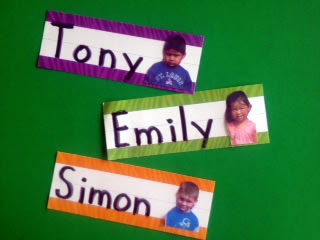
Directions: Write each child’s name on a card and glue their picture on the right as shown. Store the name cards in a box or basket.

Sign In
Place name cards by a large sheet of paper. Each day when children come to school they can find their card and write their name on the chart.

Writing Center
Keep cards in the writing center so children can use their friends’ names to write stories, notes, etc.

Transitions
Pull names to line up, answer questions, go to centers, etc.

Seating
Place cards on the rug before circle time. Children find their name and sit in that spot. (The cards can be used in a similar manner for snack or table activities.)
NOTE! This is a perfect way to separate children who challenge you.

Mystery Name
Choose one child’s name each day and place it in an envelope. Give clues about the consonants and vowels in the name. For example, “This person’s name has one vowel and it is in the middle.” Write an “a” on the envelope. “Whose name could it be? This name has a /t/ sound at the end.” Write a “t” on the envelope. “Anybody guess whose name this might be? There is a /p/ at the beginning of this name.” Write a “P” on the envelope. “Stand up if this is your name.” Pull the name card from the envelope to verify.


BINGO
Give children dry cereal or buttons and let them play Bingo with their name cards. As you call out letters they cover them up if they are in their name.

Hint! As children become familiar with their names, let them choose a symbol or sticker to replace their photo. During the next stage, write each child’s name using a different color for the first letter in their name. Finally, just use cards with the children’s names.

Wednesday, July 15, 2026

THAT'S MY NAME


Names are very important to children. (Call them by the wrong name and they will let you know about it!) Here are some songs and chants you can use to help the children learn their classmates’ names as you nurture your “classroom family.”

Who Ate the Cookie?
Child’s name ate the cookie (Hold up name card.)
in the cookie jar.
Who me? (First child responds.)
Yes you. (Class chants.)
Couldn’t be? (First child.)
Then who? (Class chants.)
Second child’s name ate (Hold up another name.)
the cookie in the cookie jar…

*Cut out paper cookies and write the children’s names on them. Store in an empty cookie box and use as you say the chant.


*Cut out gingerbread cookies. Glue children’s faces on the head and write their names on the bodies. Add a strip of magnetic tape to the back and these can be used for signing in, the question of the day, or graphs.


*Make cookies and glue the child’s photo to one side and print their name on the other side. Place the cookies face down on the floor. Children try to read their friends’ names and then flip over with a spatula to confirm.


Hickety Pickety
(Clap hands and snap fingers.)
Hickety, pickety bumblebee
Who can say their name for me? Child’s name.
Clap it. (Clap out syllables as you say the name.)
Snap it. (Snap syllables in name.)
Whisper it. (Whisper name.)
No sound. (Lip sinc name.)

Name Cheer
(Cheer each child’s name.)Give me a ‘K’.
‘K’ - I’ve got a ‘K,’ you’ve got a ‘K.’
Give me an ‘i’…Give me an ‘M’
What’s it spell? ‘Kim’ Say it again. ‘Kim’ One more time. ‘Kim’ Yeah!!!

Shakey, Shakey
(Clap hands or slap knees.)
Child’s name, child’s name sick in bed.
Called the doctor and the doctor said,
“Get up child’s name, you’re not sick.
All you need is an exercise trick.”
So hands up, and shakey, shakey, shakey.
Get down and shakey, shakey, shakey.
Turn around and shakey, shakey, shakey.
Sit down and shakey, shakey, shakey.

Hint! When doing these chants, never force children to participate. If you have a very shy child, I would ask them if they would like you to use their name. Often, they want to hear their name, but they don’t want to stand up and dance.

Little Red Box
(Tune: “Polly Wolly Doodle”)
I wish I had a little red box
To put my child’s name in. (Hold up name card.)
I’d take him/her out and go,
“How do you do?” (Pretend to shake hand.)
And put him/her back again.
*Sing “Hug, hug, hug” instead of “How do you do?” as you pretend to hug.
Cover a small box with red paper and insert the name cards. Pull out one at a time as you sing the song.


Pick It Up
Have children stand in a circle. Spread name cards in the middle on the floor. The children find their name and pick it up when you sing it in this song that goes to the tune of "If You're Happy."
If your name is child's name pick it up.
If your name is second child's name pick it up.
If your name is third child's name pick it up.
If your name is fourth child's name pick it up.


Letter Song
(Tune: “The Bear Went over the Mountain”)
Use the first letter of each child’s name as you sing.

W is for Will,
W is for Will,
W is for Will,
And he’s a friend of mine.

BINGO
(Traditional Tune)
There is a friend in our class
And David is his name-o.
D – A – V – I - D
D – A – V – I - D
D – A – V – I - D
And David is his name-o.
*Hint! You may have to be creative as you use different children’s names in this song. Short names you will have to stretch out and long names try using the first five letters.

Thursday, July 2, 2026

PLAYING WITH LETTERS

PLAYING WITH LETTERS is meant to be a resource that you can use with any reading or alphabet program that your school has selected. The ideas can be adapted for circle time, learning centers, small group instruction, take home activities, brain breaks, or transitions to provide children with learning opportunities throughout the day. Think of these activities as a spoonful of sugar to make those skills and standards “taste” more fun!


https://drive.google.com/file/d/1lG6M8DVJP2umDSVMAdv5uq1vF0l3XjBo/view?usp=sharing

The activities in our book are organized around these categories:

Touch and Tell (Multisensory)

Teaching Transitions

ABC Tools and “Toys”

Let’s Play and Learn Games

Letter Land (Classroom Print &Alphabet Books)

Ready to Write

Letter Centers

Singing Letters and Sounds

Alphabet Poetry Book

NOTE!

Many teachers question how they should introduce letters. Should you do capital letters first? Is there a specific order you should follow? There is NO definitive research to support one particular strategy. Children come to you with so many varied experiences and skills that one size will not fit all. However, there are two principles that we think are important.

First, make it authentic! Teach letters in context and connect with children’s names, units of study, nursery rhymes, and other interests. For example, a trip to the pumpkin patch would be the perfect time to talk about Pp. Talk about the letter Jjwhen you say Jack and Jill. If your football team is the Falcons discuss the letter Ff.

Second, make it playful and challenging. Use hands-on activities, songs, movements, and games to stimulate multiple senses. Blocks, play dough, puzzles, and magnetic letters are much more REAL than a worksheet or computer game.

Finally, remember that children take it in and take it in and take it in – and then something comes out! They don’t all learn in the same way at the same time, so you have to provide a variety of opportunities to learn. The key is to keep it fun and make them feel successful. 

HINT!  You’ll also be able to adapt many of these strategies for other skills, such as sight words, math concepts, etc.

Tuesday, June 16, 2026

GREAT TEACHERS 113

Yes, indeed, there were some great teachers with great ideas in North Carolina in 2013!

Envelope Factory
This is how teachers take an idea and milk it for all its worth! I’ve showed you before how to cut an envelope in half to make a puppet. Look how this can be used to reinforce Standards.


*Put a period on one side and a question mark on the other. When the teacher makes a statement, children hold up the period. When the teacher asks a question, the children hold up the question mark.
*Write “fact” on one side and “opinion” on the other side.
*Write “fiction” on one side and “non-fiction” on the other side.
*Write “yes” on one side and “no” on the other side for a quick review.


Letter Pops (Kristi Moore)
Glue upper and lowercase letters on jumbo craft sticks. Children can match letters that go together.

*You could also use these for helping children find a partner.


Silent Math (Cindy Lang)
While students are waiting for the restroom or drinking fountain, one student shows the person beside them a number on their fingers and then a function sign (+ or -) and another number. The friend will answer by showing the correct number of fingers. Continue playing until everyone is back in line.


Syllable Stepping (Michaela White)
As a way to transition and line up students, have them step out syllables and sounds. Every student stands in place. The teacher (or student helper) calls out a word. The students move according to the syllables they hear.
Ex: arctic – 2 syllables – walk 2 steps in line
*Segment sounds (CVC words, etc.) by stepping for each sound and then sliding as you blend the sounds.


Twister (Traci Branch)
Use a Twister mat and write words, numerals, letters, etc. on the circles. Write the words on the spinner and let the children play.
Hint! A shower curtain can be used to make the game with a homemade spinner.


Word Family Step Book (Gaye Vitolo)
Staple a step book at the top and cut up as shown. Write a different rime on each section and then challenge children to write all the words they can that end with that sound.
*Use for long vowel, short vowel, and r controlled.
*Use for tenses or place value.


Question Strategy (Jamie Turnage)
Students tap their brain to think of the answer to a question and then blow the answer in their hands. They all release the answer on the count of three.


Wolfpack Cheer (Julie Earnhardt, Lisa Byrom, Joan Munn)
Stick index finger and pinky up in the air and then touch middle finger and ring finger to your thumb to make the “wolf.” Children can make fingers “bark” as they give a silent cheer for their friends.


Schoolwide Vocabulary Parade
(Tammi and Tiffany from Manchester El.)
This is a one month project. First, each child chooses a word and writes a proposal with the word, the definition, a sentence, and a picture.
Kindergarten – nouns
1st Grade – verbs
2nd Grade – adjectives
3rd Grade – multiple meaning words
4th Grade – similes
5th Grade – idioms
Based on their word, each child creates a hat that they wear on a special day and they parade around the school.


Word Wall Wednesday
(Joan Munn)
Ask questions about words on the word wall. Assess by having the student write down their answer on a “ticket.”
*On “Thinking Thursday” do math word problems.

Sunday, June 14, 2026

GREAT TEACHERS 111

I’m sharing more good news and good ideas with you today!

Sharing Good News (Jessica Williams)
Write children’s names on craft sticks and place in a jar that says “Good News.” The teacher starts every morning by sharing her own “good news.” The children clap or cheer for her. Next, she pulls a stick and the class sings, "Tell me something good!" That child shares their good news and then the class does a cheer. The teacher pulls the second stick and they sing, "Tell me something good" and then cheer. Do three children each day and then put those who have had a turn in an envelope and start all over again when everyone has had a turn.


Whisper and Release Questioning Strategy (Mary Claire Porter)
When the teacher asks a question have the children blow their answer into their closed fist. When the teacher says, “What is it?” they “release” their answer by opening their hand and saying the answer out loud.


Name Bingo
Play BINGO using children’s names and googly eyes. Write children’s names on sentence strips and give them googly eyes. “I spy the letter R. “ If children have an “R” in their name they cover it up with a googly eye.


Category Game
The children repeat after the teacher:
“Pink is a color.” (Children repeat.)
“Purple is a color.” (Children repeat.)
“A square is a color.” (Children yell NO!)
Adapt for shapes, objects in a house, rhyming words, numbers, and other categories.


Eating the Alphabet (Yolanda Coppedge)
You will need upper and lowercase magnetic letters, a bowl, spoon, and alphabet cards. Each child uses the spoon to scoop out a letter. They have to name the letter, make the sound, and say something that starts with the sound before matching it to the alphabet card.

ABC Tune (Marina Attix)
Did you know that you could sing the ABC’s to the tune of “Mary Had a Little Lamb.” It’s great because L M N O P don’t end up sounding like “a lemon and a pea.”


Class Pictionary
Each day choose a different letter of the alphabet and write it on a large sheet of paper. Let the children cut out objects or draw pictures of things that start with that sound. Be sure and label their pictures. After introducing all 26 letters, put the pages together to make a BIG BOOK PICTIONARY for your classroom. Don’t forget to add a page for illustrators and the publisher (school, city, and state). You could also let the children dedicate the book and make a page that says “The End.”


Silly Band Writing
This is the coolest idea with silly bands. Explain that when you go for a ride in the car you have to wear your seat belt. When you write you have to put a seat belt on your pencil. Put a silly band on your wrist, hold your pencil, and then loop the silly band around the pencil. It will stabilize the pencil and make it easier for the children to write.
*A teacher also suggested holding the lid of the marker in your hand when you draw to get the correct grip.


Who Stole the Sound? (Candice Hall)
Adapt “Who Stole the Cookie?” to letters. Write letters on cookie shapes and place them in a bag. Pass the bag around and as children pull out a letter say:
Who stole the letter sound from the cookie jar?
Child’s name stole the letter sound from the cookie jar!
Who me?
Yes, you!
Couldn’t be.
Then who?


Sunday, April 26, 2026

ABC COUNTDOWN

Years ago Brad McKinney (Kindergarten Teacher at Severn Elementary) emailed this idea to me. I was searching through old blogs and I found it!! With all the craziness this past year, the ABC COUNTDOWN might end your year on a positive note. It's something that you could easily adapt to your calendar or teaching situation.

Note! As someone once told me, "It doesn't matter what you serve your guests for dinner. Just make sure the dessert is good because that's what they'll remember." Think of this last month of school as "dessert"! Make it GOOD and HAPPY!


Parents and Guardians,

Believe it or not, the school year is quickly coming to an end. During the last 26 days of school, our class will be participating in an ABC Countdown. Each school day will have a different activity related to the letter for that day. Your child may need to wear or bring something special on some days – those days are underlined. This sheet will help you and your child remember what day of the countdown we are on.


A
Monday
Animal Day
Bring your favorite stuffed animal to school

B
Tuesday
Bubble Day
We will be making and blowing bubbles

C
Wednesday
Card Game Day
Bring your favorite card game to play at school

D
Thursday
Dinosaur Day
We will be dinosaur detectives

E
Friday
Everybody dress in your favorite team shirt

F
Wednesday
Fruit Day
Bring your favorite fruit for snack today

G
Thursday
Going on a picnic
Bring a packed lunch!

H
Friday
Hat Day
Wear your favorite hat to school

I
Monday
Imagine Day
Imagine you had a magic wand - what would you wish for?

J
Tuesday
Joke Day
Write down your favorite joke to share with class

K
Wednesday
Kick Off Your Shoes Day
You will be able to take your shoes off in class all day

L
Thursday
Leisure Day
We will relax outside with a book (weather permitting)

M
Friday
Memory Day
We will be writing about our favorite memories from kindergarten this year

N
Monday
Nature Day
Make binoculars and go on a nature walk

O
Tuesday
Orange Day
Wear the color orange and bring an orange for snack

P
Wednesday
Picnic Day
Bring a packed lunch from home

Q
Thursday, June 12
Quiz Your Teacher Day
Bring your hardest question to stump your teacher.

R
Friday
Roadrunner Field Day
Field day games and activities outside with entire grade level

S
Monday
Sidewalk Art Day
We will be decorating a section of the sidewalk

T
Tuesday
Talent Show Day
Share your talent with the class

U
Wednesday
Used Book Day
Bring a used book you would like to donate to the class or library

V
Thursday
Veggie Day
Bring your favorite vegetable for snack

W
Friday
Wishy Washy Day
Be prepared to get wet!

X
Monday
X-change Autographs Day
Make an autograph book and collect as many autographs as you can

Y
Tuesday
Year End Clearance
Bring a bag to gather all your items from the year

Z
Wednesday, June 25
Zoom Out of School Day
Last day of kindergarten

Wednesday, March 18, 2026

SPRING"ING" INTO SKILLS

Spring, spring, where are you? March 20th is the “official” first day of spring, so here are some activities that you can use in your lesson plans to help kids PLAY and LEARN!

Spring-O
Make a bingo card with signs of spring and objects that children can find on your playground. Children can walk around the playground and and color in the objects as they find them. Children could do this activity individually or with a partner.


Scavenger Hunt
Here’s a spring hunt for older students. Divide them into groups of 4 and give each group a clipboard with the items below. Have them record their answers. When you return to the classroom groups can share their results and compare answers.

Can you find a sign of spring? 

Can you find something older than you? 

Can you find something younger than you? 

Can you find something rough? 

Can you find something that feels soft? 

Can you find something living? 

Can you find something dead? 

Can you find something smaller than your fingernail? 

Can you find something bigger than you? 

Can you find something green? 

Can you find something yellow? 

Can you find something that smells good? 

Can you find some trash? Pick it up and throw it away! 


Long and Short
Give children a piece of string or yarn. Challenge them to walk around the playground and find objects that are "longer" than their string and "shorter" than their string.


Alphabet Walk
Divide children into groups of four and give each group a sheet of paper with the letters of the alphabet. (They will also need a pencil and a clipboard to write on.) Challenge groups to find as many objects as they can for the letters in the alphabet. For example: A-acorn, B-bird, C-cloud, D-dirt, etc.

Shape Hunt
Cut circles, squares, rectangles, and triangles out of construction paper and put them in a bag. Children choose a shape and then try to match it up with a similar shape on the playground.
*Have children lie on the ground and make shapes with their bodies. Take photos to make a class book.

Bounce and Count
How many times can they bounce a ball and catch it? How many times can they toss a ball with a friend and not drop it?
*Have each child silently count the steps from the classroom to the playground. Compare their answers.

Sunday, November 9, 2025

ALPHABET BOOKS

A B C D E F G
Make an alphabet book with me!
H I J K L M N O P
Take a look and you will see.
Q R S T U V
Alphabet books from A to Z!

Here are some alphabet books you might want to create with your class. They are a perfect vehicle for alphabet knowledge, reading for information, reading foundations, and many other language skills. And, you know when your children make a book there is a sense of “ownership” and they will want to read it.

I Can Read!
Take 26 large sheets of paper (12” x 16”) and write a different letter on each page. Put pages between construction paper to make a book called “I Can Read My ABC’s.” Hole punch and bind with book rings. Invite children to bring in words from food labels, stores, catalogs, etc. that they can read. As children bring in their words, help them match up the first letter with the same letter in the book and glue their word on that page.


See - Sign - SING!
Enlarge copies of the sign language alphabet. Put a different letter and sign on each page; then let different children illustrate a picture that begins with that sound. Bind together to make a book. Encourage the children to reproduce the signs on each page as they read the book.
*Take digital photos of children making the different signs.
*Cut hands out of felt and glue them to make manual signs.
*You can also make a Braille alphabet book by using drops of glue to represent the different Braille letters.


Alphabet Art

Write large letters of the alphabet on paper. Give each child a letter and challenge them to create a picture around their letter. “What does your letter look like? Does it remind you of something? Can you use your crayons to turn it into that object? Try to ‘camouflage’ it so no one knows what your letter is.” Put their drawings together to make a book. Can they find the letter hidden in each picture?
*Give each child the letter that their name begins with to make this book.
*Challenge older children to turn their letter into an object that begins with the sound their letter makes.


Touch and Tell ABC Book
Make letters out of different textures, such as sandpaper, felt, yarn, canvas, fake fur, etc.


AlphaBODY Book
Challenge children to make letters with their bodies. Or, divide children into small groups and ask them to make letters.


Themes and Holidays

Make alphabet books that coordinate with various themes, holidays, and
seasons. For example, if you are studying the ocean make a “Ocean ABC
Book.” Wouldn't a "Thankful Alphabet Book" be a perfect project next week?

Oh, but what until you see the special alphabet book I'll have on my blog tomorrow!!!!

Tuesday, October 28, 2025

CANDY WRAPPERS

Turn those candy wrappers into a learning activity. Have children safe their wrappers and then do some of these "yummy" activities.


Counting - Count the wrappers. Tally how many in the whole class.

Sets - Make sets with the wrappers.


Sorting - Sort the wrappers. What’s the sorting rule? Can they regroup them?

Graphing
- Use the wrappers to graph their favorite candy bar.

Nutrition - Look at the food value on each wrapper. How many calories? How much sugar? Rank the candies by calories.

Vocabulary - Find descriptive words on the wrappers. Make a list of the words and use them in sentences.

Writing - Fold 2 sheets of paper in half and staple to make a book. Children write “I like…” at the top of each page and glue a candy wrapper underneath. This is a book every child in your room can read! Older children could write descriptive sentences about each candy.


Alphabet Letters
- Use the wrappers to make a class book called “The Sweet ABC’s.” Write alphabet letters on 26 sheets of paper. Children glue their wrappers to the appropriate letter. Bind pages together to make a book.
Hint! If you don’t have a wrapper for each letter, let children suggest “sweet” words for the page.


Money
- Glue candy wrappers to a file folder. Write a coin value by each wrapper. Children count out the appropriate amount and place it on the wrapper.
Hint! For young children, price the candies from 1 cent to 10 cents and give them pennies. Make the amounts higher for older students.

Art - Let children use wrappers to make a collage.

Finally, take advantage of this “teachable moment” by discussing why sugar is not good for their bodies. What happens if you eat too much sugar? Make a list of healthy snacks that would be better food choices.

Friday, October 17, 2025

ANOTHER DOSE OF VOCABULARY VITAMINS

When teaching vocabulary to children, experts suggest using interesting words and building bridges between children’s experiences and words. What a perfect time of year to enrich children’s vocabulary with “spooktacular” and “bootiful” words.

Note! These activities can be used for Halloween words, Thanksgiving words, autumn words, or any unit of study.

Brainstorm
Brainstorm “spooky” words, Halloween words, or other seasonal words. How many words can they come up with? Write them on the board as children call them out.
*Older children could brainstorm as a small group activity.

Dramatize Words
Call out nouns or adjectives like “skeleton,” “mummy,” “spooky,” “haunted,” for the children to dramatize. Encourage them to use their faces, hands, and whole bodies.

Pantomime
Write seasonal words on index cards and put them in a sack. Children choose a word and pantomime while their friends try to guess.

Seasonal Alphabet
Write the letters of the alphabet on a sheet of paper. Can they think of a seasonal word for each letter? Example: A - apples, B – bats, C – candy, D – Dracula…

Picture Words
Challenge children to turn words into pictures they represent.


Grow a Sentence
Write a simple sentence on the board. Can children add words to the sentence to make it grow?
I see a pumpkin.
I see a big pumpkin.
I see a great big enormous pumpkin.
I see a great big orange enormous pumpkin.
I see a great big orange enormous pumpkin on the porch.
I see a great big orange enormous pumpkin on the front porch.
I see a great big orange enormous pumpkin on the front porch smiling….

Monday, September 8, 2025

ALPHARDEE OR ALPHARDY???

It really doesn’t matter how you say it, but you’ll find this song one of the most meaningful tunes you can do with your students. I’ve had countless teachers tell me that they do this song every morning at circle time with their students. By repeating the song daily and adding motions and sign language children are able to make the connections between letters and sounds. This is also helpful for children who have trouble articulating some of the sounds.

Alphardy (“Jeopardy" Tune)
A for apple /a/ /a/ /a/ (Pretend fist is an apple.)
B for bounce /b/ /b/ /b/ (Bounce a ball.)
C for cut /c/ /c/ /c/ (Open and close index and middle fingers as if cutting.)
D for dig /d/ /d/ /d/ (Pretend to dig.)
E – elbow (Point to elbow.)
F – fan (Fan self with hand.)
G – gallop (Gallop in place.)
H – hop (Hop on one foot.)
I – itch (Scratch self.)
J – jump (Jump up and down.)
K – kick (Little kicks with foot.)
L – love (Hug self.)
M – munch (Move mouth as if eating.)
N – nod (Nod head.)
O – opera (Extend arms and sing dramatically.)
Q – quiet (Index finger on lips.)
R. – run (Run in place.)
S – sew (Pretend to hold a needle and sew.)
T – talk (Open and close fingers like a mouth.)
U – upside (Lean over.)
V – volley (Hands in air and pretend to volley a ball.)
W – wiggle (Wiggle all over.)
X – x-ray (Make “x” with arms.)
Y – yawn (Extend arms and pretend to yawn.)
Z – zigzag (Make an imaginary “z” in the air.)
Letter sounds are all you need.
Put them together and you can read! (Hold palms together and open like a book.)


I love this video with the manual signs for letters that Mariela Anderson recorded.

https://www.youtube.com/watch?v=p3JKf4vCeKA


*You can download this book at drjean.org.
http://www.drjean.org/html/monthly_act/act_2005/03_Mar/Alphardy.


Alphardy Poster

Run off this chart for each student and glue to a file folder. Children can use this for choral singing or for independent work at the listening center. If you give them a pretzel stick or Bugle for a pointer they’ll get a little snack at the end of the song!


http://www.drjean.org/html/monthly_act/act_2005/03_Mar/pg04a.html


Letter Office
Children will enjoy making their very own letter office and then using it for the activities below. First, tape two file folders together. Let children decorate the outside, and then glue a copy of alphabet letters on the inside.


Sing and Track

Have children point to the letters as you sing various alphabet songs. (“The Alphabet in My Mouth,” “Who Let the Letters out?” or “Letters You Should Know” all work well.)

I Spy!
Play “I Spy” and other games where children have to identify letters. Can they find the letter that makes the sound at the beginning of “hop”? Can they find the letters in their name? What comes between G and I? Can they match up magnetic letters with the letters in their office?

Partner Play
Use the offices for working with a friend. Read the capital letters, lowercase, consonants, vowels. Read loud, soft, fast, slow, backwards, and other variations. Let friends take turns calling out letters (or sounds) for their partner to identify.

Family Time
Invite children to take their letter offices home and play games with their parents.

*Take turns naming letters and touching them.

*Sing Alphabet songs and track the letters.

*Look around the house for letters that match.

*Find letters in family members’ names.

Wednesday, August 27, 2025

ACTIVE ALPHABET

Here are some active alphabet songs that you can say instead sing.

ABC Kick Box 

Children stand and make fists with their hands. Explain that you will punch across with your right hand and say a letter. Then punch across with their left hand and make the sound.


A – Punch with right hand
/a/
B - Punch with left hand /b/
C…through Z


https://www.youtube.com/watch?v=yMeGvS0x0kM

Phonercise

Children stand and put their hands in the air as they say a letter. They put their hands on their shoulders and make the letter sound. As they touch their toes they say a word that starts with that sound.


A (Hands up in the air and say “A.”)

/a/ (Hands on shoulders and make the short /a/ sound.)

(Say a word that starts with “A” as you touch your toes.)


*Have older children say words that are nouns, verbs, or other parts of speech as you touch your toes.


https://www.youtube.com/watch?v=OxrUgwVbqoM


Karate Writing
Explain that some letters are tall. They start at the top dotted line. Some letters start at the middle dotted line. Some letters have a tail. They go below the line. Sing the “Alphabet Song” stretching up in the air for tall letters, putting hands on waist for short letters, and touching the ground for letters with a tail. For example:

A -hands on waist
B - hands in air
G - touch ground


https://www.youtube.com/watch?v=CkNND0qZP9g

ABC Rap Clap
Begin a pattern by slapping thighs once and clapping twice.
A (slap on the letter and then clap twice)
B (slap, clap, clap)
C (slap, clap, clap)
D….Z

Alpha-Bodies

Children stand and as you call out letters they try and make the letter with their body.
*Spell sight words or vocabulary words with their bodies.

Tuesday, August 26, 2025

SINGING LETTERS

Music is the most natural way to learn anything. Mary Ann Wolf (one of the top reading researchers in our country) recommends singing alphabet songs with young children. She explains that songs act like an umbrella and “place holder” in the brain. When the letters and sounds make sense to the children, they have a “place” to go.

There are many ways to introduce alphabet songs, but it might be helpful to introduce a new song each week. Sing it every morning to start your day, and then use it as a brain break during the day. The next week you can teach the children another song and then review the song you sang the previous week. Write the titles of the songs as you introduce them on a sentence strip and add a picture clue. That way you can let children choose different songs and repeat them.

Visual Connections
As you sing alphabet songs, it will be helpful to connect the visual with the auditory. You can use alphabet cards or point to the letters in your classroom.

Stop and Touch
Here’s another technique that will help children connect with the letters as they sing. Have the children stand and dance as you play an alphabet song. Stop the music on a random letter. At this point, children must tiptoe around the room, find that letter, and touch it. Continue playing the song stopping at several random letters.

Note! This is a fun way to teach self-regulation and to help children make a physical connection with the letter name and symbol.


LETTER TAILS (Tune: "Gilligan's Island")
This is one of my favorite alphabet books that Barb Smith created several years ago. It's good for letter recognition, phonics, and visual closure (recognizing the whole from the part).

This is a tale about the letter A.
It makes a special sound.
/a/ /a/ /a/ /a/ A!
Let’s learn another sound.

This is a tale about the letter B….

You can download the book here. If you’ll glue the cover to the front of a pocket folder and put the pages in clear sheet protectors the book will last for a long time.


http://www.drjean.org/html/monthly_act/act_2013/09_Sep_css/pg06.html

Hint! This is a great book to put in your listening center with the song.

Here’s a YouTube video of this song:

https://www.youtube.com/watch?v=8rEzOQn5ElM

Singing Names
Insert children’s names in the song:
D for Darren /d/ /d/ /d/
E for Erin /e/ /e/ /e/
S for Sammy /s/ /s/ /s/
H for Hannah /h/ /h/ /h/

Singing Environmental Print

Adapt the words for environmental print:
M for MacDonald’s /m/ /m/ /m/
L for Legos /l/ /l/ /l/


HAPPY BIRTHDAY LETTERS

Who doesn’t like birthdays? Children will love dancing and singing this song.

Happy Birthday Letters
Yo, A,
It’s your birthday.
Let’s all read
Like your birthday.
/a/ /a/ /a/ /a/ /a/ /a/
Yo, B…etc.

*Have children stand in a circle and act like rappers. When the letter that their name begins with comes up in the song they get to jump in the middle of the circle and dance.

Letter Birthday Hats

Let the children make birthday hats from sentence strips and wear them as you sing “Happy Birthday Letters.” (Our old stick pony is modeling the birthday hat for you.)

Birthday Cake
Draw a birthday cake on a magnetic board and sing the letters as you place them on the cake:

Yo, M, it’s your birthday.
Let’s all sing like your birthday
/m/ /m/ /m/ /m/ /m/ /m/
/m/ /m/ /m/ /m/ /m/ m/


Here’s a link so you can download the birthday cake.
https://drive.google.com/file/d/0B1SnEagA4jljNTdjZWVlZzR5Zmc/view?usp=sharing


Rapper Necklace
Cut letters out of heavy cardboard. Let children decorate them with fake jewels, glitter, or stickers. Punch holes in the letters and tie on string. Children can wear these as you sing this song.


More?

Clap, jump, hop, march, tip toe, and make other movements as you sing the ABC's.