photo 3am_dj_home_zps919fb85e.png photo 3am_dj_about_zps7cce4c75.png photo 3am_dj_website_zps73051235.png photo 3am_dj_ss_zps6759ec2a.png photo 3am_dj_bs_zps43e27832.png
Showing posts with label Vocabulary. Show all posts

Tuesday, July 14, 2026

DESIGN ON A DIME

As I was looking through old blogs I found some super simple and inexpensive ideas to add a little BLING to your school.

Mirror, Mirror!
You know how much kids love to look at themselves in a mirror. Each day put a positive word or note on your classroom mirror to remind the children how special they are!

Hint!  Write a different positive character trait on the mirror each week.


What a clever idea to use a real picture frame to display children’s artwork!


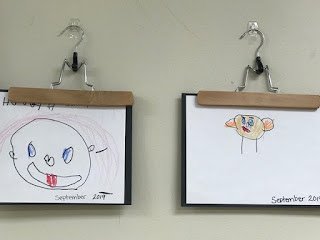
Or how about displaying children's artwork or writing using pants hangers?


I loved this idea from KIRPC Head Start in Indiana. The teacher said she bought sheets, tied the ends with ribbons, and then hung them on hooks around the smart board. Taaa daaa!


Chalk Board Table
Is this cool or what? Ms. Smalls found an old table they were going to throw away. She painted the top with chalkboard paint and let the children write special messages, draw pictures, write sight words, etc. on it. The kids LOVED it!


How about addition facts on the stairs? The science vocabulary leads to the upper grades. Letters, numbers, shapes and so many skills could “step up” learning.

Tuesday, June 16, 2026

GREAT TEACHERS 113

Yes, indeed, there were some great teachers with great ideas in North Carolina in 2013!

Envelope Factory
This is how teachers take an idea and milk it for all its worth! I’ve showed you before how to cut an envelope in half to make a puppet. Look how this can be used to reinforce Standards.


*Put a period on one side and a question mark on the other. When the teacher makes a statement, children hold up the period. When the teacher asks a question, the children hold up the question mark.
*Write “fact” on one side and “opinion” on the other side.
*Write “fiction” on one side and “non-fiction” on the other side.
*Write “yes” on one side and “no” on the other side for a quick review.


Letter Pops (Kristi Moore)
Glue upper and lowercase letters on jumbo craft sticks. Children can match letters that go together.

*You could also use these for helping children find a partner.


Silent Math (Cindy Lang)
While students are waiting for the restroom or drinking fountain, one student shows the person beside them a number on their fingers and then a function sign (+ or -) and another number. The friend will answer by showing the correct number of fingers. Continue playing until everyone is back in line.


Syllable Stepping (Michaela White)
As a way to transition and line up students, have them step out syllables and sounds. Every student stands in place. The teacher (or student helper) calls out a word. The students move according to the syllables they hear.
Ex: arctic – 2 syllables – walk 2 steps in line
*Segment sounds (CVC words, etc.) by stepping for each sound and then sliding as you blend the sounds.


Twister (Traci Branch)
Use a Twister mat and write words, numerals, letters, etc. on the circles. Write the words on the spinner and let the children play.
Hint! A shower curtain can be used to make the game with a homemade spinner.


Word Family Step Book (Gaye Vitolo)
Staple a step book at the top and cut up as shown. Write a different rime on each section and then challenge children to write all the words they can that end with that sound.
*Use for long vowel, short vowel, and r controlled.
*Use for tenses or place value.


Question Strategy (Jamie Turnage)
Students tap their brain to think of the answer to a question and then blow the answer in their hands. They all release the answer on the count of three.


Wolfpack Cheer (Julie Earnhardt, Lisa Byrom, Joan Munn)
Stick index finger and pinky up in the air and then touch middle finger and ring finger to your thumb to make the “wolf.” Children can make fingers “bark” as they give a silent cheer for their friends.


Schoolwide Vocabulary Parade
(Tammi and Tiffany from Manchester El.)
This is a one month project. First, each child chooses a word and writes a proposal with the word, the definition, a sentence, and a picture.
Kindergarten – nouns
1st Grade – verbs
2nd Grade – adjectives
3rd Grade – multiple meaning words
4th Grade – similes
5th Grade – idioms
Based on their word, each child creates a hat that they wear on a special day and they parade around the school.


Word Wall Wednesday
(Joan Munn)
Ask questions about words on the word wall. Assess by having the student write down their answer on a “ticket.”
*On “Thinking Thursday” do math word problems.

Saturday, May 16, 2026

ANIMAL CRACKERS

Some things like animal crackers never go out of style!

Animal Crackers
By Dr. Holly
Lions, and tigers, and bears, oh, my!
In my box that’s what I spy.
Take them out.
Should I run?
No, I’ll eat them!
Yum! Yum! Yum!

Descriptions
Pass out an animal cracker to each child. Encourage them to write descriptive sentences about their cracker. I see… I smell… I feel… I hear… I taste!


Tag Along Book
Cut the front and back off a box of animal crackers. (Be sure and leave the string attached.) Cut paper the size of the box. Give each child a sheet and ask them to draw a zoo animal or write a description of a zoo animal. Put their pictures between the front and back of the box and staple to make a book.

Hint! This is called a tag along book because they can hold it and it will tag along with them!


Math
Use zoo animal plates for simple addition. Children make sets in each ear and then join them together and count the sum. You can use math counters, buttons, popcorn, or cereal.


Vocabulary
What does it mean to be a carnivore? Herbivore? Omnivore? What are you? Do some research to find out eating habits of different zoo animals.


Sorting
Use animal crackers, toy animals, or pictures to sort zoo animals. Ask children what sorting rule they used. Can they think of another way to sort the animals?


Put Me in the Zoo

Do a language experience chart where children fill in the sentence:
If I were in the zoo I would be…
Let them draw pictures of which animal they would like to be. Why did they choose that animal?


Zoo Treats


You will need graham crackers, animal crackers, and peanut butter to make this snack. Children put a small amount of peanut butter on the graham cracker and stand animal cookies up on it.


*You can use icing or honey for children with peanut allergies.

Tuesday, May 5, 2026

WE'RE GREAT!

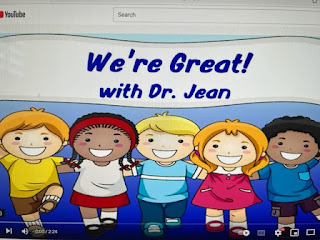
Here's great song for a positive memory at the end of your school year. It's a natural way to introduce vocabulary words and positive character traits.

We’re Great!
We’re great, but no one knows it.
No one knows it so far.
Some day they’ll realize how wonderful we are!
They’ll look at us, and point at us,
and then they’ll shout, “Hurray!”
Let’s cheer how we’re wonderful beginning with A.

A- We’re awesome.
B- We’re brave.
C- We’re creative.
D- We’re dynamic
E- We’re enthusiastic
F- We’re fantastic.
G- We’re gifted
H- We’re honest
I- We’re imaginative
J- We’re joyful.
K- We’re kind.
L- We’re lovable
M- We’re magnificent.
N- We’re nice.
O- We’re outgoing
P- We’re polite.
Q- We’re quick.
R- We’re responsible
S- We’re special.
T- We’re terrific.
U- We’re unique.
V- We’re valuable.
W- We’re wonderful.
X- We’re excellent.
Y- We’re youthful
Z- We’re zany!

http://bit.ly/drjean_Great

Hint! One teacher said each child decorated a poster with a letter and word. The children came out on stage with their letter at the appropriate time as they sang the song.

Class Book
On the front of the notebook or pocket folder write “We’re Great!” Write a
different letter of the alphabet on each page. Tell the children that you want them to help you make a special dictionary with WONDERFUL words that describe special people just like them! Use the words from the above chant to start your dictionary. Add words that children suggest.

Tuesday, February 24, 2026

BROCHURES

Giving children a “brochure” to write in is much more "inviting" than a blank sheet of paper.

Directions: Fold a sheet of paper into thirds to create a brochure.
*Or try this easy version: roll paper into a burrito/circle and “smush” flat.

Brochure / Step Books - https://bit.ly/drJBrochureStep

Narrated version: https://bit.ly/drJBrochureNar


Use for: 

story elements (title, favorite character, beginning, middle, end)
consonants or vowels (capital, lower case, pictures; long a, short a, aw sound)
all about me
assessment
field trip, vacation, place they’d like to visit
unit or theme (K-W-L)
sorting (pictures, letters, words, syllables)
fact families
biography (facts, accomplishments)
letters with lines, curves, lines and curves
inflicted endings
drawing a body


Monday, February 16, 2026

WE REALLY LIKE YOU!

You can put a little LOVE in your classroom, encourage positive behavior, and expand vocabulary with this activity.

Materials: gift bag, index cards, safety pins or tape

1st Have children brainstorm words that describe good friends. For example: wonderful, nice, helpful, responsible, kind, honest, etc.

2nd Suggest looking up additional words in the dictionary or a thesaurus.


3rd Write the adjectives on index cards and place the cards in a sack. You will need one for each child.

4th The next day let each child select a word from the sack at group time. Pin or tape the word on them as you sing this song to the tune of “We Wish You a Merry Christmas.”

We like you because you’re word .
We really like you!

5th Call the child by their word all day long instead of their name. For example, "Polite, would you be line leader?" If a child isn't behaving appropriately all you have to say is, "Do I need to take your word away from you?" They don't want to lose their word and will quickly do the right thing.

As a follow up make a book called "HOW TO BE A GREAT STUDENT." Let each child take their word and illustrate it and write (or dictate) a sentence about it.

Wednesday, February 11, 2026

ABRACADABRA

Use your finger like a magic wand as you wave it and say, "Abracadabra!." Explain that when you say a word, they must become the word. When you say, "Freeze!" they need to stand still until you wave your wand and say another word. For example, "Abracadabra! You're frogs!"


ANIMALS
Call out different animals for children to imitate.
Frog – Jump up and down.
Bird – Flap arms.
Mouse – Tip toe.
Horse – Gallop in place.
Monkey – Scratch under arms and bounce up and down.
Giraffe – Stretch arms high in the air and walk on toes.
Elephant – Arms together and swing like a trunk as you bend over.
Flamingo – Stand on one foot and balance.
Snake – Wiggle up and down.

Hint! Glue pictures to cards and hold them up for the younger children. Write words on flash cards for the older students.


SEASONAL WORDS
Use holiday or seasonal symbols to stimulate children’s brains and imaginations.

Scarecrow – Children flop arms around.
Bat – Flap arms.
Cat – Arch back and meow.
Pumpkin – Arms around head.
Spider, witch, Frankenstein, etc.


VOCABULARY WORDS
Reinforce vocabulary words by having children dramatize their meaning.

Seed – Bend down.
Roots – Stick out legs.
Stem – Stand up straight.
Leaves – Stretch out arms.
Flower – Arms around head as you smile.


PARTS OF SPEECH
Call out adjectives, adverbs, nouns, and verbs for children to dramatize.

Anxious, Brave, Curious
Slowly, Quickly, Angrily
Fire Fighter, Nurse, Chef
Chatter, Build, Sleep, Exercise
*Creativity can really blossom with this activity because there's no right or wrong way to do it.

MAGIC WAND!
How about making a magic wand out of a chop stick.  Dip the end in glue, roll in glitter, and ABRACADABRA!


Sunday, January 11, 2026

STAND UP FOR DR. KING

Dr. King’s birthday is January 19th so here are some activities to include in your lesson plans.

My daughter Holly wrote this song and I think it's one of the best to celebrate the life of Dr. King. The meaning of the song and the vocabulary you can teach are powerful!

Stand Up For Martin Luther King
(Tune: “My Bonnie Lies Over the Ocean”)
Dr. King stood up for justice. (Stand and sway
He stood up for equality, too. back and forth.)
Dr. King stood up for children.
He stood up for me and for you. (Point to self and then others.)
So now we…
Stand up, stand up, (March in place to the beat.)
Stand up for Martin Luther King.
Stand up, stand up,
Stand up for Dr. King.

Dr. King wanted all of America (Sway back and forth.)
To be tolerant, fair, and free.
He stood up for what he believed in.
He stood up for you and for me. (Point to self and the others.)
So now we…

Dr King taught us all to be dreamers (Sway back and forth.)
So one day the world could begin
To judge people based on their character
And not on the color of their skin.
So now we… (March in place.)

https://www.youtube.com/watch?v=dlL_O-B5m9w


MLK and KWL

Check out books from your school library on Dr. Martin Luther King, Jr. Put them in your class library and ask the children to see what they can find out about Dr. King. Use a KWL chart to begin your discussion. K – What do they already know about Dr. King? W – What do they want to learn about him? L – After reading books about Dr. King, add the new information the children have learned.

Heroes

Martin Luther King was a hero. Make a list of other people that the children consider to be heroes. What character traits does a hero have? Ask children to write stories about what kind of hero they would like be when they grow up.


Vocabulary


Brainstorm words that describe Dr. King and other heroes. Let each child choose a word, write it on an index card, hole punch the corners, and wear it as a necklace. Why did they choose that word? What can they do to demonstrate that word?

*You could also let them make crowns and write positive characteristics on them.


Acts of Kindness
Get a notebook and write “Acts of Kindness” on it. Encourage the children to record kind deeds their classmates do for them. Read over the book at the end of each day to encourage more positive behavior.

I Have a Dream
Dr. King had a dream, and it’s important for everyone to have dreams. Cut clouds out of white sheets of paper and have children draw or write about their dreams. Encourage them to share their dreams with classmates and display on a bulletin board or make a class book.

Monday, December 15, 2025

READY FOR WINTER?

December 21st is known as the winter solstice or the first day of winter. It is the shortest day and longest night of the year. Although your students will probably have sugar plums dancing in their heads this week, you might want to add a touch of science to your lesson plans with these ideas.


Science
Ask your students what causes winter. (Accept their answers without judging.) Have one child pretend to be the sun and stand in the middle of the circle. Use a globe to demonstrate how the earth rotates around the sun. It takes 365 days or one year for the earth to go all around the sun. Demonstrate how the earth tilts on its axis away from the sun to cause winter. Why? What happens when the earth tilts toward the sun?


Signs of Winter
Brainstorm signs of winter. What happens to the temperature in winter? What happens to the plants? What happens to animals?


Vocabulary
Make an attribute web of winter words. Include winter clothing, sports, holidays, etc.


Animals Adapt
How do animals adapt in the winter? What animals hibernate?
What animals migrate? How do human beings adapt?


Habitats
Some habitats are very cold in the winter with ice and snow. Other habitats are warmer in the winter. Use a map of the United States and have children identify their state. Do they have ice and snow in the winter? Can they find a state where it’s warm and sunny in the winter? What do they think causes the difference?


Internet Search
Visit a weather site, such as weather.gov, to compare regional weather.

Nature Walk
Go on a nature walk and look for signs of winter. Let each child take a digital photograph of a sign of winter. Put these together to make a class collage.


Trees
Explain that evergreen trees stay green all winter. Deciduous trees lose their leaves in the winter. Can they find evergreen and deciduous trees on the playground? Can they find them in their yard at home?

Make a Book
Staple two sheets of paper and let children use descriptive writing to make a book called “Winter Is…”

Creative Writing
Invite children to write a story about “Old Man Winter.” I found this great writing paper free at www.teach-nology.com.


Read a Book
What’s your favorite winter book to read to your class?

Saturday, October 18, 2025

WE CAN'T DO HALLOWEEN!

I know that some of you are not allowed to dress up on Halloween. I was looking through old blog posts with vocabulary words and I found this idea that Ginny McLay shared when I was in New Hampshire several years ago. It dawned on me that it would be a fun activity on October 31st - or any day.

Vocabulary Word Costume!
Ginny McLay and was inspired by her love of vocabulary to help her kids love learning new words with a costume party.

After focusing on words (synonyms, antonyms, nouns, verbs, and adjectives) invite children to think of a word that they LOVE, ADORE, AND ADMIRE and create a costume for their word.

Easy steps to make a costume!

1. Think of a few words that are really interesting.
2. Choose a word that you can make into a costume.
3. The word and definition must be somewhere on the costume.
4. Practice the word and definition
My word is _____. It means:_________.

Ideas for costumes:
1. Write the word and definition on a headband.
2. Write the word and definition on a piece of paper and make a necklace out of it.
3. Write the word and definition on a t-shirt and decorate with fabric paint.
4. Write the word and definition on a brown paper bag…cut it like a vest!
5. Use a costume you already have at home and think of a great word. Write the word and definition on a sash.


Can you tell? "Mysterious" and "celebrate"?

Great reads for vocabulary include:
Miss Alaineus – A Vocabulary Disaster by Debra Frasier
Fancy Nancy Books
Max’s Words by Kate Banks

NURSERY RHYME PARTY
A substitute for Halloween for younger children might be to have a nursery rhyme party. Children could all dress up like their favorite nursery rhyme character and then take turns reciting their rhyme. I'll share some snacks with you tomorrow.

Friday, October 17, 2025

ANOTHER DOSE OF VOCABULARY VITAMINS

When teaching vocabulary to children, experts suggest using interesting words and building bridges between children’s experiences and words. What a perfect time of year to enrich children’s vocabulary with “spooktacular” and “bootiful” words.

Note! These activities can be used for Halloween words, Thanksgiving words, autumn words, or any unit of study.

Brainstorm
Brainstorm “spooky” words, Halloween words, or other seasonal words. How many words can they come up with? Write them on the board as children call them out.
*Older children could brainstorm as a small group activity.

Dramatize Words
Call out nouns or adjectives like “skeleton,” “mummy,” “spooky,” “haunted,” for the children to dramatize. Encourage them to use their faces, hands, and whole bodies.

Pantomime
Write seasonal words on index cards and put them in a sack. Children choose a word and pantomime while their friends try to guess.

Seasonal Alphabet
Write the letters of the alphabet on a sheet of paper. Can they think of a seasonal word for each letter? Example: A - apples, B – bats, C – candy, D – Dracula…

Picture Words
Challenge children to turn words into pictures they represent.


Grow a Sentence
Write a simple sentence on the board. Can children add words to the sentence to make it grow?
I see a pumpkin.
I see a big pumpkin.
I see a great big enormous pumpkin.
I see a great big orange enormous pumpkin.
I see a great big orange enormous pumpkin on the porch.
I see a great big orange enormous pumpkin on the front porch.
I see a great big orange enormous pumpkin on the front porch smiling….

Thursday, October 16, 2025

VOCABULARY VITAMINS

Research continually highlights the relationship between vocabulary and comprehension as children progress in school. We know that:

- Rapid vocabulary acquisition occurs in pre-literate years (before children can read)


- Vocabulary is strongly related to reading and thus school achievement

- Systematic and direct instruction can increase children’s vocabulary

Here are some simple, meaningful strategies to add to your “vocabulary vitamin” bottle.

Attendance
Have a class puppet that gives a password every day. For attendance, the children say the password instead of “here.” Use this chant to introduce the password:
Liberty, Liberty (or whatever your puppet is named),
Oh, what do you say?
What is the password for today?


Hint! Tally the number of times children use the word during the day.

Visor
Write the vocabulary word on an index card and tape it to a visor. One child is selected to be the “supervisor” of the day and wear the visor. The “supervisor” stands at the door every time you leave and classmates must say the word before they can exit.

Name Badge
Put the word in a name badge and wear it (or let a student wear it) all day.
When the teacher says:
“Right now! Right now! Right now! Right now!
Whisper the password out right now.”
Children say the word.
Children then find a partner and use the word in a sentence.

Say, Spell, Sign
Look at the dictionary on aslpro.com to learn how to sign vocabulary words.
1. Children say the password.
2. Children fingerspell the password.
3. Children sign the password.

Wednesday, October 15, 2025

DICTIONARY DAY

Did you know that TOMORROW, October 16th is Dictionary Day? It's actually Noah Webster's birthday and a perfect day to let each child make her own personal dictionary.


Materials: pocket folder, prepared pages with alphabet letters, markers

*Here’s a link where you can download the pages with letters: http://www.drjean.org/html/monthly_act/act_2007/02_Feb/pg01.html


Directions: Ask students to tell you what they know about dictionaries. Brainstorm the many uses of dictionaries. Model looking up words and reading definitions. Explain that each of them will get to create their own dictionary that they can use to help them the rest of the school year. First, let the children decorate the outside of their pocket folder. Insert the alphabet pages. As you add new words to the word wall or have new spelling words, ask the children to write them in their dictionary. These would also be a meaningful way to introduce vocabulary words. Encourage students to use their dictionaries when they write independently.


Hint! You might want to go ahead and type your core sight words on the pages before running them off.

Here are some other activities you can play with their dictionaries.

*Play “mystery word” where you give clues about words.
Can you find a word that starts with /m/ and ends with /d/?
Can you find a word that is the opposite of “fast”?


*Play the “rhyme” game.
Can you find a word that rhymes with “bike”?
Can you find a word that rhymes with “log” and is a pet?

*How many one letter words can you find? How many two letter words? Three letter words?

*Ask children to clap out the syllables in words.

*Can they match up words in their dictionaries with words in the classroom?

*Sort words that refer to people, things we do, describing words, etc.

*Have children find a word that starts with each letter in their name.

*Have children make up sentences (oral or written) with the words.

*Ask children to illustrate words or find magazine pictures that match the words.


Homework Hint! Let the children take home their dictionaries one night a week and do some of the above activities with their parents.

Sunday, September 28, 2025

LET'S MAKE A HAT!

September 15th was “Make a Hat Day,” but kids love to make hats and wear hats any day of the year. Here are some ways that you can tie in hats with themes or skills you are working on.

Sentence Strip Hat
Materials: sentence strips or heavy paper cut in 2 ½” x 24”, markers, crayons, stickers
Directions: Let children decorate the sentence strip and then fit to their head and staple or tape in place.

Children can write letters, numerals, or vocabulary words on the headband. Sure beats doing a worksheet and accomplishes the same thing!


Children can add ears or other details to create an animal from a story. Let them wear their hats to retell the story. 


*Wouldn’t this be more fun than a written book report?

How about an “all about me” headband?

Children can make an autograph hat with friends’ names.

If you cut a zigzag line on one side every child can be king or queen for the day!


Hint! Two brad fasteners and a rubber band will make the hat easier to adjust to the head, but it’s a lot more trouble.