photo 3am_dj_home_zps919fb85e.png photo 3am_dj_about_zps7cce4c75.png photo 3am_dj_website_zps73051235.png photo 3am_dj_ss_zps6759ec2a.png photo 3am_dj_bs_zps43e27832.png
Showing posts with label Words. Show all posts

Saturday, March 21, 2026

EGG-STRA, EGG-STRA!

WOW!  How many ways can you use plastic eggs in your classroom ?

Write an upper case letter on one half with a permanent marker and the lower case letter on the other half.
*Children can match letters. They can also write words or draw pictures of things that begin with that sound and put them in the egg.


Write onsets (consonants or blends) on one half and rimes (word endings) on the other half. Children twist around and read words. You could also ask children to write the words.


Practice making and reading two letter words by writing a letter on each half. Ask children to write the words or use them in a sentence.


Write numerals or number words on the eggs. Children fill with the appropriate amount of beans or paper clips.
Can they write all the different ways they can make five?


Make compound words with eggs.

Let children draw pictures of all the animals that come from eggs.


Write a poem about spring on a small sheet of paper. Fold it up and put it in the egg.

Practice addition and subtraction with eggs.


Write sight words or spelling words on the eggs. Write the same word on a 1” x 4” sheet of paper and cut between the letters to make a puzzle. Place puzzle pieces in the egg. Children shake and then open and put the pieces together to make the word.
*You can also put random letters in the egg and ask children to see how many words they can make and write from the letters.


Hint! I have tried both Sharpies and permanent markers and they rub off. I would suggest just putting clear tape on top of the marker.

Monday, October 27, 2025

TIPS AND TREATS FOR HALLOWEEN WEEK


You can do this, yes you can! As the excitement increases for Neewollah (Halloween spelled backwards) go with the flow with one of these activities.

Pumpkin Face
Play "Pumpkin Face" which is similar to Wheel of Fortune. Think of a vocabulary word or sight word. Put a blank on the board for each letter in the word. Children take turns calling out letters. If they guess correctly put the letter on the line. If their letter is not in the word begin drawing a pumpkin and then adding features. If letters are not in the word make a "bone pile" at the bottom of the board.


Real and Pretend
Do a T-chart of things that are real and pretend.


Halloween Safety
Let them work in small groups and make posters about Halloween safety.


Making Words
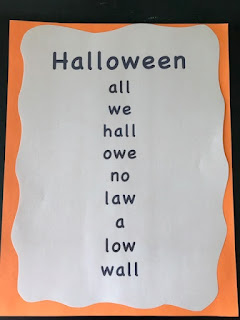
How many words can you make out of HALLOWEEN?


Partner Writing
Divide the children into partners and challenge them to write a ghost story together or draw a spooky picture together.


Charades
Play a game of pantomime where children act out Halloween symbols and events as their friends try and guess.


Pass the Pumpkin
Play "pass the pumpkin." (You can use a real little pumpkin for this or just pretend with a ball.) Children stand or sit in a circle and pass the pumpkin around as the music plays. When the music stops the one holding the pumpkin has to read a flash card, answer a math problem, recall information from a book, and so forth.


PATALINA MATALINA

Here's another new video to share this week.  It's Katalina's friend!

https://bit.ly/drJPatalinaYT


Wednesday, October 15, 2025

DICTIONARY DAY

Did you know that TOMORROW, October 16th is Dictionary Day? It's actually Noah Webster's birthday and a perfect day to let each child make her own personal dictionary.


Materials: pocket folder, prepared pages with alphabet letters, markers

*Here’s a link where you can download the pages with letters: http://www.drjean.org/html/monthly_act/act_2007/02_Feb/pg01.html


Directions: Ask students to tell you what they know about dictionaries. Brainstorm the many uses of dictionaries. Model looking up words and reading definitions. Explain that each of them will get to create their own dictionary that they can use to help them the rest of the school year. First, let the children decorate the outside of their pocket folder. Insert the alphabet pages. As you add new words to the word wall or have new spelling words, ask the children to write them in their dictionary. These would also be a meaningful way to introduce vocabulary words. Encourage students to use their dictionaries when they write independently.


Hint! You might want to go ahead and type your core sight words on the pages before running them off.

Here are some other activities you can play with their dictionaries.

*Play “mystery word” where you give clues about words.
Can you find a word that starts with /m/ and ends with /d/?
Can you find a word that is the opposite of “fast”?


*Play the “rhyme” game.
Can you find a word that rhymes with “bike”?
Can you find a word that rhymes with “log” and is a pet?

*How many one letter words can you find? How many two letter words? Three letter words?

*Ask children to clap out the syllables in words.

*Can they match up words in their dictionaries with words in the classroom?

*Sort words that refer to people, things we do, describing words, etc.

*Have children find a word that starts with each letter in their name.

*Have children make up sentences (oral or written) with the words.

*Ask children to illustrate words or find magazine pictures that match the words.


Homework Hint! Let the children take home their dictionaries one night a week and do some of the above activities with their parents.

Thursday, August 21, 2025

BIG SKY WRITING

Occupational therapists are some of the smartest people I know. I’m always picking their brains for ideas that will help children learn. One thing they’ve taught me is to practice making big strokes, shapes, and letters in the air before asking children to do it on paper. Think outside the box with these strategies to help children at all age levels.

Note! Even second graders would enjoy writing their spelling words on their “palm pilot” or tummies.

Sky Writing (aka "invisible writing")
Keep arm stiff and extend index and middle fingers. Make lines, circles, slants, pushes and other strokes in the air.

Note! The teacher will need to reverse movements if doing it in front of the class.


Air Writing (Lisa Callis)
Go from large to small as you practice air writing letters, numerals, shapes, etc.
Stick out one arm and write with your finger.
Hold your shoulder with the opposite hand as you write with one finger.
Hold your elbow and write.
Hold your wrist and write.
Hold finger and write.


Writing Wand
Staple ribbon to a straw or tape tissue paper to a craft stick to make a writing wand.


Noodles
Cut swim noodles into 8” sections and let children use these to write in the air.


Tummy Writing
Have children lie on their tummies and extend their index finger above their head. Practice making shapes, letters, etc. on the floor. (This technique will help children start writing “at the top.”)

*Let children practice cutting, drawing, and reading on their tummies to give them control as they build upper body strength.


Body Parts
Let children suggest different body parts, such as elbows, noses, toes, etc. to write with.


Palm Pilot
Hold up one palm. Write on it with the index finger from the other hand. Be sure and “erase” in between letters!


Back to Back
Children stand in a circle and then turn right so they are all facing in the same directions. The teacher begins by making a letter, shape, numeral, etc. on the first child’s back. The first child draws the same thing on the second child’s back. Continue around the circle as every has a turn.


Wet Sponge
Let children dip a small piece of sponge in water and write with it on a chalk board.


Rainbow Writing
Make a large letter or shape on a chart. Children trace around it with different colors of crayons or markers.

Tuesday, February 25, 2025

SEALED AND DELIVERED

Here are more ideas "sealed and delivered" in envelopes.

Letters
Write the uppercase letter on one side and the lowercase letter on the other side.
Sing the “Hokey Pokey” with the letter puppet.
You put your (letter) in,
You take your (letter) out,
You put your (letter) in
And you shake it all about.
You make the (letter sound)
And then you put it down.

Listen Up
Children listen as you say words. If the word starts with that sound they hold their puppet up. If it doesn’t start with that sound they keep their puppet down.

Shapes
Glue shapes to envelopes and pass out to students. Children listen and then respond as you sing this song to the tune of “If You’re Happy.”
If you have a circle stand up.
If you have a square stand up.
If you have a rectangle stand up.
If you have a triangle stand up.
*Adapt for other shapes, as well as three-dimensional shapes.

*Use shapes to reinforce positional words. Can you put your shape ON your head? Can you put your shape BEHIND you? Can you put your shape UNDER your chin?

I Have - Who Has Numbers?

Seal envelopes, cut them in half, and then write numbers on the envelopes. (You will need one for each child in your class). Pass out envelopes and have the child with 1 say: I have 1. Who has 2?
The child with 2 says: I have 2. Who has 3? And so forth.
*Count backwards: I have 20. Who has 19?
*You can also play this game with alphabet letters.


High Five Words

Write sight words on envelopes. Children walk around the room giving a high five and reading each other’s words.


Missing Fingers
Hide several fingers in the envelope. Can the children tell how many you have in the envelope? How did you know that?


Note!  Here's the video I did if you want to see these activities demonstrated: 


Tuesday, January 28, 2025

ASL - SIGN TO LEARN

You know I LOVE sign language! I’m certainly no expert, but if I can do it, anybody can do it. Let me give you a few reasons why I’m such a believer that sign language is the perfect  vehicle for active learning.

It’s quiet.

It’s multi-sensory.

It’s engaging. (All I have to do is sing a song in sign language and I have children’s undivided attention.)

It’s good for differentiated instruction and for children who are non-English speakers. 

It’s free and it’s simple.

It’s like bubblegum. Bubblegum? Yep! We need to figure out how to stick things in the brain, and sign language can provide that connection.

Sign language can be a powerful tool for classroom management.

Sign language can be a strategy to teach children how to communicate with friends and work through conflicts.

Sign language can be a creative vehicle for reinforcing state standards.

It’s a great learning tool for teaching letters, high frequency words, vocabulary, etc.)


SIGN LANGUAGE CENTER
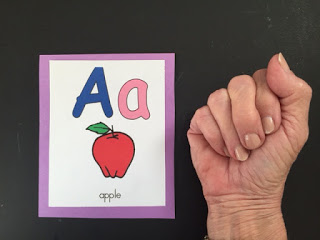
Make a SIGN LANGUAGE CENTER with a pocket folder. Glue a copy of manual signs for letters on the inside of the folder. Write alphabet letters on index cards and place in the pocket. Children choose a card and then try to reproduce that sign.  For older children, write sight words or spelling words on index cards for them to practice spelling manually.
    

Monday, January 27, 2025

PATTY CAKE PLAY

WHY PATTY CAKE?

Patty cake is a great brain break when children are restless.

When you patty cake you cross the midline which activates both sides of the brain.

It's good for eye-hand coordination.

It's TPR - Total Physical Response - motor skills and oral language.

Patty cake encourages self-regulation and the executive function.

It nurtures 21st century skills - cooperation, collaboration, and communication.

You've got purposeful practice for automaticity (aka repetition) because children will want to do it over and over.

How about INTENTIONAL TEACHING? Choose words or skills you are working on and integrate them into this movement game.

It's free, simple, environmentally friendly, sugar-free...Doesn't get much better than that!!

What skills can you practice?

In addition to traditional hand clap chants like "Miss Mary Mack," you can practice these skills.

Sight Words
Children face a partner. They say the word as they clap. They cross and tap partner’s hands on each letter. Then high five and say the word in the air.
the (clap hands)
t (right hand)
h (left hand)
e (right hand)
the (high five)

Letters and Sounds
Clap right hands and say a letter. Cross left hands and make the sound.
A (right hand)
/a/ (left hand)
B (right hand)
/b/ (left hand)
C through Z

Counting
Count by one’s, five’s, ten’s, etc.

Nursery Rhymes
Patty cake nursery rhymes.
*Use the tune to "100 Bottles of Pop on the Wall" or "Yankee Doodle.)

Math Facts

Say addends and then high five the sum.
3 (right hand)
plus (left hand)
4 (right hand)
equals (left hand)
7 (high five)
Here's a patty cake video I made several (well, many) years ago with my grandson.


http://bit.ly/drjeanPattyCakePlay

Tuesday, January 21, 2025

ACTIVE WRITING

Why teach children to write with their wrist when you can get so much more movement with one of these strategies?  Use these movements for letters, numerals, shapes, words, etc.


Invisible Writing
Children extend the middle and index finger and write in the air as they keep their elbow stiff.


Noodle
To practice writing numerals, letters, etc. give children a 9” inch section of a swim noodle. They can use both hands to write in the air (activates both sides of the brain.) Say, “Statue of Liberty” when you want them to listen and hold their noodles in the air.


Palm Pilot 
Children hold up one palm and trace letters on it with the index finger from the other hand. Take it to the brain! 

Midline Writing
Activate both sides of the brain by extending the index finger from both hands as you write in the air.

Tummy Writing
Children lay on the floor and extend one finger above their head. Children use that finger to trace shapes, letters, etc. on the floor.

Back Writing
Children practice writing on each other’s backs.

Hint! Stand in a circle and face right. The teacher models how to write on the first child’s back. The first child repeats it on the second child’s back and it continues around the circle.

Body Parts
Practice making shapes, letters and numerals in the air with different body parts, such as the elbow, foot, nose, belly button, chin, etc.

Hint! Let a different child choose the body part you use each day.

Letter Claps
Hold hands in the air touching and make little claps as you make the shape of the letter and alliterate the sound.

More! Let children write letters with shaving cream on a table, in the sandbox, on the board with a wet sponge, or with chalk on the sidewalk.

Tuesday, October 15, 2024

VOCABULARY PASSWORD

Research continually highlights the relationship between vocabulary and comprehension as children progress in school. We know that:

- Rapid vocabulary acquisition occurs in pre-literate years (before children can read)

- Vocabulary is strongly related to reading and thus school achievement

- Systematic and direct instruction can increase children’s vocabulary


Here are some simple, meaningful strategies to add to your “vocabulary vitamin” bottle.

Attendance
Have a class puppet that gives a password every day. For attendance, the children say the password instead of “here.” Use this chant to introduce the password:
Liberty, Liberty (or whatever your puppet is named),
Oh, what do you say?
What is the password for today?


Hint! Tally the number of times children use the word during the day.

Visor
Write the vocabulary word on an index card and tape it to a visor. One child is selected to be the “supervisor” of the day and wear the visor. The “supervisor” stands at the door every time you leave and classmates must say the word before they can exit.


Name Badge
Put the word in a name badge and wear it (or let a student wear it) all day.
When the teacher says:
“Right now! Right now! Right now! Right now!
Whisper the password out right now.”
Children say the word.
Children then find a partner and use the word in a sentence.

Say, Spell, Sign
Look at the dictionary on aslpro.com to learn how to sign vocabulary words.
1. Children say the password.
2. Children fingerspell the password.
3. Children sign the password.

Thursday, August 1, 2024

READING PICTURES (AKA ENVIRONMENTAL PRINT)

BEFORE CHILDREN READ WORDS THEY READ PICTURES!

Environmental print is one way young children “read pictures” and develop visual literacy. Using environmental print at the beginning of the school year is a great way to help children make print connections, develop visual memory skills, and motivate them to read.

Mother Hubbard’s Cupboard

Ask children to save food wrappers from snacks and their lunches. Glue wrappers to sheets of paper and write this rhyme at the top of each page:
 Old Mother Hubbard
 Went to her cupboard
 To get her poor dog a bone.
 But when she got there
 The cupboard was bare
 And so the poor dog had…(Children read food logo.)


What’s for Breakfast?

Ask children to bring in the box from their favorite cereal. Cut the front section off and on a sentence strip write: “Child’s name eats name of cereal.” Glue to the bottom of the cereal box. Put all the boxes together and make a book. Write “What’s for Breakfast?” on the front cover. Hole punch and put the boxes together with book rings.
*You can also make a book with sacks from fast food restaurants. 


Clothes 

Read sayings on T-shirts, sports jerseys, shoes, and other clothing the children wear to school.


We Can Read Bulletin Board


Ask children to bring logos from food boxes, magazines, toys, clothing and household products. Make a poster or bulletin board that says: “We Can Read!” Let children glue their logos to the poster. Read over the words together.


Read at Home Book


Cut 9” x 12” sheets of construction paper in half. Let each child choose 4 or 5 different colors and staple them together to make a book. Write “I Can Read” on the front and let the children decorate with their name and picture. Send the book home with a note to the parents about helping their child recognize different logos, signs, and words on products and in the home and as they drive down the road. Encourage parents to help their child cut out words they can read from boxes, magazines, and advertisements. Ask children to bring their books back to school to “read” with classmates.


I Like

On Monday send home a sandwich bag with a note asking parents to help their child look for words she can read on food labels, toys, advertisements, and other products around their house. Children cut these out and bring them to school Friday in the sandwich bag. On Friday, encourage the children to “read” the labels that they have brought to class. Write the words “I” and “like” on index cards for each child. Model how to place the cards on the floor with a label from their bag. Point to the words as you read, “I like logo.” Ask the child to read it for you as you point to each word. Comment, “Look at you reading!!!!”


Block Engineers

Cut store logos from Sunday advertisements. Tape to wooden blocks and make your own mall in the block center.


Out the Door
Several years ago when I was in Pleasanton, TX, Nadine Barrow shared this idea. She posts words and environmental print on the inside of her door. Students have to read two of the words before exiting the classroom.

Saturday, October 28, 2023

TIPS FOR TRICK OR TREAT WEEK

You can do this, yes you can! As the excitement increases for Halloween, go with the flow with one of these activities.

Pumpkin Face
Play "Pumpkin Face" which is similar to Wheel of Fortune. Think of a vocabulary word or sight word. Put a blank on the board for each letter in the word. Children take turns calling out letters. If they guess correctly put the letter on the line. If their letter is not in the word begin drawing a pumpkin and then adding features. If letters are not in the word make a "bone pile" at the bottom of the board.


Real and Pretend

Do a T-chart of things that are real and pretend.


Halloween Safety
Let them work in small groups and make posters about Halloween safety.

Making Words
How many words can you make out of HALLOWEEN?


Partner Writing
Divide the children into partners and challenge them to write a ghost story together or draw a spooky picture together.

Charades
Play a game of pantomime where children act out Halloween symbols and events as their friends try and guess.

Pass the Pumpkin
Play "pass the pumpkin." (You can use a real little pumpkin for this or just pretend with a ball.) Children stand or sit in a circle and pass the pumpkin around as the music plays. When the music stops the one holding the pumpkin has to read a flash card, answer a math problem, recall information from a book, and so forth.

Tuesday, December 6, 2022

CRAFTS AND SCRAPS

Need a few center ideas to keep the kids busy?

Recycle Catalogs
It breaks my heart to think of all those beautiful trees that went into making all the catalogs and advertisements you receive this time of year. Recycle them by integrating a cut and paste activity with skills you want to reinforce.

Letters - Find things with a particular sound.
Shapes - Cut out geometric shapes they find.
Words - Cut out words that they can read.
*Can they find words and make a sentence?


Wrapping Paper Tear
Take in scraps of wrapping paper and put them in a tub. Invite children to tear them and then glue them to a paper plate to make a collage.


Mystery Jar
Every year I get out my decorations and find a hand full of little holiday "junk." Put it in a jar and turn it into a learning activity.
*Children can draw what they see.
*Children can make a list of the items.
*Children can write stories using the items as prompts.


Scrap Box 
Want to keep children focused in a positive direction. Put out a scrap box with construction paper and other art media and challenge them to create cards for family members.