photo 3am_dj_home_zps919fb85e.png photo 3am_dj_about_zps7cce4c75.png photo 3am_dj_website_zps73051235.png photo 3am_dj_ss_zps6759ec2a.png photo 3am_dj_bs_zps43e27832.png
Showing posts with label Multi-sensory. Show all posts

Friday, April 3, 2026

SENSES

Senses are like pathways to the brain, and children can learn about them with this song.


Senses (Tune: BINGO)
There are five senses that we use to help us learn each day.
See (Point to eyes.)
Hear (Point to ears.)
Smell (Point to nose.)
Taste (Point to mouth.)
Touch (Hold up hands.)
See, hear, smell, taste, touch,
We use them every day.


https://www.youtube.com/watch?v=4-jMyDR6kSQ


Sense Walk
*Go on a walk and have children touch various objects. “How does it feel?”
*Have them close their eyes and try to identify objects by their sense of touch.
*Take a listening walk where children close their eyes and try to identify different sounds in the environment.


Descriptive Writing 

Give children a clipboard and encourage them to explore the playground as they fill in the blanks (write or draw pictures). Let children share their findings with classmates and then put their pages together to make a class book.


Thursday, April 2, 2026

BLOCK BOOK AND PLAY DOUGH BOOK


These books are a perfect way to integrate literacy in practical ways in learning centers. Children will be engineers and mathematicians as they develop small motor skills and eye-hand coordination.


BLOCK BOOK
1. Cut small squares and rectangles similar to unit blocks out of construction paper.
2. Arrange on file folders to make structures similar to the ones shown.


3. Punch holes and bind together to make a book.
4. Place in the block center and challenge children to look at the designs and then make them with the blocks.
5. Can they look at the design and then turn it over and make it without looking?


PLAY DOUGH BOOK
1. Write “Can you make lines?” at the top of one folder.
Make lines similar to the one shown.

2. Draw curves on another folder and write “Can you make curves?” at the top.

3. Make shapes (square, rectangle, circle, triangle) on another folder and write “Can you make shapes?”

4. Draw simple objects (nest and eggs, hotdogs, bunny, etc.) on the last folder and write “What else can you make?”

5. Punch holes in the folders and attach with book rings.

6. Place the book in a center with play dough and challenge the children to roll the dough and place it on top of the lines and shapes.

Tuesday, February 10, 2026

BUDDY TIME BRAIN BREAKS

First, everyone will need a buddy. “Elbow partners” where children stick out their elbow and the person’s elbow they touch is a quick way to do this. You could also quickly number your students 1-12 and then 1-12 (depending on the number in your class). Ones get together, twos, threes, and so forth.

Patty Cake - Have children play hand clap games, such as “Miss Mary Mack” or “Say, Say My Playmate.” (You can find lots of these online.) Children face a partner and clap their hands together. Next, clap right hand to partner’s right hand. Clap hands together and then clap left hand to partner’s left hand. Continue the pattern.
He learned to tie his shoe.
*Patty cake and count to 10, 20, 50, 100 or more!
*Skip count by 2’s, 5’s, 10’s etc. as you patty cake.
*Patty cake spelling words or word wall words
*Say nursery rhymes or other poems as you patty cake with a partner.
*Say ABC’s saying letter and making then making the sound.

Ride that Pony 
Ride, ride, ride that pony, (Face partner and begin clapping
Get up and ride that big, black pony. to the beat. Bounce up and down
Ride, ride, ride that pony. as if riding on a pony.)
This is what they told me.
Front, front, front, my baby. (Clap hands up in the air with partner.)
Side, to side, to side, my baby. (Gently bump hips on the side.)
Back, back, back, my baby, (Turn around and bump back sides.)
This is what they told me. (Find a new partner.)

Spider Challenge – Children sing the “Itsy Bitsy Spider” as they make the motions on a partner’s back. Next, have children stand next to their partner and extend their inside arms around their partner’s waist. Each child will use her outside arm to sing the song and cooperate with their partner.

Back to Back
– Children touch backs with a partner. The children continue to touch various body parts as the teacher calls them out. End with, “Bottoms to chairs.”

Head, Shoulders – Slowly sing the song as children face their partner and gently touch their partner’s body parts. (You might need to demonstrate the meaning of “gently”!)
*Just for fun have partners put their backs to each other and touch body parts.

Criss Cross Applesauce – Do this on each other’s backs:
Cross cross, (Make an “x” on back.)
Applesauce, (Wiggle fingers down back.)
Spiders crawling up your back. (Crawl fingers up back.)
Warm breeze. (Gently blow on neck.)
Gentle squeeze. (Hug from behind.)
Now you’ve got the shiveries! (Tickle fingers down back.)
Hint! Have children stand in a circle and face right. That way they will each have a back to write on.


Plant a Garden – Do on each other’s backs:
Dig up the dirt. (Knead back with fingers.)
Rake the ground. (Stroke down with fingertips.)
Dig holes for the seeds. (Pretend to dig holes with index finger.)
Cover up the seeds. (Finger covers up seeds.)
Pat the dirt down. (Pat back with both hands.)
Here comes the rain. (Lightly touch the back with fingertips.)
Up come the plants. (Make upward movement with hands.)
Then you pick, pick, pick. (Pretend to pick plants.)
Note! If children are sensitive and don’t want to participate do not force them.


Thursday, October 16, 2025

VOCABULARY VITAMINS

Research continually highlights the relationship between vocabulary and comprehension as children progress in school. We know that:

- Rapid vocabulary acquisition occurs in pre-literate years (before children can read)


- Vocabulary is strongly related to reading and thus school achievement

- Systematic and direct instruction can increase children’s vocabulary

Here are some simple, meaningful strategies to add to your “vocabulary vitamin” bottle.

Attendance
Have a class puppet that gives a password every day. For attendance, the children say the password instead of “here.” Use this chant to introduce the password:
Liberty, Liberty (or whatever your puppet is named),
Oh, what do you say?
What is the password for today?


Hint! Tally the number of times children use the word during the day.

Visor
Write the vocabulary word on an index card and tape it to a visor. One child is selected to be the “supervisor” of the day and wear the visor. The “supervisor” stands at the door every time you leave and classmates must say the word before they can exit.

Name Badge
Put the word in a name badge and wear it (or let a student wear it) all day.
When the teacher says:
“Right now! Right now! Right now! Right now!
Whisper the password out right now.”
Children say the word.
Children then find a partner and use the word in a sentence.

Say, Spell, Sign
Look at the dictionary on aslpro.com to learn how to sign vocabulary words.
1. Children say the password.
2. Children fingerspell the password.
3. Children sign the password.

Tuesday, September 16, 2025

PLAY DOUGH DAY

Play dough is multi-sensory, engaging, creative, and open-ended. Talk about PURPOSEFUL PLAY! National Play Dough Day is September 16th, but you can use it every day as a tool just like a worksheet or video game. Play dough also develops small motor skills which help children write. Here are just a few ways to integrate it into centers and independent learning in your classroom.

Comprehension
Let children make their favorite character and use it to retell a story.


Make something that you learned from the book.


Phonics
Rhymes – Make two objects that rhyme.


Sounds – Make objects that start with a consonant, blend, or diagraph you are working on.
Vowels- Make an object for a long vowel sound and short vowel sound.

Writing
Make something you like (or don’t like) and write about it.

Make something from a book you have read and write about it.

Make letter plates by writing letters with a permanent marker on plastic plates. Children roll play dough and make the letters on top.


Make letters (or words) using a bubble font. Children roll dough and fill in.

Make something that is a noun. How can you make it plural?


Math
Make objects that match numbers.


Make a set and then decompose it.


Science and Social Studies
Reinforce information from a science or social studies unit with play dough. Children could make animals from a habitat, parts of a flower, tools of community helpers, healthy foods…endless possibilities! 

Here's a link for my FREE Play Dough book:


Play Dough Book is 46 pages of ideas and activities.

.

Monday, September 8, 2025

ALPHARDEE OR ALPHARDY???

It really doesn’t matter how you say it, but you’ll find this song one of the most meaningful tunes you can do with your students. I’ve had countless teachers tell me that they do this song every morning at circle time with their students. By repeating the song daily and adding motions and sign language children are able to make the connections between letters and sounds. This is also helpful for children who have trouble articulating some of the sounds.

Alphardy (“Jeopardy" Tune)
A for apple /a/ /a/ /a/ (Pretend fist is an apple.)
B for bounce /b/ /b/ /b/ (Bounce a ball.)
C for cut /c/ /c/ /c/ (Open and close index and middle fingers as if cutting.)
D for dig /d/ /d/ /d/ (Pretend to dig.)
E – elbow (Point to elbow.)
F – fan (Fan self with hand.)
G – gallop (Gallop in place.)
H – hop (Hop on one foot.)
I – itch (Scratch self.)
J – jump (Jump up and down.)
K – kick (Little kicks with foot.)
L – love (Hug self.)
M – munch (Move mouth as if eating.)
N – nod (Nod head.)
O – opera (Extend arms and sing dramatically.)
Q – quiet (Index finger on lips.)
R. – run (Run in place.)
S – sew (Pretend to hold a needle and sew.)
T – talk (Open and close fingers like a mouth.)
U – upside (Lean over.)
V – volley (Hands in air and pretend to volley a ball.)
W – wiggle (Wiggle all over.)
X – x-ray (Make “x” with arms.)
Y – yawn (Extend arms and pretend to yawn.)
Z – zigzag (Make an imaginary “z” in the air.)
Letter sounds are all you need.
Put them together and you can read! (Hold palms together and open like a book.)


I love this video with the manual signs for letters that Mariela Anderson recorded.

https://www.youtube.com/watch?v=p3JKf4vCeKA


*You can download this book at drjean.org.
http://www.drjean.org/html/monthly_act/act_2005/03_Mar/Alphardy.


Alphardy Poster

Run off this chart for each student and glue to a file folder. Children can use this for choral singing or for independent work at the listening center. If you give them a pretzel stick or Bugle for a pointer they’ll get a little snack at the end of the song!


http://www.drjean.org/html/monthly_act/act_2005/03_Mar/pg04a.html


Letter Office
Children will enjoy making their very own letter office and then using it for the activities below. First, tape two file folders together. Let children decorate the outside, and then glue a copy of alphabet letters on the inside.


Sing and Track

Have children point to the letters as you sing various alphabet songs. (“The Alphabet in My Mouth,” “Who Let the Letters out?” or “Letters You Should Know” all work well.)

I Spy!
Play “I Spy” and other games where children have to identify letters. Can they find the letter that makes the sound at the beginning of “hop”? Can they find the letters in their name? What comes between G and I? Can they match up magnetic letters with the letters in their office?

Partner Play
Use the offices for working with a friend. Read the capital letters, lowercase, consonants, vowels. Read loud, soft, fast, slow, backwards, and other variations. Let friends take turns calling out letters (or sounds) for their partner to identify.

Family Time
Invite children to take their letter offices home and play games with their parents.

*Take turns naming letters and touching them.

*Sing Alphabet songs and track the letters.

*Look around the house for letters that match.

*Find letters in family members’ names.

Sunday, September 7, 2025

WRITING NUMERALS AND COUNTING CADENCE

Oh, my! Those little hands may not be ready to write numerals, but the curriculum says they should. Believe it or not, 20 years ago we didn't even teach children to write numbers in kindergarten. We saved that for first grade. Now, we are expecting pre-k children to write numbers. I can't change your curriculum, but I can give you some songs and activities that may make it a little more positive and meaningful.

The Numeral Song
This song goes to the tune of "Skip to My Lou." Have children stand and use their index finger to write in the air. Everybody's writing will look "good" when you do it in the air!

Come right down and that is all.
Come right down and that is all
To make the numeral one. (Hold up 1 finger.)

2 – Curve around and slide to the right…
3 – Curve in and around again…
4 – Down, over, down some more…
5 – Down, around, put on a hat…
6 – Curve in and around again…
7 – Slide to the right and slant it down…
8 – Make an “s” then close the gate…
9 – Circle around then come right down…
10 – Come right down, then make a zero…
We can sing the “Numeral Song”…
And make numerals all day long!


*Let children do air writing with other body parts, such as their elbow, foot, etc.
They can also practice writing on their palm or a friend's back.


*Squirt shaving cream on a safe surface so the children can practice making numbers.

*Have children practice writing numbers in salt, sand, and other sensory materials.


Number Chant
Children can associate numbers with the amount with this song and video. Encourage them to hold up the appropriate number of fingers as you sing.


Theme Books (Beth Cordier)

Let children make books for whatever theme you’re studying. Make a word wall with words from the theme. (Put magnetic tape on the back so children can take them off and copy them.) Children choose a different word for each page and illustrate it.

*Older children could write sentences with the words.

For example: Fall Theme
Page 1 “Pumpkin”
Page 2 “Leaves”
Page 3 “Squirrels”
Page 4 “Footballs”


Here's another song where children can stand and practice writing numerals without getting frustrated.

Chant and Write
(Children echo each line.)

Zero is where it all begins- (Slap thighs to the beat.)
Curve down around and up again.
Number one is so much fun—
Pull straight down and you’ve got a one.
Number two is easy to do—
Up around down and across makes two.
Number three is simple to see—
Draw two humps sideways and that’s a three.
Number four I do adore—
Go down, across, then down some more.
We’ve reached five, now let’s not stop—
Pull down, circle round, put a hat on top.
Number six is easy to fix—
Big curve, small loop will give you six.
Number seven is really sizzlin’—
Straight across, slant down, and that’s a seven.
Number eight isn’t very straight—
Make “S” then back up for an eight.
Number nine I think you’re fine—
A loop on top of a long straight line.
Number ten we’ve reached the end—
Put a one by a zero and count again:
1-2-3-4-5-6-7-8-9-10!


You're going to love this new video that Alex May created!


Counting Cadence video
https://bit.ly/drJCadence


Handouts

Two pages per printed page
https://bit.ly/drJCadenceHalf


One page per printed page
https://bit.ly/drJCadenceFull


Tuesday, August 26, 2025

SINGING LETTERS

Music is the most natural way to learn anything. Mary Ann Wolf (one of the top reading researchers in our country) recommends singing alphabet songs with young children. She explains that songs act like an umbrella and “place holder” in the brain. When the letters and sounds make sense to the children, they have a “place” to go.

There are many ways to introduce alphabet songs, but it might be helpful to introduce a new song each week. Sing it every morning to start your day, and then use it as a brain break during the day. The next week you can teach the children another song and then review the song you sang the previous week. Write the titles of the songs as you introduce them on a sentence strip and add a picture clue. That way you can let children choose different songs and repeat them.

Visual Connections
As you sing alphabet songs, it will be helpful to connect the visual with the auditory. You can use alphabet cards or point to the letters in your classroom.

Stop and Touch
Here’s another technique that will help children connect with the letters as they sing. Have the children stand and dance as you play an alphabet song. Stop the music on a random letter. At this point, children must tiptoe around the room, find that letter, and touch it. Continue playing the song stopping at several random letters.

Note! This is a fun way to teach self-regulation and to help children make a physical connection with the letter name and symbol.


LETTER TAILS (Tune: "Gilligan's Island")
This is one of my favorite alphabet books that Barb Smith created several years ago. It's good for letter recognition, phonics, and visual closure (recognizing the whole from the part).

This is a tale about the letter A.
It makes a special sound.
/a/ /a/ /a/ /a/ A!
Let’s learn another sound.

This is a tale about the letter B….

You can download the book here. If you’ll glue the cover to the front of a pocket folder and put the pages in clear sheet protectors the book will last for a long time.


http://www.drjean.org/html/monthly_act/act_2013/09_Sep_css/pg06.html

Hint! This is a great book to put in your listening center with the song.

Here’s a YouTube video of this song:

https://www.youtube.com/watch?v=8rEzOQn5ElM

Singing Names
Insert children’s names in the song:
D for Darren /d/ /d/ /d/
E for Erin /e/ /e/ /e/
S for Sammy /s/ /s/ /s/
H for Hannah /h/ /h/ /h/

Singing Environmental Print

Adapt the words for environmental print:
M for MacDonald’s /m/ /m/ /m/
L for Legos /l/ /l/ /l/


HAPPY BIRTHDAY LETTERS

Who doesn’t like birthdays? Children will love dancing and singing this song.

Happy Birthday Letters
Yo, A,
It’s your birthday.
Let’s all read
Like your birthday.
/a/ /a/ /a/ /a/ /a/ /a/
Yo, B…etc.

*Have children stand in a circle and act like rappers. When the letter that their name begins with comes up in the song they get to jump in the middle of the circle and dance.

Letter Birthday Hats

Let the children make birthday hats from sentence strips and wear them as you sing “Happy Birthday Letters.” (Our old stick pony is modeling the birthday hat for you.)

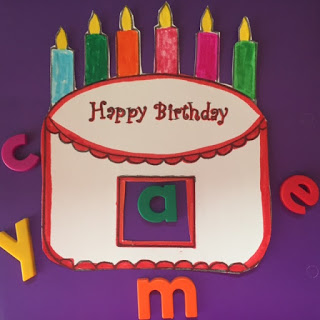
Birthday Cake
Draw a birthday cake on a magnetic board and sing the letters as you place them on the cake:

Yo, M, it’s your birthday.
Let’s all sing like your birthday
/m/ /m/ /m/ /m/ /m/ /m/
/m/ /m/ /m/ /m/ /m/ m/


Here’s a link so you can download the birthday cake.
https://drive.google.com/file/d/0B1SnEagA4jljNTdjZWVlZzR5Zmc/view?usp=sharing


Rapper Necklace
Cut letters out of heavy cardboard. Let children decorate them with fake jewels, glitter, or stickers. Punch holes in the letters and tie on string. Children can wear these as you sing this song.


More?

Clap, jump, hop, march, tip toe, and make other movements as you sing the ABC's.

Sunday, August 24, 2025

HIGHWAY LETTERS

Throw those worksheets away and get ready to PLAY with these hands-0n projects.

HIGHWAY LETTERS
Highway letters are a "rabbit trap" to engage kids and reinforce a variety of skills and different age levels.  I put my letters in clear sheet protectors because it’s cheaper and easier than laminating. You can also punch holes at the top and tie on string so the children can wear them like letter vests.


You can find several versions of these road letters free on the web.  
https://www.prekinders.com/wp-content/uploads/2020/11/TPT-letter-roads.pdf

Here are just a few ways you can use the highway letters with different age levels throughout the school year.

Toy Cars - Let children drive over letters with toy cars.


Writing - Trace over the letters with dry erase markers. Erase and use again and again.

Hint! Put a green dot where they start and a red dot where they stop.

Play Dough - Roll play dough and place on top of the letters.

Songs - Pass out letter vests to children. Let them stand up when their letter is sung in the song.

Phonics - Practice blending C V C words. (consonant, vowel, consonant) with vests. Add the “silent e” to words to change the vowel sound.

Chunking - Start by asking children who are wearing “a” and “t” to stand. What does that say? Ask “m” to stand in front of “at.” What does that say? Tell “m” to go away and have “r” stand in front of “at.” Have children suggest other letters to stand in front of “at.” Reinforce other word families with this strategy.

Spelling Words - Slowly call out sight words or spelling words. (Stretch out the sounds.) Children come up if they are wearing that sound and make the word.

ABC Order- Children arrange themselves in alphabetical order according to the letter that they are wearing.

Hint! You can also play “I Have – Who Has?” with the letters. For example: “I have A. Who has B?” “I have B. Who has C?”


LETTERS ON THE BUS
Here’s another visual to help children focus on letters and sounds.
Color and cut out a bus similar to the one below. Add magnetic tape to the back and place it on a magnetic board. Put magnetic letters in the window as you sing the song.

The Letters on the Bus (Tune: “The Wheels on the Bus”)
The letters on the bus all make their sounds,
Make their sounds,
Make their sounds.
The letters on the bus all make their sounds
All around the town.
The B on the bus goes /b/ /b/ /b/, /b/ /b/ /b, /b/ /b/ /b/,
The B on the bus goes /b/ /b/ /b/ all around the town.


Thursday, August 21, 2025

BIG SKY WRITING

Occupational therapists are some of the smartest people I know. I’m always picking their brains for ideas that will help children learn. One thing they’ve taught me is to practice making big strokes, shapes, and letters in the air before asking children to do it on paper. Think outside the box with these strategies to help children at all age levels.

Note! Even second graders would enjoy writing their spelling words on their “palm pilot” or tummies.

Sky Writing (aka "invisible writing")
Keep arm stiff and extend index and middle fingers. Make lines, circles, slants, pushes and other strokes in the air.

Note! The teacher will need to reverse movements if doing it in front of the class.


Air Writing (Lisa Callis)
Go from large to small as you practice air writing letters, numerals, shapes, etc.
Stick out one arm and write with your finger.
Hold your shoulder with the opposite hand as you write with one finger.
Hold your elbow and write.
Hold your wrist and write.
Hold finger and write.


Writing Wand
Staple ribbon to a straw or tape tissue paper to a craft stick to make a writing wand.


Noodles
Cut swim noodles into 8” sections and let children use these to write in the air.


Tummy Writing
Have children lie on their tummies and extend their index finger above their head. Practice making shapes, letters, etc. on the floor. (This technique will help children start writing “at the top.”)

*Let children practice cutting, drawing, and reading on their tummies to give them control as they build upper body strength.


Body Parts
Let children suggest different body parts, such as elbows, noses, toes, etc. to write with.


Palm Pilot
Hold up one palm. Write on it with the index finger from the other hand. Be sure and “erase” in between letters!


Back to Back
Children stand in a circle and then turn right so they are all facing in the same directions. The teacher begins by making a letter, shape, numeral, etc. on the first child’s back. The first child draws the same thing on the second child’s back. Continue around the circle as every has a turn.


Wet Sponge
Let children dip a small piece of sponge in water and write with it on a chalk board.


Rainbow Writing
Make a large letter or shape on a chart. Children trace around it with different colors of crayons or markers.

Saturday, July 26, 2025

TRANSITION TIPS AND TRICKS


https://www.youtube.com/watch?v=vK6EKSUJ6Wg

Is, “Shhhhhh!” not working? Well, here are a few tricks for you to try!


Hocus Pocus
Teacher says:
“Hocus Pocus!” (Stick out index finger and circle around like a magic wand.)
Children respond:
“Everybody focus!” (Children make circles with fingers and thumbs and place
around eyes like spectacles.)

Tootsie Roll
Tootsie roll, (Roll hands around each other.)
Lollipop. (Pretend to lick a lollipop.)
We’ve been talking, (Open and shut fingers.)
Now let’s stop! (Make sign language sign for “stop.”)


Student Heroes
5-4-3-2-1-zero (Hold up hand and put down one finger at a time.)
I’m looking for my (Make circles with index fingers and thumbs and
student heroes. place around eyes like glasses.)
*Call the names of children who are sitting quietly.


Special Signals
Blow bubbles. Challenge children to look at you and be quiet before all the bubbles pop.

Open a music box. When children hear the music they should freeze.

Blink the lights, play a xylophone, or make some other unique noise or motion.


Magic Clap
Explain to the children that you have a magic signal that only your class will know about. Every time you clap your hands, you want them to repeat the clap and look at you. Practice clapping various patterns until all the children have joined in..


If You Can Hear My Voice

In a normal voice say:
If you can hear my voice, clap your hands one time.
In a softer voice say:
If you can hear my voice, clap your hands two times.
In a whisper voice say:
If you can hear my voice, please look at me.
Continue lowering your voice until children are focused on you.


Give Me a Clap
(Tune: “Addams Family”)
Give me a clap. (Clap twice.) Give me a clap. (Clap twice.)
Give me a clap, give me a clap,
Give me a clap. (Clap twice.)
Give me a snap. (Snap twice.) Give me a snap. (Snap twice.)
Now fold your hands and put them down
Into your lap. (Model putting your hands in your lap.)


Thumbs Up
Thumbs up, across the chest.
Pat on the back because you’re the best!


How Does My Teacher Feel About Me?
Teacher says: “How does my teacher feel about me?”
Children respond: “I’m as special as special can be because my teacher believes in me!”


Simon Says
Begin a game of Simon Says:
Simon says clap three times.
Simon says put your hands in the air.
Simon says touch your ears.
Simon says blink your eyes, etc.
As children join in the game lower your voice as you say:
Simon says put your hands in your lap and
listen to me…line up at the door…get out your
math books, etc.


Hands on Top
Teacher says: Hands on top. (Place hands on head.)

Students respond: Everybody stop. (Place hands on head and freeze.)


Here's another video where I demonstrate some of these attention grabbers.


https://www.youtube.com/watch?v=8xRVtrnnw-w&t=1s