photo 3am_dj_home_zps919fb85e.png photo 3am_dj_about_zps7cce4c75.png photo 3am_dj_website_zps73051235.png photo 3am_dj_ss_zps6759ec2a.png photo 3am_dj_bs_zps43e27832.png
Showing posts with label Routines. Show all posts

Monday, August 17, 2026

BADGES AND BEARS AND COOKIES, OH, MY!

These are inexpensive, easy to make, and can provide repetition in daily routines.

LETTER BADGES
Purchase plastic name badge holders at an office supply store. (Or you can save these from conferences.) Choose one letter each day and write it on paper cut to fit in the name badge. Wear the badge and at random times break out in this song to the tune of “BINGO.”


There is a letter you should know,
What can the letter be oh?
/F/ /F/ It’s an F.
/F/ /F/ It’s an F.
/F/ /F/ It’s an F.
The letter F you know!

*Make letter badges for all the letters in the alphabet and let children choose a different one each day to wear. Let the children walk around the room and shake hands with their friends as they practice identifying each other’s letters. For example: “Hello Q!” “Hello S!”

*Call the children by the letter they are wearing instead of their name.
For example: “D, come sit by me.”


LETTER SUPERVISOR

You will need a plastic visor, index cards, and tape for this activity. Choose a different letter each day and write it on the index card. Tape the index card to the visor. Choose one child each day to wear the visor and be the “letter supervisor.” Every time you leave the classroom the letter supervisor stands at the door with her arm extended. Classmates must name the letter or say a word that starts with that sound before she raises her arm and lets them exit the room.


HIGH FIVE HANDS
Cut hands out of construction paper and write letters you want to reinforce on the hands. Tape to the door. As children exit or enter the classroom they “high five” the hands and say the letters (or make the letter sounds.)


LETTER BEARS

You will be able to get a lot of “mileage” out of these little bears. Cut 26 bears out of construction paper. Write upper and lowercase letters on all the bears. Mix up the bears and then sing this song to the tune of “Twinkle Little Star” as the letters are revealed:

Dd bear, Dd bear, what do you see?
I see Kk bear looking at me.
Kk bear, Kk bear, what do you see…

*Focus children’s attention while they settle down for a story or lesson with the letter bears. You could also use the bears as a transition activity. Dismiss children to line up, wash their hands, etc. when the letter that their name starts with appears.

Letter Bear Pattern
https://drive.google.com/file/d/0B1SnEagA4jljUjloN1BNSUxlOUU/view?usp=sharing


WHO ATE THE COOKIE?
You will need an empty cookie box and cardstock to make this game. Cut 3” circles out of the cardstock and write letters on them. Place in the box. One child at a time chooses a “cookie” (letter) out of the box as you chant?

Who ate (letter) in the cookie jar?
(Child’s name) at the (letter) in the cookie jar.
Who me?
Yes, you!
Couldn’t be.
Then who? (It names another friend and passes the box to them.)


Note! This game is made from all recycled materials!

Friday, August 7, 2026

WASH YOUR HANDS

Washing hands can be an effective way to keep you and your children healthy. It might be wise at the beginning of the year to have a discussion about WHEN you should wash your hands. (You have to remember that children come from different homes with different expectation.)


Practice washing hands following the guidelines and teach children a song to make the task more fun.


Wash, Wash, Wash Your Hands (Tune: "Row, Row, Row Your Boat")
Wash, wash, wash your hands
play the handy game.
Rub and scrub and scrub and rub
Germs go down the drain!

Mirror
Children love to look at themselves in the mirror, so place a mirror above the sink where children clean up. Remind them to sing "Happy Birthday" to yourself twice as you look in the mirror.

Scrub a Dub
(Tune: "Yellow Bird")
Scrub a dub, rub, rub, a scrub a dub.
Germs go down the drain,
And that’s not a shame.
Wash the dirt away,
Get hands clean today.
Soap them up real good,
Rinse them like you should.
And healthy you’ll be!


Potty, Flush, and Wash (Cindy and Tracy)
Several years ago at a workshop two teachers taught us this song to the tune of “London Bridge.”
Potty, flush, and wash your hands,
Wash your hands, wash your hands.
Potty, flush and wash your hands
Everytime!

Saturday, August 1, 2026

HAPPINESS HANDSHAKES

Handshakes are a “hands” on way to connect with the children physically and emotionally as you start your day.

Handshake Greeting
Have each child stand as you extend your right hand to them. Say, “Good morning child’s name.” Teach the children to look you in the eyes as they shake your hand and say, “Good morning teacher’s name.”

Note! It would be good to have a discussion about this and ask them if they’ve ever seen adults shake hands. Why do we shake hands? Which hand should you use? Put a sticker or stamp on their right hand or tie a ribbon around their right wrist to help them remember. Explain that it’s important to give a firm handshake, smile, and look the other person in the eyes.

Shake a Hand (Tune: “Mulberry Bush”)
Everybody shake a hand, shake a hand, shake a hand.
Everybody shake a hand and walk around the room.
(Walk around the room as you shake hands.)

Everybody give high 5… (High five.)

Hug a hand… (Palms together, wrap thumbs around, and squeeze.)

Knuckle bump… (Make fists and bump knuckles.)

Boogey down… (Wiggle down and up with a friend.)

Smile and wink and walk back to your seat. (Smile and wink.)


Happy Handshakes

Here are some other handshakes your class might enjoy. Choose one and do it every day for a week. After you’ve introduced several you can let a special helper choose the handshake for the day.


Butterfly – Hook right thumbs together. Extend the other four fingers to make the butterfly’s wings. Pretend to flutter the butterfly’s wings as you move your hands in a circular motion.

Squirrel – One friend extends her arm. The other friend quickly runs fingers from the wrist up to the shoulder. Switch places.

Thumb Kiss – Hold up thumbs and touch as you make a smacking sound.

Hamburger – Children bump fists and say, “Burger.” Open fists and wiggle fingers together as they say, “Fries.” Hands in the air and shake fists and hips as they say, “Shake.”

Farmer – The teacher crosses her fingers and points thumbs down to represent the cow’s utter. The child grabs the thumbs and pretends to milk the cow.

Cool Dude – Partners knuckle bump and then open their fist and slide it back as they say, “Pssshhh!”

Double Cross Handshake – Shake right hands and then reach across and shake left hands.

Lumberjack – Partners hold up right thumbs and grab them with the left hand. Partners then clasp right fingers and pretend to saw back and forth.

Builder – Shake hands and move them up and down vertically as you say, “Here’s a hammer.” Move hands horizontally back and forth as you say, “Here’s a saw.” Gently twist wrists as you say, “And here’s a screwdriver.”

Potato – Bump fists as you say, “Baked potato.” Bend index fingers and touch as you say, “Tader tot.” Open fingers and wiggle with your partner as you say, “And fries.”

Ghost – Extend arms and swish back in forth as you say, “Woooo!”

Buzz! Extend index finger and touch to your partner’s index finger as you make a buzzing sound.

Fisherman – Place right hand on each other’s right forearm and tap gently like a fish tail. Bend right arm back as if reeling in a fish as you say, “Good morning!”

Hand Hug – Hold up right palms and touch in the air. Bend thumbs around and gently squeeze.

Spiderman – Partners hold up four fingers and intertwine. Spiders have 8 legs and you have 8 wiggly fingers.

Biker – Children hold out fists and stick up thumbs. The teacher grabs the thumbs and pretends to turn them while making a “Brrrrmmmm” sound. “Now your brain is revved up and you’re ready to learn!”

Body Parts – Call out different body parts and challenge children to greet partners by gently touching elbows, knees, heads, ankles, toes, chins, etc.

Jellyfish – Bump fists and then open and close fingers as you pull them back like a jellyfish.

Bow Wow – Partners bow and then make “w’s” by sticking up three middle fingers. Open mouth and place “w’s” on either side to create the word “WOW!”

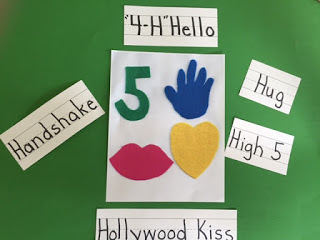
4-H Hello – Children can choose one of these “H’s.”
High Five (High five partner.)
Handshake (Shake hands.)
Hug (Hug each other.)
Hollywood kiss (Air kiss on left and right.)

*They can also choose a homerun, which is all four!

Hint! Cut a hand, numeral “5”, heart, and lips out of fun foam or felt. Place on the floor so the children can stand on the one they’d like.


P.S. Think about saying good-bye to your students at the end of the day with a handshake.

Here’s a video where you can watch me demonstrate some of these handshakes.

https://www.youtube.com/watch?v=lOD5TUqILcQ

Wednesday, July 29, 2026

MOVING THE MORNING MEETING


There is a limit to the time that children can sit and pay attention, but this idea might help spark interest in your morning routine as you build skills. Think about having older children stand and walk around the room to face the flag, calendar, word wall, and classroom alphabet. As children stand and walk around the room you can engage them in some of the songs, movements, and interactive activities suggested.

My World
What? flag, US map, poster of handshakes, classroom rules

How? Sing a good morning song, say the pledge, do a handshake, review rules, etc.


Math/Science
What? calendar, weather chart, hundreds chart, daily schedule

How? Sing songs about the days of the week or the month, review your daily schedule. Sing the weather song and have a “meteorologist” report. Count, add boys and girls, think of equations that equal the date, etc.

Word Wall
What? word wall, flashlight, pointer, fly swatter

How? Sing, dance, clap, and cheer words. Make sentences with words, play games, spotlight words, spell words with sign language, etc.


Alphabet Wall
What? class alphabet, pointers

How? Sing alphabet songs and play letter recognition games. Clap on consonants and jump on vowels. Do Karate writing where children punch up high for tall letters, punch in front of them for middle letters, and give a little kick for letters with a tail.

Hint! Even if you don’t want to do all of the above activities, it’s important to get the children up and wake up their brains with a song or movement activity.

Sunday, July 26, 2026

UNPLUGGED CIRCLE TIME

Circle time should be a natural time when you look the children in their eyes and give them 100% of your attention. Let this be an AUTHENTIC time when it’s just YOU and the CHILDREN!
Be in the moment!


Do Your Own Thing- Each class is different and unique. Get to know your kids and adapt activities to stimulate them and create interest.

Intentional Teaching– What’s the point? Think of your goals and objectives and then make a plan. What age do you teach? What is their skill level?

Balance – Integrate activities where children sit and then let them stand and wiggle. Sometimes they need to be quiet and listen, and sometimes they can be encouraged to talk.

Hands-on– Try to provide multi-sensory experiences to activate different pathways to the brain. Finger plays, movement songs, handshakes, and real objects will engage children more than watching a video.

Vary the Stimulus–
Yes, you want to have a basic routine to give children security and help them feel comfortable, but you need a little spark each day to keep them focused and curious.

Model, Model, Model! Children learn more from your actions than your words. Model sitting quietly, listening attentively when a child is talking, being enthusiastic with your facial expressions, and making the motions for the songs and finger plays.

Quit while you are ahead!
Don’t make circle time too long! Start with 10-15 minutes and then extend it as the year goes along. They will let you know by their body language when they’ve had enough!

Follow a basic routine:

Good Morning Song
Handshake
Morning Message/Review Schedule
Calendar and Weather
Pledge, Rules & Mantra
Active - Skill Songs
Concept Lesson – Theme

You might also want to highlight a different area of the curriculum each day of the week.

Marvelous Monday– Teach a new nursery rhyme or finger play. Practice it each day at circle time.

Terrific Tuesday– What’s in the news? Introduce social studies concepts of interest to the children. Discuss friendship and showing kindness. Brainstorm what to do about classroom behavior issues.

Wonderful Wednesday– Focus on oral language with show and tell, echo chants, and phonological awareness games.

Thrilling Thursday– There’s always something interesting outside your classroom door that your children will be interested in. Each season brings new experiences and objects to observe.

Fabulous Friday
– Just for fun! Play a silly game, have a dress up day (silly socks, shirt of favorite sports team, etc.), be DJ and play favorite songs, etc.

My hope is that you’ll be a little more excited to start the new school year and have some fun as you make plans so EVERY DAY WILL BE THE BEST DAY EVER!


https://www.youtube.com/watch?v=b74N-h_4oB4


Saturday, July 25, 2026

CIRCLE TIME FOREVER

You know I’ve been at this rodeo a LONG time, but before they put me out to the pasture, I want to keep all the ideas I’ve gleaned along the way alive and I want them available for you. I am a broken record saying, “THE WORLD KEEPS CHANGING, BUT CHILDREN ARE THE SAME.” The activities I used in my classroom years ago will still work for you today. You can call it circle time, or morning meeting, or anything you want, but the bottom line is it’s a special way to start your day.  

P.S.  I actually think the world would be a better place if we all started our day with circle time!

What if someone says that circle time is a waste of time?
What would you respond? Do you really think it’s a waste of time? Most of us who have actually sat in a circle with our children to start the day realize it is MAGIC! It is the way to connect with your children, nurture your classroom family, develop social /emotional skills, and set the stage for the day. Since standards and skills are driving education, take a look at these skills that can be nurtured in a natural way at circle time.

Oral language– Children learn to feel comfortable talking in a group and expressing their thoughts and opinions. They also learn to listen to their classmates and respect their ideas.

Literacy skills– Alphabet songs, phonological awareness activities, choral reading, nursery rhymes, finger plays, daily message, and classroom print can be highlighted at circle time.

Math concepts– Talking about the calendar, counting the friends present, comparing sizes, or discussing shapes can be a meaningful part of circle time.

Executive function– As children learn to sit quietly and participate in a group they are developing self-regulation. There is also a beginning and an end to the routine.

Classroom management– This is a time when the teacher can reinforce simple skills, explain classroom activities, review the daily schedule, and model expectations.

Social skills– Learning to take turns and listen to classmates is expected in circle time. As children sing songs together or say rhymes or finger plays they can have fun with their friends. At this group time you can brainstorm classroom problems – tattling, hurting someone’s feelings, pushing in line, etc.

Emotional skills– In circle time all children can be accepted and valued for their individuality. Feelings that we are all different, but that’s O.K., are of primary focus.

Physical skills– Dances and movement songs release wiggles and oxygenate the brain. Cross-lateral activities activate the brain and get it ready to learn.

Science & Social Studies– Talking about the weather, the leaves changing colors, the different ways families celebrate, classroom pets, and real events in the children’s world are meaningful topics at circle time. Specific themes and units of study can also be integrated into this large group time.

Fall in Love with Books- Circle time can be used for book walks, talks, themes, and bibliotherapy.


We Can Make a Circle
This is a precious song to gather the children and make a circle. It goes to the tune of “Lassie and Laddie.” Take the hands of several children and slowly walk in a circle as you sing.

We can make a circle, a circle, a circle.
We can make a circle and hold hands right now.
Hold hands with a friend, a circle never ends.
We can make a circle and hold hands right now.
Hint! Continue singing the song until all the children have joined hands to make a circle. Sit down and you’re ready to begin.

https://www.youtube.com/watch?v=b74N-h_4oB4 

Saturday, July 4, 2026

TEACHER SURVIVAL GUIDE

Many years ago Drew Giles and I created a book called: 

TEACHER SURVIVAL GUIDE - WHAT THEY DIDN'T TEACH YOU IN COLLEGE. 

Drew has generously let me give you the link so that you can download it FREE!


https://drive.google.com/file/d/0B1SnEagA4jljcjI0UVJYR05QcmM/view?usp=sharing&resourcekey=0-GmNGIBdPSzzWAi0GZMkhUQ

It's so cool because there are little QR codes so you can watch me do all the songs, chants, tips and tricks! (Yeah, you know Drew did that part!) This is what you will find:

Good Morning Songs

Morning Meeting Ideas

Shake a Hand

Attention Grabbers

Line Up! Line Up!

Clean Up

So Long - Farewell

A Tune & Tip for Every Transition

A Pocketful of Props

Brain Breaks and Energizers

Cheers!


Sunday, June 7, 2026

GREAT TEACHERS 104


I have so much fun going through ideas teachers have shared with me at my workshops. See if you can make a “fist list” of three new things you’d like to try this week.


Rainbow Clap(Kammi O'Hara) 

Start on one side of your body and clap in an arch over to the other side.


Spiderman(Jessica Schmidt)

To focus children’s attention in the hall say, “Spiderman.” When the children hear that they need to "glue" themselves against the wall.

Silence (Karen Reindl) 

Tell the kids you're going to play "silence." 
"Let's shake it out!" 
Stand tall and still and hold up one hand. Slowly put up one finger at a time. However, if they make noise before that stop until they are silent again. When you get to 5 or 10 everyone can clap.


Self-Regulation(Sarah Mumaw-Flury) 

To discourage children from shouting out the answer, have them whisper their answer to the question in their hand and then hold it up. When the teacher says, “Release!” they open their hand and say/whisper the answer. 


First Thing on Your Paper(Christine Williamson) 

The first thing I do is always the same. 

Pick up a pencil and write my name!


Word of the Day(Mairin Born)

Put a sight word each week (or day) in a clear nametag pocket. All week the kids must name the word or turn it into a sentence as a "ticket" to talk to the teacher.

Hint! Use shapes or letters for younger students.


Class Names(Tune: "Ten Little Indians")

Aiden, Grayson, Hugh, Jack 
Jacob, Jayden, Mac, Maddie 
Nicholas, Oliver, Samuel Willa 
These are the kids in our class. 

*Sing this song all year to learn each other's names, alphabetical order, etc. With different class sizes, just adjust the names to fit by either singing quickly in a row or drawing out one name a little longer. 


Stress Button
(Christine Burchfield)

Put a piece of Velcro on a poker chip for children to keep in their pocket. They can rub the Velcro on the chip to calm down.
*Place Velcro strips on the side of their desk to rub and relax. (Pam Armon)


N.A.P.(Joy & Dawn)

Teach children to say “N.A.P.” when they make a mistake or bad things happen.
N – not
A – a
P – problem


Useful Signs(Miranda)

Teach children signs for white and chocolate milk, as well as specials like art, music, PE, etc.


Daily Song List

Make a song list for each day of the week with a different good morning song, calendar song, phonics song, movement song, and good-bye song.


15 Minutes of Walking/Exercising

Whether or not you have a Fitbit, try building 15 minutes of walking each day as you count, sing letter songs, say days of the week, months, spell words, and review other information.

Thursday, November 20, 2025

A CUP OF IDEAS

Plastic cups for classroom management!!! Here are a few new "tricks" for you to try!

Help Me!
Give each child a red and green cup to keep in their desk. When they are doing independent work have them place the cups on their desk with the green on top. Green means they are good to GO! If they need help they put the red cup on top to indicate, “Please STOP and help me.”

Group Check
You’ll need a red, green, and yellow cup for this activity. Stack the red (bottom), yellow (middle), and green (top) cups in that order and place them in the middle of a table where students sit. If the group gets loud, remove the green cup and the yellow will be a warning to calm down. If the noise continues remove the yellow cup and they must stop all talking.


Note! I didn’t think of this. There are several variations of it on the internet.

Dippers and Fillers
This is a popular management system that many schools use. When children are unkind or say something hurtful they are “dippers.” When they are kind they are “fillers.” Punch holes in the sides of a cup and tie on a string or pipe cleaner so children can hang them on their chairs or a bulletin board. The teacher or friends can put a token in their cup to thank them for being a “filler.”
                                        

Storage
Plastic cups can be used for organizing art materials, pencils, and other supplies.
*How about a cup for “Lost and Found Crayons” or “Lost and Found Pencils”?


Snack Cups
In addition to using cups for liquids, they’re handy for serving popcorn and other snacks to children.

*Decorate with stickers and use for party treats.

Lucky Sticks
Let each child decorate a craft stick with her name. Place the sticks in a cup labeled “lucky sticks.” When you have a special job to be done pull a stick from the cup. That’s the “lucky” winner. Put their stick in your desk after they’ve had a turn and when all the sticks are in your desk put them back in the cup and start all over.


Review Questions
Write a question on the front of the cup and write the answer inside for a self-check activity.


Brainstorm
Divide students into groups of 4. Give each group a cup and challenge them to come up with as many uses for the cup as they can in 5 minutes.

Thursday, October 16, 2025

VOCABULARY VITAMINS

Research continually highlights the relationship between vocabulary and comprehension as children progress in school. We know that:

- Rapid vocabulary acquisition occurs in pre-literate years (before children can read)


- Vocabulary is strongly related to reading and thus school achievement

- Systematic and direct instruction can increase children’s vocabulary

Here are some simple, meaningful strategies to add to your “vocabulary vitamin” bottle.

Attendance
Have a class puppet that gives a password every day. For attendance, the children say the password instead of “here.” Use this chant to introduce the password:
Liberty, Liberty (or whatever your puppet is named),
Oh, what do you say?
What is the password for today?


Hint! Tally the number of times children use the word during the day.

Visor
Write the vocabulary word on an index card and tape it to a visor. One child is selected to be the “supervisor” of the day and wear the visor. The “supervisor” stands at the door every time you leave and classmates must say the word before they can exit.

Name Badge
Put the word in a name badge and wear it (or let a student wear it) all day.
When the teacher says:
“Right now! Right now! Right now! Right now!
Whisper the password out right now.”
Children say the word.
Children then find a partner and use the word in a sentence.

Say, Spell, Sign
Look at the dictionary on aslpro.com to learn how to sign vocabulary words.
1. Children say the password.
2. Children fingerspell the password.
3. Children sign the password.

Saturday, September 20, 2025

BRING AND BRAG OR SHOW AND SHARE?

One of the enduring rituals in early childhood has been sharing time. Most children love to be the center of attention and talk in front of their friends. However, you can also reinforce important speaking and listening standards with some of these ideas.

Show and Share

Instead of “bring and brag,” focus show and tell on a specific theme you are studying, such as a letter, science concept, shape, etc.


Podium
Provide a child-size podium (old music stand) for children to stand behind when they speak.


*Let children stand on a giant block to speak.


Visualize
Have children close their eyes as friends take turns sharing. Can everyone remember one thing at the end of sharing time?

Clues
Ask children to come up with three clues about what they have brought from home. (Parents could write these for young students.) After giving the clues, friends try and guess what it is.

Questions
Let the class ask 20 questions about show and tell items. Tally their answers on the board.

*The person sharing can make three statements about what they have brought. The class then gets to ask them three questions about it.

Show What You Know
Try “show what you know” where children can demonstrate what they have learned about a theme. They could do an art project, make up a song, do a skit, make a video, etc.

Hint! Designate a special shelf or table in your classroom where students can place their show and tell objects for friends to look at later in the day.

Specific Time
Assign students different days of the week for sharing time or designate one day for show and tell.

Show and Tell Challenge(Maribel Mohr)
Use gift bags and staple a note with a challenge, such as a letter, three dimensional shape, numeral, etc. Pass out the bags to the students at the beginning of the day. At the end of the day they can share what they've found.

*You could also send these bags home for the children to do with their parents.

Tuesday, September 2, 2025

A COLORING WE'LL GO


Do you remember how happy a new box of crayons made you when you were a child? There was always a lot of “hope” in those sharp, new crayons. I was never a great artist, but I was thrilled with the “possibilities” those crayons offered!

*A good rule of thumb for encouraging children to use many colors in their drawings is to ask them to use as many colors as they are in age. If they are four years old they should use at least 4 different crayons; if they are five years old they should use five colors, etc.

*As you read books to the class, explain the illustrator’s name. Have children notice details in illustrations. Why is it important to add details? Remind them when they draw pictures they are illustrators, too, and they should add lots of details to make their pictures more interesting.

*Encourage children to close their eyes and think about what they want to draw before they begin coloring. “Get a picture in your brain and then you’ll know what you want your picture to look like. It’s like telling a story with your crayons.”

*Keep a box for “lost crayons” on a shelf so children have a place to put crayons that get misplaced.

*Use mint tins or other small containers to store crayons when boxes fall apart.


A Coloring We’ll Go
(Tune: “A Hunting We Will Go”)
A coloring we’ll go.
Hi ho, it’s fun you know,
A coloring we’ll go.

Use straight and curvy lines.
With yellow, purple, green, and orange,
We’ll make our picture fine. (Chorus)

The details we will draw.
Imagine all the little things.
The details we will draw. (Chorus)

We’ll fill in the page.
Use as many colors
As you are in age.

A coloring we’ll go.
We’ll put them in the box and close the top
When we’re through, you know.

Check out this video my webmaster made to go with the song.


https://bit.ly/drjeanAColoring


Tuesday, August 12, 2025

NAME ON YOUR PAPER

Long ago a veteran teacher gave me some good advice about starting the school year. She said, "GO SLOW!" Take your time and teach children the correct procedures and you'll be set for the rest of the year.

It will be so much easier to teach children routines (like putting their name on their paper) with a song.


Name on Your Paper (Tune: "Shine and a hair cut - two bits")
Name on your paper ~ first thing!
Where does it go?
At the top.
Where does it go?
At the top.
Name on your paper~ first thing!

*Add a verse that says, "Date on your paper - second thing!"

Put Your Name First Thing
Here's another song to the tune of "If You're Happy and You Know It" to remind children to write their name.

Put your name on your paper first thing.
Your teacher needs to know who did the work and so
Put your name on your paper first thing.

Secret Code
Each day give your students a "secret code" to put on their work. Write it on the board and explain that it's the date. For example, the secret code for today would be 8-7-18.

Name Notes
Here's a great idea for class note cards. Give each child a 4" square and ask them to draw their picture and write their name. Reduce the size and glue to half a sheet of paper or around a full sheet as shown. Make many, many copies and use for notes to parents or place in the writing center for the children to use.


Sunday, August 10, 2025

TIDY UP

Clean up will be much more successful if you choose a song and sing it consistently when you want the children to tidy up. You really can use any song that you like (country, broadway, college fight song), but use the same song every day and model what you want the children to do.

I used to sing these songs in my classroom and to my own children at home. (My daughter and son would clean up just to get me to shut up!)

A Helper I Will Be (“The Farmer in the Dell”)
A helper I will be.
A helper I will be.
There’s work to do,
There’s work to do.
A helper I will be.
A picker up I’ll be.
It’s time to put our things away,
A picker up I’ll be.

Hint! Change the words to whatever you want the children to do, such as “pick up the trash,” “push in the chairs,” etc.

Tidy Up (“Jingle Bells”)
Chorus:
Tidy up, tidy up, put your things away.
Tidy up, tidy up, we’re finished for today.
Oh, tidy up, tidy up, put your things away.
For we’ll get them out again another school day.

We’ve had lots of fun as we’ve worked and played.
Now it’s time to all join in and play the clean up game.
Chorus

Can You? (Tune: “Skip to My Lou”)
I can clean quietly, how about you?
How about you, my darlin?

*Change the words to “push in my chair,” “pick up trash,” etc.

Magic Trash
Select one random piece of trash to be the “magic trash.” Have children pick up the room. As they dump the paper and scraps in the trash can, inspect what they have in their hands. The one to find the “magic trash” gets a prize or gets to be the line leader. (Only you and I know there's no special piece of trash!)


Timer
To help prepare children to clean-up or move to another activity, set a timer for five minutes. Explain, “You have five more minutes. When the timer goes
off we will have a whisper clean up.”

Who You Gonna Call?
Send a letter home asking if anyone has an old dust buster to donate to your classroom. Choose one person each day to be the “dust buster.” When there’s a mess shout, “Who you gonna call?” Children respond, “Dust buster!” The designated “dust buster” of the day GETS to clean up the mess.

Classroom Jobs
Assign classroom jobs weekly. Title the jobs by real careers.
Supervisor – Calls the roll.
Maintenance – Picks up the classroom.
Police Officer – Makes sure everyone walks slowly in the hall.
Mail Carrier – Passes out papers.
Librarian – Cleans the classroom library.
Gardener – Waters the plants.
Meteorologist – Gives the morning weather report.
Accountant – Does the lunch count.
UPS – Takes reports to the office.

Saturday, August 9, 2025

WASH YOUR HANDS AND BACK TO SCHOOL JOKES

Washing hands can be an effective way to keep you and your children healthy. It might be wise at the beginning of the year to have a discussion about WHEN you should wash your hands. (You have to remember that children come from different homes with different expectation.) 


Practice washing hands following the guidelines and teach children a song to make the task more fun.


Wash, Wash, Wash Your Hands (Tune: "Row, Row, Row Your Boat")
Wash, wash, wash your hands
play the handy game.
Rub and scrub and scrub and rub
Germs go down the drain!

Mirror
Children love to look at themselves in the mirror, so place a mirror above the sink where children clean up. Remind them to sing "Happy Birthday" to yourself twice as you look in the mirror.
Scrub a Dub
(Tune: "Yellow Bird")
Scrub a dub, rub, rub, a scrub a dub.
Germs go down the drain,
And that’s not a shame.
Wash the dirt away,
Get hands clean today.
Soap them up real good,
Rinse them like you should.
And healthy you’ll be!

Potty, Flush, and Wash (Cindy and Tracy)
Several years ago at a workshop two teachers taught us this song to the tune of “London Bridge.”
Potty, flush, and wash your hands,
Wash your hands, wash your hands.
Potty, flush and wash your hands
Every time!


BACK TO SCHOOL JOKES