photo 3am_dj_home_zps919fb85e.png photo 3am_dj_about_zps7cce4c75.png photo 3am_dj_website_zps73051235.png photo 3am_dj_ss_zps6759ec2a.png photo 3am_dj_bs_zps43e27832.png
Showing posts with label Active Learning. Show all posts

Wednesday, July 29, 2026

MOVING THE MORNING MEETING


There is a limit to the time that children can sit and pay attention, but this idea might help spark interest in your morning routine as you build skills. Think about having older children stand and walk around the room to face the flag, calendar, word wall, and classroom alphabet. As children stand and walk around the room you can engage them in some of the songs, movements, and interactive activities suggested.

My World
What? flag, US map, poster of handshakes, classroom rules

How? Sing a good morning song, say the pledge, do a handshake, review rules, etc.


Math/Science
What? calendar, weather chart, hundreds chart, daily schedule

How? Sing songs about the days of the week or the month, review your daily schedule. Sing the weather song and have a “meteorologist” report. Count, add boys and girls, think of equations that equal the date, etc.

Word Wall
What? word wall, flashlight, pointer, fly swatter

How? Sing, dance, clap, and cheer words. Make sentences with words, play games, spotlight words, spell words with sign language, etc.


Alphabet Wall
What? class alphabet, pointers

How? Sing alphabet songs and play letter recognition games. Clap on consonants and jump on vowels. Do Karate writing where children punch up high for tall letters, punch in front of them for middle letters, and give a little kick for letters with a tail.

Hint! Even if you don’t want to do all of the above activities, it’s important to get the children up and wake up their brains with a song or movement activity.

Tuesday, June 30, 2026

FINGER PLAYS FOREVER

https://drive.google.com/file/d/1i6sEb-2mtP3WlVSB-xCCBruLXd1eAQWU/view?usp=sharing

I've heard people say, "Finger plays are old fashion." Well, you might call them that, but then you'd have to call chocolate chip cookies and mashed potatoes and BINGO and swings and hugs...old fashion as well. Let me share just a few things children can learn when you do a finger play. (You might want to enlighten some administrators or supervisors or parents with this information. Sometimes they just don't "get" what we do!)


Engagement – Doing a finger play is a natural way to engage children’s attention and help them focus.

Oral language – Repetition of finger plays builds oral language skills.

Auditory memory – Children activate their short term memory as they memorize finger plays.

Comprehension – Most finger plays have a simple story plot for children to follow.

Imagination – With so much time spent in front of a screen, finger plays encourage children to make pictures in their brains.

Sequence – Remembering the sequence in finger plays can help children retell stories.

Phonological awareness – Finger plays build a foundation for rhyme, rhythm and alliteration.

Eye-hand coordination – Visual connections with finger plays are important for writing and reading.

Small motor skills – Doing finger plays is like sending the fingers to the gym to exercise.

Active Learning - Multiple senses are engaged as children watch and wiggle their fingers and repeat rhymes.

Purposeful Practice for Automaticity (aka repetition) - Children will enjoy saying these rhymes over and over.

Brain Breaks - Children will be oxygenating the brain and crossing the midline as they do finger plays. Memorizing poems and rhymes is also good for short term memory.

Executive function – Children develop self-regulation and impulse control when they participate in finger plays.

Social skills – All children can be successful with finger plays with this group experience.

State Standards
– You got it! Speaking, listening, comprehension, phonological awareness all rolled into one!

Transitions - Finger Plays can be used to entertain children during transitions or any time you’ve got a minute or two.

Here's a video where you can watch me do a few finger plays:


https://www.youtube.com/watch?v=Zmszqroq1pM

Monday, February 2, 2026

WINTER OLYMPICS

YOU DON'T HAVE TO BE TOO SAD WHEN FOOTBALL 
SEASON IS OVER BECAUSE THE WINTER OLYMPICS START SOON!

TEAM USA!

The Winter Olympic Games will be held in Milan and Cortina d'Ampezzo, Italy, February 6-22. Let's see how we can be a part of the fun!

Kinder Olympics
We created "Kinder Olympics" in our classroom by setting up different stations where the children could mimic different events.

Figure Skating - Give each child two paper plates and demonstrate how to put them on the floor and slide your feet. Can they skate backwards? Can they balance on one foot?

Ski and Count - Swing your arms from side to side as if skiing while you count by ones, fives, tens, etc.

Snowball Shoot
- Write sight words, math facts, sentences, letters, or other skills you want to practice on scrap pieces of paper. Wad them up like snowballs. Children open the snowball, identify the information, and then they get to throw it in a box several feet away.

Speed Skate Spell - Extend arms as you say the letters in a word. Raise arms at the end as if winning as you say the word.

You can probably think of some other great movement ideas where children have fun as they learn.


The highlight of our Kinder Olympics was the medal ceremony. The children got to make their own medals by wrapping aluminum foil around a circle, and we made a torch from a TP roll stuffed with red and yellow tissue paper. We played some patriotic music and passed the torch around. Then we invited each child to stand on a stool and seriously said, "This medal is presented to child's name for participating in the Kinder Olympics."

Note! This is a great time to talk about the characteristics of an Olympic athlete. Encourage the children to discuss what it takes to be an athlete - how they have to train, eat healthy, support their teammates, and have a positive attitude.

Pompoms
How about some pompoms to cheer on the red, white and blue? Draw lines from the top of the lunch sack to the bottom flap about ½” apart. Let children decorate their bags, and then cut down on the lines. Place the flap face down on the table and roll. Wrap a rubber band around the bottom section to make a handle. (You can also use tape to secure the handle.) “Crinkle” the strips and shake like pompoms.


You'll find other great ideas for celebrating the Olympics with kids on this website:

http://www.first-school.ws/activities/firststeps/olympics.htm


Sunday, December 28, 2025

HOW CAN PLAY BENEFIT THE CHILD?

Brain researchers, pediatricians, educators, child psychologists, and theorists all agree that we must protect and preserve PLAY! It is interesting that there is no evidence that children who read at five are better readers than those that learn at six or seven. Study after study reports that children from play-based classes excelled in reading, math, and social and emotional adjustments. They also seemed to fare better as adults in work. 

Brain Growth
When children play, their whole brain is stimulated. Play is multi-sensory, engaging, creative, and joyful. (How many of the senses are actually stimulated when a child plays a computer game?)

Dewar (Cognitive Benefits of Play) reports the following:Play improves memory and stimulates the growth of the cerebral cortex.
Play and exploration trigger the secretion of BDNR, a substance essential for the growth of brain cells.
Kids pay more attention to academic tasks when they are given frequent, brief opportunities for free play.
(Note, studies show that PE classes are not as effective as recess for cognitive benefits. PE is too structured, but a recess break can be truly playful.)
There is a link between play and the development of language skills.
Math skills benefit from play.

John Ratey argues that more physical fitness will lower obesity and improve academic performance. “Exercise stimulates the gray matter to produce Miracle-Gro for the brain… Dopamine, serotonin, and norepinephrine are elevated after exercise.” These can help with focus, calming down, and impulsivity.

Ginsburg notes: “Studies have found that children who engage in dramatic games of make-believe develop stronger language skills, better social skills, and more imagination than children who do not play this way.”


Social Development
Play develops the executive function. (impulse control, task initiation, delayed gratification)

When children play in groups they learn to share, communicate, cooperate, and collaborate. These are all 21st Century Skills!

Without play there are more behavior problems in the classroom. This is especially true for boys because sedentary learning is more difficult for them.

Children can learn to play different roles and practice life skills.

Play is essential for building relationships with parents, teachers, and friends.

Play helps children adjust to school.

Children can learn to solve their own problems through play.


Emotional Development

Play builds self-confidence.

Play provides children with the opportunity to master their world.

Play releases dopamine which makes children happy. It is an antidote for depression.

Children tell us things through their play because it serves as a bridge between fantasy and reality.

Play can relieve stress and help children manage their emotions.

Children can express new insights and be creative through play.

Play nurtures children’s individual talents and interests.

When playing children learn to experiment and take risks.

Children can develop self-help skills and independence when they play


Physical Development

Physical play builds healthy bodies and reduces the risk of obesity.

Play develops large motor skills as well as small motor skills.

Unstructured outdoor play can reduce ADHD and even improve test scores.


Cognitive Development


Through play children learn to understand the world.

Play develops language skills and vocabulary.

Play allows children to plan and make decisions.

Block building lays the groundwork for mathematical thinking.

Tuesday, November 25, 2025

GOOOO LETTERS!


This can be a good brain break when your class gets the wiggles, and you’ll be reinforcing standards at the same time.

https://youtu.be/qRCVJ0-nB5M

You can pretend to play the drums or twirl your hands and fist bump the letters and sounds. Or, better yet, challenge your students to learn sign language with me. Stand up and here we go!!!


Drums…. (Pretend to play the drums.)
Goooo A! /a/ /a/ /a/ (Roll arms and right fist in air as you make the sound.)
Goooo B! /b/ /b/ /b/ (Roll arms and left fist in the air with sound.)
Goooo C! ….Z
Yeah letters!!!!

Wednesday, August 27, 2025

ACTIVE ALPHABET

Here are some active alphabet songs that you can say instead sing.

ABC Kick Box 

Children stand and make fists with their hands. Explain that you will punch across with your right hand and say a letter. Then punch across with their left hand and make the sound.


A – Punch with right hand
/a/
B - Punch with left hand /b/
C…through Z


https://www.youtube.com/watch?v=yMeGvS0x0kM

Phonercise

Children stand and put their hands in the air as they say a letter. They put their hands on their shoulders and make the letter sound. As they touch their toes they say a word that starts with that sound.


A (Hands up in the air and say “A.”)

/a/ (Hands on shoulders and make the short /a/ sound.)

(Say a word that starts with “A” as you touch your toes.)


*Have older children say words that are nouns, verbs, or other parts of speech as you touch your toes.


https://www.youtube.com/watch?v=OxrUgwVbqoM


Karate Writing
Explain that some letters are tall. They start at the top dotted line. Some letters start at the middle dotted line. Some letters have a tail. They go below the line. Sing the “Alphabet Song” stretching up in the air for tall letters, putting hands on waist for short letters, and touching the ground for letters with a tail. For example:

A -hands on waist
B - hands in air
G - touch ground


https://www.youtube.com/watch?v=CkNND0qZP9g

ABC Rap Clap
Begin a pattern by slapping thighs once and clapping twice.
A (slap on the letter and then clap twice)
B (slap, clap, clap)
C (slap, clap, clap)
D….Z

Alpha-Bodies

Children stand and as you call out letters they try and make the letter with their body.
*Spell sight words or vocabulary words with their bodies.

Thursday, June 12, 2025

PEOPLE SING BECAUSE THEY ARE HAPPY!


People sing because they are happy, 
and they are happy because they sing!


Aren't kids great?  Even if you think you "can't sing," they'll think you are a star.  Music is a magical way to create a classroom family.  You can sing to start your day, reinforce a concept, give children a brain break, activate multiple senses, be silly together... You know I could go on all day about this!!!


THROWBACK

Song Pops 
Make these  song pops so you'll always have a song when you need one.  Cut 3" circles out of construction paper.  Write song titles on the circles and glue to craft sticks to make "song pops."  Place in a can and when you need to wiggle and smile pull out a song pop and sing and dance!

Thursday, May 22, 2025

LEARNING FITNESS TRAIL

You can integrate reading, writing, math, and exercise with a learning/fitness trail.

Materials: cardboard rectangles (8” x 10”), markers, tape

Directions: Have your students brainstorm different “body” and “brain” exercises and write them on the board. 

For example:
10 jumping jacks
say a nursery rhyme
8 windmills
count backwards from 20
12 squats
name your city, state, and country
15 toe touches
name 5 insects
run in place
sing the ABC’s forwards and then backwards
count by 10’s to 100
hop on one foot – hop on the other foot

Divide children into small groups and let them choose an exercise, write it on a piece of cardboard, and decorate it.


Tape the exercises around the playground and let the fun begin.

Hint! Invite other classes to participate in your learning/fitness trail.


Indoor Fitness Trail
Make a similar game to use in the classroom on rainy days.

For example:
*Count to 100 by 10's as you do jumping jacks
*Patty cake some nursery rhymes with a friend 
*Count backwards from 20 as you march in place
*Do squats as you name as many insects as you can
*Balance on one foot as you name your city, state, and country
*Balance on the other foot as you say your address and phone number
*Touch toes and then stand up and read a word in the room 
*Sing the ABC’s forwards and then backwards as you stand on tip toes
*Run in place as you name different shapes that you see

Monday, April 28, 2025

DANCE THOSE STANDARDS!

All you need is some good music and a little enthusiasm and your students will master those sight words, math facts, and skills as they move and have fun. Model these movements and then invite the children to join you.
Note! Children can do these standing up or sitting in their chairs.

Disco Dance – Put right index finger in the air and point to the left. Bring right index finger down by your side. Spell words or count as you move.


Swim - Pretend to swim by stroking arms as you count by ones, fives, etc. Can you backstroke? Sidestroke?

*Swim as you say letters and hold your nose and wiggle down as you say the word.


Funky Monkey - Fists out in front and move them up and down as you read sight words or count.


Hitchhike - Right thumb up and move across your body and then left thumb and move across the body as you count, read words, etc.


Chicken - Hands in armpits and flap like wings as you count or spell words.


Pony – Pretend to hold reins as you rock back and forth and say letters in a word. Lasso (arm in the air) as you say the word.


Batman – Make “v” with index and middle fingers and swoop them across your eyes as you count or read words.


Salsa - Left arm bent with index finger up in the air as you say an addend. Right arm bent with finger in air as you say another addend. Hands on hips and wiggle as you say the sum.
*Adapt for subtraction or other math facts.


Bollywood – Right palm up in the air like you’re screwing in a light bulb and then left palm down like you’re turning on a water spicket. Children can read sight words or repeat other information as they make the moves.

Monday, February 17, 2025

SKIP COUNTING

Skip counting is a powerful way to prepare children for multiplication. You can clap, snap, hop, or jump as you skip count by ones, two’s, fives, tens, and so forth.

Whisper Skip Count

You can also try this patty cake technique with a partner. Count by two’s by placing your hands on your shoulders as you whisper “one.” Shout “two” as you patty cake in the air. Whisper “three” as you touch your shoulders and then shout “four” as you patty cake…

For counting by three’s place hands on waist and whisper “one.” Hands on shoulders and whisper “two.” Hands patty cake and shout “three.” Whisper “four” with hands on waist. Whisper “five” with hands on shoulders. Shout “six” and patty cake…

Four’s – knees, waist, shoulders, patty cake

Five’s – toes, knees, waist, shoulders, patty cake


Counting by Two’s (Melanie Hope)
Have students identify body parts that come in sets of two. Stand and count by two’s as you touch the following body parts:
2 – hands on eyes
4 – hands on ears
6 – hands on elbows
8 – knees
10 – feet
12 – eyes
14 – ears….
You’ll be able to count to 100 by 2’s before you know it!


Tunes to Skip Count
Sing and skip count by 2’s to “Twinkle Little Star.”

Practice counting by 3’s to “Are You Sleeping?”

4’s “Row Your Boat”

5’s “The Bear Went over the Mountain”

6’s “London Bridge”

7’s “Ten Little Indians”

8’s “This Old Man”

High Five Book
Trace around each child’s hands on a 6” square and let them decorate it with markers or crayons. Make a cover that says “High Five Book.” Tape the pages together to make an accordion book. Number the pages 5, 10, 15, 20, etc. Read over the book counting by 5’s to 100.


*Make a “Piggie Book” by tracing around children’s feet. Number the pages 10, 20, 30, etc. and practice counting by ten’s with this book.

Macarena Skip Count
You can skip count by any multiple as you do the Macarena.

Tuesday, January 28, 2025

ASL - SIGN TO LEARN

You know I LOVE sign language! I’m certainly no expert, but if I can do it, anybody can do it. Let me give you a few reasons why I’m such a believer that sign language is the perfect  vehicle for active learning.

It’s quiet.

It’s multi-sensory.

It’s engaging. (All I have to do is sing a song in sign language and I have children’s undivided attention.)

It’s good for differentiated instruction and for children who are non-English speakers. 

It’s free and it’s simple.

It’s like bubblegum. Bubblegum? Yep! We need to figure out how to stick things in the brain, and sign language can provide that connection.

Sign language can be a powerful tool for classroom management.

Sign language can be a strategy to teach children how to communicate with friends and work through conflicts.

Sign language can be a creative vehicle for reinforcing state standards.

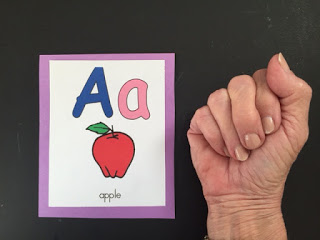
It’s a great learning tool for teaching letters, high frequency words, vocabulary, etc.)


SIGN LANGUAGE CENTER
Make a SIGN LANGUAGE CENTER with a pocket folder. Glue a copy of manual signs for letters on the inside of the folder. Write alphabet letters on index cards and place in the pocket. Children choose a card and then try to reproduce that sign.  For older children, write sight words or spelling words on index cards for them to practice spelling manually.
    

Monday, January 27, 2025

PATTY CAKE PLAY

WHY PATTY CAKE?

Patty cake is a great brain break when children are restless.

When you patty cake you cross the midline which activates both sides of the brain.

It's good for eye-hand coordination.

It's TPR - Total Physical Response - motor skills and oral language.

Patty cake encourages self-regulation and the executive function.

It nurtures 21st century skills - cooperation, collaboration, and communication.

You've got purposeful practice for automaticity (aka repetition) because children will want to do it over and over.

How about INTENTIONAL TEACHING? Choose words or skills you are working on and integrate them into this movement game.

It's free, simple, environmentally friendly, sugar-free...Doesn't get much better than that!!

What skills can you practice?

In addition to traditional hand clap chants like "Miss Mary Mack," you can practice these skills.

Sight Words
Children face a partner. They say the word as they clap. They cross and tap partner’s hands on each letter. Then high five and say the word in the air.
the (clap hands)
t (right hand)
h (left hand)
e (right hand)
the (high five)

Letters and Sounds
Clap right hands and say a letter. Cross left hands and make the sound.
A (right hand)
/a/ (left hand)
B (right hand)
/b/ (left hand)
C through Z

Counting
Count by one’s, five’s, ten’s, etc.

Nursery Rhymes
Patty cake nursery rhymes.
*Use the tune to "100 Bottles of Pop on the Wall" or "Yankee Doodle.)

Math Facts

Say addends and then high five the sum.
3 (right hand)
plus (left hand)
4 (right hand)
equals (left hand)
7 (high five)
Here's a patty cake video I made several (well, many) years ago with my grandson.


http://bit.ly/drjeanPattyCakePlay

Sunday, January 26, 2025

MOVING SIGHT WORDS TO THE BRAIN

Here are some multi-sensory ways to put vocabulary, sight words, and spelling words in the brain. Purposeful practice for automaticity (aka repetition) is essential to skill mastery, and these chants and dances will be more fun than drill and kill. They're also the perfect brain break where children can learn as they move.

Clap and Snap – As you spell out words clap on the consonants and snap on the vowels.
Jumping Jacks – Do jumping jacks for each letter in a word.

Palm Pilot – Hold up one palm and trace the letters in a word with the index finger of the opposite hand. After making the letters say the word and “take it to the brain” by pretending to run your fingers up your arm to your brain.


Sight Word Cadence
Children echo each line as you sing four word wall words at a time. Slap thighs and march as you sing.
There are some words you need
If you want to learn to read.
A All And Are
Be Book Boy By…etc.


Singing the Word Wall
Sing the word wall from a to z with the tune of “Gilligan’s Island.”

Disco – Finger up in the air and move it across your body as you say different letters in a word. Hands on hips as you say the word.


Air Writing – Children use their finger, foot, knee, tongue, elbow and other body parts to spell out words in the air.

March – Children march and swing arms on each letter. They salute and say the word at the end.


Body Writing
Tall letters (b, d, f, h, k, l, t) - touch your head
Tummy letters (a, c, e, i, m, n, o, r, s, u, v, w, x, z) – touch your tummy
Toe letters (g, j, p, q, y) – touch your feet
For example:
H – touch head
O – touch tummy
P – touch feet
Clap as you say the word “hop.”

Saturday, January 25, 2025

MOVING MATH

Turn math standards into a game with these activities.


I Love Math!
Here’s a “quickie” math game that is like “rock, scissors, paper.” Each child will need a partner. Children open one palm. Make a fist with the other hand and place it on the palm. The teacher says, “I love math” as children tap their fist on their palm. On the word “math” the children stick out some fingers. Children add their fingers with their partner’s to determine how many in all. If they agree, they continue with the game. If they disagree, they have to work it out.

Body Addition and Subtraction
Children stand and put their hands in the air as the teacher says a number. When they touch their heads the teacher says “plus” or “minus.” As they touch their waist the teacher says a second number. When the touch their knees everyone says “equals.” And when they touch their toes they say the answer to the math fact.

Adaptations: Tell number stories where children touch and tell the answer.


Magic Fingers
The teacher calls out a “magic number.” The teacher holds up numbers on one hand next to her chest. The children must hold up the correct number of fingers to equal the “magic number.”


Addition Pokey (Tune: “Hokey Pokey”)
Put 1 finger in. (Hold up finger on right hand.)
Put 1 finger more. (Hold up 1 finger on left hand.)
Shake them altogether (Roll around.)
And then lay them on the floor. (Place on floor or table.)
Add them both together, (Bring hands together.)
And you don’t want to stall.
Now you have 2 in all.
2 fingers…3 fingers…4 fingers…5 fingers

*Do “Addition Pokey” with other facts.


Hi Ho Adding We’ll Go (Tune: “The Farmer in the Dell”)
1 plus 1 equals 2 (Hold up fingers as you sing.)
1 plus 1 equals 2
Hi, ho, adding we’ll go. (Roll hands around.)
1 plus 1 equals 2


Circle Count
Students sit or stand in a big circle. Explain that the group will be counting around the circle, each saying one number. You may count zero to twenty, or decide to “count on” and choose random numbers like 36 to 47. Choose a magic number in the sequence of numbers that will be counted. The person who says that number each time around will go sit in the middle of the circle. Play continues (with the given numbers or a new set you choose) until only one student is left in the circle.

*Have students count by tens to one hundred. Each student says one number. The student who says “one hundred” goes to the middle of the circle.

Giant Number Line
Attach a piece of tape to the floor in a prominent place in your classroom. Let children walk on it forwards, backwards, hop, etc. After playing with the line, ask them to sit on the floor. Explain that you’re going to turn it into a number line as you demonstrate writing numbers (0-10) on the tape.

*Ask one child at a time to walk on the number line as they say each number.
*Call out different numbers and ask random students to stand on those numbers. What is one more? What is one less?
*Give students dot cards (0-10) and ask them to match their card with the number on the line.

*Make a number line on the sidewalk with chalk and use for similar activities.

Friday, January 24, 2025

HEY, MACARENA!

This dance is so much fun. You can count, say the months, or say the ABC's as you wiggle and cross the midline.

Macarena Count to 100
Directions: Children stand and do the “Macarena” as they count.
1 (Right arm out palm down.)
2 (Left arm out palm down.)
3 (Right palm up.)
4 (Left palm up.)
5 (Right hand on left shoulder.)
6 (Left hand on right shoulder.)
7 (Right hand behind head.)
8 (Left hand behind head.)
9 (Right hand on left hip.)
10 (Left hand on right hip.)
(Clap two times.)
That is one ten. (Hold up one finger.)
11…100

*Do the “Macarena” with Dr. Jean on this video:

https://www.youtube.com/watch?v=iGKXZVxAffM&list=PL7bsHC8DZJxh3UuXWDyOXZ1c_dGBUdxOA&index=40
*Skip count using the Macarena. Counting by 2’s, 5’s, 10’s, etc. will help children with multiplication.

Macarena Months(Dance the Macarena as you sing.)
January, (Left arm out with palm down.)
February, (Right arm out with palm down.)
March, (Turn left palm up.)
April, (Turn right palm up.)
May, (Right hand on left shoulder.)
June, (Left hand on right shoulder.)
July, (Right hand on back of head.)
August, (Left hand on back of head.)
September, (Right hand on left front hip.)
October, (Left hand on right front hip.)
November, (Right hand on back right hip.)
December, (Left hand on back left hip.)
Then you turn around. (Turn around.)

*End with "There are 12 months, 52 weeks, and 365 days in a year, WHOO!" (Point to the sky on Whoo!)


http://bit.ly/drjeanMacarenaMonths


Macarena Alphabet
Sing or say the letters as you cross the midline.
A (Left arm out with palm down.)
B (Right arm out with palm down.)
C (Turn left palm up.)
D (Turn right palm up.)
E (Right hand on left shoulder.)
F (Left hand on right shoulder.)
G (Right hand on back of head.)
H (Left hand on back of head.)
I (Right hand on left front hip.)
J (Left hand on right front hip.)
K (Right hand on back right hip.)
L (Left hand on back left hip.)
And M (Turn around.)
N (Left arm out with palm down.)
O (Right arm out with palm down.)
P (Turn left palm up.)
Q (Turn right palm up.)
R (Right hand on left shoulder.)
S (Left hand on right shoulder.)
T (Right hand on back of head.)
U (Left hand on back of head.)
V (Right hand on left front hip.)
W (Left hand on right front hip.)
X (Right hand on back right hip.)
Y (Left hand on back left hip.)
And Z (Turn around.)