photo 3am_dj_home_zps919fb85e.png photo 3am_dj_about_zps7cce4c75.png photo 3am_dj_website_zps73051235.png photo 3am_dj_ss_zps6759ec2a.png photo 3am_dj_bs_zps43e27832.png
Showing posts with label Rhymes. Show all posts

Sunday, June 28, 2026

GREAT TEACHERS 125

O'Canada! What a special memory from 2013! 

Kinderoos, Kindies, and Chikcadees
Aren’t these cute names for our little ones?

Comalya (Roberta Bondar, Kathy and Sandra)
Have a weekly “Comalya” when all the kindergarten students and teachers get together to sing.
*Comalya means “Come all ye!”

Rhyme Bag (Hieke Klapwyk)
Send home a brown “rhyme” bag with each student on Friday. They fill the bag with two items that rhyme. At show and tell time, each student removes one item from their bag. Classmates must guess what the second item in the bag is by naming objects that rhyme.

Stringing Words (Irene Bootsma)
Place pipe cleaners and letter beads in a center with a list of student names or sight words. Students string the beads on the pipe cleaner and then read the words.

Sight Word Game
On large craft sticks write sight words on one end. Write letters on clothespins. Children attach the letters on the craft stick to spell the word.


Grouping Game (Jean Broad)
The children wander about the class and the teacher calls out a number. They need to form groups with that amount and then sit down together. If there are children left over that’s O.K. They remain standing. The teacher reviews the groups and might say, “I see 1,2,3,4,5 groups of four. That makes 20. We have 2 extras so we know that 20 + 2 = 22.” Then call out another number.
Establish these rules before playing:
*Respect everyone.
*Never exclude anyone from joining your group.
*Be polite.
*Help others who need to find people for their group.
This helps children with problem solving, collaboration, number sense, oral language, etc.


Math Concept Maps (Louise Gavarkovs)
While children are waiting for the day to begin, let them create math concept maps on individual white boards with dry erase markers.
*Each child chooses what they are able to include. For example, older children could write number stories and younger children could draw sets.


Top Banana (Caroline, Tina, Megan)
The special helper of the day is the “top banana.”


Coffee, Tea, and Me - End of Year Celebration (Donna Petrocco)
Each child invites a guest to school. Set up coffee, tea, juice, fruit, and desserts. Eat and then share some classroom poems and songs. (Students take turns standing up in front of the room to share.) The teacher then passes out memory books for each child with the following:
Picture drawn by the student
Handprint poem
Santa letter
Writing samples
Poems from the teacher
Photographs of child throughout the year
The children look at their memory books with their adult.
*The teacher can stand back, observe, and smile!


Buddy Sticks for Clever Kids
(Terrie Voldimer)
Have as many sticks as kids in a variety of colors. On the end of sticks put something for the students to match, such as letters, numbers, shapes, stickers, etc. Each child selects and stick and then the teacher can choose what they should match up. For example, “Find someone with the same shape and color as you.” “Find someone with the same sticker as you.”

Pinwheel (Laura Quinton)
To make a square, fold a sheet of paper diagonally and cut off the end. Fold in half diagonally again. Cut in on diagonal lines stopping 1” from the center. Hole punch every other corner and in the middle. Insert holes on a pencil or straw and put a little play dough on the end.
*Use for a review by writing vocabulary words, spelling words, math facts, etc. on the pinwheel.


Parent Observation
(Misty Martin Gigliotti)
Prepare an observation sheet for parents who visit the classroom with the following:
-Is your child engaged in singing? Dancing? Listening? Hand movements?
-Does your child participate in activities? Centers? Are they playing alone, with a friend, friends? Are they watching other children play?
-Are they rushing through their work? Are they taking their time?
-What center did they visit first?
-Do you have questions about centers, the classroom, etc.?


Alphabet Shake
Put letters in the bottom of an egg carton. Insert a pompom and shake. The child opens and names the letter, sound, and a word that starts with that sound.
*You can make a similar game with numerals, shapes, words, etc.


Monday, June 15, 2026

GREAT GREAT TEACHERS 112

Take a look at some of these TERRIFIC ideas from Toledo in 2013!  Great ideas never go out of style!


Self Control (Becky Gilsdorf)
Use this visual cue to help children who are out of control.
Cross hands over your chest. (Self)
Slide both hands down the sides of your body. (Control)
As the child repeats the movements silently it will calm them down.


Hand Poem
(Barb Williams)
Hands up high. (Hands in the air.)
Hands down low. (Hands down.)
Hide those hands, now. (Hands behind your back.)
Where did they go? (Shrug shoulders.)
One hand up. (Right hand up.)
The other hand, too. (Left hand up.)
Clap them, (Clap.)
Fold them, (Fold in lap.)
Now we’re through!


Quiet Coyote (Alyssa)
Hold your hand with the pinky and pointer fingers up like ears. Tap the middle and ring finger on your thumb.


1, 2, 3 Eyes on Me (Rooe Aliakbar)
Teacher says: 1, 2, 3 - eyes on me.
Children respond: 1, 2 – eyes on you!


Wiggle Song (Sarah Drummond)
(Sing in a whisper voice.)
I wiggle my fingers.
I wiggle my toes.
I wiggle my ELBOWS. (yell this word)
I wiggle my nose.
Now, no more wiggles are left in me.
So I will sit still -
As still as can be. (Fold hands and place in your lap.)


Verb Chant (Linda Pelger)
A verb, a verb, is an action word, an action word.
You can do it, do it, do it, do it, do it.
Can you jump? (Jump two times)
Can you hop? Swim? Dive? Laugh? Frown? Jog? Etc.


Attention Grabber (Sherry Raessler)
I am looking.
What do I see?
I see (student, class) sitting (or standing or whatever you need)
Properly.


Rhyming Chant (Tina Ponzi)
(Slap knees and clap hands to get the rhythm.)
When I say bat, you say cat.
Bat – cat
Bat – cat

*You can also use this chant for opposites.
When I say hot, you say cold.
Hot – cold
Hot – cold


Stinky Brain Break (Jamie Garner)
The kids get to take their shoes off during center/workshop time and we call it a “Stinky Brain Break.” 


FREEZE (Jamie Garner)
Teacher says: Freeze!
Students respond: Ice Cold! (Wrap arms around self as if shivering.)
Teacher: I’m looking for frozen students.


Grab Your Partner (Tina Rufenacht)
Pass out one Old Maid card to each student and when they find their match, it’s their partner.
*You can also use shapes, clocks, beginning sounds, etc.


Quieting Tricks (Meghan Boyle)
*Before going in the hallway say, “Hands on your hips. Smile on your lips.”

*Hush little children don’t say a word.
We’re leaving the room and shouldn’t be heard.
Hands at your side and do not talk.
Tip toe in the halls when we start to walk.

Sunday, April 12, 2026

HIGH FIVE DAY IS COMING

April 16th was National High Five Day, but you can start any day with a high five and a smile! Wouldn't your kids be surprised if you drew a smile on your hand like this one?


High Five Cheer
Teach children how to give themselves a “high five” for a job well done. Hold up both palms facing each other in front of your chest. Pretend to wave with one hand as you hold up five fingers on the other hand. “Hi 5!” Get it?


Pat on the Back
Trace around each child’s hand on construction paper and let them cut it out. Write a positive comment about each child on the hand and tape it to their back at the end of the day. Parents will be proud when they see their child’s “pat on the back.” 


Pickle Tickle Partner Game
Up high. (Give a high five up in the air.)
Down low. (High five down by knees.)
Cut the pickle. (One child touches fingertips horizontally as the other child pretends to slice in between.)
Give a tickle. (Gently tickle each other.)


HIGH FIVE FOR A NEW RHYMING VIDEO

Tuesday, March 3, 2026

KNOCK! KNOCK!

Here's a silly poem my daughter wrote that you can share with your class.

Knock! Knock!
By Dr. Holly

Knock! Knock! Who can it be?
Little mousie, squeak! squeak! squeak!

Knock! Knock! Who’s at the door?
Boom! boom! boom! It’s a dinosaur!

Knock! Knock! Who is that?
It’s a drummer—rat-a-tat-tat!

Knock! Knock! Guess who?
Baby crying—boo-hoo-hoo!

Knock! Knock! Who’s there?
Grrr! Grrr! It’s a grizzly bear!

Knock! Knock! Who can it be?
It’s a cowboy—How-dy!

Knock! Knock! Who’s there?
Granny in her underwear! (or rocking chair if it’s less scandalous)

Knock! Knock! Who’s at the door?
Big strong lion—roar! roar!

Knock! Knock! Guess who?
Opera singer—la da de do!

Knock! Knock! Who is that?
Purr, purr, my big fat cat!

Knock! Knock! Guess who?
Mr. Robot—Hello. How are you.

Knock! Knock! Who can it be?
A librarian—shhh! Quiet please!


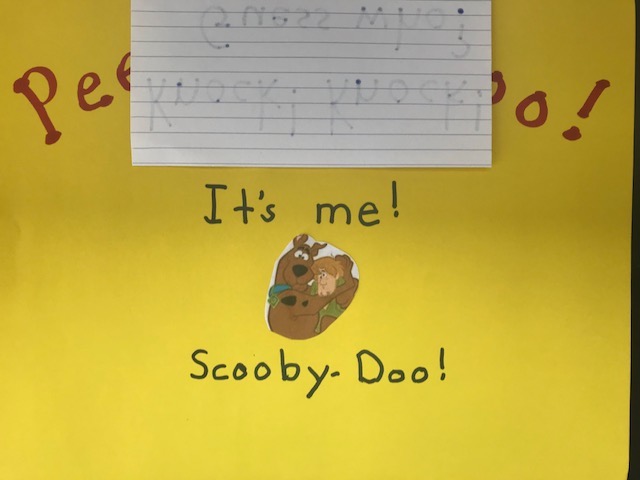
Peek a Boo Class Book
Let children come up with their own “knock, knock” rhymes. Write the first line on the front of a 3"x 5" index card. Tape at the top to a sheet of paper and then have the children draw the answer to the rhyme underneath.


SPRING RIDDLES
Alex May (webmaster) has created some new riddles for you!

http://bit.ly/drjeanSpringRiddles

And here's a link for the cards:

http://bit.ly/SpringRiddles

Tuesday, January 27, 2026

THE KITTENS' MITTENS

This was always one of my favorite flannel board stories to tell my children. They learned rhymes, colors, sequence, and oral language without realizing it!

Note! After I told this story I gave each child a small paper plate and I poured a little milk on it. They put their hands behind their backs and tried to lap up the milk like little kittens. This was many years ago, but I bet some of my students still remember being kittens better than the worksheets!

Materials: You will need a small piece of brown, white, black, red, blue, green, orange, purple, and yellow felt. (You can also use colored paper and attach a small piece of Velcro to the back.) For my flannel board I glued a piece of felt to the front of a file folder and stapled the sides. I stored the mittens in the flannel board and glued the words to the back.


Directions: Cut small mittens from the felt. You will need two of each color. Place the mittens on the flannel board as you tell the story below.


The three little kittens lost their mittens, their brand new mittens of blue.
Let’s help the kittens look for their mittens so they won’t go, “Boo hoo!”
We found some mittens just right for kittens by the bedroom light.
“Boo hoo, the mittens are not the right mittens for the are colored white.”
(Place white mittens on the flannel board.)

We found some mittens just right for kittens in our school backpack.
“Boo hoo, the mittens are not the right mittens for they are colored black.”
(Put up the black mittens.)

We found some mittens just right for kittens in the washing machine.
“Boo hoo, the mittens are not the right mittens for they are colored green.”
(Time for the green mittens.)

We found some mittens just right for kittens by the puppet clown.
“Boo hoo, the mittens are not the right mittens for they are colored brown.”
(Now the brown mittens.)

We found some mittens just right for kittens under baby’s bed.
“Boo hoo, the mittens are not the right mittens for they are colored red.”
(Put up the red mittens.)

We found some mittens just right for kittens by the crayon that’s orange.
“Boo hoo, the mittens are not the right mittens for they are colored orange.”
(Orange mittens)

We found some mittens just right for kittens by a box of Jello.
“Boo hoo, the mittens are not the right mittens for they are colored yellow.”
(Yellow mittens)

We found some mittens just right for kittens by the maple syruple.
“Boo hoo, the mittens are not the right mittens for they are colored purple.”
(Purple mittens)

We found some mittens just right for kittens in a tennis shoe.
“Hooray, the mittens are just the right mittens for they are colored blue!”
(Blue mittens)

Hint! After children have heard the story several times, encourage them to fill in the missing color word. You could also pass the mittens out to the children and let them hold up mittens at the appropriate time in the story.


*Hide mittens around the classroom for the children to find. Ask each child to find one mitten and then match it up with a classmate who has the same color of mitten.

*Sing the song about “The Three Little Kittens” and then let the children act out the song. Choose one child to be the mother and three others to get down on all fours and pretend to be the kittens.


Want to download the story?
https://drive.google.com/file/d/0B1SnEagA4jljN2NWVWJwM19ENDQ/view?usp=sharing

Saturday, November 15, 2025

RHYME ON

Being able to identify words that rhyme is key to developing phonological awareness.
However, teaching children to identify words that rhyme doesn’t happen in one day. The curriculum guide may say, “The children will learn to rhyme today,” but you and I know it takes many, many, many activities where children listen, speak, sing, and chant to develop that skill. Traditional nursery rhymes, songs, and books are the most natural way to nurture rhymes, but here are a few more activities where children can rhyme in a “playful” way.

Handy Rhymes

Have children extend their arms as they say pairs of words that rhyme and sing to the tune of “Skip to My Lou.”
sun (extend right hand)
fun (extend left hand)
Those words rhyme.
sun (extend right hand)
fun (extend left hand)
Those words rhyme.
sun (extend right hand)
fun (extend left hand)
Those words rhyme.
They both end with “un.” (Roll arms around as you say this.)

*As they progress, the teacher says a word as children extend their right hand. Children say their own rhyming word as they extend their left hand.

Rhyme Detectives

Tell the children that they will get to be detectives and listen for words that rhyme. You’ll say two words, and if they rhyme they put their pinkies up. Pinkies down if the words don’t rhyme.
For example: Cat - hat (pinkies up), run - dog (pinkies down).


Rhythm Rhyme
Start a beat by slapping legs two times, clapping hands two times, and snapping fingers two times. On the first snapping beat the teacher says a word. On the second snapping beat the children say a word that rhymes.

Slap, slap, clap, clap, snap, snap.
Slap, slap, clap, clap, mitten. (Teacher says.)
Slap, slap, clap, clap, kitten. (Children say a word that rhymes.)


Rhyme Ball
You will need a ball, beanbag, or other object to toss for this game. Children sit or stand in a circle. The teacher says a word and then tosses the ball to a child. As the child catches the ball, she must say a word that rhymes.


Rhyme Bag Homework

Give each child a paper lunch bag and ask them to bring in two objects from home that rhyme. As children share their items the following day encourage them to think of other words that rhyme.


Rhyming Puzzles
Glue rhyming pictures on opposite sides of a 3” x 5” index cards. Cut a puzzle shape between pictures. Mix up and have children put rhymes together.

*Make games with socks, mittens, shoes, etc. where children use clothes pins to put the rhyming pictures together.


Hint! Mr. Google has some great free printables with rhyming pictures.


Sentence Puzzles
Write rhymes on sentence strips. Cut between the words and let children put them in the correct order in a pocket chart.


Riddle Rhyme Game
Let children make up their own rhymes in this game. First, they choose an object in the room. Next, they say a word that it rhymes with, along with another clue.
For example: “This rhymes with hair and it is something you sit on.” “This
rhymes with look and it is something you read.”

Saturday, November 8, 2025

I KNOW AN OLD LADY

How many old ladies do you know besides me? I know the “Old Lady Who Swallowed a Fly.” She also swallowed a pie and a bat and a chick and numbers… She must be getting pretty full! The Old Lady is entertaining, but she also helps children with recall, sequence, phonological awareness, and oral language.

Here are a few visuals and craft activities that can be adapted to any version of the Old Lady. You can find free images online for the different stories or let children make their own illustrations.

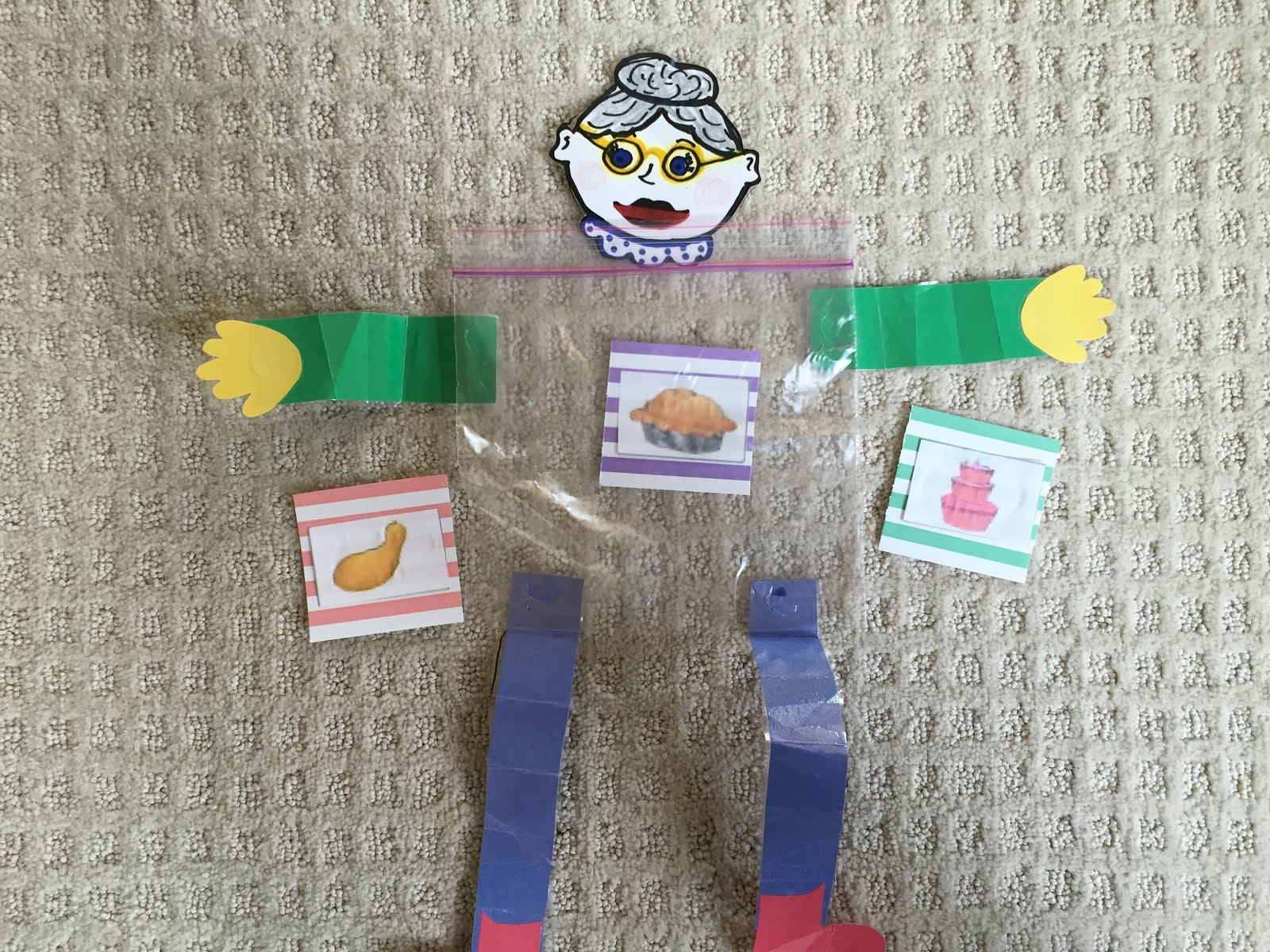
Sandwich Bag Old Lady 
Give children a circle to decorate for the head of the old lady. Staple the head to the back opening of a zip sandwich bag. Staple on strips of paper for arms and legs as shown. Run off copies of the different items for the book or song you are singing. Children line up items in sequential order and then insert them in the bag as you sing. 


You could always use a real old lady's head!


Paper Plate Old Lady
Cut the center out of a paper plate. Use the center for the Old Lady’s head and attach with a brad fastener. Attach strips of paper with brad fasteners for arms and legs. Tape a sandwich bag to the back of the plate so you can insert illustrations as you sing.


Flannel Board File Folder
Staple the sides of a file folder together and glue a piece of felt to the front. Add Velcro to the back of pictures and place on the flannel board as you sing.


Isn't this the cutest apron you've ever seen?  The Old Lady's mouth is a pocket so the children can insert different objects. What fun!!!!


Monday, August 25, 2025

UPPERCASE AND LOWERCASE LETTER LIMERICKS

I know that many of you are working on letter writing this time of year, so I thought Dr. Holly's “Letter Limericks” might be just the rhyme you need to put the strokes in children's brains.

*Use air writing, tummy writing, and other strategies to keep children interested.


The first is a letter called A
With straight lines in every way.
Two lines point up top,
To the bottom they drop,
And another crosses the way.

The second letter is B
For baseball, baby, and beach.
Straight line down the side,
Two humps on the right—
It looks like a fat bumble bee!

After B comes C:
Cookies, celery, and cheese!
Like a smile big and wide
Turned on its side
It’s easy to make C, you see!

D is a letter that’s plump
Like a tummy with one round hump.
A long line straight down,
Then go out and around
For dig, dive, dip and dump!

After D comes E.
It’s shaped like a comb with three teeth.
One line down the side,
Three more to the right
For echoes, ears, eyeballs and eat!

F is the next letter to name.
It can bring with it fortune and fame.
Like E in design
Without the bottom line
But it gets along fine all the same!

After F comes G
Which is curvy and round just like C.
When you reach the end stop,
Put a straight line across
And your G will giggle with glee!

H is a letter with pride.
It has two long straight lines side by side
Then hip, hop, and higgle
Put another ‘cross the middle
And your H will have nothing to hide!

I comes after that,
Eating ice cream, and yet it’s not fat.
One line stretches down,
One lies on the ground
And one goes on top—a flat hat!

Now jump, joke, and juggle— it’s J
With lines both curvy and straight.
The curve starts up top
Then like a hook drops
And the straight line juts over the way!

The letter K has quite a kick
With a spine as straight as a stick.
From the middle about
Two arms reach out
For kangaroos, kindness, and kids!

After K comes L
It’s a letter with lots to tell.
One line heads straight down,
One sticks out on the ground
Like a chair with no legs—how swell!

M is a letter with size,
Like two mountains side by side.
Two straight lines on the end
Two others point in
Making moms, milk, and messes—oh, my!

N is like M only thinner.
It didn’t eat quite as much dinner—
For Nick and Noelle
Two lines parallel
And a diagonal one ‘cross the center.

O is entirely round—
Not a single straight line to be found.
Like a wide open mouth
Saying oops! oh! or ouch!
It makes oceans and oranges abound!

The next of the letters is P
For people and peanuts and please.
Let one straight line prop
With a loop on the top
And you’ll make lots of pumpkins and peas!

Q comes next without fail
With quarters, quick questions, and quails:
First a circle that’s fat
Then like the back of a cat
A straight line sticks out like a tail.

R is ever so clever.
It’s P and K blended together:
The top hoops about
The bottom leg kicks out—
For running and reading there’s no better!

S is a letter with style
For summer, sunshine, and smiles.
Go up and around
Then back around down
Like a snake that slithers for miles!

T is terrific and true
Standing tall as all towers do.
One straight line sits over,
The other points lower
For tigers, trees, and tickles too!

U comes right after T.
It also comes just before V—
An upside down hump
A straight line it bumps:
Unicorn, universe, unique!

V is very healthy—it’s true!
With vitamins and vegetables for you:
Two straight lines point down
And meet at the ground
For vacations and violins, too!

W is just like 2 Vs
Stuck together—like twins, you see.
With why, when, and where?
And who will be there?
W makes words work with ease!

X is the letter that’s next.
Not many words start with an X
But X marks the spot
With two straight lines that cross—
X is never quite what you expect!

The next-to-last letter is Y
For years and yes, give it a try!
Like a small V that sits
On top of a stick
Reaching for the yellow sun in the sky!

Z comes last for a reason
Bringing zeal, zap, and zest to all seasons.
One straight line slants down
Then at foot and at crown
Two other lines zip—very pleasing!


LOWERCASE LETTER LIMERICKS
By Dr. Holly

Small a is a great way to start.
It’s made of two joined parts.
First a small circle round
Then a small line straight down
For airplanes, apples, and art.

So bouncy and bold is small b,
With a line straight and tall as can be.
Then a circle that’s small
That looks like a ball.
You can bat, bubble, bop, with a b!

Small c is a cute buttercup;
Make a circle but don’t close it up.
Leave a space on the side
Like a mouth open wide
For eating cookies and coconuts!

For d make a tall line on the right,
Then a small circle down low and tight.
It’s similar to b
But backwards, you see,
For doughnuts, delicious, delight!

Every e starts like a c, you know.
Circle up and around, here we go.
Then a nice even line.
That looks just fine.
E is for eager and eyes that glow.

Small f hooks right up at the top
Then down to the bottom it drops.
A small line cross the middle,
And fit as a fiddle,
Your f will not fidget or flop!

With g you can gallop and go
And the grass in your garden will grow.
First a circle on the ground,
Then a line stretches down
Just like a fishhook below.

Making h isn’t horribly hard.
Make a tall line straight down for the start.
Then next to it bumps
The hip of a hump
And you’ll hop with a happy heart!

Small i is so sweet to make,
Like ice cream or icing a cake.
Make a short line then stop,
Put a dot on the top,
And into the oven to bake!

Small j likes to joke, jive, and jog
And jump around just like a frog.
With a line that drops down
And hooks underground
Then a dot on its top—perfect job!

Small k starts with a tall, straight spine
Then out kick two smaller slant lines.
One kicks up, one kicks down
For the k-k-k sound
That starts kites, kids, and kisses so kind.

Small l is a likeable letter
Lean and light as a feather.
A single tall line
So straight and fine—
For laughter and love there’s none better!

Small m is magnificently wide
A short line then two humps side by side
For monkeys and marbles,
Magic and marvels,
And motorcycles, let’s take a ride!

Small n is one half of m.
Make a short straight line and then
A single small hump
To give it a bump
For a nice, neat, and nifty small n.

Small o is a round cheerio
Rolled on the ground down low.
Keep your pencil pressed down
And take it around
For octopus and ostrich, you know.

Next comes polite letter p
As pretty and proud as you please.
A long line that drops
Down below, and then pop
A circle beside it—whopee!

Small q is quiet and quick.
It’s like p, but with a trick.
It’s the other way ‘round
And the line that goes down
Ends with a quaint, quirky kick.

Now we’ve reached rock’ n’ roll r
And everyone can be a star!
Make a short line, then look—
At the top a small hook,
And your rip, roaring r will go far!

Small s is swirley and steep.
Arch up to the middle and sweep
Down to the end
With another round bend
For swinging and singing so sweet!

Next we’ll try t: don’t delay!
Start high up but not all the way.
Then down you drop,
Put a small line across,
For terrific, tip-top days!

Small u is like n upside down.
Curve down and then back up around.
Add a line on the right,
Straight, short and tight
For upside and underground.

Small v is very victorious
And making v isn’t laborious:
Two short lines slant out
From the bottom they spout
Like two arms raised to say: I am glorious!

Small w is two v’s together
For why, what, where, and whether
Slant down, up, and then
Slant down, up again
And you’ve written a wonderful letter!

Small x makes your xylophone play
And it expertly makes an x-ray.
Two lines that are little
Cross right at the middle.
You can exit and go on your way!

We’re nearing the end with small y:
For yes, yarn, and years that fly by
A short line slants down,
Another slants underground,
And they meet at a point to say hi.

Small z is for zany and zounds;
It’s short and sits right on the ground.
Straight out, slant down, then
Go straight out again
And you’ll zigzag, and zip all around!


Note!! Years ago someone told me if you want children to remember something they need to sing it or eat it. Are you hungry for some letters?

Pretzel ABC’s - Give children pretzel sticks and pretzel twists. Have them nibble the pretzels to make letters.

Squirt and Eat - Use squirt cheese to make letters on crackers. Lick the letters with your tongue.

Alphabet Cereal, Crackers, and Pretzels - Letter shaped snack foods can be used for identifying letters, making words, or eating!

Letter Snacks – Assign each child a letter and a day to bring a snack for the class. Ask parents to send in a fruit, vegetable, or healthy food that begins with their letter. Take photographs and use them to make a class alphabet book.

P.S. I know some schools have banned food in the classroom, so you might send these activities home in a newsletter for parents to do with their child.

Saturday, March 22, 2025

JUMP ROPE RHYMES


It's almost spring and you can't help but smile and have a spring in your step. And speaking of steps and springs reminds me of how much fun I had jumping rope as a child…and then teaching my students to jump rope. For some of the children it was easy, but other children really had to work at it. Being persistent and not giving up is a good thing to learn. Jumping rope also encourages social skills, motor skills, counting, and oral language. It’s good for the body and the brain!

Here are some chants we used to say, but you can adapt them if you don’t like the words. You could also use these on a rainy day. Just have the children get a pretend jump rope and jump along as you say the rhymes. What a perfect brain break for kids from pre-k through the primary grades.

*You can jump on two feet or alternate hopping on one foot at a time.

Bubble Gum
Bubble gum,
Bubble gum in a dish.
How many pieces
Do you wish?
1, 2, 3, 4, 5…(How high can you count?)

Bathing Beauty
Bathing Beauty
Thinks she’s a cutie
All she wears is bathing suities.
If you jump to 24, you will get an extra turn.
1, 2, 3…24

Cinderella
Cinderella dressed in yella.
Went upstairs to kiss her fella.
Made a mistake and kissed a snake.
How many doctors did it take?
1, 2, 3…8


Engine No. 9
Engine, engine number nine
Going down the railroad line.
If the train jumps off the track
You will get your money back.
How much money will you get?
1, 2, 3, …10

Teddy Bear, Teddy Bear
Teddy Bear, Teddy Bear, turn around.
Teddy Bear, Teddy Bear, touch the ground.
Teddy Bear, Teddy Bear, read the news.
Teddy Bear, Teddy Bear, tie your shoes.
Teddy Bear, Teddy Bear, go upstairs.
Teddy Bear, Teddy Bear, sit down in your chair!

Blue Bells
Blue bells, cockle shells, eevie, ivy, over.
I like coffee. I like tea. I like you to jump with me.

Here's my "Jump Rope Rally" video so we can jump together!
https://www.youtube.com/watch?v=6Y1UBTOFEzA


Jump Rope Rhyme Book
It might be fun to give children copies of the rhymes and let them make a book of jump rope rhymes. They could illustrate these and use them for independent reading.


*Do you remember any jump rope rhymes from your childhood that you could teach your students?


*Have students ask their parents to teach them a jump rope rhyme they did as a child.

Monday, January 27, 2025

PATTY CAKE PLAY

WHY PATTY CAKE?

Patty cake is a great brain break when children are restless.

When you patty cake you cross the midline which activates both sides of the brain.

It's good for eye-hand coordination.

It's TPR - Total Physical Response - motor skills and oral language.

Patty cake encourages self-regulation and the executive function.

It nurtures 21st century skills - cooperation, collaboration, and communication.

You've got purposeful practice for automaticity (aka repetition) because children will want to do it over and over.

How about INTENTIONAL TEACHING? Choose words or skills you are working on and integrate them into this movement game.

It's free, simple, environmentally friendly, sugar-free...Doesn't get much better than that!!

What skills can you practice?

In addition to traditional hand clap chants like "Miss Mary Mack," you can practice these skills.

Sight Words
Children face a partner. They say the word as they clap. They cross and tap partner’s hands on each letter. Then high five and say the word in the air.
the (clap hands)
t (right hand)
h (left hand)
e (right hand)
the (high five)

Letters and Sounds
Clap right hands and say a letter. Cross left hands and make the sound.
A (right hand)
/a/ (left hand)
B (right hand)
/b/ (left hand)
C through Z

Counting
Count by one’s, five’s, ten’s, etc.

Nursery Rhymes
Patty cake nursery rhymes.
*Use the tune to "100 Bottles of Pop on the Wall" or "Yankee Doodle.)

Math Facts

Say addends and then high five the sum.
3 (right hand)
plus (left hand)
4 (right hand)
equals (left hand)
7 (high five)
Here's a patty cake video I made several (well, many) years ago with my grandson.


http://bit.ly/drjeanPattyCakePlay

Saturday, December 28, 2024

SNOW PEOPLE

Whether you live in Alaska or Florida, everybody loves snowmen! Here's a finger play, puppet poem, and story you can make this week and you'll be good to go back to school!

Five Little Snowmen Finger Play
Five little snowmen fat. (Hold up five fingers.)
Each wore a different hat.
Along came the sun and melted one. (Bend down one finger.)
Now, what do you think about that?

Four little snowmen fat… (Hold up four fingers.)
Three…Two…One


Cut snowmen out of felt as shown. Place a different colored hat on each one. Remove one snowman as each verse is said.

*Place the flannel board and snowmen in a center so children can practice saying the rhyme and make sets.
*Make a simple flannel board by gluing a piece of felt to the front of a file folder. Staple the sides. Store pieces inside and glue a copy of the poem to the back.


Snowman Puppet
Cut a snowman out of heavy paper and decorate with markers. Cut a circle for the nose the width of your index finger. Cut another circle the size of your index finger out of a cup. Match up holes and tape the snowman in place. Put your hand in the cup and stick your index finger through the hole as you repeat the rhyme below.
A chubby little snowman
Had a carrot for a nose.
Along came a bunny
And what do you suppose?
That hungry little bunny
Looking for some lunch
Ate that little snowman’s nose
Nibble, nibble, crunch! (Slowly pull your finger back into the cup.)


Snowman’s Story

Once there was a beautiful snowman made of white snow. Along came a red bird one day and the bird said,
Ha, ha, ha,
He, he, he,
You’re the funniest snowman I ever did see.
The snowman said,
Oh, dear, oh, dear,
Oh, me, oh, me!
Why am I the funniest snowman you ever did see?
Well, said the bird, you should be red like me. Red is such a bright, happy color.
So that night the snowman got some red dye and turned himself red.

The next day along came a yellow duck.
Ha, ha, ha….(The story continues as the snowman dyes himself yellow.)
The next day along came a green frog…
The next day along came blue bug…

The next day the snowman was feeling rather sad. Just then along came a little girl. She said, “Why are you so sad?” The snowman said, “I’ve dyed myself red and yellow and green and blue and I just don’t feel like myself.” The little girl said, “You are wonderful just the way you are! Always be yourself!”
So the snowman blinked his eyes and he was once again the color of snow. From then on he was happy just being himself. And that’s why you always see snowmen with happy smiles on their faces.


*Cut a snowman shape out of the front of a file folder. Insert white, red, yellow, green, blue, and white paper. Glue the words to the story on the back. As you tell the story remove the paper to correspond with the story.
Hint! I painted snow on the file folder with White Out.


Here's a video where I say these rhymes and tell the story.
http://bit.ly/drjeanWinterFun

Monday, October 7, 2024

RHYME TIME

Phonological awareness is the ability to recognize sounds in oral language (rhyme, alliteration, syllables, etc.). Children must first hear the sounds before they can relate them to letters (phonics). Let's start today with rhyming. Learning to rhyme doesn't happen it one lesson...it takes a lot of oral language (nursery rhymes, finger plays), songs, books, and games to help children develop this skill.

Rhyme Detectives
Tell the children that they will get to be detectives andlisten for words that rhyme. You say a word, and they put their pinkies up if they hear a word that rhymes with it. Pinkies down if it doesn’t rhyme.
For example: Cat - hat (pinkies up), run - dog (pinkies down).


Handy Rhymes
Have children extend their arms as they say pairs of words that rhyme. For example: sun (extend right hand) - fun (extend left hand). As they progress, the teacher says a word as children extend their right hand.

Rhyming Song
Do this activity to the tune of “Skip to My Lou.”
Cat (hold out right hand)
Hat (hold out left hand)
Those words rhyme.
Cat (hold out right hand)
Hat (hold out left hand)
Those words rhyme.
Cat (hold out right hand)
Hat (hold out left hand)
Those words rhyme.
They all end with “at.” (Roll hands around as you say this.)


Rhyme Puzzles

Cut paper plates in half using puzzle designs similar to those shown. Glue pictures that rhyme on each half. Mix up the pieces. Children say the words and match up the plates that rhyme. The game is self-checking because the pieces will fit if they match the correct pictures.
*You can also use season shapes to make a rhyming game.


Rhyme Ball
You will need a ball, beanbag, or other object to toss for this game. Children sit or stand in a circle. The teacher says a word and then tosses the ball to a child. As the child catches the ball, she must say a word that rhymes.

Riddle Rhyme Game
Let children make up their own rhymes in this game. First, they choose an object in the room. Next, they say a word that it rhymes, along with another clue. For example: “This rhymes with hair and it is something you sit on.” “This rhymes with look and it is something you read.”

Rhyme Bag
Give each child a lunch bag and for homework ask them to bring two objects that rhyme. As they take turns sharing their items encourage classmates to think of other words that rhyme with their objects.

Saturday, August 10, 2024

LETTER LIMERICKS

I know that many of you are working on letter writing this time of year, so I thought Dr. Holly's “Letter Limericks” might be just the rhyme you need to put the strokes in children's brains.

Invisible Writing – Practice writing letters in the air with your index finger. Don’t forget to erase when you’re finished!

Tummy Writing
– Have children lay on their tummies and extend their finger above their head. They can practice making lines, circles, shapes, and letters.

Body Writing – How many different body parts can you use to write letters? Try elbows, noses, toes, or chins. You can also write on each other’s backs.

Note! Pick and choose for however you introduce the letters.

UPPERCASE LETTER LIMERICKS
By Dr. Holly

The first is a letter called A
With straight lines in every way.
Two lines point up top,
To the bottom they drop,
And another crosses the way.

The second letter is B
For baseball, baby, and beach.
Straight line down the side,
Two humps on the right—
It looks like a fat bumble bee!

After B comes C:
Cookies, celery, and cheese!
Like a smile big and wide
Turned on its side
It’s easy to make C, you see!

D is a letter that’s plump
Like a tummy with one round hump.
A long line straight down,
Then go out and around
For dig, dive, dip and dump!

After D comes E.
It’s shaped like a comb with three teeth.
One line down the side,
Three more to the right
For echoes, ears, eyeballs and eat!

F is the next letter to name.
It can bring with it fortune and fame.
Like E in design
Without the bottom line
But it gets along fine all the same!

After F comes G
Which is curvy and round just like C.
When you reach the end stop,
Put a straight line across
And your G will giggle with glee!

H is a letter with pride.
It has two long straight lines side by side
Then hip, hop, and higgle
Put another ‘cross the middle
And your H will have nothing to hide!

I comes after that,
Eating ice cream, and yet it’s not fat.
One line stretches down,
One lies on the ground
And one goes on top—a flat hat!

Now jump, joke, and juggle— it’s J
With lines both curvy and straight.
The curve starts up top
Then like a hook drops
And the straight line juts over the way!

The letter K has quite a kick
With a spine as straight as a stick.
From the middle about
Two arms reach out
For kangaroos, kindness, and kids!

After K comes L
It’s a letter with lots to tell.
One line heads straight down,
One sticks out on the ground
Like a chair with no legs—how swell!

M is a letter with size,
Like two mountains side by side.
Two straight lines on the end
Two others point in
Making moms, milk, and messes—oh, my!

N is like M only thinner.
It didn’t eat quite as much dinner—
For Nick and Noelle
Two lines parallel
And a diagonal one ‘cross the center.

O is entirely round—
Not a single straight line to be found.
Like a wide open mouth
Saying oops! oh! or ouch!
It makes oceans and oranges abound!

The next of the letters is P
For people and peanuts and please.
Let one straight line prop
With a loop on the top
And you’ll make lots of pumpkins and peas!

Q comes next without fail
With quarters, quick questions, and quails:
First a circle that’s fat
Then like the back of a cat
A straight line sticks out like a tail.

R is ever so clever.
It’s P and K blended together:
The top hoops about
The bottom leg kicks out—
For running and reading there’s no better!

S is a letter with style
For summer, sunshine, and smiles.
Go up and around
Then back around down
Like a snake that slithers for miles!

T is terrific and true
Standing tall as all towers do.
One straight line sits over,
The other points lower
For tigers, trees, and tickles too!

U comes right after T.
It also comes just before V—
An upside down hump
A straight line it bumps:
Unicorn, universe, unique!

V is very healthy—it’s true!
With vitamins and vegetables for you:
Two straight lines point down
And meet at the ground
For vacations and violins, too!

W is just like 2 Vs
Stuck together—like twins, you see.
With why, when, and where?
And who will be there?
W makes words work with ease!

X is the letter that’s next.
Not many words start with an X
But X marks the spot
With two straight lines that cross—
X is never quite what you expect!

The next-to-last letter is Y
For years and yes, give it a try!
Like a small V that sits
On top of a stick
Reaching for the yellow sun in the sky!

Z comes last for a reason
Bringing zeal, zap, and zest to all seasons.
One straight line slants down
Then at foot and at crown
Two other lines zip—very pleasing!


LOWERCASE LETTER LIMERICKS
By Dr. Holly

Small a is a great way to start.
It’s made of two joined parts.
First a small circle round
Then a small line straight down
For airplanes, apples, and art.

So bouncy and bold is small b,
With a line straight and tall as can be.
Then a circle that’s small
That looks like a ball.
You can bat, bubble, bop, with a b!

Small c is a cute buttercup;
Make a circle but don’t close it up.
Leave a space on the side
Like a mouth open wide
For eating cookies and coconuts!

For d make a tall line on the right,
Then a small circle down low and tight.
It’s similar to b
But backwards, you see,
For doughnuts, delicious, delight!

Every e starts like a c, you know.
Circle up and around, here we go.
Then a nice even line.
That looks just fine.
E is for eager and eyes that glow.

Small f hooks right up at the top
Then down to the bottom it drops.
A small line cross the middle,
And fit as a fiddle,
Your f will not fidget or flop!

With g you can gallop and go
And the grass in your garden will grow.
First a circle on the ground,
Then a line stretches down
Just like a fishhook below.

Making h isn’t horribly hard.
Make a tall line straight down for the start.
Then next to it bumps
The hip of a hump
And you’ll hop with a happy heart!

Small i is so sweet to make,
Like ice cream or icing a cake.
Make a short line then stop,
Put a dot on the top,
And into the oven to bake!

Small j likes to joke, jive, and jog
And jump around just like a frog.
With a line that drops down
And hooks underground
Then a dot on its top—perfect job!

Small k starts with a tall, straight spine
Then out kick two smaller slant lines.
One kicks up, one kicks down
For the k-k-k sound
That starts kites, kids, and kisses so kind.

Small l is a likeable letter
Lean and light as a feather.
A single tall line
So straight and fine—
For laughter and love there’s none better!

Small m is magnificently wide
A short line then two humps side by side
For monkeys and marbles,
Magic and marvels,
And motorcycles, let’s take a ride!

Small n is one half of m.
Make a short straight line and then
A single small hump
To give it a bump
For a nice, neat, and nifty small n.

Small o is a round cheerio
Rolled on the ground down low.
Keep your pencil pressed down
And take it around
For octopus and ostrich, you know.

Next comes polite letter p
As pretty and proud as you please.
A long line that drops
Down below, and then pop
A circle beside it—whopee!

Small q is quiet and quick.
It’s like p, but with a trick.
It’s the other way ‘round
And the line that goes down
Ends with a quaint, quirky kick.

Now we’ve reached rock’ n’ roll r
And everyone can be a star!
Make a short line, then look—
At the top a small hook,
And your rip, roaring r will go far!

Small s is swirley and steep.
Arch up to the middle and sweep
Down to the end
With another round bend
For swinging and singing so sweet!

Next we’ll try t: don’t delay!
Start high up but not all the way.
Then down you drop,
Put a small line across,
For terrific, tip-top days!

Small u is like n upside down.
Curve down and then back up around.
Add a line on the right,
Straight, short and tight
For upside and underground.

Small v is very victorious
And making v isn’t laborious:
Two short lines slant out
From the bottom they spout
Like two arms raised to say: I am glorious!

Small w is two v’s together
For why, what, where, and whether
Slant down, up, and then
Slant down, up again
And you’ve written a wonderful letter!

Small x makes your xylophone play
And it expertly makes an x-ray.
Two lines that are little
Cross right at the middle.
You can exit and go on your way!

We’re nearing the end with small y:
For yes, yarn, and years that fly by
A short line slants down,
Another slants underground,
And they meet at a point to say hi.

Small z is for zany and zounds;
It’s short and sits right on the ground.
Straight out, slant down, then
Go straight out again
And you’ll zigzag, and zip all around!


Note!! Years ago someone told me if you want children to remember something they need to sing it or eat it. Are you hungry for some letters?

Pretzel ABC’s - Give children pretzel sticks and pretzel twists. Have them nibble the pretzels to make letters.

Squirt and Eat - Use squirt cheese to make letters on crackers. Lick the letters with your tongue.

Alphabet Cereal, Crackers, and Pretzels - Letter shaped snack foods can be used for identifying letters, making words, or eating!

Letter Snacks – Assign each child a letter and a day to bring a snack for the class. Ask parents to send in a fruit, vegetable, or healthy food that begins with their letter. Take photographs and use them to make a class alphabet book.

P.S. I know some schools have banned food in the classroom, so you might send these activities home in a newsletter for parents to do with their child.