photo 3am_dj_home_zps919fb85e.png photo 3am_dj_about_zps7cce4c75.png photo 3am_dj_website_zps73051235.png photo 3am_dj_ss_zps6759ec2a.png photo 3am_dj_bs_zps43e27832.png
Showing posts with label Sequence. Show all posts

Wednesday, February 25, 2026

"STEP" INTO WRITING WITH A STEP BOOK

This is a little challenging the first time you make it, but after a few times you’ll be ready to step into writing.

Brochure / Step Books - https://bit.ly/drJBrochureStep

Narrated version: https://bit.ly/drJBrochureNar 

Layer two sheets of paper about 1” apart as shown. Fold backwards to create a step book with 4 layers.


Use for: four seasons sets and numerals
4 sentences or facts about a topic of study
sequence
two words and contraction under flap
layers in a rain forest or ocean
steps in cooking or doing an art project
letters and words that begin with that sound


Hint! Use more sheets of paper to create books with 6, 8, or 10 pages. (These could be used for the 5 senses, days in the week, planets in the solar system, continents, etc.)


Saturday, November 8, 2025

I KNOW AN OLD LADY

How many old ladies do you know besides me? I know the “Old Lady Who Swallowed a Fly.” She also swallowed a pie and a bat and a chick and numbers… She must be getting pretty full! The Old Lady is entertaining, but she also helps children with recall, sequence, phonological awareness, and oral language.

Here are a few visuals and craft activities that can be adapted to any version of the Old Lady. You can find free images online for the different stories or let children make their own illustrations.

Sandwich Bag Old Lady 
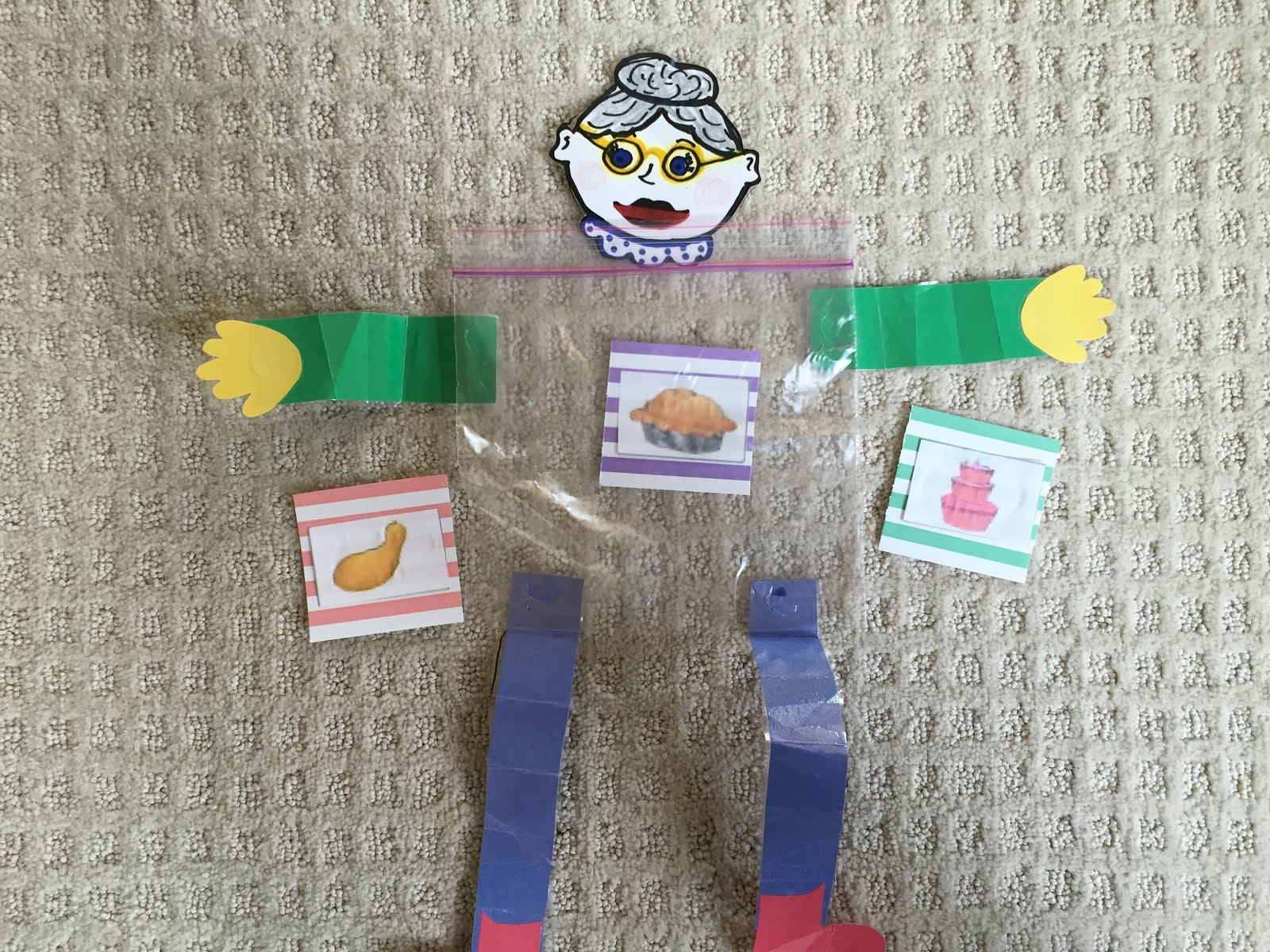
Give children a circle to decorate for the head of the old lady. Staple the head to the back opening of a zip sandwich bag. Staple on strips of paper for arms and legs as shown. Run off copies of the different items for the book or song you are singing. Children line up items in sequential order and then insert them in the bag as you sing. 


You could always use a real old lady's head!


Paper Plate Old Lady
Cut the center out of a paper plate. Use the center for the Old Lady’s head and attach with a brad fastener. Attach strips of paper with brad fasteners for arms and legs. Tape a sandwich bag to the back of the plate so you can insert illustrations as you sing.


Flannel Board File Folder
Staple the sides of a file folder together and glue a piece of felt to the front. Add Velcro to the back of pictures and place on the flannel board as you sing.


Isn't this the cutest apron you've ever seen?  The Old Lady's mouth is a pocket so the children can insert different objects. What fun!!!!


Saturday, June 21, 2025

TOOTY TA

What's the point of doing the "Tooty Ta"?

oral language
auditory memory
phonological awareness
eye-hand coordination
following directions
sequence
pattern
repetition
crossing the midline
friendship
Teachers being REAL and connecting with their students in a FUN way!


A neighbor said, “I heard your songs are good for children with autism. Do you work with children with autism?” I kept my cool as I responded, “I sing with ALL children. Music is a universal language that helps us love each other.” (I borrowed that “music helps us love each other” from Pete Seeger, but it’s true.)

Where am I going with this? I have a friend with a little granddaughter who has some physical issues and has to wear a brace on her leg. I remind her grandmother to just love her and pretend like there is nothing wrong. In my years as an educator I have seen children with no arms and legs “Tooty Ta” with me. I have had children with no arms write and draw with their toes. I have seen children in wheelchairs picked first to be on a kick ball team. I have had all the boys want to marry my little bald Lauren who had gone through chemotherapy. Why? Because if you don’t tell children they are different they won’t act different. It’s as simple as that!


I've even had teachers on mission trips to countries where children don't speak English send me photos of children enjoying "Tooty Ta."

Tooty Ta
Tooty ta, tooty ta, tooty ta ta. (Children repeat.)
Tooty ta, tooty ta, tooty ta ta.
Thumbs up.
Tooty ta….
Thumbs up…Elbows back.
Tooty ta…
Thumbs up…Elbows back…feet apart.
Song continues as you add knees together, eyes shut, tongue out, turn around.

*Substitute initial consonants or digraphs you want to reinforce in the song. For example, if you substituted /b/ for /t/ it would be “Booty ba, booty ba, booty ba ba…”

Tuesday, June 17, 2025

PEANUT BUTTER

Here's one of my silliest songs that your kids will LOVE! 
(Who wouldn't smile singing about peanut butter on their "underwear"?)


Peanut Butter (Tune: "Allouette")
Peanut butter, we like peanut butter. (Clap hands and march to the beat.)
Peanut butter, that’s what we like best.
Do you like it on your head? (Point to head.)
Yes, we like it on our head.
On your head?
On our head.
Ohhhhhh. (Hands on cheeks and move head from side to side.)

Do you like it on your shirt… (Point to shirt.)

Do you like it on your pants… (Point to pants.)

Do you like it on your socks… (Point to socks.)

Do you like it on your shoes… (Point to shoes.)

On your underwear? (Cover your eyes.)

*Is someone in your room allergic to peanuts? Let them explain what an allergy is and why they can't eat peanut butter. Let them choose another food to insert in the song, such as "macaroni" or "watermelon."

*Tie in with standards by focusing on the questions and statements.

*Cut a sheet of paper in half and then fold in half to make a book. Run off the attached worksheet and let the children put the pictures in the book in sequential order.


Friday, April 18, 2025

CARTOON TIME

What child doesn’t like cartoons? And what child wouldn’t be thrilled to have the opportunity to create their own cartoon? 

Save your funny papers from the Sunday newspaper and take them to share with your class. (All of them will not be appropriate, so select the ones you think your children will enjoy.) Explain how cartoonists use “bubbles” to let you know what the characters are saying. Tell the children that they will get to draw their own cartoons and they can use bubbles to let their characters talk.


We provided a link to download cartoon frames with 2, 3, and 4 sections. Click image above or text link below. Start off by giving them copies of the cartoon frame with 2 sections. Tell them to think of a story that has a beginning and an end and draw it.

Next, let them think of a story with a beginning, middle, and end.

Finally, challenge them to create a story with 4 sections.

*Use cartoon frames to recall the sequence of a story.

*Use cartoon frames for the life cycle of a butterfly, the water cycle, plant growth, and so forth.

*Let them draw a picture of you and make a bubble with something you frequently say coming out of your mouth. You might be surprised!!!!


Here's a link so you can download the blank cartoon frames:


Cartoons That Move
Would you like to learn how to make cartoons that move? It’s easy peasy, but you’ll surely impress your students (and parents) when you teach them how to do this.

Hint! I would demonstrate this with kindergarteners, but the primary grade children could do this with some guidance.

Materials: white copy paper, stapler, black pen or pencil

Directions:

1. Fold the paper into fourths and cut on the creased lines.

2. Take two sheets and staple them at the top.

3. Lift the top layer and draw a simple shape on the bottom. Keep your drawing on the bottom half of the page.


4. Now, place the top sheet over the bottom and trace over the lines. Vary one or two features, such as arms, ears, mouth, etc.

5. Take a pencil and roll the top sheet up around the pencil.

6. Quickly move the pencil up and down to bring life to your cartoon. Waalaa!


*Connect this activity to literature, science themes, or social studies.


Monday, March 17, 2025

VENNS AND TIME LINES

Did you know that John Venn conceived the Venn diagram around 1880 to teach elementary set theory? The Venn remains a useful tool to compare and contrast in our classrooms today.

Children can compare and contrast themselves with a friend. How are they different and how are they alike?

Children can demonstrate primary and secondary colors with Venns.

How about comparing books or characters with a Venn?

Animals (frogs and toads), plants (palm tree and cactus), or foods (apples and oranges) can be explored with Venns.

Letters (curves, lines, lines and curves) can even be sorted with a Venn diagram.


Time Lines
Time Lines are a visual way for children to recall the sequence in a story.

Time lines can be used to illustrate the life cycle of plants and animals.

Children can record the day’s events with a time line or use a time line to organize tasks that they must accomplish at school.

Time lines can also be used for history lessons or as an autobiography.
(What was I like when I was a baby…what am I like now…what will I be when I am grown.)


Hint for Pre-K teachers! Model using these graphic organizers with your students. It will increase their print awareness and be useful (prior knowledge) when used in future grades.

Friday, March 7, 2025

DO YOU LIKE PEANUT BUTTER?

Here's one of my silliest songs that your kids will LOVE! 
(Who wouldn't smile singing about peanut butter on their "underwear"?)


Peanut Butter (Tune: "Allouette")
Peanut butter, we like peanut butter. (Clap hands and march to the beat.)
Peanut butter, that’s what we like best.
Do you like it on your head? (Point to head.)
Yes, we like it on our head.
On your head?
On our head.
Ohhhhhh. (Hands on cheeks and move head from side to side.)

Do you like it on your shirt… (Point to shirt.)

Do you like it on your pants… (Point to pants.)

Do you like it on your socks… (Point to socks.)

Do you like it on your shoes… (Point to shoes.)

On your underwear? (Cover your eyes.)

*Is someone in your room allergic to peanuts? Let them explain what an allergy is and why they can't eat peanut butter. Let them choose another food to insert in the song, such as "macaroni" or "watermelon."

*Tie in with standards by focusing on the questions and statements.

*Cut a sheet of paper in half and then fold in half to make a book. Run off the attached worksheet and let the children put the pictures in the book in sequential order.


Monday, January 13, 2025

LET'S PLAY WITH BLOCKS

If you ever went to one of my workshops you heard me say, "If I could have two things in my classroom I'd take books and blocks." Blocks are great for creative play and STEM, but they can also be used for other skills.

Note! For some of these activities you will want to tape the paper to the blocks or use sticky notes. For other games that will be used in multiple ways (such as letters and numerals), you could write on the blocks with a permanent marker.

Sequence– Tape illustrations (from a workbook or worksheet) of different parts of a story. Children can sequence the pictures and retell the story using the blocks.

Rhymes– Tape pictures of objects that rhyme to blocks and have children match them up.


CVC Words– On 2 ½” squares write consonants with a blue marker and write vowels with a red marker. Tape to blocks. Let children build CVC words using the blocks.


Prefixes and Suffixes– Use a black marker to write root words on 2 ½” x 5” pieces of paper and tape to blocks of the same size. Write prefixes with a green marker and suffixes with a red marker on 2 ½”” squares and tape to square blocks. Children place the prefixes in front of the root words and read. Place the suffixes on the end of the blocks and read.


Onsets and Rimes– Write rimes (vowel and letters following) on 2 ½” x 5” pieces of paper and tape to blocks. Write onsets (consonants and blends) on 2 ½” squares and tape to blocks. Children put onsets on rimes and read the words.


Singular and Plural – Write nouns on 2 ½” x 5” pieces of paper. Tape to blocks. Write “s” on a 2 ½” square and tape to a block. Challenge children to read singular words and then make them mean “more than one.”


Inflicted Endings– Write verbs on 2 ½’” x 5” pieces of paper. Write “s,” “ing,” and “ed” on 2 ½” squares and tape to blocks. Can children make words and then use them in sentences?

Letter Blocks– Write uppercase letters on 26 blocks and lowercase letters on other blocks. Can children match upper and lowercase letters?


Alphabetical Order– Ask children to put the blocks in alphabetical order.

Sight Words and Spelling Words– Invite children to reproduce their names, high frequency words, spelling words, or vocabulary words with the letter blocks.

Beginning Sounds– Using old workbooks, cut out pictures and tape them to blocks. Ask children to match up letters with pictures that begin with the same sound. (You could do this for final sounds or vowels.)

Building Sentences– Challenge children to construct sentences using the high frequency words.
I like…
We can…
I see…

Environmental Print – Ask children to bring in labels from food products or items around the house. Tape to blocks. Can they build towers and read the words?


DON'T FORGET MATH!!!!

Sorting – Can they sort like blocks together? Can they regroup the blocks by another attribute?

Numerical Order – Write numerals 0-10 on 2 ½” x 5” pieces of paper and attach to blocks. Can they put the blocks in order? 


Sets and Numerals – Write numerals, number words, and sets on blocks for children to match.


Roll and Stack – Children take one or two dice and roll. They select that number of blocks and stack them as tall as they can. 


Counting – How many blocks can you stack?

Math Signs – Write inequality signs, =, +, and – on pieces of paper and attach to blocks. Children can build equations and practice addition and subtraction with the numeral blocks and signs.


Liquid Measurement
– Write “cup” on two square blocks. Write “pint” on a rectangular block. How many cups in a pint?


Fractions – What would happen if you cut the square block in half? What would happen if you cut the rectangular block in half? How many ways can you make the square block? Rectangular block?

Measure Up – Children lay on the floor as friends take unit blocks and measure how many blocks long they are. Use different size blocks and compare.

Graphing – Have children draw their faces on 2 ½”” squares. Tape to blocks. Use for comparing and graphing.
For example: You could have a picture of a bus, feet, and a car. Children place their block under the way they travel to school. Which one is more? Less? How can we tell for sure?

Monday, November 11, 2024

I KNOW AN OLD LADY

How many old ladies do you know besides me? I know the “Old Lady Who Swallowed a Fly.” She also swallowed a pie and a bat and a chick and numbers… She must be getting pretty full! The Old Lady is entertaining, but she also helps children with recall, sequence, phonological awareness, and oral language.

Here are a few visuals and craft activities that can be adapted to any version of the Old Lady. You can find free images online for the different stories or let children make their own illustrations.

Sandwich Bag Old Lady
Give children a circle to decorate for the head of the old lady. Staple the head to the back opening of a zip sandwich bag. Staple on strips of paper for arms and legs as shown. Run off copies of the different items for the book or song you are singing. Children line up items in sequential order and then insert them in the bag as you sing. 


You could always use a real old lady's head!


Paper Plate Old Lady
Cut the center out of a paper plate. Use the center for the Old Lady’s head and attach with a brad fastener. Attach strips of paper with brad fasteners for arms and legs. Tape a sandwich bag to the back of the plate so you can insert illustrations as you sing. 


Flannel Board File Folder
Staple the sides of a file folder together and glue a piece of felt to the front. Add Velcro to the back of pictures and place on the flannel board as you sing.


Here's a video where I demonstrate the song in sign language.


Sunday, November 3, 2024

THANKSGIVING STORY BRACELET


This has been one of the most popular posts on my website. Anyone who has made this story bracelet will attest to the fact that it is a BIG HIT with children and families. It's also a natural way for children to practice retelling a story.

Hint! It's going to be an "investment" when you buy the beads, so this might be a project to hand over to a parent. You can buy individual bags of beads or just buy a large container of beads at Walmart and let the children pick out the colors they will need. The only color I had difficulty finding was brown, so I just bought a little package of brown wooden beads.


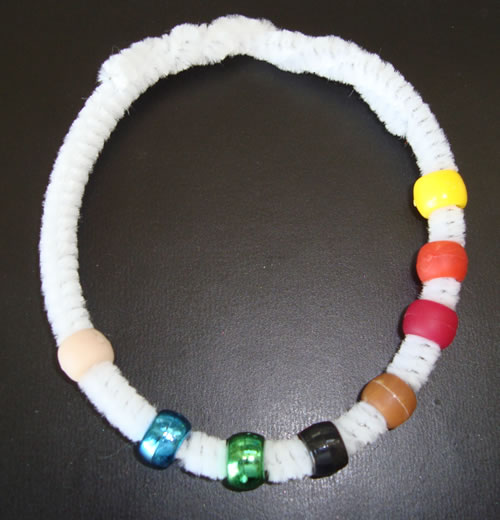
Materials: white, blue, green, black, brown, red, orange, yellow beads, pipe cleaners

Directions: Say the poem and demonstrate how to insert the beads when the appropriate color is mentioned. Model this several times and encourage the children to recall the colors and fill in words that rhyme.

Write the colors in order and put the pipe cleaners and beads in a center for the children to construct independently. You could also do this as a small group activity with younger children. Practice telling the story as the children touch the beads for a prompt. Make sure to send home a copy of the poem with the bracelet so parents can reinforce this activity at home.

Thanksgiving Story Bracelet
With this bracelet you will know (Start with a pipe cleaner.)
The first Thanksgiving that was long, long ago.
The Pilgrims set sail from far away
On the Mayflower with tall white sails. (Insert a white bead.)
They sailed many days across the ocean blue. (Add a blue bead.)
The seas were rough, but the ship came through.
At last they spotted land so green. (String on a green bead.)
They were so happy they cheered and screamed.
The first year was so hard and black. (Now a black bead.)
Many died and wished that they could go back.
But the Native Americans gave them a hand
And helped them survive in the strange new land.
They decided to celebrate in a special way
And that became the first Thanksgiving day.
They prepared a feast with turkeys brown (Add a brown bead.)
And red cranberries that they had found. (Time for a red bead.)
Yellow corn that they had learned to grow (Insert a yellow bead.)
And orange pumpkin pies, don’t you know! (Last an orange bead.)
But before they ate the turkey and dressing,
They all held hands for a thankful blessing.
(Twist the ends of the pipe cleaner to make a bracelet.)

Grateful Bracelet
Here's a new idea for those of you who teach at a faith based school.


Last year I ordered a "grateful" bracelet (aka blessing bracelet) online and I wear it every day. You are suppose to touch each bead daily and say something that you are grateful for. I adapted this for the girls in my Sunday school class by using a pipe cleaner and some beads I got at Walmart. I let the girls choose 4 large beads for the "grateful" beads and smaller beads for in between. It's a tangible way for us to count our blessings!