photo 3am_dj_home_zps919fb85e.png photo 3am_dj_about_zps7cce4c75.png photo 3am_dj_website_zps73051235.png photo 3am_dj_ss_zps6759ec2a.png photo 3am_dj_bs_zps43e27832.png
Showing posts with label Math. Show all posts

Monday, September 7, 2026

PLAY DOUGH DAY

PLAYING MAKES YOU SMARTER! 

So I guess that means playing with play dough makes kids smarter!


September 16th is National Play Dough Day, but I think every day should be a play dough day in early childhood. Play dough is multi-sensory, engaging, creative, and open-ended. Play dough can be a tool just like a worksheet, video game, or PPT. Play dough also develops small motor skills which help children write. Here are just a few ways to integrate play dough into centers and independent learning in your classroom.
Comprehension
Let children make their favorite character and use it to retell a story.


Draw a scene from a story and add details with play dough.

Make something that you learned from the book.

Phonics
Rhymes – Make two objects that rhyme.


Sounds – Make objects that start with a consonant, blend, or diagraph you are working on.
Vowels- Make an object for a long vowel sound and short vowel sound.


Writing
Make something you like (or don’t like) and write about it.

Make something from a book you have read and write about it.

Make letter plates by writing letters with a permanent marker on plastic plates. Children roll play dough and make the letters on top.


Make letters (or words) using a bubble font. Children roll dough and fill in.


Make something that is a noun. How can you make it plural?

Math
Make objects that match numbers.


Make a set and then decompose it.

Demonstrate more, less, and equal.


Make lines, curves, and shapes.

Science and Social Studies
Reinforce information from a science or social studies unit with play dough. Children could make animals from a habitat, parts of a flower, tools of community helpers, healthy foods…endless possibilities!

Silly Putty
Here’s another idea a second grade teacher shared for keeping those fingers busy! She asks each parent to provide a container of silly putty that the children keep in their pencil box. If they finish their work early, they use the silly putty to create something that relates to a reading skill, math concept, science unit, etc.


Thursday, September 3, 2026

CHEESE PIZZA DAY

September 5th is Cheese Pizza Day, but I could eat pizza every day! (Seriously!) Here’s a silly song that I used to sing just because the children got a laugh out of it. Now, I tie it into standards because it demonstrates sound substitution and reinforces vowel sounds. Whatever!!!
Pepperoni Pizza
I like to eat, eat, eat, (Extend arms to make a circle like a pizza.)
Pepperoni pizza.
I like to eat, eat, eat,
Pepperoni pizza.

Sing substituting the long “A” sound for each vowel.
A lake tae ate, ate, ate,
Papparaynay pazzay…

Continue substituting with “E,” “I,” “O,” and “U.”

Hint! Make sign language letters for the vowels as you sing.

Word Family Pizza
Chris Baker created this video to demonstrate consonant substitution as children sing the song.

https://www.youtube.com/watch?v=RrpSSXZK9-I&feature=youtu.be

EASY PEASY PIZZA GAME

There are dozens of math skills you can tie in with this easy peasy math manipulative.


Why? sorting; sets; numerals; addition; subtraction, patterns; following directions; writing how to

What? fun foam (red, yellow, green, brown, black, white), pie pan, red felt, index cards, book ring

How? Cut toppings for your pizza from fun foam using this pattern.
https://drive.google.com/file/d/0B1SnEagA4jljX1ZiakdoWjhCT00/view?usp=sharing

Sausage – brown
Peppers – green
Cheese – yellow
Pepperoni – red
Olives – black
Mushrooms – white
(Store the patterns in a zip bag.)

Cover the bottom of the pie pan with red felt.


*Let children sort the toppings.
*Give them numeral cards and ask them to make sets.
*Can they make a pattern with the toppings?
*Give them addition and subtraction facts and ask them to work out the problems with the toppings.
*Make recipe cards similar to the ones shown for the children to follow.
*Can they count how many ingredients in all on their pizza?

How To
Have children write their own recipe cards and directions for making a pizza.

Paper Pizza Collage
Give children a paper plate and some scrap paper, scissors, and crayons and let them create their own paper pizza. When they've finished they can add a few drops of glue and sprinkle with oregano or Italian seasonings to make it SMELL like a real pizza.

Thursday, August 27, 2026

FOOTBALL HERE WE COME!

If you are college football fans like we are, this weekend is like Christmas. We can hardly wait for the first kick off! Football gives us a distraction from the world's woes and it gives us something to cheer for and look forward to each weekend. Football can also be a “kick off” for teaching some skills in your classroom.

College Goals
It’s never too early to plant seeds of attending college in your students. Give them a dream and a goal! One school I visited displayed pennants of the schools where the teachers graduated from in the front hall.

*Have the children brainstorm all the colleges and universities in your area. Talk about why it is important to go to college.

*Encourage your students to think about where they would like to go to college. Give them paper shaped like pennants to decorate with their college dream.


Math
Let children do surveys of favorite college teams.
Graph favorite teams.
Predict who will win the game. Who was right? Who was wrong?
Predict what the score will be. Who was closest?

*Let children choose a favorite player and write their number on a jersey. How many math facts can they think of to equal that number?

Social Studies
Use a map of the United States and locate where games will be played.

Internet Search
Look up team mascots and colors. Listen to college fight songs. Do exercises to fight songs.

Art

Cut pictures of players out of the newspaper or sports magazines. Challenge children to write creative stories about favorite players. They could also write letters to favorite players.

*Make stick puppets from favorite players' photos.

Guest Readers
Invite a local high school football team and cheerleading squad to visit your school to read books. There’s nothing more motivating to a young child than to see someone in a uniform model how “cool” it is to read!

Team Mascots
This game can be adapted to any school mascot, action hero, or seasonal character. Since I graduated from the University of Georgia, UGA was my first choice. This is a quick, simple game that can be played with any age level or any skill that needs to be reinforced. It’s the perfect game if you’ve got a few minutes before lunch or a few minutes at the end of the day.


WHY? shapes, colors, letters, words, numerals, math facts, etc.
WHAT? flash cards, picture of a favorite school mascot
HOW? Have children sit in a circle and encourage them to identify the information on the flash cards as you place them on the floor. Tell the children to turn around and hide their eyes. Take “UGA” and slip it under one of the flash cards. The children turn back around and raise their hand if they think they know where UGA is hiding. One at a time, have children call out a word, letter, shape, etc., and then look under that card. The game continues until a child finds UGA. That child may then be “it” and hide the mascot.

*Use a pocket chart to play this game. Arrange the flash cards in the pocket chart and then hide the mascot under one of the cards as the children hide their eyes.

More? Make a concentration game using various college mascots.
Make a matching game where children match mascots to college names.
What characteristics do you need to dress up and be a school mascot?
Have children write which mascot they would like to be and why.

Wednesday, August 26, 2026

SHIP SHAPE

How about some ideas for geometry? You can use these activities with young children or school age by adapting the shapes. You might even “spy” some of your state standards here!!!

The Shape Song (Tune: "I'm a Little Teapot")


I am momma circle round like a pie. (Hands over head in a circle.)
I’m baby triangle three sides have I. (Use 3 fingers to make a triangle.)
I am papa square my sides are four. (Draw a square in the air.)
I’m cousin rectangle shaped like a door. (Draw a rectangle in the air and then knock.)

I am brother oval shaped like a zero. (Make oval with arms over head.)
I’m sister diamond with a sparkle and a glow. (Touch thumbs and index fingers and extend.)
We are the shapes that you all know. (Make circles with index fingers and thumbs and
Look for us wherever you go. place around your eyes like glasses.)

Note! Explain that “rhombus” is the correct term for the diamond shape. Sing the song calling sister a “rhombus” instead of a “diamond.”

*Have children draw shapes in the air with elbows, feet, noses, and other body parts.


*Place foam shapes or 3-dimensional shapes in a bottle filled with sand or salt. Children spin it around and try to identify the shapes. Can they draw the different shapes that they spy?


Body Shapes
Divide children into small groups and challenge them to lay on the floor and make various shapes with their bodies. How many friends will it take to make a triangle? A square? A pentagon? Take pictures and make a book.

*Make spyglasses for “spying” shapes by wrapping construction paper around paper towel rolls.

*Cut geometric shapes out of construction paper and let children use them to make a collage. Can they combine simple shapes to make larger shapes?


*Cut sponges into geometric shapes and have children dip them in paint and stamp on paper.


*Download highway shapes (free on the internet).  Children can drive around these with toy cars or they can roll play dough and place it on the shapes.

*Go on a walk and look for shapes in your school and on the playground.

Shape Book
Fold two sheets of paper in half and staple. Children decorate the front of their book with shapes. Next, they walk around the room and draw shapes that they see. Can they label the shapes?
*This would be a good homework activity to help children be more aware of the shapes around their home.

Play Dough Book
Draw lines, curves, and geometric shapes with a marker on file folders. Laminate. Bind file folders with rings to make a book. Children roll play dough and place it on top of the shapes.


Bendables
Offer children pipe cleaners, Wikki stix, etc. and challenge them to make various shapes with the items.

Pretzel Shapes
Give children pretzel sticks and pretzel twists and challenge them to make geometric shapes. How many pretzel sticks will you need to make a hexagon? How many pretzel sticks will you need to make a triangle?

*Challenge them to make letters with the pretzels. This is fun to do with a partner as they take turns making letters and identifying them.


Monday, August 24, 2026

COUNT ON WITH FINGER PLAYS

"Fiveness" and "tenness" are important to developing number sense. We can do this naturally with finger plays involving five and ten.

Noodles
One small noodle (Hold up one finger.)
On my noodle plate.
Salt and pepper,
Tastes just great. (Pretend to shake salt.)
Mother’s going to the store.
Mother, mother, get some more.

Two…Three…Four…

*Cut five small holes out of a paper plate and insert your fingers as you say the rhyme.

Five Little Ducks

Five little ducks (Hold up 5 fingers.)
Went out to play
Over the hills (Move hand up and down.)
And far away. (Put hand over your eyes as if looking.)
When the mother duck called,
“Quack, quack, quack!” (Put palms together and open and shut.)
Four little ducks (Hold up 4 fingers.)
Came waddling back.

Four…three…two…one
No little ducks went out to play (Make fist.)
Over the hills and far away.
When the daddy duck called,
“QUACK! QUACK! QUACK!” (Open and close arms and say loudly.)
Five little ducks came waddling back.


*Staple the sides of a file folder and glue felt to the front to make a flannel board. Cut ducks or other figures out of felt to use as visuals for finger plays.

Alligator and Monkeys
Five little monkeys (Hold up 5 fingers.)
Swinging from a tree,
Teasing Mr. Alligator, (Point finger as if teasing.)
“Can’t catch me!
You can’t catch me!” (Shake head “no.”)
Along came Mr. Alligator (Put palms together and slowly
Quiet as can be, move like an alligator.)
And snatched a monkey (Open and clap palms as if
Right out of the tree! chomping on something.)

Four…three…two…one
“Missed me, missed me!
Now you gotta kiss me!” (Put hands on side of your head and wiggle.)

*Attach stickers to craft sticks to make puppets for finger plays.
*Choose one child to be the alligator and five other children to be the monkeys and act out the rhyme.

Five Little Hotdogs
Five little hotdogs (Hold up 5 fingers.)
Frying in the pan.
The grease got hot,
And one went BAM! (Clap hands.)
Four little hotdogs… (Hold up 4 fingers.)
Three little hotdogs… (Hold up 3 fingers.)
Two little hotdogs… (Hold up 2 fingers.)
One little hotdog… (Hold up 1 finger.)
No little hotdogs (Hold up fist.)
Frying in the pan.
The pan got hot,
And it went BAM! (Clap hands and say the last word loudly.)


*Draw the shape of a pan on a file folder. Cut a 6" slit across the center as shown. Cut hotdogs out of construction paper and tape to spring clothespins.
*Write numbers on plastic plates and have children make the appropriate number of hotdogs from play dough.


*Change “hotdogs” to “sausages.” Or, change the rhyme to popcorn and say:
Five little kernels sizzling in the pot.
The grease got hot and one went POP!”

Gummy Bears
Down at the candy shop what did I see?
Five little gummy bears smiling at me.
Along came (child’s name) with a penny one day.
He/she bought the green one and took it away.

Down at the candy shop what did I see?
Four little gummy bears smiling at me.
Along came (child's name) with a penny one day.
He/she bought the red one and took it away.

Three...two...one

*Cut gummy bears out of construction paper. Choose five children to hold the bears. Distribute paper pennies to five other children and use their names as you say the rhyme.

Ten Little Friends
Ten little friends (Hold up fingers.)
Went out to play (Wiggle.)
On a very bright
And sunny day.
And they took a little walk.
Walk, walk, walk. (Walk fingers in front of your body.)
And they had a little talk.
Talk, talk, talk. (Put fingertips together.)
They climbed a great big hill (Move fingers over your head.)
And stood on the top very still. (Keep hands still.)
Then they all tumbled down (Roll hands around and down.)
And fell to the ground.
We’re so tired, (Hold up fingers.)
They all said.
So they all went home
And went to bed.
10 – 9 – 8 – 7 – 6 – (Put down fingers one at a time as you
5 – 4 – 3 – 2 – 1. count backwards and lower your voice.)
Good night! (Lay head on hands.)

Wednesday, July 29, 2026

MOVING THE MORNING MEETING


There is a limit to the time that children can sit and pay attention, but this idea might help spark interest in your morning routine as you build skills. Think about having older children stand and walk around the room to face the flag, calendar, word wall, and classroom alphabet. As children stand and walk around the room you can engage them in some of the songs, movements, and interactive activities suggested.

My World
What? flag, US map, poster of handshakes, classroom rules

How? Sing a good morning song, say the pledge, do a handshake, review rules, etc.


Math/Science
What? calendar, weather chart, hundreds chart, daily schedule

How? Sing songs about the days of the week or the month, review your daily schedule. Sing the weather song and have a “meteorologist” report. Count, add boys and girls, think of equations that equal the date, etc.

Word Wall
What? word wall, flashlight, pointer, fly swatter

How? Sing, dance, clap, and cheer words. Make sentences with words, play games, spotlight words, spell words with sign language, etc.


Alphabet Wall
What? class alphabet, pointers

How? Sing alphabet songs and play letter recognition games. Clap on consonants and jump on vowels. Do Karate writing where children punch up high for tall letters, punch in front of them for middle letters, and give a little kick for letters with a tail.

Hint! Even if you don’t want to do all of the above activities, it’s important to get the children up and wake up their brains with a song or movement activity.

Tuesday, July 14, 2026

DESIGN ON A DIME

As I was looking through old blogs I found some super simple and inexpensive ideas to add a little BLING to your school.

Mirror, Mirror!
You know how much kids love to look at themselves in a mirror. Each day put a positive word or note on your classroom mirror to remind the children how special they are!

Hint!  Write a different positive character trait on the mirror each week.


What a clever idea to use a real picture frame to display children’s artwork!


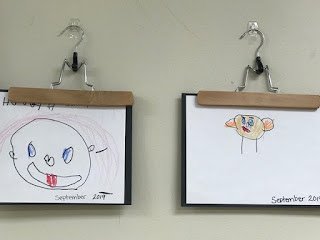
Or how about displaying children's artwork or writing using pants hangers?


I loved this idea from KIRPC Head Start in Indiana. The teacher said she bought sheets, tied the ends with ribbons, and then hung them on hooks around the smart board. Taaa daaa!


Chalk Board Table
Is this cool or what? Ms. Smalls found an old table they were going to throw away. She painted the top with chalkboard paint and let the children write special messages, draw pictures, write sight words, etc. on it. The kids LOVED it!


How about addition facts on the stairs? The science vocabulary leads to the upper grades. Letters, numbers, shapes and so many skills could “step up” learning.

Sunday, June 28, 2026

GREAT TEACHERS 125

O'Canada! What a special memory from 2013! 

Kinderoos, Kindies, and Chikcadees
Aren’t these cute names for our little ones?

Comalya (Roberta Bondar, Kathy and Sandra)
Have a weekly “Comalya” when all the kindergarten students and teachers get together to sing.
*Comalya means “Come all ye!”

Rhyme Bag (Hieke Klapwyk)
Send home a brown “rhyme” bag with each student on Friday. They fill the bag with two items that rhyme. At show and tell time, each student removes one item from their bag. Classmates must guess what the second item in the bag is by naming objects that rhyme.

Stringing Words (Irene Bootsma)
Place pipe cleaners and letter beads in a center with a list of student names or sight words. Students string the beads on the pipe cleaner and then read the words.

Sight Word Game
On large craft sticks write sight words on one end. Write letters on clothespins. Children attach the letters on the craft stick to spell the word.


Grouping Game (Jean Broad)
The children wander about the class and the teacher calls out a number. They need to form groups with that amount and then sit down together. If there are children left over that’s O.K. They remain standing. The teacher reviews the groups and might say, “I see 1,2,3,4,5 groups of four. That makes 20. We have 2 extras so we know that 20 + 2 = 22.” Then call out another number.
Establish these rules before playing:
*Respect everyone.
*Never exclude anyone from joining your group.
*Be polite.
*Help others who need to find people for their group.
This helps children with problem solving, collaboration, number sense, oral language, etc.


Math Concept Maps (Louise Gavarkovs)
While children are waiting for the day to begin, let them create math concept maps on individual white boards with dry erase markers.
*Each child chooses what they are able to include. For example, older children could write number stories and younger children could draw sets.


Top Banana (Caroline, Tina, Megan)
The special helper of the day is the “top banana.”


Coffee, Tea, and Me - End of Year Celebration (Donna Petrocco)
Each child invites a guest to school. Set up coffee, tea, juice, fruit, and desserts. Eat and then share some classroom poems and songs. (Students take turns standing up in front of the room to share.) The teacher then passes out memory books for each child with the following:
Picture drawn by the student
Handprint poem
Santa letter
Writing samples
Poems from the teacher
Photographs of child throughout the year
The children look at their memory books with their adult.
*The teacher can stand back, observe, and smile!


Buddy Sticks for Clever Kids
(Terrie Voldimer)
Have as many sticks as kids in a variety of colors. On the end of sticks put something for the students to match, such as letters, numbers, shapes, stickers, etc. Each child selects and stick and then the teacher can choose what they should match up. For example, “Find someone with the same shape and color as you.” “Find someone with the same sticker as you.”

Pinwheel (Laura Quinton)
To make a square, fold a sheet of paper diagonally and cut off the end. Fold in half diagonally again. Cut in on diagonal lines stopping 1” from the center. Hole punch every other corner and in the middle. Insert holes on a pencil or straw and put a little play dough on the end.
*Use for a review by writing vocabulary words, spelling words, math facts, etc. on the pinwheel.


Parent Observation
(Misty Martin Gigliotti)
Prepare an observation sheet for parents who visit the classroom with the following:
-Is your child engaged in singing? Dancing? Listening? Hand movements?
-Does your child participate in activities? Centers? Are they playing alone, with a friend, friends? Are they watching other children play?
-Are they rushing through their work? Are they taking their time?
-What center did they visit first?
-Do you have questions about centers, the classroom, etc.?


Alphabet Shake
Put letters in the bottom of an egg carton. Insert a pompom and shake. The child opens and names the letter, sound, and a word that starts with that sound.
*You can make a similar game with numerals, shapes, words, etc.


Friday, June 26, 2026

GREAT TEACHERS 123

HEY, HEY, WHAT DO YOU SAY?  IS THERE A NEW IDEA HERE FOR YOU TODAY?

Puppet Password
Have a class puppet that gives a password every day. For attendance, the children say the password instead of “here.” Select a password that is the subject for the day, such as “Pilgrims,” “winter,” etc. You could also use a sight word or a vocabulary word.
Use this chant to introduce the password:
Mr. Mouse, Mr. Mouse (or whatever your puppet is),
Oh, what do you say?
What is the password for today?

Pretend to let the puppet whisper the password in your ear. 

*You can also let the puppet go home with a student each weekend and come back Monday with a story and pictures. Keep the stories in a class book.

Hot Number!
(Nola Faulkner)
The teacher picks a random number between 1-10. That’s the number that is the HOT NUMBER. Students stand in a circle and one by one count by ones from 1 – 10. The student who says the hot number can jump or cheer and then must sit down. Keep counting from 1-10 until one child is left.

Polite Partner Share (Meghan Burkholder)
Before reading a story, do questioning and partner talk. The kids turn to a partner and say:
Eyes to eyes.
Knees to knee.
It’s nice that you
Are partners with me.

After sharing their thoughts they thank each other. It’s also a great way to practice taking turns when talking.


McDonald’s Cheer (Michelle Sanders)
Ba, da, ba, ba, ba.
I’m loving it! (Arms overhead like the golden arches.)

Fun Rules (Jackie Fursman)
*Hoods cannot be worn unless it rains or snows inside the school.
*You can only run in the school if there’s an elephant or tiger chasing you.
*You can only lie down if “I” do.
*Ask three before me when I’m at the reading table.

1, 2, 3, Show Me! (Joy, Olathe, KS)
Using individual white boards the teacher asks a question and the children write a response. The teacher says, “1, 2, 3, show me!” Children quickly hold up their slate and show the teacher.
Sample questions: Write the number 15. Write the letter Mm. Write 5 tally marks. Write the number that comes between 2 and 4.

Three Star Sentences (Joy, Olathe, KS)
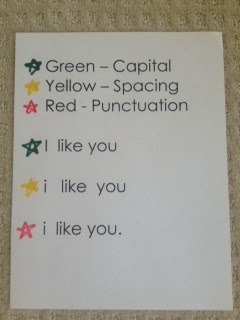
To help kids learn the mechanics of sentence writing they can earn 3 stars. They get a green for using a capital at the beginning; a yellow for spacing between words; a red star for punctuation.


Doubles Don’t Give Me Trouble (Sarah Jackson)
(Tune: “I’ve Been Working on the Railroad”)
1 + 1= 2, 2 + 2 = 4, 3 + 3 = 6, 4 + 4 = 8, 5 + 5 = 10, 6 + 6 = 12
Now I know my doubles,
They don’t give me any trouble!
7 + 7 =14, 8 + 8 = 16, 9 + 9 = 18, 10 + 10 = 20, 11 + 11 = 22, 12 + 12 = 24

Focus Finger Play (Pat Kesler uses this before handwriting. It wires up the brain!)

Two tall telephone poles (Fists touching with index fingers pointing up.)

Across them a wire was strung. (Touch middle fingers.)

Two little birds hopped on ((Put thumbs up on middle fingers.)

And sung and sung and sung. (Swing fingers.)


Push the Wall
One teacher’s occupational therapist suggested that when children are waiting in the hall you tell them to put their hands on the wall and try to “push it down.” This builds upper body strength, releases energy, and focuses children’s attention.


Tummy Reading
Here’s another easy suggestion to help children build upper body strength. Let them do “tummy reading.” Children lay on their tummies and prop themselves up with their elbows as they read. Try it and see how it strengthens those arm and shoulder muscles.

Friday Dance (Tarsha Walker)
Come on, everybody let’s take a chance. (Motion arm “come” as you move from left to right.)
It’s time to do the Friday dance. (Thumb over shoulder as you dance.)
Clap your hands (clap)
And stomp your feet. (stomp)
Come and do the Friday dance with me.
It’s Friday! (Throw arms in the air.)
YEAH!

Bubbles (Erin Yarborough)
To help children remember to walk quietly in the hall, tell them to hold a bubble in their mouths. When you get to your destination they can “pop” their bubbles.