photo 3am_dj_home_zps919fb85e.png photo 3am_dj_about_zps7cce4c75.png photo 3am_dj_website_zps73051235.png photo 3am_dj_ss_zps6759ec2a.png photo 3am_dj_bs_zps43e27832.png
Showing posts with label Buddies. Show all posts

Friday, June 26, 2026

GREAT TEACHERS 123

HEY, HEY, WHAT DO YOU SAY?  IS THERE A NEW IDEA HERE FOR YOU TODAY?

Puppet Password
Have a class puppet that gives a password every day. For attendance, the children say the password instead of “here.” Select a password that is the subject for the day, such as “Pilgrims,” “winter,” etc. You could also use a sight word or a vocabulary word.
Use this chant to introduce the password:
Mr. Mouse, Mr. Mouse (or whatever your puppet is),
Oh, what do you say?
What is the password for today?

Pretend to let the puppet whisper the password in your ear. 

*You can also let the puppet go home with a student each weekend and come back Monday with a story and pictures. Keep the stories in a class book.

Hot Number!
(Nola Faulkner)
The teacher picks a random number between 1-10. That’s the number that is the HOT NUMBER. Students stand in a circle and one by one count by ones from 1 – 10. The student who says the hot number can jump or cheer and then must sit down. Keep counting from 1-10 until one child is left.

Polite Partner Share (Meghan Burkholder)
Before reading a story, do questioning and partner talk. The kids turn to a partner and say:
Eyes to eyes.
Knees to knee.
It’s nice that you
Are partners with me.

After sharing their thoughts they thank each other. It’s also a great way to practice taking turns when talking.


McDonald’s Cheer (Michelle Sanders)
Ba, da, ba, ba, ba.
I’m loving it! (Arms overhead like the golden arches.)

Fun Rules (Jackie Fursman)
*Hoods cannot be worn unless it rains or snows inside the school.
*You can only run in the school if there’s an elephant or tiger chasing you.
*You can only lie down if “I” do.
*Ask three before me when I’m at the reading table.

1, 2, 3, Show Me! (Joy, Olathe, KS)
Using individual white boards the teacher asks a question and the children write a response. The teacher says, “1, 2, 3, show me!” Children quickly hold up their slate and show the teacher.
Sample questions: Write the number 15. Write the letter Mm. Write 5 tally marks. Write the number that comes between 2 and 4.

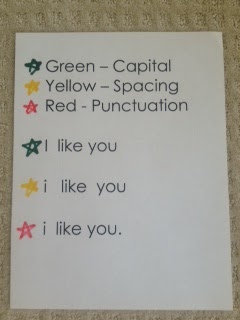
Three Star Sentences (Joy, Olathe, KS)
To help kids learn the mechanics of sentence writing they can earn 3 stars. They get a green for using a capital at the beginning; a yellow for spacing between words; a red star for punctuation.


Doubles Don’t Give Me Trouble (Sarah Jackson)
(Tune: “I’ve Been Working on the Railroad”)
1 + 1= 2, 2 + 2 = 4, 3 + 3 = 6, 4 + 4 = 8, 5 + 5 = 10, 6 + 6 = 12
Now I know my doubles,
They don’t give me any trouble!
7 + 7 =14, 8 + 8 = 16, 9 + 9 = 18, 10 + 10 = 20, 11 + 11 = 22, 12 + 12 = 24

Focus Finger Play (Pat Kesler uses this before handwriting. It wires up the brain!)

Two tall telephone poles (Fists touching with index fingers pointing up.)

Across them a wire was strung. (Touch middle fingers.)

Two little birds hopped on ((Put thumbs up on middle fingers.)

And sung and sung and sung. (Swing fingers.)


Push the Wall
One teacher’s occupational therapist suggested that when children are waiting in the hall you tell them to put their hands on the wall and try to “push it down.” This builds upper body strength, releases energy, and focuses children’s attention.


Tummy Reading
Here’s another easy suggestion to help children build upper body strength. Let them do “tummy reading.” Children lay on their tummies and prop themselves up with their elbows as they read. Try it and see how it strengthens those arm and shoulder muscles.

Friday Dance (Tarsha Walker)
Come on, everybody let’s take a chance. (Motion arm “come” as you move from left to right.)
It’s time to do the Friday dance. (Thumb over shoulder as you dance.)
Clap your hands (clap)
And stomp your feet. (stomp)
Come and do the Friday dance with me.
It’s Friday! (Throw arms in the air.)
YEAH!

Bubbles (Erin Yarborough)
To help children remember to walk quietly in the hall, tell them to hold a bubble in their mouths. When you get to your destination they can “pop” their bubbles.


Wednesday, June 24, 2026

GREAT TEACHERS 121

"Ooookkkaaalllahhhoommmaaaa!!!" 2011

Back to Back
Every child needs a partner and touches body parts as the teacher calls out:
back to back (touch backs)
shoulder to shoulder (touch shoulders)
elbow to elbow
knee to knee
head to head
wrist to wrist
feet to feet
hip to hip
Continue calling out vaious body parts...
End with "bottom to chair" as children sit down!

Can You Dig It? (Rachel Lawrence)
Hide magnetic numerals in a sand table. Each student is given a sheet with math facts appropriate to their level. During math centers they have to do their facts and then dig out the answers (magnetic letters) in the sand.

*You can also hide letters and have children spell words.

Spelling Trays (Rachel Lawrence)
Prepare "spelling trays" in plastic drawers. Children choose a tray and then take it to their desk and spell words using one of the materials below:
*Wikki sticks
*magnetic letters
*puzzle letters
*black light pens (security pen with black light key chain)
*alphabet stickers
*alphabet blocks
*dry erase board

Let’s Look Important! (Diane Ringer)
Use this idea instead of criss cross applesauce.
Would you like to know how to look important? Put your right hand over your heart like this. (Demonstrate)
Put your left hand across your chest and fold your arms like this. (Demonstrate)
Lift up your chin and smile importantly. Now look at all my important people!

Song Requests
(Heather Cline)
Make a box for song requests. Children write their favorite song on a sheet of paper and put it in the box. Pull requests each morning and sing.

End of Day Chant (Linda Wood)
Sit in a circle criss cross applesauce and start the chant with this rhythm:
Slap knees two times
Clap two times
Snap two times
Clap two times
“Linda, Linda, what do you say?
What did you like at school today?”
The child has to tell what they liked best that day. It’s a good way to remember what they learned as you reinforce oral language.

A Fuzzy Little Caterpillar (Leanne Hutchison)
(Tune: "I Had a Little Turtle")
A fuzzy little caterpillar wiggled right by me. (Wiggle index finger.)
He wiggled long. (Wiggle finger away.)
He wiggled short. (Wiggle finger close.)
He wiggled right at me. (Wiggle finger at your face.)
I put him in a box. (Cup hands.)
"Don't go away I said!" (Point finger.)
But when I opened up the box
There was a butterfly instead! (Clasp thumbs and wiggle fingers like a butterfly.)

*You can adapt this song for "I had a little tadpole...I put him in a jar... Don't go away I said. . But when I opened up the jar a frog hopped out instead!"

Surprise Can (Julie Wiegman & Anne Greer)
Each week place a different letter on top of a paint can. (You can purchase an empty paint can at Lowe's or Home Depot.) Select one child each night to take home the surprise can. Ask parents to assist their child in finding four items at home that begin with the letter. Put the four itmes in the can along with clues about each object. At school the next day, the child (with help from the teacher) gives clues as classmates try to guess what the objects are. Example: This is something that is a fruit. This is round and red. It grows on a tree. A-Apple!

Thursday, June 11, 2026

GREAT TEACHERS 108

These ideas are almost like seeds that you can take and grow into your own activities. 


Advisors and a WAITING Chair (Melanie Goodwin)
Two children are selected to be “advisors” for the day. During guided reading/workstations students ask a partner or one of the “advisors” before sitting in the “waiting chair” to ask the teacher. “Ask three, then me!” They have to wait until the teacher can get to them and often leave because they figure it out while waiting. This really helps eliminate disruptions during guided reading!


Mr. Tuttles (Karen Campbell)
Take a mirror and put a hat/head on top and add arms and legs to create “Mr. Tuttles.” Children tell Mr. Tuttles their tattles!


End of Year Gift (Julie Bright)
Ask each child to bring in a pillowcase. Use a T-shirt transfer to put this saying on the pillowcases:
Now I lay me down to sleep.
I’ll count hands instead of sheep.
Of all the friends I made
In (teacher’s name) first grade.
The students use fabric paint to put their handprint and write their name on all their friends’ pillowcases.


Insects (Katheryn Lambert)
(Tune: “Head, Shoulders, Knees and Toes”)
Head (point to head)
Thorax (point to chest)
Abdomen, abdomen (rub torso).
Head, thorax, abdomen, abdomen.
Two antennae (wiggle index fingers by temples)
And six legs (three fingers extended on each side)
Head, thorax, abdomen!
*Use the concept of two antennae and six legs to discuss symmetry and odd and even numbers. “We know our insects need six legs. Should I use one leg on this side and 5 legs on the other? No! It would be all lopsided!”


Swat (Whitney Rhyne)
Write letters, words, etc. on chart paper or board. Have 2 children come up at a time to race and find the letter the teacher calls out. Each child is given a fly swatter and the first one to “swat” it wins a point for their team.


Who Let the Letter Out?
(Whitney Rhyne)
Have the class squat down as you begin they song. They get to “pop up” when the letter that their name begins with comes up in the song. This is great for beginning sounds and teaches the kids what letters their friends’ names begin with.


Friendship Tools
(Liz Watras)
Use sign language (aslpro.com) to teach children these words:
Ask
Trade
Wait
Share
Include
Stop
When they have a problem they can use the tools and signs to work through the conflict.


Donut Vowels (Robin Davis)
Make donuts out of foam and decorate with markers. Write letters on each side of the donut. Next, put a vowel in the middle of a small paper plate. Children place the donut hole over the vowel and sound out the word.


Buddy Time (Robin Davis)
Put matching pompoms in a can and let each child draw a pompom. They match pompoms to find their buddy.


Tablecloths (Angie Barnett)
You can use flannel back tablecloths for everything. They are sturdy and won’t slip on the carpet. Just have the kids take off their shoes.
Keypad – If you draw a keypad children can jump their phone number, cafeteria number, or use for number recognition.
Popcorn Words – Write words or letters on popcorn shapes. Children jump around identifying letters or words.
Keyboard – Make a keyboard and use for letter recognition or spelling words.
Graph – Draw out a bar graph and use or comparisons.


Hall Chant (Theresa Malone)
My hands are hanging by my side
I’m standing straight and tall.
My eyes are looking straight ahead.
I’m ready for the hall.


Itsy Bitsy Spider (Sharon Howard)
After singing the “Itsy Bitsy Spider” let children change what kind of spider it is. It could be happy, mad, mean, angry, silly, pretty princess, etc. Then children decide how that spider would go up the waterspout.


Bread and Butter (Sharon Howard)
When you walk down the hall and go around a post or pole say this chant to the tune of “Frere Jacques”:
Bread and butter
Bread and butter
Toast and jam
Toast and jam
Peanut butter jelly
Peanut butter jelly
Cheese and ham
Cheese and ham

Tuesday, February 10, 2026

BUDDY TIME BRAIN BREAKS

First, everyone will need a buddy. “Elbow partners” where children stick out their elbow and the person’s elbow they touch is a quick way to do this. You could also quickly number your students 1-12 and then 1-12 (depending on the number in your class). Ones get together, twos, threes, and so forth.

Patty Cake - Have children play hand clap games, such as “Miss Mary Mack” or “Say, Say My Playmate.” (You can find lots of these online.) Children face a partner and clap their hands together. Next, clap right hand to partner’s right hand. Clap hands together and then clap left hand to partner’s left hand. Continue the pattern.
He learned to tie his shoe.
*Patty cake and count to 10, 20, 50, 100 or more!
*Skip count by 2’s, 5’s, 10’s etc. as you patty cake.
*Patty cake spelling words or word wall words
*Say nursery rhymes or other poems as you patty cake with a partner.
*Say ABC’s saying letter and making then making the sound.

Ride that Pony 
Ride, ride, ride that pony, (Face partner and begin clapping
Get up and ride that big, black pony. to the beat. Bounce up and down
Ride, ride, ride that pony. as if riding on a pony.)
This is what they told me.
Front, front, front, my baby. (Clap hands up in the air with partner.)
Side, to side, to side, my baby. (Gently bump hips on the side.)
Back, back, back, my baby, (Turn around and bump back sides.)
This is what they told me. (Find a new partner.)

Spider Challenge – Children sing the “Itsy Bitsy Spider” as they make the motions on a partner’s back. Next, have children stand next to their partner and extend their inside arms around their partner’s waist. Each child will use her outside arm to sing the song and cooperate with their partner.

Back to Back
– Children touch backs with a partner. The children continue to touch various body parts as the teacher calls them out. End with, “Bottoms to chairs.”

Head, Shoulders – Slowly sing the song as children face their partner and gently touch their partner’s body parts. (You might need to demonstrate the meaning of “gently”!)
*Just for fun have partners put their backs to each other and touch body parts.

Criss Cross Applesauce – Do this on each other’s backs:
Cross cross, (Make an “x” on back.)
Applesauce, (Wiggle fingers down back.)
Spiders crawling up your back. (Crawl fingers up back.)
Warm breeze. (Gently blow on neck.)
Gentle squeeze. (Hug from behind.)
Now you’ve got the shiveries! (Tickle fingers down back.)
Hint! Have children stand in a circle and face right. That way they will each have a back to write on.


Plant a Garden – Do on each other’s backs:
Dig up the dirt. (Knead back with fingers.)
Rake the ground. (Stroke down with fingertips.)
Dig holes for the seeds. (Pretend to dig holes with index finger.)
Cover up the seeds. (Finger covers up seeds.)
Pat the dirt down. (Pat back with both hands.)
Here comes the rain. (Lightly touch the back with fingertips.)
Up come the plants. (Make upward movement with hands.)
Then you pick, pick, pick. (Pretend to pick plants.)
Note! If children are sensitive and don’t want to participate do not force them.


Wednesday, September 18, 2024

PARTNER PROJECTS

Almost anything children do alone will be more fun with a friend. Take a look at this list and you'll probably find at least five strategies you can use in your classroom.


Read together.


Look at books or magazines together.

Retell a story. They can also discuss who, what, where, when, why, the problem, resolution, what might happen next, etc.

Whisper a prediction in each other’s ear.

Review information after a science lesson, social studies, etc.

Clean up a center or each other’s desks.

Read around the room. Give them pointers and empty glasses frames for more fun.

Write the room. Give them clipboards and ask them to write words that would reinforce a skill you are working on. For example, they could write compound words, words with the “th” diagraph, two syllable words, etc.

Sing a song or say nursery rhymes together.


Help with dressing, such a zipping coats and tying shoes.

Draw a picture together. They could draw their favorite part of a story, illustrate a poem, draw a picture of their teacher, and so forth.

Build together with blocks, Legos, etc.

Play with play dough or clay together. They can make objects that begin with a certain sound, shapes, sets, etc.

Play a computer game.

Review flashcards.


Thank You Chant
When children finish working together teach them this chant to end on a positive note.

Hand to hand (Children high five both hands with their partner.)
and feet to feet (Children touch toes of shoes with their partner.)
thank you for being partners with me. (Children smile and shake hands.)


Tuesday, September 17, 2024

BUDDY STICKS

Through partner activities children can develop social skills, cooperation, problem solving, independence, oral language, and creativity. Peer teaching is also a powerful teaching strategy. To avoid common behavior problems that can occur when children pick their own partner, try these buddy sticks.


Buddy Sticks

If you let children choose who they want to work with you might end up with two that shouldn't be together or someone that is left out. Buddy sticks are a great solution!
Put like stickers on the bottoms of two craft sticks. You will need as many sticks as there are children in your classroom. Place sticks in a plastic cup with stickers facing down. Children choose a stick and then find the person whose stick matches theirs. That is their partner.

Note! You can also use matching letters, shapes, numbers, etc. on the sticks.


*For small group work, put like stickers on four sticks. Remember, groups of two or four are more conducive to social interaction.

*When there is an odd number of students, let the last child chose whichever group she would like to be a part of.


Go Together
Glue pictures of things that go together like socks and shoes or dogs and bones on index cards. (You can find these on the internet.) Children match pictures to find their partner.

*Cut playing cards in half and pass out to students. When they match up their puzzle they will find their partner.


Weekly Study Buddy
To make buddy management a little simpler, have children use buddy sticks on Monday to find their "study buddy" for the week. Whenever you want them to work with a partner, just say "study buddy" and you'll be all set!


Elbow Buddies
Children extend elbows and the first person their elbow touches is their partner.


*Come back tomorrow for some interesting activities where children can learn with a partner.

Saturday, September 7, 2024

BE A BUDDY!

This song will encourage children to be friends. It also teaches them some effective strategies if someone tries to bully them.


Be a Buddy, NOT a Bully!
(Tune: “Harrigan”)
Give me a B – B.
Give me a U – U…D…D…Y…
What’s it spell? BUDDY!
B-u-d-d-y
I’m going to be a buddy.
I will never be a bully.
I’ll say NO to bullies!
B-u-d-d-y
That is what I’ll be.
I’ll be kind and help my friends.
I’ll protect them and defend.
A buddy, that’s ME!

What should you do if someone bullies you?
Ignore them or walk away.

What if they still bully you?
Tell them to STOP!

If they still bully you?
Get a friend to help you.

And if they still bully you?
Then tell an adult.

B-u-d-d-y
I’m going to be a buddy.
I will never be a bully.
I’ll say NO to bullies!
B-u-d-d-y
That is what I’ll be.
I’ll be kind and help my friends.
I’ll protect them and defend.
A buddy, that’s ME!


*Make a class book of the song by running off the lyrics as shown. Have the children close their eyes as you sing and get a picture in their brain. Let them choose which sentence they’d like to illustrate, and then put them together to make a book.

*Role play the steps in the song. Let children take turns being “bullies” and “buddies” and acting out what they should do.

*Make a book called “A Buddy Is…” where each child contributes a drawing of how they can be a buddy.

*Run off “Buddy Coupons” for children to distribute to friends who are kind to them. You could also have a “Buddy Board” where children write the names of buddies.


*Draw a T-chart on the board and let children suggest characteristics of buddies and bullies.

Saturday, July 31, 2021

BE A BUDDY, PUMP UP TO 100, COLOR BOX, AND GO LETTERS!

Here's a song that will encourage children to be friends. It also teaches them some effective strategies if someone tries to bully them.

Be a Buddy, NOT a Bully!
Give me a B – B.
Give me a U – U…D…D…Y…
What’s it spell? BUDDY!
B-u-d-d-y
I’m going to be a buddy.
I will never be a bully.
I’ll say NO to bullies!
B-u-d-d-y
That is what I’ll be.
I’ll be kind and help my friends.
I’ll protect them and defend.
A buddy, that’s ME!

What should you do if someone bullies you?
Ignore them or walk away.

What if they still bully you?
Tell them to STOP!

If they still bully you?
Get a friend to help you.

And if they still bully you?
Then tell an adult.


*Make a class book of the song by running off the lyrics as shown. Have the children close their eyes as you sing and get a picture in their brain. Let them choose which sentence they’d like to illustrate, and then put them together to make a book.

*Role play the steps in the song. Let children take turns being “bullies” and “buddies” and acting out what they should do.


Pump Up to 100
Directions: Have children pretend to pick up weights and count.
1-20 - bicep curls (Elbows in, pretend to hold weights in fists with palms up as you bring forearms up and down.)
21-40 - for overhead press (Fists face forwards as you start at your shoulders and push the weights overhead.)
41-60 – side raises (Elbows at 90% angles as you raise them out to the side.)
61-80 – upright rows (Fists together close to the body and raise elbows out and up until fists are at your heart.)
81-100 – frontal raises - (Fists together and arms stiff as you raise them in front of your body to eye level.)


https://www.youtube.com/watch?v=g8eep4x14BI


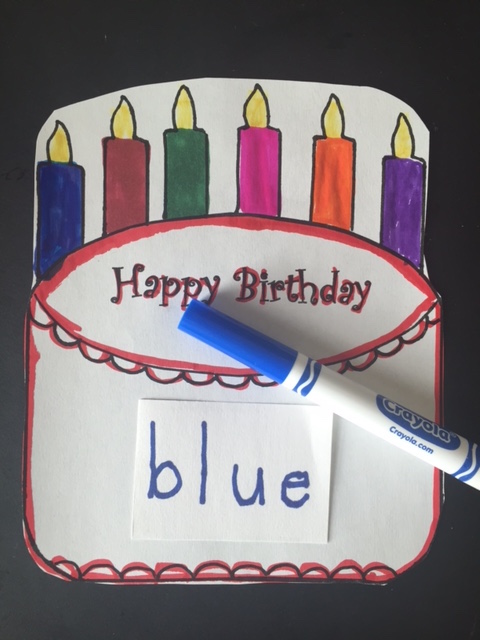
Color Box (Tune: “Happy Birthday”)
Here’s a crayon for you. (Pretend to hold a present in your hand.)
It’s a blue one for you. (Hold up a blue crayon or marker.)
B – l – u – e blue
Here’s blue for you...
Red, yellow, orange, green, purple, brown, black, white.


*Children could hold up crayons or touch something the appropriate color as you sing.


Go Letters! (Sign language) 
Children stand and roll arms around in between making the manual signs for each letter.

https://www.youtube.com/watch?v=qRCVJ0-nB5M


Tuesday, January 12, 2021

BE A BUDDY

Here's a song that will encourage children to be friends. It also teaches them some effective strategies if someone tries to bully them.

Be a Buddy, NOT a Bully!
(Tune: “Harrigan”)
Give me a B – B.
Give me a U – U…D…D…Y…
What’s it spell? BUDDY!
B-u-d-d-y
I’m going to be a buddy.
I will never be a bully.
I’ll say NO to bullies!
B-u-d-d-y
That is what I’ll be.
I’ll be kind and help my friends.
I’ll protect them and defend.
A buddy, that’s ME!

What should you do if someone bullies you?
Ignore them or walk away.

What if they still bully you?
Tell them to STOP!

If they still bully you?
Get a friend to help you.

And if they still bully you?
Then tell an adult.

B-u-d-d-y
I’m going to be a buddy.
I will never be a bully.
I’ll say NO to bullies!
B-u-d-d-y
That is what I’ll be.
I’ll be kind and help my friends.
I’ll protect them and defend.
A buddy, that’s ME!

https://www.youtube.com/watch?v=EQaWZZnFww0


*Make a class book of the song by running off the lyrics as shown. Have the children close their eyes as you sing and get a picture in their brain. Let them choose which sentence they’d like to illustrate, and then put them together to make a book.

*Role play the steps in the song. Let children take turns being “bullies” and “buddies” and acting out what they should do.

*Make a book called “A Buddy Is…” where each child contributes a drawing of how they can be a buddy.

*Run off “Buddy Coupons” for children to distribute to friends who are kind to them. You could also have a “Buddy Board” where children write the names of buddies.


*Draw a T-chart on the board and let children suggest characteristics of buddies and bullies.


Buddy Sticks
Put like stickers on the bottoms of two craft sticks. You will need as many sticks as there are children in your classroom. Place sticks in a plastic cup with stickers facing down. Children choose a stick and then find the person whose stick matches theirs. That's their "study buddy."


*For small group work, put like stickers on four sticks. Remember, groups of two or four are more conducive to social interaction.

*When there is an odd number of students, let the last child chose whichever group she would like to be a part of.

Note!  Use these sticks each Monday to pair up children. Explain that is their "study buddy" for the week. They can help each other and work with each other all week. 

Sunday, February 16, 2020

TAILS THAT TEACH

If you are an animal lover like I am you are going to be THRILLED to learn about TAILS THAT TEACH!  You can get a free teacher kit with books, a stuffed animal, and learning activities.  I'm so excited to share this special program with you!!!
 
Non-profit organization Tails That Teach educates young children about kindness, compassion, and empathy by bridging the connection between people and animals through its captivating books, Love Me Gently and Gray Whiskers written by founder, Lisa Wiehebrink. These books parallel the needs of pets and people and offer age-appropriate lessons for proper care and safety. They are ideal for grades K-2 and provided at no cost to elementary schools to supplement character education and promote literacy.
The organization’s goal is empower the next generation to make good choices and to respectfully care for pets and people. Teaching kids to properly care for pets helps them grow up to be compassionate adults and responsible pet owners.  By fostering the human-animal bond, children learn caring connections toward all living beings simply by observing how their actions directly impact others. Studies prove that children who are taught to be kind to animals often limits bullying and other abuse. Children are inspired as they observe how small acts of kindness toward peers and pets can make the world a better place for all.
Children have a special relationship with pets.  Younger children are just beginning to learn about themselves and their world and they are fascinated by the response they receive from animals.  Caring for a pet gives children a sense of empowerment when they are caring for another living being.  This sense of empowerment turns into compassion and children are able to manifest that compassion toward other human beings.  Children who live with pets in their home seem to make that transition more easily than those children who have no interaction with animals.
Children also develop social skills from talking to and playing with pets. They learn what unconditional love feels like and they have a companion that they can talk to and tell secrets to.  They are able to learn basic effective social interaction skills and what is acceptable and unacceptable behavior.  Pets respond to emotional cues and can teach children to respond appropriately and show compassion for those who need it.
In addition to free book donations, Tails That Teach also provides the Adventures with Cooper Kit to teachers.  This kit is provided to teachers for a unique expansion activity to teach kindness and inspire students to act with compassion and empathy toward pets and peers. Included in the reusable canvas tote bag is a set of our books, a stuffed plush dog, and journal.  Students take turns bringing the kit home so they may read, write, and even draw about their adventures while learning responsibility and kind care. Classroom teachers across the country have reported improved critical thinking, decreases in bullying behaviors and overall increases in morale at schools where these and other programs are being used.  Early education and literacy are key!
For more information about Tails That Teach, please visit www.tailsthatteach.org. 


Wednesday, November 13, 2019

BUDDY TIME

One of the best ways to help children learn to work with others is with "buddy time." Besides, it's more fun to learn with a friend than it is alone. Take a look at this list and you'll probably find at least five strategies you can use in your classroom this week.

Buddy Sticks
If you let children choose who they want to work with you might end up with two that shouldn't be together or someone that is left out. Buddy sticks are a great solution!


Put like stickers on the bottoms of two craft sticks.  (You will need as many sticks as there are children in your classroom.)  Place sticks in a plastic cup with stickers facing down.  Children choose a stick and then find the person whose stick matches theirs.  That is their partner.

*If there is an odd number, let the last child choose the group she wants to work with.

Weekly Study Buddy

To make buddy management a little simpler, have children use buddy sticks on Monday to find their "study buddy" for the week.  Whenever you want them to work with a partner, just say "study buddy" and you'll be all set!

Elbow Buddies

Children extend elbows and the first person their elbow touches is their partner.


What can children do with a study buddy?

Read together.

Look at books or magazines together.

Retell a story. They can also discuss who, what, where, when, why, the problem, resolution, what might happen next, etc.

Whisper a prediction in each other’s ear.

Review information after a science lesson, social studies, etc.

Clean up a center or each other’s desks.

Read around the room. Give them pointers and empty glasses frames for more fun.

Write the room. Give them clipboards and ask them to write words that would reinforce a skill you are working on. For example, they could write compound words, words with the “th” diagraph, two syllable words, etc.

Sing a song or say nursery rhymes together.
             
Help with dressing, such a zipping coats and tying shoes.

Draw a picture together. They could draw their favorite part of a story, illustrate a poem, draw a picture of their teacher, and so forth.

Build together with blocks, Legos, etc.

Play with play dough or clay together. They can make objects that begin with a certain sound, shapes, sets, etc.

Play a computer game.

Review flashcards.


Partner Pop Up Q & A 
Students stand and face their study buddy. The teacher poses a question. The students talk it over, agree on an answer, and then stoop down. When the teacher sees all students down she says, “Pop!” The students pop up and say their answer out loud.