There was a study that showed pre-k children who knew how to play games were more successful in kindergarten. When you think about it, games help children learn to follow rules, take turns, and develop the executive function (task initiation and completion). This is good information to share with parents to encourage them to play board games and card games with their children rather than hand them their phone.
Alphabet Categories
Sounds, parts of speech, categories, rapid automatic naming, and multiple skills are reinforced with this game. When I introduced alphabet categories we played it as a large group game. Once the kids “caught on” we divided the class into two teams and played. Later, they enjoyed playing the game in small groups or with a partner.
Why? initial sounds, categories, rapid naming
What? poster board
How? You will need 2 sheets of poster board of different colors. Cut the poster board into 4” squares. (You will need 23 squares of each color.) On one color print alphabet letters. (Print “u & v” on the same card and “x, y, z” on another card.) On the other color print one of the categories below:
something in the yard an animal
fruit or vegetable movie star
something in the kitchen body part
river, lake, or ocean town or city
country or state a machine
type of transportation a food
something you wear an action
something in the zoo a plant
a toy a book
a song a noun
a famous person a verb
something in the school a game
a TV show a feeling
a color an occupation
restaurant or store something that flies
Shuffle up each set of cards. Draw a card from the “letter pile” and a card from the “category pile.” Encourage the children to make the sound of the letter. Can they think of a word in the category that begins with that sound?
*When introducing this game, simply play it as a shared group activity and do not keep score. As children become more proficient, divide the class into teams and give points to the first team to come up with a word that fits the category. Children may also enjoy playing this game in small groups.
*Adapt the categories to the age and ability of your students. For example, you could use adjectives, adverbs, nouns, verbs, prepositions, mammals, etc. for older students.
Rapid Automatic Naming
Here 's an adaptation of "categories" that you can use to develop Rapid Automatized Naming. RAN is the ability to name letters, symbols, words, or objects in a quick and automatic manner and impacts reading fluency.
Write categories on index cards, punch a hole in the cards, and attach to a book ring. If you’ve got a few minutes before lunch or while you’re waiting during other transitions you can flip through the category cards and see how many words children can “pop out.”
*Whisper - Let the whole class participate by whispering as many words as they can.
*Toss and Tell – Throw a beanbag around the group and each child must add a word to the category as they catch the beanbag.
*Brainstorm - Write words on the board as the students call them out.
*Think Time - Give older children 2 or 3 minutes to write all the words they can think of. You could also divide students into partners or small groups to do this.
Showing posts with label Sounds. Show all posts
Wednesday, January 14, 2026
CATEGORIES AND RAN
Tuesday, November 25, 2025
GOOOO LETTERS!
This can be a good brain break when your class gets the wiggles, and you’ll be reinforcing standards at the same time.
https://youtu.be/qRCVJ0-nB5M
You can pretend to play the drums or twirl your hands and fist bump the letters and sounds. Or, better yet, challenge your students to learn sign language with me. Stand up and here we go!!!
https://youtu.be/qRCVJ0-nB5M
You can pretend to play the drums or twirl your hands and fist bump the letters and sounds. Or, better yet, challenge your students to learn sign language with me. Stand up and here we go!!!
Drums…. (Pretend to play the drums.)
Goooo A! /a/ /a/ /a/ (Roll arms and right fist in air as you make the sound.)
Goooo B! /b/ /b/ /b/ (Roll arms and left fist in the air with sound.)
Goooo C! ….Z
Yeah letters!!!!
Goooo A! /a/ /a/ /a/ (Roll arms and right fist in air as you make the sound.)
Goooo B! /b/ /b/ /b/ (Roll arms and left fist in the air with sound.)
Goooo C! ….Z
Yeah letters!!!!
Find many of my songs easily on iTunes and Amazon!
Labels:
Active Learning,
Letters,
Sounds
Thursday, October 23, 2025
VOWEL FAMILY
Here's a song that introduces the long and short sounds for the vowels. Making manual signs for the letters or holding up letters will help add the visual connection as you sing.
The Vowel Song (Tune: “Are You Sleeping?”)
A makes two sounds. (Echo each line.)
/A/ and /a/.
/A/ for apron, /a/ for apple.
/A/ and /a/.
/E/ and /e/ - eagle and elephant…
/I/ and /i/ - ice cream and inchworm…
/O/ and /o/ - open and octopus…
/U/ and /u/ - ukulele and uncle…
The long vowel sounds are easier for children to remember because "they just say their name." Here's a song that will help put those short vowel sounds in the brain. Of course, the letter U will be their favorite!
The Vowel Family (Tune: "BINGO")
Aunt Aggie had an allergy
and she would always sneeze-o (Pretend to sneeze.)
/a/a/a/a/a/ /a/a/a/a/a/ /a/a/a/a/a/
And she would always sneeze-o.
Grandpa Eddie stayed in shape
and he would exercise-o (Pretend to lift weights.)
/e/e/e/e/e/ /e/e/e/e/e/ /e/e/e/e/e/
He liked to exercise-o.
Baby Izzi had chicken pox
and she would always itch-o. (Scratch body.)
/i/i/i/i/i/ /i/i/i/i/i/ /i/i/i/i/i/
And she would always itch-o.
Cousin Otto’s throat was sore
And this is what he’d say-o. (Put hand on throat.)
/o/o/o/o/o/ /o/o/o/o/o/ /o/o/o/o/o/
And this is what he’d say-o.
Uncle Unk wore underwear
and it did stink-o. (Hold nose.)
/u/u/u/u/u/ /u/u/u/u/u/ /u/u/u/u/u/
And it did stink-o.
Let the children use the attached sheet to make vowel puppets. Tape the letters to craft sticks or glue to an envelope that's been cut in half.

https://drive.google.com/file/d/0B1SnEagA4jljRjhzN3oxNFliSEU/view?usp=sharing
Five Little Vowels (Adapted from "Monkeys and the Alligator")
Five little vowels swinging from a tree (Hold up 5 fingers.)
Teasing Mr. Alligator, “Can’t catch me! (Point finger.)
You can’t catch me!”
Along came Mr. Alligator quiet as can be (Open and close arms.)
And snatched that A right out of the tree.
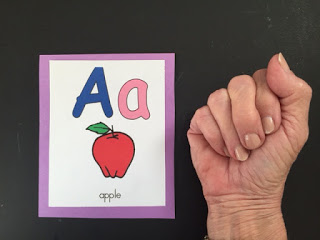
/a/ /a/ /a/ /a/ /a/ /a/ /a/ /a/ /a/ (Make sign language A with hand.)
E…I…O…U
*Draw a tree on a magnetic board and remove magnetic letters as you say the chant.
The Vowel Song (Tune: “Are You Sleeping?”)
A makes two sounds. (Echo each line.)
/A/ and /a/.
/A/ for apron, /a/ for apple.
/A/ and /a/.
/E/ and /e/ - eagle and elephant…
/I/ and /i/ - ice cream and inchworm…
/O/ and /o/ - open and octopus…
/U/ and /u/ - ukulele and uncle…
The long vowel sounds are easier for children to remember because "they just say their name." Here's a song that will help put those short vowel sounds in the brain. Of course, the letter U will be their favorite!
The Vowel Family (Tune: "BINGO")
https://www.youtube.com/watch?v=Eihx8_jXrOo
Aunt Aggie had an allergy
and she would always sneeze-o (Pretend to sneeze.)
/a/a/a/a/a/ /a/a/a/a/a/ /a/a/a/a/a/
And she would always sneeze-o.
Grandpa Eddie stayed in shape
and he would exercise-o (Pretend to lift weights.)
/e/e/e/e/e/ /e/e/e/e/e/ /e/e/e/e/e/
He liked to exercise-o.
Baby Izzi had chicken pox
and she would always itch-o. (Scratch body.)
/i/i/i/i/i/ /i/i/i/i/i/ /i/i/i/i/i/
And she would always itch-o.
Cousin Otto’s throat was sore
And this is what he’d say-o. (Put hand on throat.)
/o/o/o/o/o/ /o/o/o/o/o/ /o/o/o/o/o/
And this is what he’d say-o.
Uncle Unk wore underwear
and it did stink-o. (Hold nose.)
/u/u/u/u/u/ /u/u/u/u/u/ /u/u/u/u/u/
And it did stink-o.
Let the children use the attached sheet to make vowel puppets. Tape the letters to craft sticks or glue to an envelope that's been cut in half.

https://drive.google.com/file/d/0B1SnEagA4jljRjhzN3oxNFliSEU/view?usp=sharing
Five Little Vowels (Adapted from "Monkeys and the Alligator")
Five little vowels swinging from a tree (Hold up 5 fingers.)
Teasing Mr. Alligator, “Can’t catch me! (Point finger.)
You can’t catch me!”
Along came Mr. Alligator quiet as can be (Open and close arms.)
And snatched that A right out of the tree.
/a/ /a/ /a/ /a/ /a/ /a/ /a/ /a/ /a/ (Make sign language A with hand.)
E…I…O…U
*Draw a tree on a magnetic board and remove magnetic letters as you say the chant.
Monday, September 8, 2025
ALPHARDEE OR ALPHARDY???
It really doesn’t matter how you say it, but you’ll find this song one of the most meaningful tunes you can do with your students. I’ve had countless teachers tell me that they do this song every morning at circle time with their students. By repeating the song daily and adding motions and sign language children are able to make the connections between letters and sounds. This is also helpful for children who have trouble articulating some of the sounds.
Alphardy (“Jeopardy" Tune)
A for apple /a/ /a/ /a/ (Pretend fist is an apple.)
B for bounce /b/ /b/ /b/ (Bounce a ball.)
C for cut /c/ /c/ /c/ (Open and close index and middle fingers as if cutting.)
D for dig /d/ /d/ /d/ (Pretend to dig.)
E – elbow (Point to elbow.)
F – fan (Fan self with hand.)
G – gallop (Gallop in place.)
H – hop (Hop on one foot.)
I – itch (Scratch self.)
J – jump (Jump up and down.)
K – kick (Little kicks with foot.)
L – love (Hug self.)
M – munch (Move mouth as if eating.)
N – nod (Nod head.)
O – opera (Extend arms and sing dramatically.)
Q – quiet (Index finger on lips.)
R. – run (Run in place.)
S – sew (Pretend to hold a needle and sew.)
T – talk (Open and close fingers like a mouth.)
U – upside (Lean over.)
V – volley (Hands in air and pretend to volley a ball.)
W – wiggle (Wiggle all over.)
X – x-ray (Make “x” with arms.)
Y – yawn (Extend arms and pretend to yawn.)
Z – zigzag (Make an imaginary “z” in the air.)
Letter sounds are all you need.
Put them together and you can read! (Hold palms together and open like a book.)
I love this video with the manual signs for letters that Mariela Anderson recorded.
*You can download this book at drjean.org.
http://www.drjean.org/html/monthly_act/act_2005/03_Mar/Alphardy.

Alphardy Poster
Run off this chart for each student and glue to a file folder. Children can use this for choral singing or for independent work at the listening center. If you give them a pretzel stick or Bugle for a pointer they’ll get a little snack at the end of the song!
http://www.drjean.org/html/monthly_act/act_2005/03_Mar/pg04a.html
Letter Office
Children will enjoy making their very own letter office and then using it for the activities below. First, tape two file folders together. Let children decorate the outside, and then glue a copy of alphabet letters on the inside.
Sing and Track
Have children point to the letters as you sing various alphabet songs. (“The Alphabet in My Mouth,” “Who Let the Letters out?” or “Letters You Should Know” all work well.)
I Spy!
Play “I Spy” and other games where children have to identify letters. Can they find the letter that makes the sound at the beginning of “hop”? Can they find the letters in their name? What comes between G and I? Can they match up magnetic letters with the letters in their office?
Partner Play
Use the offices for working with a friend. Read the capital letters, lowercase, consonants, vowels. Read loud, soft, fast, slow, backwards, and other variations. Let friends take turns calling out letters (or sounds) for their partner to identify.
Family Time
Invite children to take their letter offices home and play games with their parents.
*Take turns naming letters and touching them.
*Sing Alphabet songs and track the letters.
*Look around the house for letters that match.
*Find letters in family members’ names.

Alphardy (“Jeopardy" Tune)
A for apple /a/ /a/ /a/ (Pretend fist is an apple.)
B for bounce /b/ /b/ /b/ (Bounce a ball.)
C for cut /c/ /c/ /c/ (Open and close index and middle fingers as if cutting.)
D for dig /d/ /d/ /d/ (Pretend to dig.)
E – elbow (Point to elbow.)
F – fan (Fan self with hand.)
G – gallop (Gallop in place.)
H – hop (Hop on one foot.)
I – itch (Scratch self.)
J – jump (Jump up and down.)
K – kick (Little kicks with foot.)
L – love (Hug self.)
M – munch (Move mouth as if eating.)
N – nod (Nod head.)
O – opera (Extend arms and sing dramatically.)
Q – quiet (Index finger on lips.)
R. – run (Run in place.)
S – sew (Pretend to hold a needle and sew.)
T – talk (Open and close fingers like a mouth.)
U – upside (Lean over.)
V – volley (Hands in air and pretend to volley a ball.)
W – wiggle (Wiggle all over.)
X – x-ray (Make “x” with arms.)
Y – yawn (Extend arms and pretend to yawn.)
Z – zigzag (Make an imaginary “z” in the air.)
Letter sounds are all you need.
Put them together and you can read! (Hold palms together and open like a book.)
I love this video with the manual signs for letters that Mariela Anderson recorded.
https://www.youtube.com/watch?v=p3JKf4vCeKA
*You can download this book at drjean.org.
http://www.drjean.org/html/monthly_act/act_2005/03_Mar/Alphardy.

Alphardy Poster
Run off this chart for each student and glue to a file folder. Children can use this for choral singing or for independent work at the listening center. If you give them a pretzel stick or Bugle for a pointer they’ll get a little snack at the end of the song!
http://www.drjean.org/html/monthly_act/act_2005/03_Mar/pg04a.html
Letter Office
Children will enjoy making their very own letter office and then using it for the activities below. First, tape two file folders together. Let children decorate the outside, and then glue a copy of alphabet letters on the inside.
Sing and Track
Have children point to the letters as you sing various alphabet songs. (“The Alphabet in My Mouth,” “Who Let the Letters out?” or “Letters You Should Know” all work well.)
I Spy!
Play “I Spy” and other games where children have to identify letters. Can they find the letter that makes the sound at the beginning of “hop”? Can they find the letters in their name? What comes between G and I? Can they match up magnetic letters with the letters in their office?
Partner Play
Use the offices for working with a friend. Read the capital letters, lowercase, consonants, vowels. Read loud, soft, fast, slow, backwards, and other variations. Let friends take turns calling out letters (or sounds) for their partner to identify.
Family Time
Invite children to take their letter offices home and play games with their parents.
*Take turns naming letters and touching them.
*Sing Alphabet songs and track the letters.
*Look around the house for letters that match.
*Find letters in family members’ names.
Saturday, August 30, 2025
CHEESE PIZZA DAY
September 5th is Cheese Pizza Day, but I could eat pizza every day! (Seriously!) Here’s a silly song that I used to sing just because the children got a laugh out of it. Now, I tie it into standards because it demonstrates sound substitution and reinforces vowel sounds. Whatever!!!
Pepperoni pizza.
I like to eat, eat, eat,
Pepperoni pizza.
Sing substituting the long “A” sound for each vowel.
A lake tae ate, ate, ate,
Papparaynay pazzay…
Continue substituting with “E,” “I,” “O,” and “U.”
Hint! Make sign language letters for the vowels as you sing.
Word Family Pizza
Chris Baker created this video to demonstrate consonant substitution as children sing the song.
https://www.youtube.com/watch?v=RrpSSXZK9-I&feature=youtu.be
EASY PEASY PIZZA GAME
There are dozens of math skills you can tie in with this easy peasy math manipulative.
Pepperoni Pizza
I like to eat, eat, eat, (Extend arms to make a circle like a pizza.)Pepperoni pizza.
I like to eat, eat, eat,
Pepperoni pizza.
Sing substituting the long “A” sound for each vowel.
A lake tae ate, ate, ate,
Papparaynay pazzay…
Continue substituting with “E,” “I,” “O,” and “U.”
Hint! Make sign language letters for the vowels as you sing.
Word Family Pizza
Chris Baker created this video to demonstrate consonant substitution as children sing the song.
https://www.youtube.com/watch?v=RrpSSXZK9-I&feature=youtu.be
EASY PEASY PIZZA GAME
There are dozens of math skills you can tie in with this easy peasy math manipulative.
Why? sorting; sets; numerals; addition; subtraction, patterns; following directions; writing how to
What? fun foam (red, yellow, green, brown, black, white), pie pan, red felt, index cards, book ring
How? Cut toppings for your pizza from fun foam.
Sausage – brown
Peppers – green
Cheese – yellow
Pepperoni – red
Olives – black
Mushrooms – white
(Store the patterns in a zip bag.)
Cover the bottom of the pie pan with red felt.

*Let children sort the toppings.
*Give them numeral cards and ask them to make sets.
*Can they make a pattern with the toppings?
*Give them addition and subtraction facts and ask them to work out the problems with the toppings.
*Make recipe cards similar to the ones shown for the children to follow.
*Can they count how many ingredients in all on their pizza?
How To
Have children write their own recipe cards and directions for making a pizza.
Paper Pizza Collage
Give children a paper plate and some scrap paper, scissors, and crayons and let them create their own paper pizza. When they've finished they can add a few drops of glue and sprinkle with oregano or Italian seasonings to make it SMELL like a real pizza.
What? fun foam (red, yellow, green, brown, black, white), pie pan, red felt, index cards, book ring
How? Cut toppings for your pizza from fun foam.
Sausage – brown
Peppers – green
Cheese – yellow
Pepperoni – red
Olives – black
Mushrooms – white
(Store the patterns in a zip bag.)
Cover the bottom of the pie pan with red felt.

*Let children sort the toppings.
*Give them numeral cards and ask them to make sets.
*Can they make a pattern with the toppings?
*Give them addition and subtraction facts and ask them to work out the problems with the toppings.
*Make recipe cards similar to the ones shown for the children to follow.
*Can they count how many ingredients in all on their pizza?
How To
Have children write their own recipe cards and directions for making a pizza.
Paper Pizza Collage
Give children a paper plate and some scrap paper, scissors, and crayons and let them create their own paper pizza. When they've finished they can add a few drops of glue and sprinkle with oregano or Italian seasonings to make it SMELL like a real pizza.
Find many of my songs easily on iTunes and Amazon!
Labels:
Alliteration,
Crafts,
Food,
Games,
Sounds,
Special Days
Friday, August 29, 2025
I HAD A BIRD
Most children love animals, but learning to recognize farm animals and their sounds can also help children get ready to read. In Early Childhood 101 you learned that children go from real and concrete to abstract. You also learned that children need to go from simple to complex. Take a look at how farm animals can nurture these pre-reading skills.
Visual Memory
Visual memory is critical for remembering letters, sight words, etc. If children can recognize farm animals they will develop the visual skills that will help them remember letters, numbers, shapes, etc.
Visual Discrimination
When children can recognize the difference between a horse and a cow, they'll be on the path for discriminating an "m" from an "n" and "the" from "that."
Auditory Discrimination
As children learn to tell the difference between sounds animals make like "baa baa" and "moo," they are developing auditory skills that will help them tell the difference between /b/ and /m/.
Auditory Memory
What sound does the duck make? Well, isn't that very similar to learning that the letter D makes the /d/ sound?
Visual Memory
Visual memory is critical for remembering letters, sight words, etc. If children can recognize farm animals they will develop the visual skills that will help them remember letters, numbers, shapes, etc.
Visual Discrimination
When children can recognize the difference between a horse and a cow, they'll be on the path for discriminating an "m" from an "n" and "the" from "that."
Auditory Discrimination
As children learn to tell the difference between sounds animals make like "baa baa" and "moo," they are developing auditory skills that will help them tell the difference between /b/ and /m/.
Auditory Memory
What sound does the duck make? Well, isn't that very similar to learning that the letter D makes the /d/ sound?
I Had a Bird
(Make signs for the animals as you sing.)
I had a bird, and the bird pleased me.
I fed my bird by yonder tree.
Bird went, “Tweedle dee dee.” (Open and close index finger and thumb by mouth.)
Cat - "meow, meow" (Pretend to stroke whiskers.)
Dog – “woof-woof” (Pretend to call your dog by patting your leg.)
Pig – “oink, oink” (Put palm of hand under chin and wave fingers.)
Duck – “quack, quack” (Open and close index and middle fingers and thumb by mouth.)
Cow – “moo-moo” (Extend thumb and little finger to look like horns and place on head.)
And here are some picture cards for the song.
http://bit.ly/DrJeanBirdPrintables

Old MacDonald
Sing along with me.
(Make signs for the animals as you sing.)
I had a bird, and the bird pleased me.
I fed my bird by yonder tree.
Bird went, “Tweedle dee dee.” (Open and close index finger and thumb by mouth.)
Cat - "meow, meow" (Pretend to stroke whiskers.)
Dog – “woof-woof” (Pretend to call your dog by patting your leg.)
Pig – “oink, oink” (Put palm of hand under chin and wave fingers.)
Duck – “quack, quack” (Open and close index and middle fingers and thumb by mouth.)
Cow – “moo-moo” (Extend thumb and little finger to look like horns and place on head.)
And here are some picture cards for the song.
http://bit.ly/DrJeanBirdPrintables

Old MacDonald
Sing along with me.
https://www.youtube.com/watch?v=Q5iDjbNN1Og
Find many of my songs easily on iTunes and Amazon!
Labels:
Animals,
Auditory Discrimination,
Auditory Memory,
Sounds
Wednesday, August 27, 2025
ACTIVE ALPHABET
Here are some active alphabet songs that you can say instead sing.
ABC Kick Box
Children stand and make fists with their hands. Explain that you will punch across with your right hand and say a letter. Then punch across with their left hand and make the sound.
A – Punch with right hand /a/
B - Punch with left hand /b/
C…through Z
Phonercise
Children stand and put their hands in the air as they say a letter. They put their hands on their shoulders and make the letter sound. As they touch their toes they say a word that starts with that sound.
A (Hands up in the air and say “A.”)
/a/ (Hands on shoulders and make the short /a/ sound.)
(Say a word that starts with “A” as you touch your toes.)
*Have older children say words that are nouns, verbs, or other parts of speech as you touch your toes.
Karate Writing
Explain that some letters are tall. They start at the top dotted line. Some letters start at the middle dotted line. Some letters have a tail. They go below the line. Sing the “Alphabet Song” stretching up in the air for tall letters, putting hands on waist for short letters, and touching the ground for letters with a tail. For example:
A -hands on waist
B - hands in air
G - touch ground
ABC Rap Clap
Begin a pattern by slapping thighs once and clapping twice.
A (slap on the letter and then clap twice)
B (slap, clap, clap)
C (slap, clap, clap)
D….Z
Alpha-Bodies
Children stand and as you call out letters they try and make the letter with their body.
*Spell sight words or vocabulary words with their bodies.
ABC Kick Box
Children stand and make fists with their hands. Explain that you will punch across with your right hand and say a letter. Then punch across with their left hand and make the sound.
A – Punch with right hand /a/
B - Punch with left hand /b/
C…through Z
https://www.youtube.com/watch?v=yMeGvS0x0kM
Phonercise
Children stand and put their hands in the air as they say a letter. They put their hands on their shoulders and make the letter sound. As they touch their toes they say a word that starts with that sound.
A (Hands up in the air and say “A.”)
/a/ (Hands on shoulders and make the short /a/ sound.)
(Say a word that starts with “A” as you touch your toes.)
*Have older children say words that are nouns, verbs, or other parts of speech as you touch your toes.
https://www.youtube.com/watch?v=OxrUgwVbqoM
Karate Writing
Explain that some letters are tall. They start at the top dotted line. Some letters start at the middle dotted line. Some letters have a tail. They go below the line. Sing the “Alphabet Song” stretching up in the air for tall letters, putting hands on waist for short letters, and touching the ground for letters with a tail. For example:
A -hands on waist
B - hands in air
G - touch ground
https://www.youtube.com/watch?v=CkNND0qZP9g
ABC Rap Clap
Begin a pattern by slapping thighs once and clapping twice.
A (slap on the letter and then clap twice)
B (slap, clap, clap)
C (slap, clap, clap)
D….Z
Alpha-Bodies
Children stand and as you call out letters they try and make the letter with their body.
*Spell sight words or vocabulary words with their bodies.
Find many of my songs easily on iTunes and Amazon!
Labels:
Active Learning,
Alphabet,
Letters,
Sounds
Tuesday, August 26, 2025
SINGING LETTERS
Music is the most natural way to learn anything. Mary Ann Wolf (one of the top reading researchers in our country) recommends singing alphabet songs with young children. She explains that songs act like an umbrella and “place holder” in the brain. When the letters and sounds make sense to the children, they have a “place” to go.
There are many ways to introduce alphabet songs, but it might be helpful to introduce a new song each week. Sing it every morning to start your day, and then use it as a brain break during the day. The next week you can teach the children another song and then review the song you sang the previous week. Write the titles of the songs as you introduce them on a sentence strip and add a picture clue. That way you can let children choose different songs and repeat them.
Visual Connections
As you sing alphabet songs, it will be helpful to connect the visual with the auditory. You can use alphabet cards or point to the letters in your classroom.
Stop and Touch
Here’s another technique that will help children connect with the letters as they sing. Have the children stand and dance as you play an alphabet song. Stop the music on a random letter. At this point, children must tiptoe around the room, find that letter, and touch it. Continue playing the song stopping at several random letters.
Note! This is a fun way to teach self-regulation and to help children make a physical connection with the letter name and symbol.
LETTER TAILS (Tune: "Gilligan's Island")
This is one of my favorite alphabet books that Barb Smith created several years ago. It's good for letter recognition, phonics, and visual closure (recognizing the whole from the part).
This is a tale about the letter A.
It makes a special sound.
/a/ /a/ /a/ /a/ A!
Let’s learn another sound.
This is a tale about the letter B….
You can download the book here. If you’ll glue the cover to the front of a pocket folder and put the pages in clear sheet protectors the book will last for a long time.

http://www.drjean.org/html/monthly_act/act_2013/09_Sep_css/pg06.html
Hint! This is a great book to put in your listening center with the song.
Here’s a YouTube video of this song:
https://www.youtube.com/watch?v=8rEzOQn5ElM
Singing Names
Insert children’s names in the song:
D for Darren /d/ /d/ /d/
E for Erin /e/ /e/ /e/
S for Sammy /s/ /s/ /s/
H for Hannah /h/ /h/ /h/
Singing Environmental Print
Adapt the words for environmental print:
M for MacDonald’s /m/ /m/ /m/
L for Legos /l/ /l/ /l/
HAPPY BIRTHDAY LETTERS
Who doesn’t like birthdays? Children will love dancing and singing this song.
Happy Birthday Letters
Yo, A,
It’s your birthday.
Let’s all read
Like your birthday.
/a/ /a/ /a/ /a/ /a/ /a/
Yo, B…etc.
*Have children stand in a circle and act like rappers. When the letter that their name begins with comes up in the song they get to jump in the middle of the circle and dance.
Letter Birthday Hats
Let the children make birthday hats from sentence strips and wear them as you sing “Happy Birthday Letters.” (Our old stick pony is modeling the birthday hat for you.)
Birthday Cake
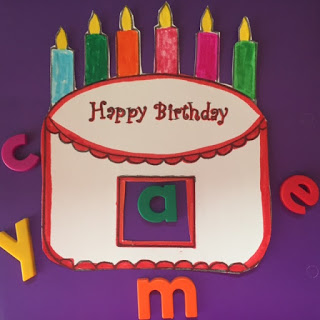
Draw a birthday cake on a magnetic board and sing the letters as you place them on the cake:
Yo, M, it’s your birthday.
Let’s all sing like your birthday
/m/ /m/ /m/ /m/ /m/ /m/
/m/ /m/ /m/ /m/ /m/ m/
Here’s a link so you can download the birthday cake.
There are many ways to introduce alphabet songs, but it might be helpful to introduce a new song each week. Sing it every morning to start your day, and then use it as a brain break during the day. The next week you can teach the children another song and then review the song you sang the previous week. Write the titles of the songs as you introduce them on a sentence strip and add a picture clue. That way you can let children choose different songs and repeat them.
Visual Connections
As you sing alphabet songs, it will be helpful to connect the visual with the auditory. You can use alphabet cards or point to the letters in your classroom.
Stop and Touch
Here’s another technique that will help children connect with the letters as they sing. Have the children stand and dance as you play an alphabet song. Stop the music on a random letter. At this point, children must tiptoe around the room, find that letter, and touch it. Continue playing the song stopping at several random letters.
Note! This is a fun way to teach self-regulation and to help children make a physical connection with the letter name and symbol.
LETTER TAILS (Tune: "Gilligan's Island")
This is one of my favorite alphabet books that Barb Smith created several years ago. It's good for letter recognition, phonics, and visual closure (recognizing the whole from the part).
This is a tale about the letter A.
It makes a special sound.
/a/ /a/ /a/ /a/ A!
Let’s learn another sound.
This is a tale about the letter B….
You can download the book here. If you’ll glue the cover to the front of a pocket folder and put the pages in clear sheet protectors the book will last for a long time.

http://www.drjean.org/html/monthly_act/act_2013/09_Sep_css/pg06.html
Hint! This is a great book to put in your listening center with the song.
Here’s a YouTube video of this song:
https://www.youtube.com/watch?v=8rEzOQn5ElM
Singing Names
Insert children’s names in the song:
D for Darren /d/ /d/ /d/
E for Erin /e/ /e/ /e/
S for Sammy /s/ /s/ /s/
H for Hannah /h/ /h/ /h/
Singing Environmental Print
Adapt the words for environmental print:
M for MacDonald’s /m/ /m/ /m/
L for Legos /l/ /l/ /l/
HAPPY BIRTHDAY LETTERS
Who doesn’t like birthdays? Children will love dancing and singing this song.
Happy Birthday Letters
Yo, A,
It’s your birthday.
Let’s all read
Like your birthday.
/a/ /a/ /a/ /a/ /a/ /a/
Yo, B…etc.
*Have children stand in a circle and act like rappers. When the letter that their name begins with comes up in the song they get to jump in the middle of the circle and dance.
Letter Birthday Hats
Let the children make birthday hats from sentence strips and wear them as you sing “Happy Birthday Letters.” (Our old stick pony is modeling the birthday hat for you.)
Birthday Cake
Draw a birthday cake on a magnetic board and sing the letters as you place them on the cake:
Yo, M, it’s your birthday.
Let’s all sing like your birthday
/m/ /m/ /m/ /m/ /m/ /m/
/m/ /m/ /m/ /m/ /m/ m/
Here’s a link so you can download the birthday cake.
https://drive.google.com/file/d/0B1SnEagA4jljNTdjZWVlZzR5Zmc/view?usp=sharing
Sunday, August 24, 2025
HIGHWAY LETTERS
Throw those worksheets away and get ready to PLAY with these hands-0n projects.
HIGHWAY LETTERS
Highway letters are a "rabbit trap" to engage kids and reinforce a variety of skills and different age levels. I put my letters in clear sheet protectors because it’s cheaper and easier than laminating. You can also punch holes at the top and tie on string so the children can wear them like letter vests.
You can find several versions of these road letters free on the web.
HIGHWAY LETTERS
Highway letters are a "rabbit trap" to engage kids and reinforce a variety of skills and different age levels. I put my letters in clear sheet protectors because it’s cheaper and easier than laminating. You can also punch holes at the top and tie on string so the children can wear them like letter vests.
https://www.prekinders.com/wp-content/uploads/2020/11/TPT-letter-roads.pdf
Here are just a few ways you can use the highway letters with different age levels throughout the school year.
Toy Cars - Let children drive over letters with toy cars.

Writing - Trace over the letters with dry erase markers. Erase and use again and again.
Hint! Put a green dot where they start and a red dot where they stop.
Play Dough - Roll play dough and place on top of the letters.
Songs - Pass out letter vests to children. Let them stand up when their letter is sung in the song.
Phonics - Practice blending C V C words. (consonant, vowel, consonant) with vests. Add the “silent e” to words to change the vowel sound.
Chunking - Start by asking children who are wearing “a” and “t” to stand. What does that say? Ask “m” to stand in front of “at.” What does that say? Tell “m” to go away and have “r” stand in front of “at.” Have children suggest other letters to stand in front of “at.” Reinforce other word families with this strategy.
Spelling Words - Slowly call out sight words or spelling words. (Stretch out the sounds.) Children come up if they are wearing that sound and make the word.
ABC Order- Children arrange themselves in alphabetical order according to the letter that they are wearing.
Hint! You can also play “I Have – Who Has?” with the letters. For example: “I have A. Who has B?” “I have B. Who has C?”
LETTERS ON THE BUS
Here’s another visual to help children focus on letters and sounds.
Color and cut out a bus similar to the one below. Add magnetic tape to the back and place it on a magnetic board. Put magnetic letters in the window as you sing the song.
The Letters on the Bus (Tune: “The Wheels on the Bus”)
The letters on the bus all make their sounds,
Make their sounds,
Make their sounds.
The letters on the bus all make their sounds
All around the town.
The B on the bus goes /b/ /b/ /b/, /b/ /b/ /b, /b/ /b/ /b/,
The B on the bus goes /b/ /b/ /b/ all around the town.

Toy Cars - Let children drive over letters with toy cars.
Writing - Trace over the letters with dry erase markers. Erase and use again and again.
Hint! Put a green dot where they start and a red dot where they stop.
Play Dough - Roll play dough and place on top of the letters.
Songs - Pass out letter vests to children. Let them stand up when their letter is sung in the song.
Phonics - Practice blending C V C words. (consonant, vowel, consonant) with vests. Add the “silent e” to words to change the vowel sound.
Chunking - Start by asking children who are wearing “a” and “t” to stand. What does that say? Ask “m” to stand in front of “at.” What does that say? Tell “m” to go away and have “r” stand in front of “at.” Have children suggest other letters to stand in front of “at.” Reinforce other word families with this strategy.
Spelling Words - Slowly call out sight words or spelling words. (Stretch out the sounds.) Children come up if they are wearing that sound and make the word.
ABC Order- Children arrange themselves in alphabetical order according to the letter that they are wearing.
Hint! You can also play “I Have – Who Has?” with the letters. For example: “I have A. Who has B?” “I have B. Who has C?”
LETTERS ON THE BUS
Here’s another visual to help children focus on letters and sounds.
Color and cut out a bus similar to the one below. Add magnetic tape to the back and place it on a magnetic board. Put magnetic letters in the window as you sing the song.
The Letters on the Bus (Tune: “The Wheels on the Bus”)
The letters on the bus all make their sounds,
Make their sounds,
Make their sounds.
The letters on the bus all make their sounds
All around the town.
The B on the bus goes /b/ /b/ /b/, /b/ /b/ /b, /b/ /b/ /b/,
The B on the bus goes /b/ /b/ /b/ all around the town.
Find many of my songs easily on iTunes and Amazon!
Labels:
Letters,
Multi-sensory,
Pre-Writing,
Small Motor,
Songs,
Sounds
Wednesday, June 25, 2025
THE WHEELS ON THE BUS
Here's one of my favorite "oldies but goodies." I think this song is even older than me!
The Wheels on the Bus
The wheels on the bus (Move hands in circular motion.)
Go round and round,
Round and round, round and round.
The wheels on the bus
Go round and round,
All around the town.
Wipers – swish, swish, swish… (Palms up and move back and forth.)
Horn – beep, beep, beep… (Pretend to beep horn.)
Lights – blink, blink, blink… (Open and close fists.)
Doors – open and shut… (Palms together, then spread apart.)
Driver on the bus…”Move on back”… (Stick up thumb.)
Children on the bus – bounce up and down…(Bounce up and down.)
The Letter Bus
The letters on the bus all make their sounds,
Make their sounds, make their sounds.
The letters on the bus all make their sounds
All around the town.
The A on the bus goes /a/ /a/ /a/
/a/ /a/ /a/ /a/ /a/ /a/
The A on the bus goes /a/ /a/ /a/
All around the town.
*Continue singing different letters and making their sounds.
*Place magnetic letters in the outline of a bus as you sing the song.
*If you have a toy bus, write the letter on an index card and tape it to the bus as you sing.
The Wheels on the Bus
The wheels on the bus (Move hands in circular motion.)
Go round and round,
Round and round, round and round.
The wheels on the bus
Go round and round,
All around the town.
Wipers – swish, swish, swish… (Palms up and move back and forth.)
Horn – beep, beep, beep… (Pretend to beep horn.)
Lights – blink, blink, blink… (Open and close fists.)
Doors – open and shut… (Palms together, then spread apart.)
Driver on the bus…”Move on back”… (Stick up thumb.)
Children on the bus – bounce up and down…(Bounce up and down.)
The Letter Bus
The letters on the bus all make their sounds,
Make their sounds, make their sounds.
The letters on the bus all make their sounds
All around the town.
The A on the bus goes /a/ /a/ /a/
/a/ /a/ /a/ /a/ /a/ /a/
The A on the bus goes /a/ /a/ /a/
All around the town.
*Continue singing different letters and making their sounds.
*Place magnetic letters in the outline of a bus as you sing the song.
*If you have a toy bus, write the letter on an index card and tape it to the bus as you sing.
Humpty Dumpty
Humpty Blank Rhymes
Your students can follow along and fill in the blanks.
Humpty Narrated with Rhymes
No blanks.
Find many of my songs easily on iTunes and Amazon!
Labels:
Magnetic Letters,
Movements,
Silly Songs,
Sounds
Tuesday, February 25, 2025
SEALED AND DELIVERED
Here are more ideas "sealed and delivered" in envelopes.
LettersWrite the uppercase letter on one side and the lowercase letter on the other side.
Sing the “Hokey Pokey” with the letter puppet.
You put your (letter) in,
You take your (letter) out,
You put your (letter) in
And you shake it all about.
You make the (letter sound)
And then you put it down.
Listen Up
Children listen as you say words. If the word starts with that sound they hold their puppet up. If it doesn’t start with that sound they keep their puppet down.
Shapes
Glue shapes to envelopes and pass out to students. Children listen and then respond as you sing this song to the tune of “If You’re Happy.”
If you have a circle stand up.
If you have a square stand up.
If you have a rectangle stand up.
If you have a triangle stand up.
*Adapt for other shapes, as well as three-dimensional shapes.
*Use shapes to reinforce positional words. Can you put your shape ON your head? Can you put your shape BEHIND you? Can you put your shape UNDER your chin?
I Have - Who Has Numbers?
Seal envelopes, cut them in half, and then write numbers on the envelopes. (You will need one for each child in your class). Pass out envelopes and have the child with 1 say: I have 1. Who has 2?
The child with 2 says: I have 2. Who has 3? And so forth.
*Count backwards: I have 20. Who has 19?
*You can also play this game with alphabet letters.
Write sight words on envelopes. Children walk around the room giving a high five and reading each other’s words.
Missing Fingers
Hide several fingers in the envelope. Can the children tell how many you have in the envelope? How did you know that?
Note! Here's the video I did if you want to see these activities demonstrated:
Tuesday, January 28, 2025
ASL - SIGN TO LEARN
You know I LOVE sign language! I’m certainly no expert, but if I can do it, anybody can do it. Let me give you a few reasons why I’m such a believer that sign language is the perfect vehicle for active learning.
It’s quiet.
It’s multi-sensory.
It’s engaging. (All I have to do is sing a song in sign language and I have children’s undivided attention.)
It’s good for differentiated instruction and for children who are non-English speakers.
It’s free and it’s simple.
It’s like bubblegum. Bubblegum? Yep! We need to figure out how to stick things in the brain, and sign language can provide that connection.
Sign language can be a powerful tool for classroom management.
Sign language can be a strategy to teach children how to communicate with friends and work through conflicts.
Sign language can be a creative vehicle for reinforcing state standards.
It’s a great learning tool for teaching letters, high frequency words, vocabulary, etc.)
SIGN LANGUAGE CENTER
Make a SIGN LANGUAGE CENTER with a pocket folder. Glue a copy of manual signs for letters on the inside of the folder. Write alphabet letters on index cards and place in the pocket. Children choose a card and then try to reproduce that sign. For older children, write sight words or spelling words on index cards for them to practice spelling manually.
Find many of my songs easily on iTunes and Amazon!
Labels:
Active Learning,
ASL,
Letters,
Multi-sensory,
Sounds,
Words
Wednesday, October 9, 2024
SYLLABICATION
Syllabication is the practice of breaking down words into individual sounds. Syllabication can help children read unknown words and learn to spell words.
Mouth It!
Have children gently place their palm under their chin and ask them repeat to words. Surprise! The mouth opens on each syllable (all syllables have vowels and the mouth opens).
Move It!
Clap, hop, walk, or nod the syllables in classroom objects.
*Disco, hula, swim, or march to syllables in rhymes and songs.
“Beep” like aliens or “Wa wa” like Charlie Brown’s teacher as you say words or read.
Instruments
Have children beat out syllables with instruments.
*You could also use cardboard rollers, straws, pencils, etc. like drum sticks to tap out rhythms and syllables.
Syllable Show
Slowly say a word. Children hold up the number of syllables they hear on their fingers.
*You could also let them show the number of syllables by placing the appropriate number of poker chips or other objects on their desk.
Clap a Name

Cut out small hands from construction paper. Glue them under children's pictures to indicate how many syllables in their names. Make a book with their pictures and clap your hands!
Hickety Pickety
Slowly clap hands to the beat as you say the chant below.
Hickety, pickety bumblebee
Who can say their name for me? Child’s name.
Clap it. (Clap out syllables as you say the name.)
Snap it. (Snap syllables in name.)
Whisper it. (Whisper name.)
No sound. (Lip sinc name.)
Mouth It!
Have children gently place their palm under their chin and ask them repeat to words. Surprise! The mouth opens on each syllable (all syllables have vowels and the mouth opens).
Move It!
Clap, hop, walk, or nod the syllables in classroom objects.
*Disco, hula, swim, or march to syllables in rhymes and songs.
“Beep” like aliens or “Wa wa” like Charlie Brown’s teacher as you say words or read.
Instruments
Have children beat out syllables with instruments.
*You could also use cardboard rollers, straws, pencils, etc. like drum sticks to tap out rhythms and syllables.
Syllable Show
Slowly say a word. Children hold up the number of syllables they hear on their fingers.
*You could also let them show the number of syllables by placing the appropriate number of poker chips or other objects on their desk.
Clap a Name

Cut out small hands from construction paper. Glue them under children's pictures to indicate how many syllables in their names. Make a book with their pictures and clap your hands!
Hickety Pickety
Slowly clap hands to the beat as you say the chant below.
Hickety, pickety bumblebee
Who can say their name for me? Child’s name.
Clap it. (Clap out syllables as you say the name.)
Snap it. (Snap syllables in name.)
Whisper it. (Whisper name.)
No sound. (Lip sinc name.)
Find many of my songs easily on iTunes and Amazon!
Labels:
Active,
Listening,
Phonological Awareness,
Sounds,
Syllabication
Sunday, August 11, 2024
ACTIVE ALPHABET SONGS
You can give kids a brain break and reinforce letters and sounds with these activities.
Directions: Children stand and make fists with their hands. Explain that you will punch across with your right hand and say a letter. Then punch across with their left hand and make the sound.
A – Punch with right hand.
/a/ - Punch with left hand.
B through Z.
Phonercise
Directions: Children stand and put their hands in the air as they say a letter. They put their hands on their shoulders and make the letter sound. As they touch their toes they say a word that starts with that sound.
A (Hands up in the air and say “A.”)
/a/ (Hands on shoulders and make the short /a/ sound.)
____ (Say a word that starts with “A” as you touch your toes.)
Go Letters! (Sign language)
Directions: Children stand and roll arms around in between making the manual signs for each letter.
Karate Writing
Directions: Explain that some letters are tall. They start at the top dotted line. Some letters start at the middle dotted line. Some letters have a tail. They go below the line. Sing the “Alphabet Song” stretching up in the air for tall letters, putting hands on waist for short letters, and touching the ground for letters with a tail. For example:
A -hands on waist
B - hands in air
G - touch ground
Subscribe to:
Posts (Atom)