photo 3am_dj_home_zps919fb85e.png photo 3am_dj_about_zps7cce4c75.png photo 3am_dj_website_zps73051235.png photo 3am_dj_ss_zps6759ec2a.png photo 3am_dj_bs_zps43e27832.png
Showing posts with label Math Facts. Show all posts

Monday, April 28, 2025

DANCE THOSE STANDARDS!

All you need is some good music and a little enthusiasm and your students will master those sight words, math facts, and skills as they move and have fun. Model these movements and then invite the children to join you.
Note! Children can do these standing up or sitting in their chairs.

Disco Dance – Put right index finger in the air and point to the left. Bring right index finger down by your side. Spell words or count as you move.


Swim - Pretend to swim by stroking arms as you count by ones, fives, etc. Can you backstroke? Sidestroke?

*Swim as you say letters and hold your nose and wiggle down as you say the word.


Funky Monkey - Fists out in front and move them up and down as you read sight words or count.


Hitchhike - Right thumb up and move across your body and then left thumb and move across the body as you count, read words, etc.


Chicken - Hands in armpits and flap like wings as you count or spell words.


Pony – Pretend to hold reins as you rock back and forth and say letters in a word. Lasso (arm in the air) as you say the word.


Batman – Make “v” with index and middle fingers and swoop them across your eyes as you count or read words.


Salsa - Left arm bent with index finger up in the air as you say an addend. Right arm bent with finger in air as you say another addend. Hands on hips and wiggle as you say the sum.
*Adapt for subtraction or other math facts.


Bollywood – Right palm up in the air like you’re screwing in a light bulb and then left palm down like you’re turning on a water spicket. Children can read sight words or repeat other information as they make the moves.

Friday, April 25, 2025

GROUP GAMES

If you've got a few extra minutes, try one of these games that you can adapt to skills you want your students to master.


BOOM!

Write “BOOM!” with a bright marker or glitter pen on several of the flashcards. As you “flash” through the cards, children identify the information. When “BOOM!” appears, children jump up and shout out “Boom!”


*Change the surprise word for different holidays and seasons. 

Johnny Jump Up
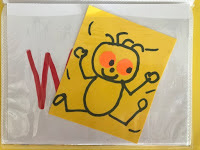
You will need a photo album and index cards to make this game. Write words on the index cards and insert them in the plastic sleeves. On several cards draw a stick figure jumping and write, “Johnny jump up!” Randomly insert the Johnny cards in the album. As you shuffle through the book children read the words. When Johnny appears they all jump up!


Catch and Tell
“Catch and Tell” can be played if you've got a few minutes during transitions, while waiting in the hall, or at the end of the day as a review. All you will need is a bean bag or small sponge ball to play this game. The teacher says a letter and then tosses the ball to a child. That child must name something that begins with that sound before tossing the ball back to the teacher.

*This game can be adapted for rhyming words, colors, math facts, social studies, and other skills.


Kids vs. Teacher
Draw a T chart on the board with “Kids” on one side and “Teacher” on the other side. Hold up a flash card. If a child raises her hand and correctly reads the word, she gets a point for the “kids.” If any child shouts out the answer, then the teacher gets a point.

(If children keep talking out of turn, just continue to give points to the teacher. They’ll figure it out!)


Pick Up

Place the flash cards randomly on the floor in the middle of the room. Divide the class into two teams. Choose one child from each team to come up and play. Call out a word. The first child to pick it up wins a point for their team.

Hint! Here's an idea for "keeping score." Cut out two circles from poster board and glue them together. Write “high” on one side and “low” on the other. After playing a game toss the circle. If “high” appears the team with the highest score wins. If “low” comes up the team with the lowest score is the winner.


*If children don’t know the answer when playing games allow them to “phone a friend” (ask a friend) or “ask the audience” (ask the class).

Thursday, April 24, 2025

PLAY AND LEARN GAMES

A teacher told me that her administrator wouldn't let her play games because he said, "They are a waste of time." (Obviously, that principal needs a little review of why we should play games with children!)

WHY PLAY GAMES?

Standards and Intentional Teaching– Teachers can create flashcard games, board games, or a variety of games based on any skill (letters, numbers, sight words, vocabulary, math facts, science or social studies, etc.) Think about skills in your curriculum and there’s the content for your game.

Purposeful Practice for Automaticity– In order to master skills children need to repeat and practice them. Clearly, kids would rather do that with a game than with a worksheet.

Executive Function– Through games children can develop task initiation and completion because there is a beginning and an end. They also learn self- regulation and delayed gratification.

Active Learning and SEL (Social Emotional)– With games children can talk, interact with friends, and use multi-sensory materials.

Instructional Time – Take advantage of transitions and those few extra minutes during the school day by playing games.


*Try one of these quick learning games if you have a few extra minutes or if it's a rainy/snowy day.

Hide, Seek, and Read

Make multiple copies of sight words on index cards. Hide these around the room while the children "hide their eyes." The children hunt for the words, but they may only find one at a time. When they find a word they have to take it to the teacher, read it, and then hide the word again.


Word Worm

Draw the face of a worm on a paper plate. Write sight words on other plates. Pass out a word card to each child. One at a time children come up and place their word next to the worm’s head. Each child reads all of the previous words before placing her word down. How long can the worm grow!


Hint! Children can “ask the audience” to read with them if they are unsure of the words.


Musical Words
Write words on paper plates and scatter around the room on the floor. Play some catchy music for the children to dance to. When the music stops, each child stands on a word. As the teacher points to random students, they must identify their word.

*You can play a game similar to musical chairs where you remove one word at a time so children have to scramble to find a word.

Word Hunt
Give students a list of words that can be found in the classroom. Children walk around the room and cross the words off as they find them.
*Let them take a “selfie” of the words as they find them.

Word Detectives
Let children be “detectives” as they listen to clues about different word wall words. Hints might include: “This word rhymes with ______.” “This word starts with letter and ends with letter.” “This word is the opposite of _______,”

Sunday, March 9, 2025

WHAT'S IN YOUR WALLET?

Here's a simple "hands on" activity that you can use this week.  Children can "save" sight words, letters, math facts, colors, shapes, and other skills you want them to master in their wallets.

How to Make a Wallet

Materials: construction paper 9” x 12”, markers, green paper cut 4” x 2”


1st Place the paper lengthwise and fold up the bottom to an inch from the top.

2nd Fold in half.


3rd Open and glue both sides.

4th Let the children decorate the outside.


5th Cut 4 ½ ” x 2 ¼ ” green rectangles and write high frequency words on them.
When children learn a word they get to “save” it in their wallets.

Letter Wallets
Younger children could save letters, numbers, or shapes in their wallets.


Math Wallets - Write addition and subtraction facts on dollars and save them in math wallets.

Vocabulary - Have children write vocabulary words on dollars and store them in their wallets.

Sunday, December 1, 2024

MERRY MATH CENTERS

A package of pompoms, bows, erasers, or other small items and you're set for "merry math."

Sorting
Ask children to sort the pompoms. What was their sorting rule? Can they sort them another way? 


Patterns
Use the pompoms for making patterns.


Estimating
Have children estimate the number of each type and then verify by counting.


Math Mat
Children place the correct amount on the trees.


Match Dot Cards
Pompoms are a perfect one-to-one activity for younger children.


Touch and Tell
Place numbers in a bag. Children reach in, feel a number and try to identify what it is. They can take it out to confirm and then write the number.


Number Hunt
Put numbers in a box of Styrofoam packing or sand. Children search through the Styrofoam packing and color off the numbers as they find them.


Stampers
Stamp a pattern, stamp out math facts, or stamp a set.


Roll of the Dice
Roll them, count them, add them, or let children make up their own games with the dice.

Friday, May 3, 2024

SUMMER SKILL KITS

Need another strategy to encourage children to practice sight words and other skills over the summer?

Note! You can adapt these activities to letters, math facts, or anything you want the children to master.

Treasure Boxes
Ask parents to send in empty mint cans. Cut paper into 1 ¾” by 3” rectangles. Have children write sight words on these rectangles and store them their containers.


Hint! Explain that lifetime words are words you will need to be able to read all your life. They are like a “treasure” because they will belong to you forever!!!


Word Pockets
Seal envelopes and cut in half. Cut down 1” from each side and fold down the flap as shown. Punch holes in the sides and tie on a piece of string or yarn. Give children strips of paper cut 2 1/2” x 4” on which to write their sight words. Students can take the words home in their little pockets for summertime practice.


How about some games parents and children can play with the flashcards?

Hide and Seek
Hide the words around the room. Children find them one at a time, bring them to you, and read them.

Sentence Makers
Children choose a word and use it in a sentence.
*Older students could write a sentence.

Sidewalk Words
Children practice writing words with chalk on the sidewalk.

Sort the Words
Put all the one letter words together, two letter words, three letter words, and so forth.
Sort the nouns and verbs.
Sort the words by syllables.

Can You Find?
Can you find the words in a book? Can you find them printed on food labels or other things around the house?

Monday, October 23, 2023

HAVE A CUP OF MATH!

WHAT ARE MATH CUPS?
Here’s an inexpensive tool that can be used for counting as well as other math activities. These cups are not only quiet to play with, but they develop small motor skills and eye-hand coordination.  They're perfect for center work or fun with a friend.

Materials:  bathroom cups and permanent marker
Directions: Turn the cups upside down and write numerals 1-20 on the tops (actually bottoms of the cups) and sides of the cups.


Counting
Mix up the cups. Ask the children to put the cups in order.

Matching
Trace around the bottom of one cup 20 times on a file folder as shown. Write the numerals in sequential order from top to bottom and left to right in the circles. Children take the cups and match them up to the appropriate circle on the file folder. Next, sweep the cups off and try to stack them up vertically from 1-20.


Math Facts
Write addition and subtraction facts on the sides of the cups. Write the answer inside on a dot sticker. Children can solve the problem and then check by looking inside the cup. 


*Let them use the cup to build a pyramid if they answer correctly.

Counting by Multiples
Make math cups with multiples so children can practice counting by 2's, 5’s, 10’s, and so forth.

Hint! Store bathroom cups in an empty Pringle’s can.

Monday, April 17, 2023

ZAP! BOOM! WIGGLE WORMS! STARS!

ZAP, BOOM, WIGGLE WORMS, AND STARS are all adaptions of a classroom game that your students will love (and learn from) when you've got a few extra minutes.

SKILLS: letters; words; phrase cards; math facts; shapes, etc.


MATERIALS: small can with a smooth edge (such as one from chips,
frosting, etc.), large craft sticks, markers, wrapping paper

DIRECTIONS: Cover the can with paper and write ZAP! on it as shown.

On the bottom of sticks print words or other skills. On several sticks write “ZAP!” Place all the sticks in the can with the words towards the bottom of the can. Have the children sit in a circle. One at a time, children hold the can and pull out a stick and identify the word on it. When a child chooses a stick with “Zap!” on it, they return all their 
sticks to the can. Continue passing the can until there is one person left. 


Hint! If children can’t identify the information on their stick, let them “phone a friend” for the answer.

More! For older students, add sticks that say, “You get two turns.” “Take a peek.” “Loose a turn.” “Skip.”

BOOM! 
Write "Boom!" on several sticks and when children choose that stick they jump up and shout, "BOOM!


WIGGLE WORMS
 
Write "Wiggle Worms!" on several sticks. Children stand and wiggle like a worm if they pull this stick.


STARS 
Glue stars to several sticks. If children choose this stick they get to keep it.

*You can also adapt this game for different holidays or units of study. For example, in October you could use skeleton stickers and the children could “shake their bones.” In January glue a snowman and they have to shiver.


Four Corners
Several years ago Ginny McLay told me how she adapted 4 corners for different skills she was working on. She said she wrote skills they needed to practice (sounds, math facts, sight words, etc.) on sticky notes and placed them in a corner in the classroom. She made a second copy on index cards. The kids tiptoed to a corner while the teacher covered her eyes. The teacher then randomly picked an index card and called out that information. If they were in that corner they had to sit down. The game continued as the kids moved to another corner until one student was left.

Saturday, July 16, 2022

ZAP! BOOM! WIGGLE WORMS! STARS!

ZAP, BOOM, WIGGLE WORMS, AND STARS? 

Believe it or not, these are all adaptions of a classroom game that your students will love (and learn from) when you've got a few extra minutes.

SKILLS: letters; words; phrase cards; math facts; shapes, etc.


ZAP!

MATERIALS small can with a smooth edge (such as one from chips,
frosting, etc.), large craft sticks, markers, wrapping paper

DIRECTIONS Cover the can with paper and write ZAP! on it as shown.

On the bottom of sticks print words or other skills. On several sticks write “ZAP!” Place all the sticks in the can with the words towards the bottom of the can. Have the children sit in a circle. One at a time, children hold the can and pull out a stick and identify the word on it. When a child chooses a stick with “Zap!” on it, they return all their sticks to the can. Continue passing the can until there is one person left. 


Hint! If children can’t identify the information on their stick, let them “phone a friend” for the answer.

More! For older students, add sticks that say, “You get two turns.” “Take a peek.” “Loose a turn.” “Skip.”


BOOM! 
Write "Boom!" on several sticks and when children choose that stick they jump up and shout, "BOOM!


WIGGLE WORMS 
Write "Wiggle Worms!" on several sticks. Children stand and wiggle like a worm if they pull this stick.


STARS 
Glue stars to several sticks. If children choose this stick they get to keep it.


*You can also adapt this game for different holidays or units of study. For example, in October you could use skeleton stickers and the children could “shake their bones.” In January glue a snowman and they have to shiver.

Monday, July 11, 2022

PD #25 STINKY CHEESE


You definitely want a stinky cheese game in your hip pocket when school begins. This game is the perfect way to nurture social skills and the executive function (self-regulation, task initiation and completion). Children will learn to take turns and practice “losing.” (Your silly reaction to “stinky cheese” will encourage the children to laugh along with you.


Stinky Cheese

What? lunch bag, yellow construction paper or poster board, marker

*Hint! An empty cheese cracker box will make a more durable container for the game.

Why? sight words, fluency phrases, letters, math facts, shapes, etc.


When? Large group or small group

How? Cut cheese slices out of poster board or construction paper. Write letters, words, numbers, etc. or any skill you want to reinforce on the cheese slices. On two slices write “Stinky Cheese!” Place the cheese slices in the lunch sack. Children pass around the sack drawing out one slice at a time. If they can identify the information on the slice they get to keep it. If they get “Stinky Cheese!” everyone holds their noses and says, “Stinky Cheese!” That person must then put all her slices back in the bag.

Hint! If children can’t identify what is on their cheese slice invite them to “phone a friend” (ask a friend) or “ask the audience” (ask the group).


Role Model

Some children need to learn how to “lose.” Explain that when something doesn’t go your way you just say, “OH, WELL!” as you open your palms and shrug your shoulders. Have children practice saying, “Oh, well!” when they lose.


*How about a game of “stinky feet” or “stinky socks”?


Sunday, March 6, 2022

WHAT'S IN YOUR WALLET?

This wallet is perfect for “saving” sight words, letters, math facts, colors, shapes, and other skills you want children to master.

How to Make a Wallet

Materials: construction paper 9” x 12”, markers, green paper cut 4” x 2”

1st Place the paper lengthwise and fold up the bottom to an inch from the top.

2nd Fold in half.


3rd Open and glue both sides.

4th Let the children decorate the outside.


5th Cut 4 ½ ” x 2 ¼ ” green rectangles and write sight words on them.
When children learn a word they get to “save” it in their wallets.


Letter Wallets

Younger children could save letters, numbers, or shapes in their wallets.
                                     

Math Wallets - Write addition and subtraction facts on dollars and save them in math wallets.

Vocabulary - Have children write vocabulary words on dollars and store them in their wallets.

Word Families - Use wallets to reinforce word families.


Saturday, March 5, 2022

SKILL GAMES

March weather can be windy, stormy, sunny or frightful!  
Rain or shine these skill games are delightful! 

Snowballs
Write words on scrap paper and distribute to the children. (Older children could write their own words.) Each child wads up their paper to make a snowball. Divide the class into two teams and have them stand on opposite sides of the room. When the teacher says, “Let it snow!” the children begin throwing snowballs at each other. Before they can throw a snowball back at the other team, they must open the paper and read the word. The game continues until the teacher says, “Freeze.” The children gather the snowballs on their side and count. The side with the least amount wins.

*Adapt the game for math facts, letters, children's names, and other skills.


Johnny Jump Up
You will need a photo album and index cards to make this game. Write words on the index cards and insert them in the plastic sleeves. On several cards draw a stick figure jumping and write, “Johnny jump up!” Randomly insert the Johnny cards in the album. As you shuffle through the book children read the words. When Johnny appears they all jump up!


Note!  This game is perfect when you have a few minutes before lunch or at the end of the day.


Catch and Tell
“Catch and Tell” can be played if you've got a few minutes during transitions, while waiting in the hall, or at the end of the day as a review. All you will need is a bean bag or small sponge ball to play this game. The teacher says a letter and then tosses the ball to a child. That child must name something that begins with that sound before tossing the ball back to the teacher.

*This game can be adapted for rhyming words, colors, math facts, social studies, and other skills.


BOOM!
Write “BOOM!” with a bright marker or glitter pen on several of the flashcards. As you “flash” through the cards, children identify the information. When “BOOM!” appears, children jump up and shout out “Boom!”

*Change the surprise word for different holidays and seasons. In January use a snowman sticker and write “Brrrr!” The children stand up and pretend to shiver when it appears.


Kids vs. Teacher
Draw a T chart on the board with “Kids” on one side and “Teacher” on the other side. Hold up a flash card. If a child raises her hand and correctly reads the word, she gets a point for the “kids.” If any child shouts out the answer, then the teacher gets a point.

(If children keep talking out of turn, just continue to give points to the teacher. They’ll figure it out!)


Pick Up
Place the flash cards randomly on the floor in the middle of the room. Divide the class into two teams. Choose one child from each team to come up and play. Call out a word. The first child to pick it up wins a point for their team.

Hint! Here's an idea for "keeping score." Cut out two circles from poster board and glue them together. Write “high” on one side and “low” on the other. After playing a game toss the circle. If “high” appears the team with the highest score wins. If “low” comes up the team with the lowest score is the winner.


*If children don’t know the answer when playing games allow them to “phone a friend” (ask a friend) or “ask the audience” (ask the class).