photo 3am_dj_home_zps919fb85e.png photo 3am_dj_about_zps7cce4c75.png photo 3am_dj_website_zps73051235.png photo 3am_dj_ss_zps6759ec2a.png photo 3am_dj_bs_zps43e27832.png

Monday, March 27, 2017

SOME BUNNY HAS A JOKE FOR YOU!


Sometimes I wonder if I write these blogs for teachers and children or for myself! Just kidding! It’s fun to look for jokes every month and share them with you. I hope you’ll find one or two here today to make you smile! 
                             
Hint! Some of your children will “get” these and some of your children will just fake laugh. This is a good opportunity to have children “think out loud” and explain the jokes to their friends.

Why did the egg go to school?
To get "Egg-u-cated".

What kind of jokes do eggs tell?
Egg yolks!

What did the mommy egg say to the baby egg?
You're "Egg-stra special".

How do eggs stay healthy?
They "Egg-cercize".

What happened to the egg when he was tickled too much?
He cracked up.

What kind of plants do eggs keep?
Eggplants

What flowers grow on faces?
Tulips (Two-lips)! 

                             
What is a bunny's motto?
Don't be mad, be hoppy!

How do you catch a unique rabbit?
Unique up on it.

How do you catch a tame rabbit?

The tame way.  Unique up on it.

What is a rabbit's favorite dance style?
Hip-Hop!

Why are rabbits so lucky?
They have four rabbit's feet?

Some “bunny’s” got some knock knock jokes for you!

Knock, knock.
Who's there?
Ether.
Ether who?
Ether bunny.

Knock, knock.
Who's there?
Justin.
Justin who?
Justin other Ether Bunny.

Knock, knock.
Who's there?
Notta.
Notta who?
Notta nother Ether Bunnies.

Knock, knock.
Who's there?
Stella.
Stella who?
Stella nother Ether bunny.

Knock, knock.
Who's there?
Juan.
Juan who?
Juan more Ether bunny.

Knock, knock
Who's there?
Chuck.
Chuck who?
Chuck-olate bunny!

Knock, knock.
Who's there?
Dewey.
Dewey who?
Dewey have to listen to any more Ether bunny jokes?

Knock Knock
Who's there?
Some bunny.
Some bunny who?
Some bunny is eating all my Easter eggs! 

                           
Knock, knock!

Who's there?

Noah.

Noah who?

Noah body . . . April Fool's!

Sunday, March 26, 2017

BUNNY TUNES AND TALES

Whether you celebrate Easter or not, 
You've all got to love bunnies a lot!
Here are some rhymes and crafts, too.
I've even got a rabbit story for you!

Flip, Flop, Hop
(Tune: “Wheels on the Bus”)
The ears on the bunny go flip, flop, flop (Hands over head and wiggle.)
Flip, flop, flop,
Flip, flop, flop.
The ears on the bunny go flip, flop, flop,
Flip, flip, flop.

The nose on the bunny goes twitch, twitch, twitch… (Wiggle nose.)

The eyes on the bunny go blink, blink, blink… (Blink eyes.)

The tail on the bunny goes wiggle, wobble, wobble… (Wiggle hips.)

The feet on the bunny go hop, hop, hop… (Hop up and down.)

Drawing Rabbits - Teach children how to draw a bunny from two circles. Add details to the bunny as you sing the song.
*You can also make bunnies out of play dough.


Here Is a Bunny
Here is a bunny (Hold up index and middle fingers.)
With ears so funny. (Wiggle fingers.)
And here is his
Hole in the ground. (Make hole with fist of the other hand.)
At the slightest noise he hears,
He pricks up his ears, (Wiggle fingers.)
Then hops to his
Hole in the ground! (Pretend to hop bunny ears into the hole.)

Handprint Bunny


Trace around children's hands and cut them out.  Cut off the middle finger and bring the pinky finger and thumb finger down to make arms as shown.  Decorate and there's your bunny!

Bunny Basket – Fold the sack in half lengthwise as shown. Draw ears on the sack similar to those shown. Cut on the lines and then cut off the sides. Open the sack. Staple the top points to make ears. Put a face and cotton tail on your bunny basket.


A Bunny Tale (Tell and Draw Story)
1. One day a man went walking with his arms behind his back.
2. It started to snow.
3. He got a sled so he could play in the snow.
4. But after awhile he got cold and decided to build himself a house with two stories.
5. He put two windows in the top floor and divided them in half.
6. Then he built two chimneys.
7. He threw some sticks on the fire.
8. And soon he was snug as a bunny. 


Saturday, March 25, 2017

THE BLOCK BOOK and PLAY DOUGH BOOK

                                       
These books are a perfect way to integrate literacy in practical ways in learning centers. Children will be engineers and mathematicians as they develop small motor skills and eye-hand coordination.

WHAT? 

 file folders, construction paper, markers, glue, book rings

BLOCK BOOK
1. Cut small squares and rectangles similar to unit blocks out of construction paper.
2. Arrange on file folders to make structures similar to the ones shown.


3. Punch holes and bind together to make a book.
4. Place in the block center and challenge children to look at the designs and then make them with the blocks.
5. Can they look at the design and then turn it over and make it without looking?

PLAY DOUGH BOOK
1. Write “Can you make lines?” at the top of one folder.
Make lines similar to the one shown. 

2. Draw curves on another folder and write “Can you make curves?” at the top.
                          
3. Make shapes (square, rectangle, circle, triangle) on another folder and write “Can you make shapes?”
                                                   
4. Draw simple objects (nest and eggs, hotdogs, bunny, etc.) on the last folder and write “What else can you make?”
                                                                    
5. Punch holes in the folders and attach with book rings.
                                                                                             
6. Place the book in a center with play dough and challenge the children to roll the dough and place it on top of the lines and shapes.


Friday, March 24, 2017

LOOK! LOOK!

This is a meaningful way to encourage children to observe nature. It’s also a powerful way for them to make print connections and write descriptive sentences.

WHAT? 

cardboard paper towel rolls, string, hole punch, wide packaging tape, markers, crayons

HOW? 

1. Cut the cardboard rollers into 4” sections and tape together to make binoculars.  Punch a hole in each side and tie on a piece of string that can easily go over children's heads.
                          
2. Let the children decorate their binoculars with markers.
3. Go on a nature walk and encourage children to observe through their binoculars. What do you see when you look up? What do you see when you look down? 
4. When you return to the classroom give each child a sheet of paper with two large circles. Ask them to draw their favorite thing they saw through their binoculars in the circles.
5. 
Older children can write descriptive sentences about what they saw.  
           
Younger children can dictate this sentence:
     (Child’s name) saw (what they saw).
Encourage each child to read over the sentence with you as you point to the words.
6. Make a cover for the book that says “Look! Look!”
Add a page that says “Authors and Illustrators” where children sign their names. Put their pictures together, bind, and you’ll have a wonderful class book that all your students will want to read.

                                
*Let one child take the book home each evening to share with their families.

Hint! Use binoculars to focus on themes you are studying in science. This time of year they could look for signs of spring. When you are studying birds they could try and identify different birds.

Thursday, March 23, 2017

ENGINEERING JOBS

I’m packing for my trip to Kentucky where I’ll be presenting “Full STEAM Ahead in Early Childhood” this weekend. Since you can’t come to the workshop, I’ll share a few ideas that might add a little STE(A)M to your classroom.

Engineering is the design process used to solve problems and build things. Children are natural engineers as they play with blocks and Legos, create things in art, or build a fort outside with their friends. Here are a few other activities that will give your little “engineers” a job.

Engineer Planning Book

Write “Engineer Planning Book” on the cover of the notebook. Explain that engineers draw a plan and then try to build their design. Place the book in the block center along with a pencil and encourage children to draw their idea and then try to build it.
                
Cups and Plates
Little guys to big kids will be challenged to build structures with simple materials like plates and cups.
                                     
Lunch Bag City
Buildings and houses from lunch bags are fun to construct and use to create a community, reproduce a scene from a book, or design a city of the future. Take 2 lunch bags and open them up. Fill one with crushed newspaper. Insert the second bag on top and then decorate with markers, construction paper scraps, etc.


Wednesday, March 22, 2017

BUGGING YOU!

If you haven't downloaded this free packet on "Bugs and Insects" that Carolyn Kisloski and I created you are missing a good thing.
                                         
https://www.teacherspayteachers.com/Product/Bugs-and-Insects-Unit-2513730

You'll find QR Codes of some of my favorite books about bugs and insects.
                 
You'll also find writing prompts.
                                  
How about some math games?
                                                        

There's even a free song download of my "Insect" song. 
INSECT’S BODY (Tune: “Head, Shoulders, Knees, and Toes”)
Head (point to head)
Thorax (point to chest)
Abdomen – abdomen! (point to stomach)
Head, thorax, abdomen – abdomen!
And eyes (point to eyes)
And mouth (point to mouth)
And antennae, two (stick 2 fingers up)
Six legs (wiggle 3 fingers on each hand)
And there’s an insect for you!
(Leave off a verse each time and hum.)


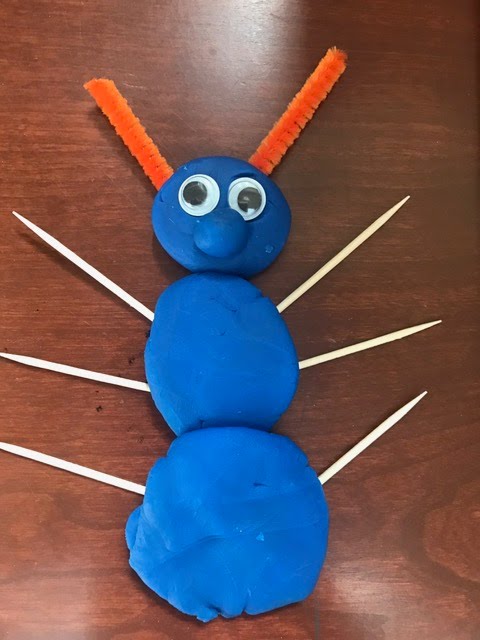
Let children make insects from play dough, toothpicks, pipe cleaners, and other art media.
                                               

Tuesday, March 21, 2017

CHEAPER BY THE DOZEN

Here's a link to my Facebook Live video I did last night if you missed it:
        
Plastic eggs are inexpensive, easy to find, and can be "playful and challenging."  Sure, you can hide them or put candy in them, but you can also use them for centers and learning activities in your classroom.

Reading Games

Write an upper case letter on one half with a permanent marker and the lower case letter on the other half.
       
Give children small pictures of objects to put into appropriate eggs.

Put antonyms on eggs for children to match.
                                               
Write synonyms on eggs.

Reinforce compound words with eggs.

*Ask older children to write the synonyms, antonyms, and compounds after matching them.

Write two letter words on eggs. Children make words and then read them. Can they use the word in a sentence?
                
Write onsets (consonants or blends) on one half and rimes (word endings) on the other half. Children twist around and read words. You could also ask children to write the words.
                                                   
Make puzzles of sight words and put them in the eggs. Children put the letters together, read the word, and then write the word.

Make puzzles of simple sentences and challenge children to put the words together and read the sentence.
                                  
Put random letters in the egg and ask children to see how many words they can make and write from the letters.

Write a poem about spring on a small sheet of paper. Fold it up and put it in the egg.

Math
Write numerals or number words on the eggs. Children fill with the appropriate amount of beans or paper clips.
                   
Children match up dots or number words with numerals.

Place a certain number of small objects in the eggs (2-10). Children dump out the objects and then write all the combinations they can make.

Give children a variety of objects. Ask them to predict if each object will fit in an egg or if is too big. Sort the objects after testing if they will fit.
                                                   
Use the eggs for addition and subtraction problems.

Reinforce place value by writing numerals 1-9 on the eggs. Children put the eggs together and then say the numeral.
                
Science
Let children draw pictures of all the animals that come from eggs.

Place objects in the eggs, such as popcorn kernels, cotton balls, bells, etc. Children shake the eggs and predict what is inside.
*Make two eggs with like objects for children to match the sounds.

Musical Instrument
Put dried beans in the eggs and tape to a plastic spoon to make maracas.
                                                                      
Spoon Relay
Give children a large spoon and an egg. Can they get their egg from one point to another without dropping it?

Yummy Snack
Put small crackers, raisins, cereal, grapes, or other healthy snacks in the eggs.
                                  
Sand and Water
Place eggs in a water table or sand box for pouring and measuring.