photo 3am_dj_home_zps919fb85e.png photo 3am_dj_about_zps7cce4c75.png photo 3am_dj_website_zps73051235.png photo 3am_dj_ss_zps6759ec2a.png photo 3am_dj_bs_zps43e27832.png

Sunday, October 7, 2018

MATH OFFICE AND MATH MATH BOX

Math Office

WHAT?
OWNERSHIP of materials is important to elementary children, and this math office is the perfect tool to give them their own space. Tape two file folders together for each child. Glue copies of math concepts you are working on to the folders. For example, a hundreds chart, days of the week, months of the year, shapes, and so forth. Use a pipe cleaner and pony beads to make an abacus you can attach at the top.  


HOW?
Children can set these up on their table or desk when it's time for math to help them focus.


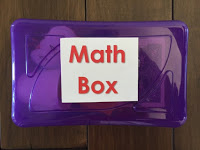
Math Box


WHAT?
Create a special math box for each child that they can use if they finish their work early. Encourage them to make up their own games as they explore with the materials.
*Thanks to Sue Dier for sharing this idea with me.

HOW?
Each child will need their own container (pencil box, bag, diaper wipe box, etc.) to make their math box.
Put math manipulatives similar to the ones below in the boxes:

Dice
Math cards (1-10 or 10-20)
Math fans (http://www.senteacher.org/print/mathematics/)
Deck of cards
Rekenrek
Inexpensive calculators
Counting items with a small cup
Set of tangrams
Dot cards
Small Calendars
Number Path (Use an index card and cut a strip out so the kids can just see one number at a time. What’s one more, one less, etc.?)

Hint!  Some of these materials can be download free off the internet.  The parents will need to send in other items.  Most can be found at a dollar store.

Saturday, October 6, 2018

BEANS, CARDS, AND DOTS ADD UP TO MATH LEARNING!

Here's a video where you can watch me demonstrate the math tools:


Bean Counters 

WHAT?
Inches are an abstract concept for children, but bean counters will provide a concrete way to do measurement. You will need a package of large, dry lima beans and wide clear packaging tape.  Place a 12 strip of packaging tape on a table with the sticky side up. Put ten lima beans end to end horizontally on the tape. Fold the bottom up and the top down and seal. Trim off the edges.


HOW?
Measurement 

Demonstrate how to take the bean counter and place it on the end of the item to be measured? How many beans long is it?

Counting by Tens 
To measure larger objects, lay bean counters end to end and count by tens.

Estimation 
Challenge the children to use estimation skills as they try to find something 5 beans long? Can you find something 9 beans long? Can you find something shorter than 3 beans? Can you find two objects that are equal beans long.

Cheez-It Measuring
Did you know that Cheez-Its are one inch squares? What another great way to measure and then EAT!
Dealer’s Choice


WHAT?
People have been entertained by card games for centuries, so shuffle up that deck and let’s pass on some learning fun with children.

HOW?
Sorting
Ask children to sort cards by color, suit, number, etc.


Order Please
Remove the face cards and then have the children put the cards in numerical order.

Patterns
Can children make a pattern with their cards? Can friends identify the pattern?
                          

Mind Reader
Remove face cards. One child comes to the front of the room and draws a card. Don’t let anyone see what it is! Classmates take turns trying to guess the number by asking yes/no questions that include math vocabulary. For example, “Is it greater than 5? Is it even? Do 3 and 5 equal it?”

Line Up
Remove face cards and pass out a card to each child. Call out directions for lining up using math vocabulary. For example, “If you come between 7 and 9 you can line up. If you are an odd number lower than 5 you may line up. If you add your number to 6 and get 8 you may line up.”

Number Stories
Remove face cards, shuffle, and then have each child draw two cards. Encourage them to think of a number story using the two digits. Can their friends tell the answer?

Memory
Use two suites of cards for this game. Shuffle cards and place them face down in rows on the floor or a table. Children rotate turning over two cards. If their cards match they may keep them and take another turn. If their cards don’t match they turn them back over and the next child has a turn. The game continues until all pairs have been matched.

Top It
(This game was formerly known as “war,” but “top it” sounds more politically correct.) Remove face cards and shuffle. Split the deck and place face down. Children remove one card at a time and turn it over. The child with the highest number takes both cards. If they turn over the same amount they place 3 cards face down and turn over the 3rd card. The highest number takes all the cards. The game continues as long as time permits.

Add It Up
This is similar to top it. Children turn over one card at a time. The first child to correctly add up both numbers gets both cards.

High, Low, Equal
Make a game board similar to the one shown. Children place a deck of cards face down. They select two cards at a time and place them in the correct category.
                                                       
Scramble
Remove face cards. Pass out a card to each child. The teacher calls out a number between 2 and 20. Children “scramble” around the room and find one or two other numbers that will equal that amount.

Dealer’s Choice
Go Fish and Crazy Eights are other traditional card games your students can play, or let them create their own games.

Homework
Wouldn’t it be great if children taught their parents how to play some of these card games?


Doing Dot Cards
WHAT?
Dot cards can be downloaded free from several sites on the internet.

HOW?
One to One
Children match up pompoms, beans, erasers, pebbles, and other small objects with dots on cards.

*Children can also clip clothespins or paper clips to the dot cards.

Dot Flash
The teacher quickly holds up a dot card and then places it face down. The children hold up that number of fingers on their chest. Ask, “How did you know it was that number?”

Copy Cat
The teacher holds up a dot card. The children try to reproduce the pattern with their own counters.

Matching
Match dot cards with dots on dice.
*Match dot cards with ten frames with the same amount.
*Make puzzle games where children match dots with numerals or words.


Partner Count
Cards are placed face down on the table. One card is turned over and the first child to say the number gets to keep the card. The partner must count the dots to verify it’s correct.

*To make the game more challenging, ask them to say one more than the quantity of dots, one less, two more, etc.

Memory
Run off two sets of dot cards. Place them face down on the floor. One child at a time turns over two cards. If the cards match they make keep them and take another turn. If the cards don’t match, they are turned back over and the next child takes a turn.

It Adds Up
Two children have a set of cards and face each other. They each turn over a card and add up the amount. The first child to correctly say the answer gets to keep the cards.


Friday, October 5, 2018

MATH MATS AND MATH BATS!

Here's a video where you can watch me demonstrate the math tools:


Math Mats
WHAT?
Math mats are a “hands on” way to give children concrete experiences with addition and subtraction. Trim a file folder to make a 12” square. Draw a line down the middle of the square as shown. Draw a line down the middle of the top section. Explain that the line in the middle is like the equal sign in an equation. What is on the top has to equal (be the same as) what is on the bottom.  
     
Note! Poker chips, small toys, natural items, small erasers, and other objects can be used with the math mat.  You can also make smaller math mats from an 8" square.

HOW?
Addition 
Demonstrate how to use counters to make a set in the top left section and a set in the top right section. Count. Pull down the objects into the bottom section and count how many altogether.

Subtraction 
Use counters to demonstrate subtraction.

Missing Addend 
”If I have 3 and I want 8, how many more do I need? Let’s put 8 in the bottom. Now, move 3 to the top. How many more do you think I’ll need?” Continue to let children move the counters to solve similar problems.

Note! Have children write the number sentence when you do these activities.

Hint! You can also use divided plates for adding and subtracting 2 numbers. Children will “eat this up” with dry cereal!
Bats in the Cave

WHAT?
You will need some small plastic toys and a plastic or Styrofoam bowl. Turn the bowl upside down and draw an arch similar to an opening in a cave.

     
*This is game is really fun this time of year because you can use plastic bat rings or spider rings.

HOW?
Place several toys on the table in front of the “cave” and count. Ask the children to hide their eyes as you hide several of the toys in the cave. Can they figure out how many are in the cave?

Hint! Ask, “How did you know that?” When children explain their thinking process it helps other classmates scaffold to a higher level.

Math Bags

WHAT?
Children will be able to manipulate objects to demonstrate different number bonds with these math bags.  You will need zip sandwich bags, permanent marker, small flat counters (buttons, poker chips, lima beans, glass pebbles).

HOW?
Draw a line down the middle of a bag with a permanent marker. Insert objects in the bag. Ask the children to count the objects in the bag. Slide the objects from one side to the other to make different combinations. Can they write down the different combinations?

Thursday, October 4, 2018

SHOW ME AND ZIP IT WITH INDIVIDUAL MATH TOOLS

Here's a video where you can watch me demonstrate the math tools:

Today I have two hands-on tools that I call “individual response techniques.” The good thing about these tools is that every child will be engaged and the teacher can quickly glance around the room and observe their responses.
SHOW ME CARDS

WHAT?
Make a set of “show me” cards for each child by writing the numerals 0-10 on 3” squares of heavy cardstock. Have children store these cards in a zip bag in their desk. When you have a few extra minutes, ask the children to get their cards and arrange them on the floor or table in numerical order from 0-10. Use the cards for some of the games below. 

*Adapt the number of cards to the ability of your students.

HOW?
How Many? 

The teacher claps, snaps, or stomps a set. Children listen and then hold up the correct number.

*Show me how many toes you have?  How many thumbs at your table?  Show me how many days in the week?

*Make a set with felt pieces on the flannel board. Show me how many.

Mystery Number
I’m thinking of a number between 4 and 6. Show me. I’m thinking of a number two more than seven. Show me.

Math Facts
4 plus 2. Show me. 
9 minus 3. Show me.

Number Stories
I had four pennies. I found three more. Show me how many I have in all.

*Let children make up math stories for their friends.

Fact Families 
Call out numbers in a fact family. Can children write the equations in that fact family?

Number Bonds
How many ways can you make seven?

Base Ten
Put 3 in the tens spot and two in the ones spot. What’s the number?

Odd and Even 
Sort the odd and even numbers.

Slap Happy Math
Children get a partner and place one set of show me cards on the floor between them. The teacher calls out different math problems. The first child to slap the correct numeral gets a point.

Hint! Put a line on the bottom of each card to help the children identify the direction they should go.

ZIP IT!


WHAT?
You will need zip gallon bags with a tab to make these “zip it” bags. These bags can be used throughout the school year for different math concepts you are working on. Cut cardstock to fit in the bag and write the numerals 0-10 on the bottom horizontally as shown.
Note! The good thing with these bags is that every child will be engaged and the teacher can quickly glance around the room to observe their responses. 

HOW?
Number Recognition
Call out a number. Children slide the tab to that number and then hold it up.

More and Less
Play mystery number using the bags. What is “one more”? “One less”? “What comes between?”

Math Facts
Hold up flash cards with addition and subtraction problems for the children to solve. After sliding the tab to the correct answer they hold it up for the teacher to see.

Wednesday, October 3, 2018

MATH TOOLS FOR CENTERS

How about some math tools that can be used in a center?


Math Cups
WHAT?
Here’s another inexpensive tool that can be used for counting as well as other math activities. These cups are not only quiet to play with, but they develop small motor skills and eye-hand coordination. You will need bathroom cups and permanent marker. Turn the cups upside down and write numerals 1-20 on the tops (actually bottoms of the cups) and sides of the cups.


HOW?
Counting

Mix up the cups. Ask the children to put the cups in order.

Matching 
Trace around the bottom of one cup 20 times on a file folder as shown. Write the numerals in sequential order from top to bottom and left to right in the circles. Children take the cups and match them up to the appropriate circle on the file folder. Next, sweep the cups off and try to stack them up vertically from 1-20.


Math Facts
Write addition and subtraction facts on the sides of the cups. Write the answer inside on a dot sticker. Children can solve the problem and then check by looking inside the cup.
                                                     
*Let them use the cup to build a pyramid if they answer correctly.

Counting by Multiples
Make math cups with multiples so children can practice counting by 2's, 5’s, 10’s, and so forth.

Hint! Store bathroom cups in an empty Pringle’s can.


Cell Phone
WHAT?
This giant cell phone will be a BIG hit with your students when it comes to practicing math facts. You’ll need a shower curtain liner, permanent marker, and fly swatter. Cut the shower curtain in half and draw a cell phone similar to the one shown with a permanent marker.


HOW?
Number Recognition
Children can use the fly swatter to identify numbers. They can also practice typing their phone numbers, zip code, etc.

*Let children throw a bean bag on a number and then do that many jumping jacks, toe touches, or other exercises.

Math Facts
Write math facts on 5”x8” index cards. Let children use the fly swatter to type out numbers and the answers.

*Children can throw two beanbags on the phone and add, subtract, etc.

Sight Words
*Use the fly swatter to spell words. Can they add up how much a word is worth?

Personal Cell Phones

Let children make individual cell phones to use for numeral recognition, adding, subtracting, spelling words, and so forth.
     
*Download the pattern and then ask children to design their own covers.  Punch a hole for a view finder so you can "take pictures."

https://drive.google.com/file/d/0B1SnEagA4jljb0hMY2hKSjJPV1k/view?usp=sharing

Sidewalk Math
Draw a cell phone on a paved playground surface and use for activities similar to those above.

Tuesday, October 2, 2018

TOOLS FOR MATH - SIMPLE, INEXPENSIVE, AND MULTI-FUNCTIONAL!

FACEBOOK LIVE COMPLETED
ACTIVITIES PUBLISHED HERE

Don’t you just love tools that you can use in lots of different ways? It’s like my kitchen scissors. I couldn’t live without them to open packages, snip herbs, trim meat, cut veggies, etc. Just like tools in your kitchen, I have some handy math tools that you will be able to use in creating multi-sensory experiences in a variety of ways with a variety of skill levels.
Brain Beads
WHAT?
Brain beads are a simple tool that can be used to reinforce counting in a concrete way. You will need pipe cleaners and pony beads.  Knot one end of the pipe cleaner. String on 10 beads. Knot the other end.

HOW?
Counting
Slide the beads to the left and then move them over one at a time to the right as you count.

*Flip the pipe cleaner over so the beads are on the left again and count from 11-20. Continue flipping the pipe cleaner and counting higher.

*Slide all the beads at once and count “ten.” Flip it over and slide all the beads as you say “twenty.” Continue counting by ten’s by sliding all ten beads at one time.

Friends of Ten
How many ways can you make ten?

Number Stories
Use the beads for addition and subtraction problems.

Number Bracelets
Make bead bracelets for different quantities. Match the colors of the pipe cleaners to the colors of the beads. For example, you could make a purple bracelet with 6 purple beads and ask the children to show how many ways they could make six.
                                                           
*Challenge students to write down the different ways to make six.


Shape and Number Sticks
WHAT?
These math sticks are easy to make and can be used in many ways. You’ll need magnetic numbers and shapes, jumbo craft sticks, and a strong glue (such as E6000). Glue the numbers and shapes to the sticks and you are all set!

HOW?
Number Recognition
Pass out sticks to children. Can they walk around the room and match up their number with classroom print?  Can they match their number with that amount of objects in the classroom?

*Let children hold up appropriate sticks as you sing or say number rhymes.

Numerical Order
Can children get in order from 0-9?

*Pass out sticks and play “I have___? Who has ___?”

Can You Find?
Children walk around the room and find a number less than theirs. Can they find a number that’s greater? Can they find a number that’s the same?

Number Friends
Call out a number. Students have to find a friend whose stick added to theirs makes the sum. Record the different combinations.

Shape Hunt
Pass out shape sticks for children to match in the classroom. Are the shapes flat or solid?


Walk around the school and look for shapes.

Monday, October 1, 2018

NURSERY RHYME NEWS!!!!

FACEBOOK LIVE AT FIVE TOMORROW 10/2
MATH TOOLS TO LOVE!

It's October 1st and you'll find some great news about nursery rhymes on my website (drjean.org) this month.  A teacher recently told me that her administrator said, "Don't do nursery rhymes."  What???  That administrator hasn't looked at the research!

rhymes:www.earlyliteracylearning.org

https://www.researchgate.net/publication/20396377_Nursery_Rhymes_Phonological_Skills_and_Reading

Saying nursery rhymes is a delightful way for children to practice oral language.  Rhymes also develop auditory memory (good for the brain) and phonological awareness (key to beginning reading).  Nursery rhymes have a simple plot and can be used to introduce story elements:  characters, setting, problem, solution.

Rhyme Pops
Make some "rhyme pops" similar to the ones shown by gluing pictures of rhymes to 3" cardboard circles.  Attach a jumbo craft stick and keep them in a can.  Whenever you have a few extra minutes you can let children choose a rhyme pop and sing or say that rhyme.
Hint!  You can sing most rhymes to "Yankee Doodle," "Gilligan's Island," or "100 Bottles of Pop on the Wall."

Nursery Rhyme Rap
I think you'll enjoy this free song download we have for you on my website this month.  Sam Williams helped me put this packet together with illustrations from the 3amteacher.com.  The song, book, take home book, and activity guide are all yours FREE on my website!!


Nursery Rhyme Halloween
Think about this!  Several schools have said that they are not allowed to celebrate Halloween, so they have a NURSERY RHYME PARTY instead.  Children dress up as their favorite nursery rhyme character and have muffins (Muffin Man), hard boiled eggs (Humpty Dumpty), cottage cheese (Miss Muffet), haystack cookies (Little Boy Blue), etc.


17 songs and over 100 pages of ready to use activities!