photo 3am_dj_home_zps919fb85e.png photo 3am_dj_about_zps7cce4c75.png photo 3am_dj_website_zps73051235.png photo 3am_dj_ss_zps6759ec2a.png photo 3am_dj_bs_zps43e27832.png

Monday, April 15, 2019

NATIONAL ARBOR DAY

National Arbor Day is April, 26, so you'll want to be sure and check out this website and plan some special activities for your class this coming week.
https://www.arborday.org/celebrate/educational-resources.cfm

Plant a Tree
Contact your local cooperative extension service, Forestry Services, or National Arbor Day Foundation for free seedlings. Discuss what your tree will need to thrive. Prepare the soil, water your tree, and record its growth.


Brainstorm!
Divide children into small groups and let them brainstorm all the products we get from trees.

*THE GIVING TREE by Shel Silverstein is a wonderful book to share, but my little kids always wanted to know, "Why did he have to get old?" (I wonder the same thing sometimes!!!)


TREEmendous Writing
Let children look out the window or sit under a tree and write descriptions. Think about the colors in the tree. Are there animals in the tree? What are the parts of a tree?


*For creative writing, ask children to complete this sentence: If I were a tree I would...

Tree Identification
Get a book on trees from your school library. Take a nature walk and challenge the children to identify the trees on the school grounds. How does the bark on trees vary? Do all trees have blossoms in the spring? How are the leaves different?
*Hint! Give children a clipboard and let them draw their favorite tree.
*Let them do rubbings of leaves from different trees and compare.

*You can find many different free printables for leaf identification online.
                                            

Vocabulary
What's a deciduous tree? What's an evergreen tree?
Sing this song to the tune of "London Bridge" to help your students learn how about deciduous and evergreen trees.
If your leaves fall to the ground,
to the ground,
to the ground.
If your leaves fall to the ground
You're deciduous.
If your leaves stay green all year,
green all year,
green all year.
If your leaves stay green all year,
You're an evergreen.

Sunday, April 14, 2019

SEESAW INTO WRITING AND TECHNOLOGY

You're going to love this blog from Betsy Cruz! I met her at the Southern California Kindergarten Conference and she showed me how her children used technology to integrate nursery rhymes and finger plays in a meaningful and FUN way. It might be just what you are looking for right now to spark writing and reading!


Being a teacher of English language learners, and well, a teacher of five and six year olds, I know how important the development of oral language is. Fortunately, I have inspiration from Dr. Jean to help make this engaging for kids. I use ideas from Dr. Jean’s Happies, Teacher Survival Kit, songs, and best of all, free ideas from her blog.

Young children love an audience. With the FREE "Seesaw: The Learning Journal" app that I use, they have one.  
https://web.seesaw.me/   Students can record and share work of drawings, photos, audio recordings, videos, and more. They are able to use technology to show off their oral language skills, and countless other skills. Parents connect with their child’s journal from their own devices and get to see the projects that the children create at school. For the parents who may have trouble with this technology, I invite them to see their child’s work from our devices at school. We use both Chromebooks and iPads, but it is also available on Android devices, computers, and Kindle Fire.


When learning Dr. Jean’s finger play, Black Bird, my students first acted it out with their fingers, enjoying changing partners as their audience.They were also excited to illustrate it in their art journals. Seesaw allows them to record audio on top of a picture, so their next task was to take a photo of their drawing, and record themselves reciting the finger play. Knowing they would be recording their voices, and that their parents would get to see it on their device at home, there was great motivation for rehearsal.
                                                               
When practicing Humpty Dumpty, they illustrated it to show sequencing of the nursery rhyme. Then they were able to take a photo of it and record themselves reciting it. Some even sang it for the recording. Imagine the pride, confidence, motivation, and dare I say it, enjoyment, they get from doing these activities!


Their latest project has incorporated a new, yet simple art project from Dr. Jean. If you seal an envelope and cut it down the middle, you can turn the halves into puppets! Students designed their puppets and told stories with them. Their language skills have improved their writing throughout the year, and they were very motivated to write creative stories about their puppets. Taking a photo of their puppet to read and record their story was a cherry on top of the puppet sundae!


elizabeth_crus@cesd.us

San Marino Elementary

Saturday, April 13, 2019

LIVING MINDFULNESS

My dear friend Barbara Gruener is my guest blogger today. This blog is WONDERFUL and POWERFUL because Barbara explains what mindfulness can mean to you and your students. She also has some meaningful activities and tools that can promote mindfulness in your classroom.

Though I’d been an educator for thirty-plus years at that point, it wasn’t until about three summers ago when I first sat in on a mindfulness growth session and truly experienced what I’ve now come to know as something I simply cannot live without, the practice of mindfulness. Simply put, mindfulness means being in the moment, fully present, mindfully aware, without judgment.

It’s also something I wish I’d done better when my own children were young.

I’m finding that mindfulness is called a practice because it takes lots of practice. Every. Single. Day. And just because I’ve been studying it, been creating ways to nurture it, been attending summits to research and learn everything I can about it doesn’t mean that I’m there yet. Quite the opposite, actually. The more I learn about this calming practice to keep me fully present, the more I find gaps that keep me wanting more.

More awakening. More practice. More calm.

Here now, five ways to help you and your students get more mindful when your minds start to get full.

Magical Breathing

There’s nothing easier in the practice of mindfulness than turning something automatic, like breathing, into something that you do with intention. Try variations of the deep breath, like box breathing. Popular with military personnel, this deep-breathing technique asks you to breathe in for four counts, pause and hold it for four counts, exhale for four counts, and pause again for four counts. Use your pointer finger to draw a square to make it more tangible. Or, for fun, try backward breathing. Exhale first, then inhale.

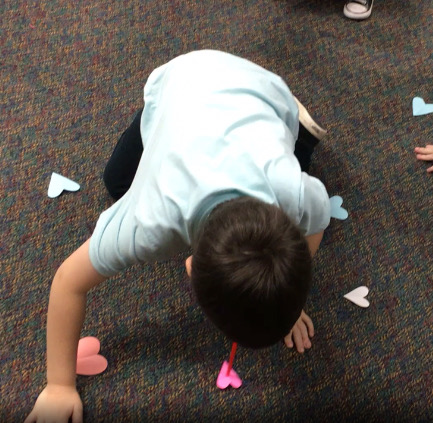
My students also enjoy something we call straw breathing.


For straw breathing, you’ll need a straw for each child and some hearts or other cut-out shapes spread out all over the floor. Ask students to deep breathe into the straw as they pick up one of the paper shapes. They will then pause their breath as they travel that shape from where they found it to a designated home basket, where they will deposit the shape by exhaling slowly and deeply. Students can race against one another to see how many straw breaths they can take as they pick up the hearts off of the floor and move them to their safe place.

Don’t stop there; try rainbow breathing, labyrinth breathing, five finger breathing, and shapes breathingfor more ways to engage your mindful learners in the practice of mindfulness to elevate energy and to center and calm.

Mindfulness Mantras

A mantra is a short phrase that we can repeat to help us focus and stay in the moment. It will also help center us and bring us back to mindful awareness of our real-time circumstances to help us unwrap the present. One of my favorite mantras is Be where your feet are.                                                
                                                                

Try this: Adopt a four-word phrase like Peace begins with me; start by touching your pinky finger to your thumb, then move through the other fingers to make it a touchstone. Add some deep breathing to unwind and restore: Inhale courage, exhale worries. Make your mantras tangible and cross your midpoint by using your right-hand pointer and middle fingers to tap out your mantra as you ascend your left arm from your wrist to your elbow and back down again. Switch sides and repeat it a few more times.

Button Bowls
Tap into the senses with a collection of all of the spare buttons that you and your class can collect. Put assorted buttons into a bowl and listen while little fingers manipulate them; can you hear the rainforest? If not, what does it sound like to you? Look at the bright colors; how many can you see? Feel the different shapes, sizes, temperatures, and textures.

Which button reminds you of your mom? Your dad? Your grandparents? Your teacher? Do you have a favorite button? What draws you to that particular one? Spray the buttons with an essential oil for an added mindfulness treat.

Calming Containers 
Fill a water bottle with water and add ½ teaspoon of water beads. Watch them grow from small, dry, brittle beads to fully-hydrated, colorfully-squishy bouncy balls. Put a drop of food coloring into the water before sealing the bottle up tightly to give your younger learners a visual tool to use as they enjoy the visual benefits of watching the water gently rocking the beads back and forth.
           

If you’ve got older learners, consider adding a drop of an essential oil like lavender so students can unscrew the cap and inhale the fragrance to reduce stress and increase productivity.

Scent-sational Shakers
A common roadblock to scents is that diffusers have been banned from classrooms and/or schools out of sensitivity to students and staff with allergies. I get it; I, too, have an eye disease that prevents me from enjoying anything strongly scented or perfumed. A beautiful alternative is capturing those scents and decentralizing them so that they are available when needed without causing unwanted allergic reactions.


My favorite way to infuse scents is by soaking a cotton ball with the desired essential oil and putting it inside these shakers. Now my salt shaker smells of citrus and the pepper shaker holds, you guessed it, a peppermint scent.

Check out a few of our favorite mindfulness apps:


For more on the benefits of mindfulness, click {here}; for posts and other resources, visit my Mindfulness Pinterest page.


P.S.  Check out Barbara's book on character education.  This is exactly what is needed in each home and classroom right now!


https://corneroncharacter.blogspot.com/p/my-book.html

Friday, April 12, 2019

EGG-STR SPECIAL EGG EXPERIMENTS WITH EGGS

There's more to eggs than dying them this week!
                              
Rubber Egg
Materials: clear jar with lid
vinegar
raw egg in its shell

1. Put a raw egg in a jar and then cover it with vinegar. Screw on the lid and set it aside for 3-5 days.
2. Observe the egg each day and describe what is happening to it.
3. After 3-5 days, the eggshell should be almost invisible. Remove the egg, rinse it off, and hold it up to the light. How does the shell feel? Hold the egg several inches from the table and drop it. Does it break?


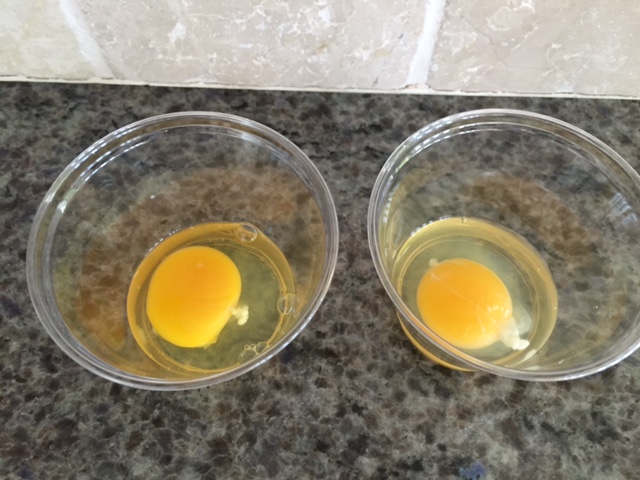
EggStra Special
Materials: 2 clear cups
1 brown egg
1 white egg
                          
1. Pass around the eggs for the children to gently hold and observe.
2. Discuss how the eggs are alike and how they are different.
3. Ask the children to predict if they are alike or different on the inside.
4. Break each egg into a different cup and compare.
5. How are people like the eggs? Do people look alike on the outside? Are people the same on the inside?
*They made good scrambled eggs, too!

Happy Teeth
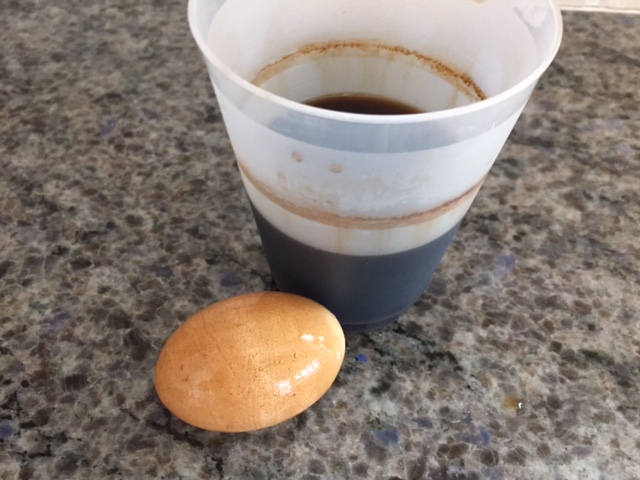
Materials: 4 raw white eggs
4 clear cups
tea, coffee, cola, water

1. Place each egg in a different cup and cover with one of the liquids.
2. Observe the eggs for several days to see what happens.
3. Remove the eggs and encourage the children to describe what happened to each egg and why.
4. How are teeth like the eggs? What will happen to your teeth of you drink tea and coffee all the time?
*Brush the eggs gently with toothbrush and toothpaste and see what happens.
                            
Note! Brushing the egg with toothpaste didn't work too well. I might have left the egg in the coffee too many days. Or, maybe it was the toothpaste???

What’s in an Egg?
Materials: plastic egg
small toy animal that would hatch from an egg (fish, bird, alligator, frog, spider, snake, etc.)

1. Put the toy in the egg? Let the children shake it and try and guess what it is.
2. Have them make a list of all the animals they can think of that hatch from eggs.
3. Open the egg to confirm their guess.
*Make a t-chart of animals that come from eggs and animals that do not hatch from eggs.


Natural Dyes
Did you know you could dye eggs with berries, vegetables, and spices?  There are many ideas on the internet if you want to give it a try.

Thursday, April 11, 2019

JOIN THE GREEN TEAM

Who wouldn't want to be a super hero on the green team?  How about some membership cards?
                                          
https://drive.google.com/file/d/0B1SnEagA4jljUFdXTkFpR2ZOUE0/view?usp=sharing

The Green Team (Tune: “When Johnny Comes Marching Home”)
We are on the Green Team. (March in place as you swing your arms.)
Hoorah! Hoorah! (Fist in air as if cheering.)
We can recycle every day. (March in place as you roll your arms around.)
Hoorah! Hoorah! (Fist in air as if cheering.)
Aluminum, glass, tin, (March in place.)
Put paper and cans in recycle bins. (March in place.)
Join the Green Team, (March in place.)
Defend the earth and keep it clean. (Put both fists in the air like a hero.)

We are on the Green Team. Hoorah! Hoorah!
We can reduce what we use. Hoorah! Hoorah!
Turn off water and the lights.
Walk, take a bus, or ride your bike.
Join the Green Team.
Defend the earth and keep it clean.

We are on the Green Team. Hoorah! Hoorah!
We can reuse many things. Hoorah! Hoorah!
Share old toys and old clothes, too.
Give away what you don't use.
Join the Green Team,
Defend the earth and keep it clean.

We are on the Green Team. Hoorah! Hoorah!
We can keep our planet clean. Hoorah! Hoorah!
Pick up all the trash you see.
Protect wildlife and plant new trees.
Join the Green Team.
Defend the earth and keep it clean.

*Make a language experience chart of children’s suggestions for what it means to be on the “Green Team.” Have children dip their thumb in green paint and “sign” it on the list to signify that they are going to join the “Green Team.”
                   

*Walk around the school and encourage the children to draw pictures or write suggestions for conserving energy and making the learning environment “green.” Compile results and ask the principal to visit your class and discuss improvements that can be made.

Naturalist Kit
Make a naturalist kit by recycling a detergent box or similar container with a handle. Make binoculars by cutting a cardboard paper towel roll in half. Tape the halves together and hole punch at the top. Tie on a piece of string so children can easily take the binoculars on and off their heads. Add a magnifying glass, field guide, tweezers, film canister (for collecting specimens), paper, pencil, etc. Talk about what naturalists do. Can you be a naturalist? Divide children up into groups of two and let them take turns playing “naturalist” on the playground.


Put out scrap materials in the art center and encourage children to make “Green Team” badges. You can also let them decorate sheets of newspaper and staple them around their necks to make “Super Green Hero” capes. Let children dramatize what they would do if they were a “Super Green Hero.”
                                    

Wednesday, April 10, 2019

RECYCLE ME, PLEASE!

You know all those cardboard food boxes you throw away?  Well, here's a great opportunity to give them a second life, teach your children to recycle, and make some cool materials for your classroom.  Send a note asking families to save their cardboard food boxes for a week and then let the fun begin!

Cardboard Castle – Let children use masking tape to create a castle or other play sculpture.


What's for Breakfast? Book - Each child chooses the front of their favorite cereal box.  They can write original sentences or fill in the blank "(Child's name) likes (cereal)."


Puzzles – Cut box fronts into puzzle shapes. Store in zip bags. For younger children use two like boxes. Cut one up and let them place the pieces on the second box.


Fronts and Backs – Cut front and back panels off of boxes. Mix them up and then ask the children to match up the ones that go together.


*Play a memory game where you place the fronts and backs face down on the floor. Children try to match up pairs.

Stencils and Templates – Cut geometric shapes out of box fronts. Children can trace these with colored pencils, crayons, or markers.
*Cut seasonal shapes or objects that relate to a unit of study for the children to trace.
                                                  
Sewing Cards – Punch holes around the sides of boxes. Children can sew these with yarn, string, or old shoelaces.


Weaving – Cut notches around the sides of boxes and let children weave through these with yarn.

Fractions – Give each child the front panel off a box. Can you cut it in half? Fourths? Eights?


Math – Have children sort the boxes by product, size, etc. Graph favorite cereals, cookies, crackers, etc.

How about a free song download and flip book about recycling?    


http://www.drjean.org/html/monthly_act/act_2015/04_Apr_css/index.html

                         
What Will I Be When They Recycle Me?
(Tune: “Oh, Dear, What Can the Matter Be?”)
What will I be when they recycle me? (Roll hands in a circle.)
What will I be when they recycle me?
I’ll come back to life—you will see! (Clap your hands and then point your finger.)

I am an empty soda can (Pretend to hold a soda can in front of you.)
Made of precious aluminum.
I can save lots of energy
If you will recycle me. (Roll hands in a circle.) 

I’m an old bottle of plastic (Pretend to hold a plastic bottle.)
But I could be fantastic!
Toys, pipes, car bumpers, and much more—
That’s what my plastic is for. (Roll hands in a circle.)

A pile of used boxes and papers we (Make an invisible square in the air.)
Come from the precious wood of trees.
Recycled we’ll be as good as new (Roll hands in a circle.)
And save some other trees, too.

I am a fine jar made of glass— (Cup hands to make a bowl.)
Please don’t treat me like plain old trash! (Shake head “no.”)
I’ll make new jars again and again
Recycle me—yes you can! (Roll hands in a circle.)

Though we may look like old used stuff, (Open palms.)
Stop, wait! Please don’t give up on us! (Make sign language for “stop.”)
Think of the great possibilities— (Put index finger on your head and tap.)
Recycle us, set us free! (Roll hands in a circle and then throw up hands in the air.)

Tuesday, April 9, 2019

WE'RE ON THE LITTER PATROL

One of the best ways to be on the "green team" is to keep the earth beautiful by picking up trash.  There's nothing more frustrating to me than to see trash along the road, but maybe we can improve things in the future by getting our students to join the LITTER PATROL!


Litter Patrol
Well, here we go, (Clap and snap fingers to the beat.)
We’re on the litter patrol.
We’re going to work all day
To put the trash away.
The planet earth, you see
Is our habitat.
We’re going to clean it up,
Well, how about that!

Litter Bags
Ask your students to bring in an empty cereal box or cardboard food box.
1. Cut the tops off the boxes.
2. Punch a hole in each short side.
3. Tie on a piece of string. Use these to collect trash or have the children place these in their cars.


Earth Day Project
Plan a community project where parents and children come together to clean up a park or natural area in your community. Make sure you have gloves and trash bags for the participants.

Trash Snack
How about a “trash snack”? You will need ice cream cones, Gold Fish crackers, Cheerios,  pretzel sticks, and peanuts. Take 4 lunch sacks and put a different item in each sack. Write “old tires” on the sack with Cheerios, write "dead fish" on the sack with the crackers, “sticks” on the sack with pretzel sticks, and “stones” on the sack with peanuts. Take a large bowl and make up a story about collecting trash. As you name the different items, invite different children to dump the contents in the bowl. Stir with a large spoon and then serve the “trash” in trashcans (ice cream cones). The cool thing about this snack is that there is NO trash when the children have finished eating!
                                       
Hint! Substitute raisins for peanuts if you have students with food allergies. You can also use sunflower seeds or other snack foods.