photo 3am_dj_home_zps919fb85e.png photo 3am_dj_about_zps7cce4c75.png photo 3am_dj_website_zps73051235.png photo 3am_dj_ss_zps6759ec2a.png photo 3am_dj_bs_zps43e27832.png

Tuesday, September 13, 2016

WHAT'S YOUR NUMBER?

As adults, we don’t memorize phone numbers any more because everything we need is in the palm of our hands. However, it’s still important for children to know their full name, birthday, phone number, and address. One year I had a little boy and I said, “What’s your name?” He replied, “Bubba.” I said, “No honey, your full name.” Well, he straightened me out as he said, “Bubba Bubba!”

Here are some tips to remind parents how to help their child learn this information at home.

Full Name
Help children learn their full name “The Wheels on the Bus.”
My full name is (first) (middle) (last),
____, ____, ____,
____, ____, ____,
My full name is (first) (middle) (last),
That’s my full name.

Birthday
Birthdays can be sung to “Happy Birthday to You.”
September 24th, 
September 24th,
My special birthday is
September 24th.

Phone Number
Phone numbers can be learned by singing them to “Michael Row Your Boat Ashore.”
213-297-4308
213-297-4308

Address
Addresses can be sung to “Do You Know the Muffin Man?”
874 Pine Oak Circle,
Cincinnati, Ohio

Zip Code
Learn zip codes by singing them to the tune of “BINGO.”
There is a zip code where I live
And I will sing it to you.
54892, 54892, 54892
Now I know my zip code.

These are good rhymes to transition children, as well as to reinforce birthdays, phone numbers, and addresses.

Apples, pears, peaches, plums,
Tell me when your birthday comes.

Candy, candy, ice cream cone.
Tell me the number of your telephone.

Rabbit, dog, cat, mouse,
Tell me the number on your house.

Hint! Have a “cheat sheet” with the information so you can prompt the children that don’t know.


CONFERENCE TIME ALREADY???


Ready or not, it's time for parent conferences! I used to dread conferences because many of the parents didn’t want to talk about their child. They wanted to talk about the neighbor’s kid or their “ex” or whatever. Once I started using this questionnaire my conferences became much more meaningful for me and the parents.

A week before conferences I’d ask the children, “Would you like me to give your parents some homework? Well, here is something they need to fill out and bring to our conference next week.”

Note! If parents show up without the form, simply smile and say, “I’ll give you a few minutes to fill this out before we get started.”

                                  CONFERENCE QUESTIONNAIRE

Please fill out this form and bring it to your conference on __________________at _________________.

Child’s name__________________________

1. My child’s favorite activity at school is________________

2. My child expresses concern about_____________________

3. My child’s strong qualities are__________________________

4. Areas I feel my child needs to work on are_____________

5. Something I would like to see my child do at school is _______

6. Is there any special information about your child that you think we should know about?
                                     
https://drive.google.com/file/d/0B1SnEagA4jljYWFnNXNybFdyZVE/view?usp=sharing

Cheers and Goals
Here’s another idea for conference time. Ask parents to write down three things positive (cheers) about their child and three goals that they have for their child. This will give the teacher insight as to what is important to parents. It will also provide the teacher with the opportunity to say, “This is what I can do at school to help your child accomplish these goals. What can you do to help at home?”
                    
Student Led Conferences
I must admit I never did these, but many schools are now using this approach and find if very successful. You can find videos and other useful information about student led conferences on the internet.

Conference Tips
Sit beside the parent at a table, rather than behind a desk.

Keep the conversation focused on the child.

Have samples of the child’s work to share with the parents. Focus on the total child, including intellectual, physical, social, and emotional development.

If there is a problem, brainstorm solutions and develop a plan for action.

End the conference on a positive note by reassuring the parents and thanking them for their support.

Provide an interpreter for parents who do not speak English.

Follow-up with the parents after the conference.

Monday, September 12, 2016

HO HO HOMEWORK

Every year around this time I hear horror stories about primary grade children having several hours of homework each evening. The child ends up crying - the parents end up yelling – what’s the point?

First of all, if a young child goes to school and sits and listens and works and learns for six hours, they deserve to do what they want when they get home. The need to play, move, laugh, yell, imagine, and be KIDS!

Homework should teach children responsibility. Homework should be a tool to help parents see what their child is doing at school. Homework should extend learning from the classroom to the home. Homework should be MEANINGFUL!

If I were in charge of the world, primary grade children would NOT be allowed to spend more than 30 minutes on homework each night. They might be asked to read 20+ minutes and then have ONE other assignment. I would try to make the assignment engage with the parent and connect the real world with what’s going on in the classroom. For example, the assignment might be to ask their parents what a veteran is and to find out who the veterans in their family are. The assignment might be to ask their parents how they use math in their jobs. The assignment might be to cut out a picture from the newspaper and write one or two sentences about it. Drill and kill worksheets should be banned!

My daughter brought up the point that many parents WANT homework and are impressed with lengthy assignments because they think it will make their children smarter. In the book Battle Over Homework: Common Ground for Administrators,Teachers, and Parents, Harris Cooper put together a variety of research studies on homework. He found that in elementary school, homework has almost no impact on academic achievement. In middle school, the results are mixed. In high school, moderate levels of homework can help the learning process.

Here are some ideas that might encourage children to develop responsibility and positive attitudes about homework.

Tic Tac Toe HomeworkMake a tic-tac-toe grid and put a different assignment in each section. Children can do as many activities as they choose, but they must do at least 3 to get tic-tac-toe by the end of the week.
Hint! This is perfect for the parents and children who actually “like” homework because they can do all nine.
                                    
Homework Folders
You will need a pocket folder, crayons, and markers to make a homework folder. First, let children decorate the outside of their folders. Trace around their “left” hand on the left pocket. At the end of each day children put completed work in that pocket and it is “left” at home. Trace around their “right” hand on the right pocket. Use a homework sheet similar to the one below. Fill out assignments for the whole week and place it in the “right” hand side of the child’s folder on Monday. On Friday save homework sheets in children’s folders. Review with parents at conferences.


Weekly Homework Sheet

Monday ________________ Tuesday ______________

_______________________ ______________________

_______________________ ______________________

Parent Signature/Comments Parent Signature/Comments

_______________________ ______________________

Wednesday_____________ Thursday_______________ 

_______________________ ______________________

_______________________ ______________________

Parent Signature/Comments Parent Signature/Comments

_______________________ ______________________


Clipboard Homework
Each child will need a clipboard that she can decorate with her name, stickers, etc. Each night clip the homework assignment to children’s clipboards. (Think outside the box with interactive activities, rather than worksheets!) Make sure parents know that their job is to look at the clipboard each night, help their child with the assignment, and send it back to school the next day. 
                    
Monthly Calendar
Send a calendar home at the beginning of each month and ask parents to complete at least ten activities and return by the end of the month.
Note!  You can download these free on my website drjean.org.
                               

Sunday, September 11, 2016

MY COLORFUL WORLD

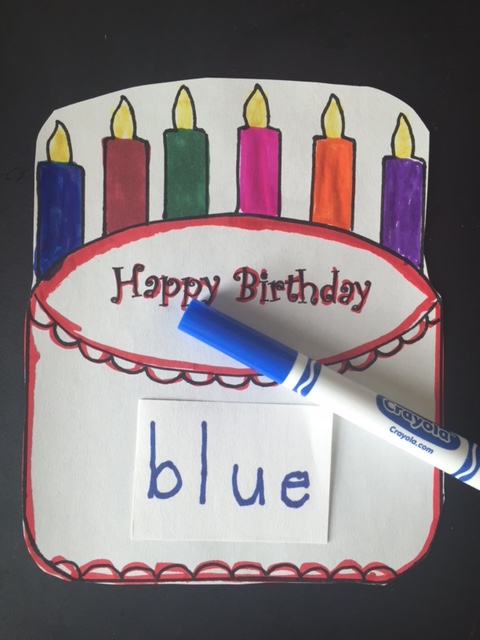
The world is full of beautiful, colorful things. And, I know most classrooms are full of colorful things and discussions about colors this time of year. Here’s a song to the tune of “Happy Birthday” where children can learn to spell the color words.

Color Box (Tune: “Happy Birthday” – On Move It! Learn It! CD)
Here’s a crayon for you. (Pretend to hold a present in your hand.)
It’s a blue one for you. (Hold up a blue crayon or marker.)
B – l – u – e  blue
Here’s blue for you...
Red, yellow, orange, green, purple, brown, black, white.
                                           
*Children could hold up crayons or touch something the appropriate color as you sing.

Sign Language
Teach children manual signs for the colors. You can see video clips at aslpro.com.

Color Book
Materials: copy paper, hole punch, crayons, rubber band


Directions: Fold two sheets of paper in half. Cut in half. Stack and fold in half again. Make two hole punches on the folded sided about 2” from the ends. Insert a rubber band in one
hole and slip a crayon through the loop. Insert the other end of the rubber band in the other hole and slide the other end of the crayon through that loop. Children can use these books to write color words, draw pictures of their favorite colors, cut objects out of
magazines and label the color, and so forth.

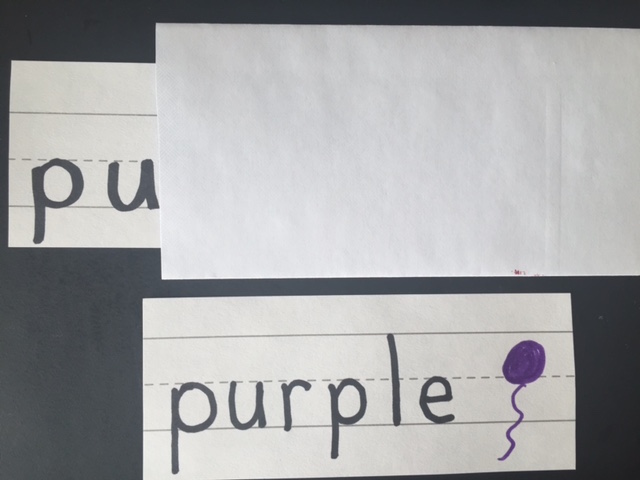
Word Puzzles
Materials: sentence strips, envelopes, markers
                                             
Directions: Write sight words on sentence strips. Cut between the letters to make a puzzle. Place the puzzle pieces in an envelope. Make a balloon the appropriate color on the front of the envelope. Children remove the letters and try to put them together to make the word.
Hint! Write the word on the back of the envelope so children can self-check.

Pull and Read
Materials: sentence strips, envelopes, markers

                        
Directions: Write sight words on 10” sections of sentence strips with a black marker. Draw a small balloon the appropriate color at the right end of each word. Seal a letter size envelope and then trim off the left end. Insert the sight words in the envelope. Children pull out one letter at a time and try to blend the sounds and identify the color word. They can self-check with the balloon at the end.


Rainbow Everything
Materials:  paper, crayons or markers
                Directions:  Children can trace around shapes or letters with different colors of crayons.  You can adapt this activity to seasonal shapes, words, numerals, or anything you want the children to practice.

Configuration Puzzles
Write color words on the board. Invite children to trace around the outside shape of each word. Erase the letters inside the outlines. Can children identify the word from the shadow? 

Colorful Snack
Have a “colorful snack” where every child brings a colorful fruit or vegetable. Ask parents to prepare the food in bite size pieces so it will be easy to serve the class.
*Have children draw pictures of the “colors” they ate.

Color Scavenger Hunt
Cut construction paper in a variety of colors into 2” squares. Place these in a bag and let children choose a square. Have them hunt around the classroom to find an object that color. Can they find more than one?

*Try a color scavenger hunt on the playground.

And if you really want to a COLORFUL STEAM unit, then check out Carolyn’s latest packet with 77 pages of ideas!
                                  
https://www.teacherspayteachers.com/Product/Colors-STEAM-Activity-Packet-2766492

Saturday, September 10, 2016

I DECLARE!!!

I declare! I don’t know where some of these people come up with these ridiculous ideas!!! I wonder sometimes if common sense has completely disappeared!

A teacher recently sent me a message because her principal had told them no coloring. No writing sight words with crayons, markers, or colored pencils. No rainbow writing. Children are only suppose to use pencils to draw pictures. Really??? Where did that come from??? Has the principal ever read the research on using colors to help remember things? Would the principal like to go back to the days of black and white TV?

It’s basically an example of nit picking – but that kind of thing actually undermines the teacher’s autonomy. Who cares? Well, the teacher cares and the kids care because they like to make their drawings colorful.

At a workshop this summer we were making my blank books, which I LOVE because they are open-ended and can be used across the curriculum to integrate reading and writing. A teacher commented they were only suppose to use lined paper. Now, where on earth did that come from??? Yes, lined paper is good, but blank paper is just as good. Did Shakespeare use lined paper to write his plays? Was the Declaration of Independence written on lined paper? Another example of perseverating on something that won’t amount to a hill of beans at the end of the day.

How about the superintendent that said NO playdough in kindergarten? That’d be like me telling a band director how to teach a child to play the tuba. Would I ever tell a high school chemistry teacher how to teach chemistry? Give teachers credit for knowing their grade level, their students’ interests, needs, and how best to help them learn.

Let’s start focusing on children. Let’s start respecting teachers and giving them the latitude to be creative and try different approaches. Let’s stop thinking there is only ONE way. I’m right and you are wrong. Well, let me tell you, I’ve been at this rodeo a LONG time!!! There are many ways to teach children and there are many ways to be a wonderful teacher.

So, now I’ll get off my soapbox and tell you about a wonderful surprise that happened to me last week. My husband and I went to Dublin, Ireland, for the GA Tech/Boston College football game. (Yes, he’s a little fanatic!) We took a day train trip to Galway and there were several college students taking a little “holiday” (that’s what they call it) before school started. One of them started singing, “Guacamole, guac guac a mole…” I said, “Hey, that’s my song!” Of course they freaked out and said NO WAY. YES WAY! Even big kids in the UK know that singing and dancing makes life more fun!         
                           
                      Doing the "Banana Dance" in the Galway train station.

Friday, September 9, 2016

THE BOO BOO WHISPERER AND MORE...

I was searching for something on an old blog and I found these ideas from a few summers ago. They are certainly worth repeating and adding to the tricks up your sleeve.

When a child gets hurt…
The Booboo Whisperer (Kim Brodie)
When a child comes to Kim in tears with a booboo, she sits them down and says, “Lemme have a chat with your booboo.” She holds their arm or leg and pretends to have a conversation with the hurt spot. “Now, listen here. You need to stop hurting my friend ____. Stop it now!” It always calms the child and gets her to smile while the others gather around and show empathy.

At the end of the day…
Good-bye Handshake or Hug (Cathy Richardson & Jeanette Wannop)
Children give the teacher a handshake or hug before they leave at the end of the day.


When children finish their work early…
I’m Done Jar (Deb Rocco)
Put pictures of activities that children can do if they finish their work (puzzle, etch-a-sketch, easel) on sticks. Place these in a jar that says “I’m Done.” When children finish their work they can choose a stick and do that activity.
                                  
To form a circle…
Let’s Make a Circle (Val Minihan)
(Tune: “Lassie and Laddie”)
Let’s make a circle, a circle, a circle.
Let’s make a circle and hold hands right now.
Hold hands with a friend.
The circle won’t end.
Let’s make a circle and hold hands right now.

To get children quiet…
Echo Chant (Martha Edwards)
1, 2 (Students repeat each line.)
3, 4
We’re not talking.
Anymore!
5, 6
7, 8
9, 10
Let’s begin!

Line Up Call Back (Jeana Rhoades)
I say “line.”
You say “up.”
Line (teacher)
Up (Children)
I say “sit.”
You say “down.”
Sit (teacher)
Down (Children)
“Happy” – “Monday” etc.

To reinforce skills…
Crumple Balls (Linda)
Take a piece of recycled paper and write or draw something on it. It could be a letter, color, word, shape, number, math fact, question, etc. Children crumple their paper into a ball. On the count of three, they throw the ball into a circle or around the room. Each child picks up a crumpled ball and answers the question, gives a word that starts with that letter, etc.
*You can repeat the activity with the same “balls” because they’ll usually pick up a different question.

To encourage reading…
Rock Solid Readers (Cathy Richardson & Jeanette Wannop)
Children earn a polished rock (from the dollar store) for every 15 books that they read. Young children love to collect things and you could get a “class granny” to sew little bags for collecting or purchase small bags at the dollar store.
                 
If a child doesn’t know the answer…
I Don’t Know
Here’s a tip for getting a response from a child who is hesitant or typically replies, “I don’t know.” Just say, “Well, if you did know what would you say?” Nine out of ten times they will give you an answer.

If children need to work on scissor skills…
Scissor Wizards (Sandy Spoon)
Buy cheap drinking straws and let the children use these to practice cutting. They make a “snapping” sound that the children love when they cut. Keep the straws in a tub and they can cut and recut until they are tiny pieces that can be used for stringing on plastic lacing.
                                            
Note!   This really is fun!  They make a cool sound and pop all over.  Your kids will love it!


To reinforce numbers or letters…
Little Red Number Box (Sarah Wilson)
Put magnetic numbers in a metal tin and then sing the song as you pull out a number. Then count to that number.
For example: I wish I had a little tin box to put a 6 in. I’d take it out and count 1, 2, 3, 4, 5, 6 and put it back in.

Thursday, September 8, 2016

WE ROCK!

"Collect Rocks Day" is September 16th, but rocks are everywhere every day. Rocks can be a perfect spark for scientific investigations if you add a little STEAM. When you collect rocks or look at rocks, explain that scientists who study rocks are called geologists. Remind the children that they can be geologists, too!
                          
Take a nature walk and invite each child to pick up ONE rock. You might need to limit the size to a rock that will fit in their hand. Take the rocks to the classroom and ask the children to observe their rock for one minute without talking. Go around the room and ask each child to make one statement about their rock. Encourage them to use descriptive words.

*Ask older children to write descriptions about their rocks.

*Place the rocks in a basket. Gently shake the rocks and then pass the basket around the class to see if each child can find his rock.

*Let the children sort the rocks. What was their sorting rule? Can they sort them another way?

*Check out a book on rocks from the library. Place it in the science center along with a magnifying glass. Ask the children to do research and identify the different rocks they collected. (Remind the children to return the rocks to nature after they have finished investigating them.)

*Are rocks older than you or younger than you?

*Make a list of all the things that rocks are used for. 


*Have children make a design and build something with rocks.

*Let children paint rocks or use other art media to make paperweights.

*Place rocks in the math center for children to explore with the balance scale.

*For homework, ask families to take a walk and look for different kinds of rocks in their neighborhood.

*Encourage children to start their own rock collection with this idea. Cut an egg crate in half. Attach a pipe cleaner handle and use it to collect little rocks and pebbles.