Last Tuesday I skyped with some precious children at St. Mary's Catholic School in Salem, SD. Mr. Basil Knebel, their teacher, asked them to sing this blessing for me. I thought it would be a wonderful blessing for all of you on this Easter Day.
http://youtu.be/Fs5VS3-SOyg
Sunday, April 5, 2015
BE BLESSED!
Find many of my songs easily on iTunes and Amazon!
Labels:
Easter
Saturday, April 4, 2015
EGG-STRA, EGG-CELLENT, EGG-CEPTIONAL!
I know you'll be busy today dying eggs, hiding eggs, and getting your bonnets all set for the Easter parade. Tomorrow evening you're going to be asking yourself, "Now what am I going to do with all these plastic eggs?" Take a look at this blog I wrote several years ago and your dilemma is solved.
Write an upper case letter on one half with a permanent marker and the lower case letter on the other half.
*Children can match letters. They can also write words or draw pictures of things that begin with that sound and put them in the egg.

Write onsets (consonants or blends) on one half and rimes (word endings) on the other half. Children twist around and read words. You could also ask children to write the words.
Practice making and reading two letter words by writing a letter on each half. Ask children to write the words or use them in a sentence.

Write numerals or number words on the eggs. Children fill with the appropriate amount of beans or paper clips.
Can they write all the different ways they can make five?
Make compound words with eggs.
Let children draw pictures of all the animals that come from eggs.
Write a poem about spring on a small sheet of paper. Fold it up and put it in the egg.

Practice addition and subtraction with eggs.
Write sight words or spelling words on the eggs. Write the same word on a 1” x 4” sheet of paper and cut between the letters to make a puzzle. Place puzzle pieces in the egg. Children shake and then open and put the pieces together to make the word.
*You can also put random letters in the egg and ask children to see how many words they can make and write from the letters.

Hint! I have tried both Sharpies and permanent markers and they rub off. I would suggest just putting clear tape on top of the marker.
Friday, April 3, 2015
MARCO POLO
Do you remember playing that game in the swimming pool with your friends? It’s a good example of a call back that you can use in your classroom to focus the children’s attention. Whenever the teacher says something, the students respond. Call backs are a “gentle” way to say “pay attention and look at me!”
Here are a few that teachers have shared with me. I’ve actually used many of them when I volunteer in schools, and they really do work. It might be helpful to introduce one each Monday and use it throughout the week. Write it on a sentence strip and use a picture clue to help put it in the brain. If you’ve got other call backs that work in your classroom, please email them to me and I’ll post them on my blog.

Teacher says: Criss cross.
Children respond: Be your own boss. (Cross arms and sit up straight.)
Teacher says: All set? (Snap fingers twice.)
Children respond: You bet! (Snap fingers twice.)
*If they are not ready they respond “not yet.” Keep saying “All set?” until the entire class is responding “You bet!”
Teacher says: Hands on top.
Children respond: Everybody stop! (Put hands on head and freeze.)
Teacher says: Macaroni and cheese.
Children respond: Freeze please! (Freeze and look at the teacher.)
Teacher says: Ready?
Children respond: Spaghetti! (Stand up straight.)
Line Up Tip
Teacher says: Locket. (Pretend to lock lips.)
Children respond: Pocket. (Pretend to put the key in their pocket.)
Teacher says: Hips (Put one hand on your hip.)
Children respond: And lips. (Put index finger on lips.)
Teacher says: Standing straight?
Children respond: Check!
Teacher says: Hands to self?
Children respond: Check!
Teacher says: Mouth closed?
Children respond: Check!
Teacher says: Ready for the hall?
Children respond: Check!
It’s also fun to play the “Marco Polo” game as you wait for children to get ready to go home, clean the room, and so forth.
Teacher: Marco
Children: Polo
Teacher: Okeedookee
Children: Artichokee
Teacher: Peanut butter
Children: Jelly
Teacher: Mickey
Children: Minnie
*Challenge children to create their own call backs.
Find many of my songs easily on iTunes and Amazon!
Labels:
Classroom Management,
Routines
Thursday, April 2, 2015
LET'S PLANT SOME JELLY BEANS AND PENNIES!
The Planting Song
(Tune: “The Farmer in the Dell”
Let’s all plant some seeds, (Pretend to dig.)
Let’s all plant some seeds.
Hi, ho, it’s spring you know,
Let’s all plant some seeds.
The rain begins to fall… (Wiggle fingers down.)
The sun warms the earth…(Arms over head.)
The seeds begin to grow… (Pretend one arm is a plant.)
Growing, Growing!
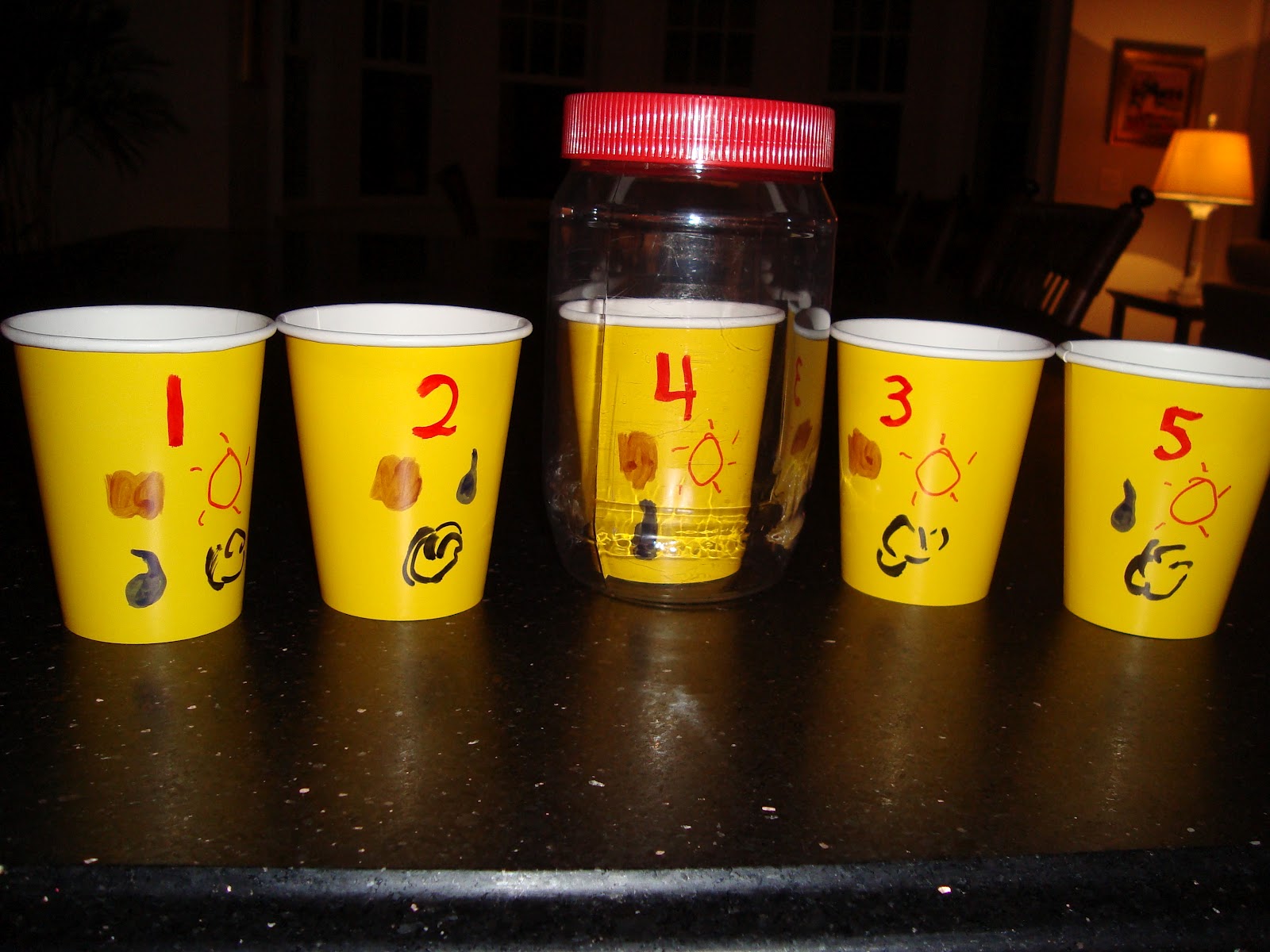
What does a seed need to grow? Brainstorm with the children and write their responses on the board. Take five cups and draw the following as shown:
soil, water, sun, air
soil, water, air
soil, water, sun
soil, sun, air
sun, air, water
Plant several bean seeds in each cup. Encourage the children to predict what will happen. Observe. Evaluate predictions after several weeks.

soil, water, sun, air
soil, water, air
soil, water, sun
soil, sun, air
sun, air, water
Plant several bean seeds in each cup. Encourage the children to predict what will happen. Observe. Evaluate predictions after several weeks.
Seed Hunt
Brainstorm different seeds that come from foods we eat, such as apples, oranges, sunflowers, avocados, popcorn... Challenge children to look in their kitchens at home and bring in seeds. Plant the seeds in clear cups and label. Place in a sunny window, water, and you might be surprised at what comes up!
*We also planted jelly beans and pennies, but alas, they never grew. It was fun experimenting and thinking about eating those jelly beans and spending those pennies!
Wednesday, April 1, 2015
NO FOOLIN!
It’s April first and I'm not foolin' around with the “green” ideas for you on my website this month. How about a free song download and flip book my webmaster created?
What Will I Be When They Recycle Me?
(Tune: “Oh, Dear, What Can the Matter Be?”)
What will I be when they recycle me? (Roll hands in a circle.)
What will I be when they recycle me?
I’ll come back to life—you will see! (Clap your hands and then point your finger.)
I am an empty soda can (Pretend to hold a soda can in front of you.)
Made of precious aluminum.
I can save lots of energy
If you will recycle me. (Roll hands in a circle.)
I’m an old bottle of plastic (Pretend to hold a plastic bottle.)
But I could be fantastic!
Toys, pipes, car bumpers, and much more—
That’s what my plastic is for. (Roll hands in a circle.)
A pile of used boxes and papers we (Make an invisible square in the air.)
Come from the precious wood of trees.
Recycled we’ll be as good as new (Roll hands in a circle.)
And save some other trees, too.
I am a fine jar made of glass— (Cup hands to make a bowl.)
Please don’t treat me like plain old trash! (Shake head “no.”)
I’ll make new jars again and again
Recycle me—yes you can! (Roll hands in a circle.)
Though we may look like old used stuff, (Open palms.)
Stop, wait! Please don’t give up on us! (Make sign language for “stop.”)
Think of the great possibilities— (Put index finger on your head and tap.)
Recycle us, set us free! (Roll hands in a circle and then throw up hands in the air.)
You’ll have to take a look at all the things you can recycle for classroom games and craft activities. You’ll never be able to throw away a plastic bottle, cereal box, paper towel roll, or bottle cap again!
Find many of my songs easily on iTunes and Amazon!
Labels:
Books,
recycling,
science,
Special Days
Tuesday, March 31, 2015
SHOES, SALAD, SIGNS, AND SONGS
Thanks to all the teachers in Houston, Lake Charles, and Marquette, MI, who sang, danced, and shared some new ideas with me last week.
Tying Shoes (Pam Rusnak)
Use two different colors of strings.

*I think this is a brilliant idea that could really help children learn to tie their shoes.
Sign for Your Door (Monica Welch)
My curriculum is NOT in a book. It is in the mind of the child who walks through the door.
Attention Grabber (Patricia Young)
Look up, point to the ceiling, and move your hand as you make the “Ahhhh!” sound. The children will all get quiet and try to see what you are looking at.
Bunny Salad (Marie H. L’Anse, MI)
Here’s a healthy bunny snack.
Put a lettuce leaf on a plate.
Put half a pear upside down. (You can used canned pears or a peeled fresh pair.)
Add 2 cloves (or chocolate chips) for eyes.
Add 2 almond halves for ears.
Put a teaspoon of cottage cheese for a tail.

Someone emailed and asked if I had a song to teach “heavy” and “light.” I didn’t, so I made this one up.
Heavy and Light (Tune: “Shortnin’ Bread”)
Heavy and light, (Tighten up arms like you're doing a bicep curl on 'heavy.'
Heavy and light, (Lift arms up in the air and open palms on 'light.)
Heavy and light,
give a little clap.
Bricks are heavy,
feathers are light,
heavy and light,
give a little clap.
Elephants are heavy,
butterflies are light,
heavy and light,
give a little clap.
Let children suggest other things that are heavy and light and insert them in the song.
Find many of my songs easily on iTunes and Amazon!
Labels:
Classroom Management,
Food,
Songs
Monday, March 30, 2015
MOVERS AND SHAKERS
How many times have teachers asked me, "What do I do with the child who wiggles all the time?" My guest blogger Margaret Rice has some excellent suggestions today. And, I'm sure you'll want to check out her website for more practical ideas.
Most classrooms have a few children who are constantly on the go. All children like to move but some have trouble settling down for activities that require sitting still and listening. Here are 5 suggestions to help movers and shakers during group activities such as circle time or large group instruction.
2. Mix up how and where the students are seated during group time. For example, can they stand to complete the activity, lay on their bellies on the floor, sit in a rocking chair, etc?
3. Use visual cues for personal space. During listening tasks, can each student sit on a carpet square or perhaps inside a hula hoop? Put painter’s tape on the floor around the student’s desk to indicate personal space.
4. Take a break half way through the lesson for an additional movement activity like a quick brain break. A few examples of easy brain breaks are: jump over a pencil on the floor 20x, run in place for 30 seconds, do 10 jumping jacks, etc.
Another option is to incorporate movement into the academic lesson. For example, look for .books that include animals, sports, transportation, or other movement type activities in the story. It will make it easier to incorporate actions while reading. Try reading the book through the first time. Then the second time you read it the children can act out the motions to go along with the story. Perhaps make some cards with the action verbs on it from the story. Use those cards during other times during the day for movement break activities.
5. Establish a routine that you stick to each group session. Every time you are leading a group try and keep the same routine. Over time, the students will know exactly what the expectations are helping to reduce negative behaviors.
About the author: Margaret Rice is a pediatric physical therapist and owner of Your Therapy Source Inc., an online resource for sensory motor, fine motor and visual perceptual publications. You can download many free activities at http://www.YourTherapySource.com/freestuff
Find many of my songs easily on iTunes and Amazon!
Labels:
Active,
Brain,
Classroom Management
Subscribe to:
Posts (Atom)