photo 3am_dj_home_zps919fb85e.png photo 3am_dj_about_zps7cce4c75.png photo 3am_dj_website_zps73051235.png photo 3am_dj_ss_zps6759ec2a.png photo 3am_dj_bs_zps43e27832.png

Saturday, January 7, 2017

WE REALLY LIKE YOU!

Here's a great idea to start your week. It will encourage positive behavior and expand vocabulary.  

1st  Have children brainstorm words that describe good friends. For example: wonderful, nice, helpful, responsible, kind, honest, etc.

2nd  Suggest looking up additional words in the dictionary or a thesaurus.
                               
3rd  Write the adjectives on index cards and place the cards in a sack.  You will need one for each child.


4th  The next day let each child select a word from the sack at group time. Tape the word on them as you sing this song to the tune of “We Wish You a Merry Christmas.”

     We like you because you’re word .
     We like you because you’re word .
     We like you because you’re word .
     We really like you!


5th  Call the child by their word all day long instead of their name.  For example, "Polite, would you be line leader?"  If a child isn't behaving appropriately all you have to say is, "Do I need to take your word away from you?"  They don't want to lose their word and will quickly do the right thing.

As a follow up make a book called "HOW TO BE A GREAT STUDENT."  Let each child take their word and illustrate it and write (or dictate) a sentence about it.

Friday, January 6, 2017

MITTEN WEATHER

P.S.  If you missed my Facebook Live yesterday where I demonstrated the different activities you can do with plastic cups here it is!!
https://youtu.be/MXdP4m7iBfY
Mitten Weather
Thumbs in the thumb place (Stick out thumbs.)
Fingers all together. (Put fingers together.)
This is the song
We sing in mitten weather. (Wiggle palms left and right.)
When it is cold (Wrap arms around self and shiver.)
It does not matter whether (Shake head.)
Mittens are wool (Hold out right hand.)
Or made of finest leather. (Hold out left hand.)

Mitten Match
Cut mittens out of a wallpaper book or wrapping paper. (It’s easy to find a mitten pattern on google images.) Cut two out of each pattern and then mix them up. Give children clothespins clip the two that go together. Introduce vocabulary to describe various patterns, such as “stripes,” “checked,” “plaid,” “solid,” “polka dots,” “animal print,” etc.


*Make a mitten match game with upper and lowercase letters, synonyms, math facts and answers, etc.

*Hide mittens around the room for children to find and match.

Kitten Game
Note!  When you read the directions for this game you'll think it's pretty silly.  And, it is, but my kids LOVED it just the same!
One person is “Mama” or “Papa” cat. “Mama” or “Papa” go out in the hall while the teacher selects 3-5 students to be their kittens. All students put their heads on their desks. The students who are kittens begin make quiet “meowing” noises. “Mama” or “Papa” cat must walk around the room and try to identify their kittens. When a kitten is found that student puts her hand in the air. The last kitten to be found becomes the new “Mama” or “Papa” cat.

Mitten Art

Let children trace around mitten patterns and cut out two. Can they decorate the mittens with crayons or markers so they look exactly the same? Hole punch around the sides of the mittens and sew with yarn.
Hint! Wrap the end of the yarn with tape to make it easier to sew.


The Mitten

Select several different versions of “The Mitten” and read them to your class. Compare and contrast stories and illustrations. Let the children vote on their favorite.
*This is also a delightful tale to dramatize. A blanket on the floor works just fine as a mitten.

Thursday, January 5, 2017

STEM CUPS??? YES, INDEED!

Now, who would think to use cups for STEM?  Look at see!

Construction Cups
*Let children be engineers and design structures with plastic cups. How many can they use? How high can they build? What worked? What didn’t work?
                    
*Divide children into groups of two or four. Give each group cups and paper plates and see what they can come up with. Let each group report on what they created. Talk about 21st Century skills! Collaboration, communication, problem solving, and creativity at its finest!
                                               
Touch and Tell
Insert a cup in a sock. Put an unusual item down in the cup. Children reach in the sock and try to identify the object by touch.
                 
*Make several of these and number each one. Have children draw a picture or write a sentence about each object.

Sequence
Sequence pictures of plant growth, life cycle, seasons, and so forth.
            
Hairy Creatures
Let children draw silly faces on small bathroom cups. Fill the cups with soil and sprinkle grass seed on the top. Water, set in the sun, and before long you’ll have a hairy creature!
                                     
Instruments 
Give each child a cup and play some catchy music. Have them gently tap the cup on their desk to the beat of the music.

*Give them two cups that they can tap together to make music. 

*Tap out syllables in words with cups.

Clucker Cup 
Take a nail and poke it through the bottom of a cup. (An adult will need to do this.) Thread a 2’ piece of string through the hole and tie a paper clip to the end in the cup. Hold the cup upside down and dip the string in water. With your index finger and thumb, gently pull down on the string. You can make a long squeaking noise or jerk it to sound like a chicken.
                     
Phone
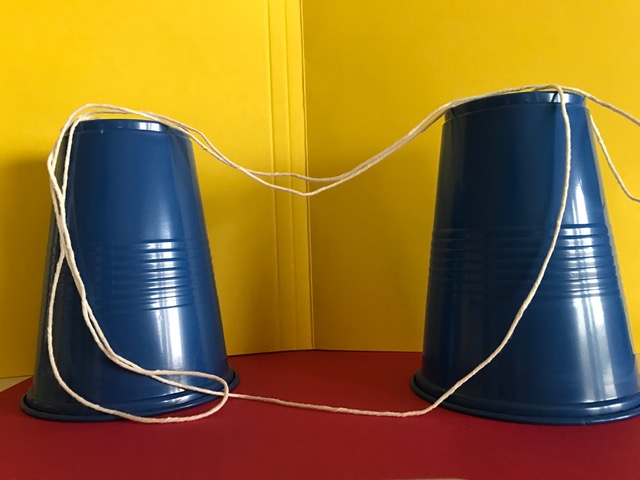
Punch holes in the bottoms of two cups. Take an 8’ piece of string and thread each end through the bottom of a cup. Tie paper clips to the ends of the strings in the cups. Each friend takes a cup and pulls the string taut. One child talks in a cup while the other child holds the cup to her ear and listens.
                                            
Fence Art 
You’ve all seen this where the children stick cups in a chain link fence to make a design. This is great for holidays and other special celebrations.

*You could also challenge children to make patterns in a fence with cups.

Pop Up Puppet
This is cute for a groundhog or a bunny. Poke a hole in the bottom of a cup. Draw a groundhog, bunny, or other creature that lives underground on a piece of paper. Cut out and attach to a straw. Turn the cup upside down and insert the straw through the hole in the cup. Move the straw up and down so the critter can pop out of the hole.
                        
Is your cup “overflowing” with ideas???

Can’t wait to see you for LIVE AT FIVE this afternoon!


Wednesday, January 4, 2017

CLASSROOM MANAGEMENT CUPS, OF COURSE!

Yes, cups can even help you with classroom management!

Help Me! 
Give each child a red and green cup to keep in their desk. When they are doing independent work have them place the cups on their desk with the green on top. Green means they are good to GO! If they need help they put the red cup on top to indicate, “Please STOP and help me.”
                             
Group Check 
You’ll need a red, green, and yellow cup for this activity. Stack the red (bottom), yellow (middle), and green (top) cups in that order and place them in the middle of a table where students sit. If the group gets loud, remove the green cup and the yellow will be a warning to calm down. If the noise continues remove the yellow cup and they must stop all talking.

Note! I didn’t think of this. There are several variations of it on the internet.

Dippers and Fillers 
This is a popular management system that many schools use. When children are unkind or say something hurtful they are “dippers.” When they are kind they are “fillers.” Punch holes in the sides of a cup and tie on a string or pipe cleaner so children can hang them on their chairs or a bulletin board. The teacher or friends can put a token in their cup to thank them for being a “filler.”
                                                      
Storage 
Plastic cups can be used for organizing art materials, pencils, and other supplies.

*How about a cup for “Lost and Found Crayons” or “Lost and Found Pencils”?
                 
*Store brain tickets or other coupons in cups.

Snack Cups 

In addition to using cups for liquids, they’re handy for serving popcorn and other snacks to children.

*Decorate with stickers and use for party treats.

Lucky Sticks

Let each child decorate a craft stick with her name. Place the sticks in a cup labeled “lucky sticks.” When you have a special job to be done pull a stick from the cup. That’s the “lucky” winner. Put their stick in your desk after they’ve had a turn and when all the sticks are in your desk put them back in the cup and start all over.
                                                  
Review Questions

Write a question on the front of the cup and write the answer inside for a self-check activity.
          
Brainstorm 

Divide students into groups of 4. Give each group a cup and challenge them to come up with as many uses for the cup as they can in 5 minutes.

Tuesday, January 3, 2017

HERE'S A CUP OF MATH

How about a cup of math today?
*Write numerals on cups. Children can put them in numerical order.
                                           
*Write numerals on some, number words on some, and on others draw sets of objects. Children can stack the numerals, words, and sets together.

*Use cups for place value - one color for hundreds, one for tens, and another for ones.

*Write addition and subtraction facts on cups. Put a sticker dot with the answer inside. Children can self- check by looking inside the cup. If they get it correct they can use the cup to build a pyramid.
                       
*Use different colored cups for children to make patterns.

*Have children sort the cups by odd and even numbers.

*Trace around the bottom of cups on a file folder. (Bathroom cups work best for this game.) Write numerals on the circles or letters on the circles. Challenge children to match cups and circles as fast as they can. Mix the cups up and then see if they can stack them in order.
                                                   
Melted Cups
I wish I could give you one of these to hold so you could actually FEEL how cool they are. Preheat your oven to 350. Place the cups upside down on a cookie sheet. No, you don’t have to spray or do anything. Put the cups in the oven and don’t walk away!!! It won’t be long until they melt down into disks and you can take them out of the oven.
            
*Write letters, numbers, sight words, etc. on the disks with a permanent marker. Put them in an empty cookie box and let children take turns choosing one and identifying the information.
               
*Let children flip them over with a pancake spatula. Write math facts on one side and the answer on the other side. You could also put pictures on the front and beginning sounds on the back.

*Use them like little dry erase boards. Children can write answers to math facts, sound out words, etc. and then erase.


Monday, January 2, 2017

HOW ABOUT A CUP OF LETTERS?

I guess I am easily entertained because I have fun taking something simple and seeing how many creative ideas I can come up with for using it in the classroom. You can’t beat plastic cups for price, adaptability, storage, and hands-on. So, raise your cup and here we go!!! If you like these ideas you can watch me demonstrate them LIVE at FIVE this Thursday, January 5th.

You can use any size cup for these activities. The inexpensive variety works just as well as the name brand cups. I used permanent markers, but I think letter stickers look better than my handwriting. I also used my favorite E6000 to glue for the words and pictures.

*The good thing about using the bathroom size cups is that you can stack them and store them in Pringles cans.
                                           
Alphabet Cups 

Write letters on the sides of the cups. Children can put these in alphabetical order or make words with the cups.
(I put the uppercase letter on one side and the lowercase letter on the side.)

*Trace around the bottom of a cup and write uppercase letters in the circles.  Have children match cups with lowercase letters.
                                            
*Glue pictures to cups and use them to match beginning sounds, ending sounds, vowels, etc.
                  
*Put letters together to make spelling words and word wall words. As a follow-up ask children to write the words.
                                                         
*Write words on cups. Children can arrange them to make simple sentences.

*Write word families on cups. Children can read the words as they stack the rimes.

*Glue pictures of opposites or write synonyms on cups to make a matching game.
                                
*Write compound words (one word on each cup) and have children stack them and say the word. Write the compound words as an extension activity.


Sunday, January 1, 2017

HAPPY NEW YEAR!!!

Hope springs eternal as we begin 2017! Our students will all score 99% on tests, our parents will appreciate us, and our administrators will tell us what a great job we are doing. We will get money back from our taxes, our favorite sports teams will win, the sun will shine, we will lose weight, we will win the lottery!!!! Sounds like a great year, doesn't it? Well, even if all those things don't come true we are lucky to be alive!

My website this month focuses on 21st Century Skills. With increased screen time in the classroom, I’m the one that keeps yelling, “BALANCE! BALANCE! BALANCE!” The Partnership for the 21st Century Skills (21stcenturyskills.org) recognized the gap between the knowledge and skills students learn in school and what is needed to succeed in the work place. Their goal is to align classroom environments with real world environments by fusing the traditional 3R’s with the 4 C’s. The 3R’s are the framework for Standards and core subjects, while the 4 C’s suggest the skills needed to be successful in career and life.

     3Rs include: English, reading or language arts; mathematics; science; foreign         languages; civics; government; economics; arts; history; and geography.

    4Cs include: Critical thinking & problem solving; Communication, Collaboration; Creativity & innovation.

It’s interesting that when leading industries are asked what skills they look for in employees they do not focus on technical skills. Their top responses usually include “good oral communication skills,” “knows how to get along and work with others,” and “knows how to find and use resources.” Isn't that what we've always emphasized in early childhood classrooms with open-ended centers, play, and opportunities for children to interact with friends. And, that’s why I embrace the Skills for the 21st Century!
                           

Learn from the past…live in the present…prepare for the future! Check out my website and I promise you’ll find some simple and practical ideas for promoting 21st Century Skills in your classroom in 2017.  You'll find activities for critical thinking, collaboration, adaptability, creativity, global awareness, and financial responsibility.
     
Note!  Since I haven't used "financial responsibility" very well this month I 

thought I'd try and grow a money tree.  Wonder why it didn't work?

May 2017 be filled with many blessings for you and those you love! 

 ENJOY THE FIRST DAY OF THE NEW YEAR!