photo 3am_dj_home_zps919fb85e.png photo 3am_dj_about_zps7cce4c75.png photo 3am_dj_website_zps73051235.png photo 3am_dj_ss_zps6759ec2a.png photo 3am_dj_bs_zps43e27832.png

Wednesday, February 7, 2018

WORDS, WORDS, WORDS!

Did you know that 3 words make up 10% of what we read? (I, and, the)
Did you know that 13 words make up 25% of what we read?
Did you know that 100 words make up 50% of what we read?

Here are some center ideas to help children master sight words.  Studies suggest that it takes the average child 25-36 exposures/experiences with a word before it is saved in their brains, so they'll be on their way with these activities.


*Note!  You might use some of these strategies already, but I hope you find at least one new idea.

In the News
Give children a section of the newspaper and highlighters. How many letters can they find that they can read? Ask them to write the words on a sheet of paper.
*Children can also identify words with glass pebbles.


Roll and Write
Make a graph with six sections going across and down. Number the sections in the top row 1-6 and then write a high frequency word in each section. Children roll a die. They find that number at the top of their frame and then write that word under it. They continue rolling the die and writing words as long as time permits.
                                         

Four Square Writing
Show children how to fold a sheet of paper into fourths. Have them trace over the creased lines to make four squares. Number the sections “1,” “2,” “3,” “4.” Ask children to write one letter words in the section numbered “l.” Write 2 letter words in the second section, 3 letter words in the third section, and 4 letter words in the fourth section.    


Bookmark
Make a bookmark from a 2” x 8 ½” piece of construction paper. Give children old newspapers and magazines and ask them to out words they can read and glue them to the bookmark.
                                       
Word Necklace
Cut a sheet of paper in half. Fold into eighths and cut on the creased lines. Staple to make a small book. Hole punch in the corner and tie on a piece of string. Children walk around the classroom and write words they can read.
*Use this necklace book for color words, shapes, adjectives, etc.


Rainbow Writing 
Make “rainbow words” by tracing around each word with different colors of crayons.

Word Search
Prepare a list of words found in the classroom and run off. Children walk around the room searching for the words on the list. They can cross through the words as they find them.

Partner Read the Room 
One child is the “student” and wears an empty pair of glasses. The other child is the “teacher” and holds a pointer. As they walk around the room the teacher points to words and the student reads them. After ten words they switch places.
Note! Whisper voices only for this activity!

Tuesday, February 6, 2018

PHONICS CENTERS

Children can practice "building" words with some of these simple materials. These activities can also be adapted for sight words, vocabulary words, or spelling words.

Alphabet Soup
Place magnetic letters in a bowl. Give children a large soup spoon to
scoop out some letters. Can they make a word with the letters? Have
them write the words that they make.

                                   
Letter Tin
Place magnetic letters inside a cookie tin. On the inside cover make three lines with a permanent marker. Have the children take out the letters and place them around the lid. Give children a list of CVC words to make and read.

Unifix Cubes 
Place dot stickers on unifix cubes. Write letters on the dots. Children can use these for constructing words.
*Let children play this game with a friend. One child builds a word and the other friend must then read it.
                                 
Play Dough Phonics
Let children use play dough to make objects that begin with different letter sounds.
*Use play dough to make two words that rhyme.

Duplo Letters and Words
Here is a photo a teacher sent demonstrating how she integrates blocks with phonics and sight words. She said she asked the parents to donate the Duplo blocks and the children thought they were "playing" instead of "learning."

Monday, February 5, 2018

LETTERS MAKE WORDS

These center ideas will help children develop the concept that "letters make words."  They can be adapted for older students to reinforce vocabulary or spelling words.

Name Puzzles 
Write children’s names on a sentence strip. Cut between the letters to make a puzzle. Next, write each child’s name and glue their photo to the front of an envelope. Place the puzzle pieces inside. Children can practice putting the puzzles together and reading friends’ names.

                            
*Put sticky dots on unifix cubes. (Use one color for the first letter and same colored dots for the other letters.) Print the letters in children’s names on the dots. Place a class directory with names and pictures so children can practice “building” their friends’ names.

Pull and Read 

Write children’s names or high frequency words on 12” sentence strips. Cut the left end off the envelope and insert sentence strips inside. Pull out one letter at a time to blend sounds and predict what the word might be.
     
*Use children’s photos or picture cues on the right side of the sentence strip so children can self-check.

Alphabet Beads
Give children alphabet beads and pipe cleaners so they can string on names, words, and so forth.


Clothespin Words
Write words on jumbo craft sticks. Write letters on spring clothespins. Children attach letters to the craft stick to make words.
        

Letter Bags and Boxes
Save sacks from restaurants or use food boxes for this center. Place foam letters or magnetic letters in a basket. Children pick a letter and then try to match it up with the same letter on a bag or box.

Sunday, February 4, 2018

THE TIDE IS TURNING - I HOPE!!!

There are two recent articles that are giving me hope for “kindergarten” as it was meant to be and should be!

https://www.artsy.net/article/artsy-editorial-learned-kindergarten-boost-creativity

The first article is about a book by Mitchel Resnick (MIT) called LIFELONG KINDERGARTEN: CULTIVATING CREATIVITY THROUGH PROJECTS, PASSION, PEERS, AND PLAY. He is passionate about kindergarten and calls it the “greatest invention of the previous thousand years.” He’s troubled like many of us and urges a return to Froebel’s model.


“When [children] build a tower with blocks, they learn about structure and stability.…When they create pictures with finger paint, they learn how colors mix together…But most important, is that they’re learning about the creative process—how to start with an idea and turn it into a project. How to imagine something new, play with the idea, share it with others, and keep refining it based on those experiences.”

                               
I just ordered the book and can’t wait to read it and tell you more about it.

The second article comes from New Hampshire where a state representative is trying to reform kindergarten standards. 

http://www.wmur.com/article/state-rep-calls-for-play-based-kindergarten-standards/15393362#ampshare=http://www.wmur.com/article/state-rep-calls-for-play-based-kindergarten-standards/15393362


State Rep. Victoria Sullivan suggests “that rigorous standards have smothered the best parts of what kindergarten used to be.” She’s introduced a bill mandating a play-based curriculum for kindergarten. "We're giving them a love of education," she said. "We're teaching them to explore and discover things on their own, and that's really what education should be about for children that age."

Amen and amen!!!!

Saturday, February 3, 2018

THINKING STATION

Want something new to spark a little creativity and critical thinking in your classroom this week? How about one of these open-ended activities?

Mystery Object
Materials: box with a lid
                Interesting objects from nature, souvenirs from other countries, etc.
                Paper, pencils
                                           
Directions: Place an object in the box and tape the lid on. Write clues about what is in the box. Challenge children to draw a picture or write a sentence about what they think it is. At the end of the day open the box and compare responses.

Alike and Different
Materials: common objects such as paper clips, rubber bands, toothpicks, crayons, etc.
                 Paper, pencils

Directions: Put out two or three objects. Have the children fold a piece of paper in half. On one side of the paper ask them to write how the objects are alike. On the other side have them write how they are different.

Picture This
Materials: interesting magazine pictures or newspaper photographs    
                Paper, pencils
                                                                
Directions: Display one of the pictures and ask the children to imagine that they are there and to write a story about what is happening.

Brainstorm
Materials: items that relate to a season or unit of study, such as a pumpkin, magnet, pine             cone, plastic egg, etc.
                Paper pencils
                         
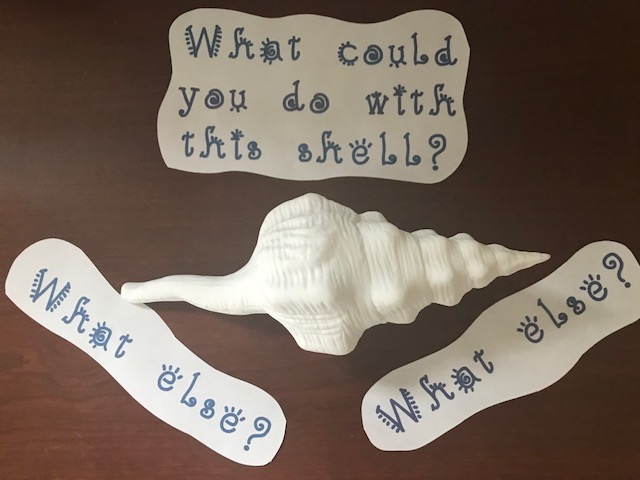
Directions: Place the unique object in the thinking station and ask the children to make a list of all the different ways it could be used.

Friday, February 2, 2018

BUILDING MATH SKILLS WITH BLOCKS

If I could have two things in my classroom I would choose books and blocks.  I almost weep when teacher say, "My administrator made me get rid of my blocks."  Blocks are wonderful for open-ended activities, but they can also be a springboard for developing math concepts.

Sorting – Can they sort like blocks together? Can they regroup the blocks by another attribute?

Numerical Order – Write numerals 0-10 on 2 ½” x 5” pieces of paper and attach to blocks. Can they put the blocks in order?


Sets and Numerals – Write numerals, number words, and sets on blocks for children to match. 


Roll and Stack – Children take one or two dice and roll. They select that number of blocks and stack them as tall as they can.                                            


Counting – How many blocks can you stack?

Math Signs – Write inequality signs, =, +, and – on pieces of paper and attach to blocks. Children can build equations and practice addition and subtraction with the numeral blocks and signs.


Liquid Measurement – Write “cup” on two square blocks. Write “pint” on a rectangular block. How many cups in a pint?    


Fractions – What would happen if you cut the square block in half? What would happen if you cut the rectangular block in half? How many ways can you make the square block? Rectangular block?

Measure Up – Children lay on the floor as friends take unit blocks and measure how many blocks long they are. Use different size blocks and compare.

Graphing – Have children draw their faces on 2 ½”” squares. Tape to blocks. Use for comparing and graphing.
For example: You could have a picture of a bus, feet, and a car. Children place their block under the way they travel to school. Which one is more? Less? How can we tell for sure?


Block Book – Cut small shapes out of construction paper to represent the different unit blocks. Glue these to a file folder to make structures similar to the ones shown. Hole punch to create a book. Children look at the drawings and then try to duplicate them with blocks.


Thursday, February 1, 2018

FEBRUARY HAPPIES

It's February and a great time to focus on kindness and friendship! You'll find ideas for morning meeting, transitions, math, reading, science, and social studies in our February Happies. There are some great ideas in the preview, or you can order the entire package (136 pages and 16 songs) at Dr. Jean’s website or at Carolyn Kisloski's my TpT Store!

Will You Be My Valentine?
(Tune: “Do You Know the Muffin Man?”)
Will you be my Valentine, (Point to various friends.)
Valentine, Valentine?
Will you be my Valentine?
I’ll be yours if you’ll be mine! (Point to self and then a friend.)


Some are red, some are blue, (Hold up fingers.)
Some have lace and ribbons, too.
Some are funny, some are not. (Smile and then shake head “no.”)
I like the candy ones a lot.
*Download this book at drjean.org.


Bringing Home a Valentine
(Tune: “Baby Bumblebee”)
I’m bringing home a valentine for you, (Cup hands and move them to
One that says, “I love you.” the beat in front of your body.)
I’m bringing home a valentine for you
With a great big hug, and a (kiss) (kiss), too! (Hug self and then kiss
              in the air.)
Softer….hum
                                     

Here’s a story just right for this month to help children think about how words can hurt. Cut a large heart out of red construction paper and hold it in your lap as you begin to tell the story below:

              
This is a story about a special friend named (imaginary name). He always came to school with a smile on his face and a big heart full of love for his classmates. (Hold up the big heart.) (Name) listened to his teacher, did his best work, and helped his friends. However, some of his friends weren’t always so kind. Joe made fun of his shoes and broke a little of his heart. (Tear off a piece of the heart and let it drop to the floor.) Ann said, “I’m saving this seat and you can’t sit here” at story time and broke a little more of his heart. Sammy wouldn’t share his crayons (tear off a little of the heart) and Sara called him a mean name. What are some other things that might break his heart? (Let the children name other things that cause hurt feelings as you let the pieces fall to the floor.) By the end of the day his heart was all in pieces and it was so sad.


Who can tell me how to put his heart back together? What are some kind things you can do for your friends? As children name different acts of kindness pick the pieces of the heart off the floor. Glue the pieces together on a poster as a reminder to have a kind heart. Encourage children to write friends’ names on the poster when they are kind and helpful to them!


Run off "Kindness Tickets" and distribute them to your students. Children can thank friends for a kindness shown by writing their name on a ticket.

https://drive.google.com/file/d/0B1SnEagA4jljaHRsT05ZYmxPZlE/view?usp=sharing