photo 3am_dj_home_zps919fb85e.png photo 3am_dj_about_zps7cce4c75.png photo 3am_dj_website_zps73051235.png photo 3am_dj_ss_zps6759ec2a.png photo 3am_dj_bs_zps43e27832.png

Friday, August 28, 2020

SUPER SIMPLE CRAYON ACTIVITIES

How about some simple art projects that children can do at home or at school using crayons and paper? These can be adapted to any age, and they are activities that children might enjoy doing several times.


Dancing Crayons
Materials: crayons, paper, music
Directions: Hold a crayon in each hand. Put on some music, and let the crayons “dance” on the paper.
*Use a variety of music, such as classical, country, march, lullaby, etc.


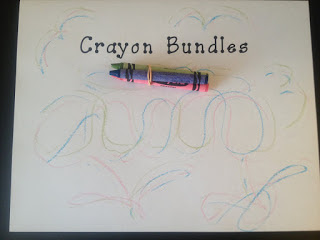
Bundles
Materials: crayons, rubber bands, paper
Directions: Wrap a rubber band around 3 or 4 crayons. Children can hold the “bundle” and draw a design or picture on their


Dot to Dot
Materials: crayons, paper
Directions: Make a specified number of dots (six, ten, whatever) on a piece of paper. Exchange papers with a friend. Connect the dots. What does it look like? Add details to create an object or design.


Wiggles and Squiggles
Materials: crayons, paper
Directions: Have the children close their eyes and make a design on their paper with a black crayon. When they open their eyes, ask them to create something out of their design.


Folded Designs
Materials: paper, crayons
Directions: Have children take a sheet of paper and fold it several times. Next, open it and trace over the creases on the paper with a black crayon. Finally, fill in each section with a different color, design, or pattern.





Thursday, August 27, 2020

A COLORING WE'LL GO!


Do you remember how happy a new box of crayons made you when you were a child? There was always a lot of “hope” in those sharp, new crayons. I was never a great artist, but I was thrilled with the “possibilities” those crayons offered!

*A good rule of thumb for encouraging children to use many colors in their drawings is to ask them to use as many colors as they are in age. If they are four years old they should use at least 4 different crayons; if they are five years old they should use five colors, and so forth.

*As you read books to the class, explain the illustrator’s name. Have children notice details in illustrations. Why is it important to add details? Remind them when they draw pictures they are illustrators, too, and they should add lots of details to make their pictures more interesting.

*Encourage children to close their eyes and think about what they want to draw before they begin coloring. “Get a picture in your brain and then you’ll know what you want your picture to look like. It’s like telling a story with your crayons.”

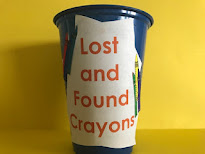
*Keep a cup or box for “lost crayons” on a shelf so children have a place to put crayons that get misplaced.


*Use mint tins to store crayonswhen boxes fall apart.


A Coloring We’ll Go
(Tune: “A Hunting We Will Go” – ALL DAY LONG CD)
A coloring we’ll go.
Hi ho, it’s fun you know,
A coloring we’ll go.

Use straight and curvy lines.
With yellow, purple, green, and orange,
We’ll make our picture fine. (Chorus)

The details we will draw.
Imagine all the little things.
The details we will draw. (Chorus)

We’ll fill in the page.
Use as many colors
As you are in age.

A coloring we’ll go.
We’ll put them in the box and close the top
When we’re through, you know.

Here's a song to help children learn color words.


Color Box
(Tune: “Happy Birthday” MOVE IT! LEARN IT! CD)
Here’s a crayon for you. (Pretend to hold a present in your hand.)
It’s a blue one for you. (Hold up a blue crayon.)
B – l – u – e.
Here’s blue for you.


Continue singing and spelling red, yellow, orange, green, purple, brown, black, white.

*Have children take their box of crayons and hold up the appropriate color as you sing.

*Let children walk around the room and touch objects that are the color you are singing about.

*Have children stand up when the color that they are wearing is sung in the song.

Wednesday, August 26, 2020

CENTER SIGNS

I mentioned these center signs in one of the virtual conferences I spoke at this summer.  Several teachers have emailed asking for these.  Although many of you won't need them when school begins this year, keep them in your pocket and keep on believing that you'll use them one day soon.

I used this idea years ago in my kindergarten to help parents, administrators, and visitors understand the value of active learning. All of my centers had signs that described what children were learning as they played. Below you’ll find some of the captions that I used.

Good teaching is good children and children are children!  Although I used these over 20 years ago before I retired, the meaning is just as valuable today!


Dramatic Play – It looks like I’m playing, but I’m developing social skills, emotional skills, independence, oral language, my imagination, responsibility, and the executive function. I may use these skills as a mother, father, safety officer, or politician one day. 


Blocks - It looks like I’m playing, but I’m developing motor skills, math concepts (number, size, shape, space), oral language, social skills. eye-hand coordination, self control, and my imagination. I may be a builder or architect when I’m grown. 

Art – It looks like I’m playing, but I’m developing my creativity, small motor skills, problem solving, sharing, cooperation, independence and responsibility. I may use these skills as an artist, illustrator, or designer one day. 

Math - It looks like I’m playing, but I’m developing oral language, social skills, small motor skills, concepts about quantity, shape, size, pattern, and an interest in math. I may use these tools as a computer programmer, accountant, or mathematician in the future. 

Library - It looks like I’m playing, but I’m developing alphabet knowledge, oral language, print knowledge, listening skills, eye-hand coordination, concepts about the world, and the desire to read. Maybe I’ll be a publisher, author, or librarian when I grow up. 

Science - It looks like I’m playing, but I’m developing a curiosity about the world, sensory skills, problem solving, language skills, and experience with the scientific process (observing, predicting, experimenting, recording, reporting). If I’m a doctor, lab technician, pharmacist, or landscaper I will utilize these skills. 

Small Motor - It looks like I’m playing, but I’m developing small muscles, eye-hand coordination, attention span, social skills, and concepts about size, shape, color pattern. I might use these skills as a chef or dentist one day. 

Language – It looks like I’m playing, but I’m developing oral language, alphabet knowledge, print connections, phonological awareness, visual skills, book knowledge, phonics, motivation to read. No matter what I become when I grow it, it will be important to know how to read. 

Writing - It looks like I’m playing, but I’m developing eye-hand coordination, small motor skills, alphabet knowledge, self confidence, vocabulary, and an interest in print. I might use these skills one day as a journalist, administrative assistant, or poet. 

Embrace the curiosity, enthusiasm, energy, and JOY of young children and let it be the momentum and springboard for developing skills and meeting standards! Play can be just as “rigorous” as a worksheet. 


                                 LET’S MAKE IT PLAYFUL AND CHALLENGING! 
                              
Hint! You could also make a book with the descriptions and photos of your students working in the centers. Let one child take the book home each evening to share with their families.


Tuesday, August 25, 2020

SAY AND MOVE MATH

Many math concepts can be introduced and practiced as you SAY and MOVE!

Macarena Count to 100
Children stand and do the “Macarena” as they count.
1 (Right arm out palm down.)
2 (Left arm out palm down.)
3 (Right palm up.)
4 (Left palm up.)
5 (Right hand on left shoulder.)
6 (Left hand on right shoulder.)
7 (Right hand behind head.)
8 (Left hand behind head.)
9 (Right hand on left hip.)
10 (Left hand on right hip.)
(Clap two times.)
That is one ten. (Hold up one finger.)
11…100


                                     Watch Macarena Count to 100


Karate Chop Count
Feet out, knees bent, karate chop with your right hand and then your left as you count by ones.
*Do leg curls and chops as you count by 5’s to 100
*Kick front and back as you count by 10’s to 200.
*Wax on, wax off as you count by 100’s to 1000.

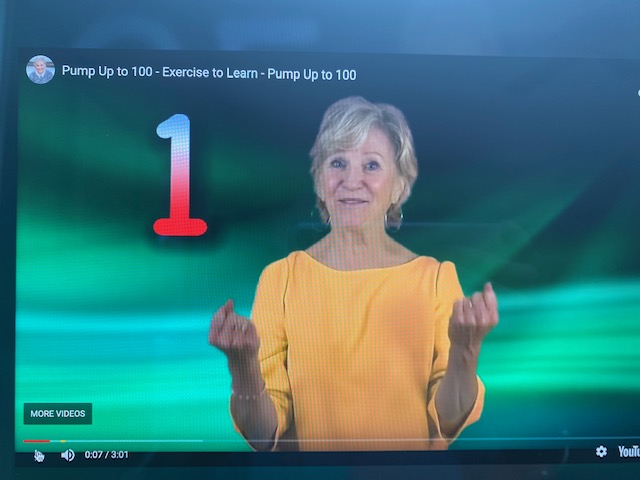
Pump Up to 100

Pretend to hold weights as you count.
1-20 - bicep curls (Elbows in, pretend to hold weights in fists with palms up as you bring forearms up and down.)
21-40 - for overhead press (Fists face forwards as you start at your shoulders and push the weights overhead.)
41-60 – side raises (Elbows at 90% angles as you raise them out to the side.)
61-80 – upright rows (Fists together close to the body and raise elbows out and up until fists are at your heart.)
81-100 – frontal raises - (Fists together and arms stiff as you raise them in front of your body to eye level.)
Whew! (Wipe brow!!!) 


Country Countdown 1-20
All right all you cowboys and cowgirls.
Time to count ‘em up and count ‘em down with me.
(Children kick right heel to the ground and then their left heel to the ground as they count.)

1 2 3 4 5 6 7 8 9 10 11 12 13 14 15 16 17 18 19 20 

Turn around and count back down. (Turn around.)

20 19 18 …..

Chant and Write 
(Children echo each line.)

Zero is where it all begins- (Slap thighs to the beat.)
Curve down around and up again.

Number one is so much fun—
Pull straight down and you’ve got a one.

Number two is easy to do—
Up around down and across makes two.

Number three is simple to see—
Draw two humps sideways and that’s a three.

Number four I do adore—
Go down, across, then down some more.

We’ve reached five, now let’s not stop—
Pull down, circle round, put a hat on top.

Number six is easy to fix—
Big curve, small loop will give you six.

Number seven is really sizzlin’—
Straight across, slant down, and that’s a seven.

Number eight isn’t very straight—
Make “S” then back up for an eight.

Number nine I think you’re fine—
A loop on top of a long straight line.

Number ten we’ve reached the end—
Put a one by a zero and count again:

1-2-3-4-5-6-7-8-9-10!

*Write numerals in the air as you chant.


Addition Pokey 
Put 1 finger in. (Hold up finger on right hand.)
Put 1 finger more. (Hold up 1 finger on left hand.)
Shake them altogether (Roll around.)
And then lay them on the floor. (Place on floor or table.)
Add them both together, (Bring hands together.)
And you don’t want to stall.
Now you have 2 in all.

2 fingers…3 fingers…4 fingers…5 fingers


Kitty-Cat! Position Scat!
Kitty-cat, kitty-cat stretch up high; (Point up.)
Kitty-cat, kitty-cat touch the sky.
Kitty-cat, kitty-cat, reach down low; (Point down.)
Kitty-cat, kitty-cat, don’t be slow!
Kitty-cat, kitty-cat, point to the right; (Point right.)
Kitty-cat, kitty-cat, out of sight! (Hands over eyes.)
Kitty-cat, kitty-cat, now point left; (Point left.)
Kitty-cat, kitty-cat, you’re the best!
Kitty-cat, kitty-cat, step out front; (Step forward.)
Kitty-cat, kitty-cat, what a stunt!
Kitty-cat, kitty-cat, walk behind; (Walk backwards.)
Kitty-cat, kitty-cat, please be kind.
Kitty-cat, kitty-cat, crawl below; (Get down on hands and knees.)
Kitty-cat, kitty-cat, to and fro.
Kitty-cat, kitty-cat, climb above; (Pretend to climb up with arms.)
Kitty-cat, kitty-cat, you I love.
Kitty-cat, kitty-cat, go between; ((Put hand between legs.)
Kitty-cat, kitty-cat, don’t be mean! (Shake finger.)
Kitty-cat, kitty-cat, now jump over; (Jump up.)
Kitty-cat, kitty-cat, roll in the clover. (Roll arms around.)
Kitty-cat, kitty-cat, now creep under; (Put right hand under left arm.)
Kitty-cat, kitty-cat, you’re a wonder.
Kitty-cat, kitty-cat, reach to the side; (Reach left and then right.)
Kitty-cat, kitty-cat, smile with pride. (Smile.)
Kitty-cat, kitty-cat, be my friend; (Hold up left hand and pretend to
Kitty-cat, kitty-cat, that’s the end! stroke like a kitten with right hand.)
Kitty-cat, kitty-cat, you know where you’re at.
Kitty-cat, kitty-cat, time to scat! (Slap hands.)
                                

Macarena Months(Dance the Macarena as you say the months.)
January, (Left arm out with palm down.)
February, (Right arm out with palm down.)
March, (Turn left palm up.)
April, (Turn right palm up.)
May, (Right hand on left shoulder.)
June, (Left hand on right shoulder.)
July, (Right hand on back of head.)
August, (Left hand on back of head.)
September, (Right hand on left front hip.)
October, (Left hand on right front hip.)
November, (Right hand on back right hip.)
December, (Left hand on back left hip.)
Then you turn around. (Turn around.)

*End with "There are 12 months, 52 weeks, and 365 days in a year, WHOO!" (Point to the sky on Whoo!)


Monday, August 24, 2020

CAN'T SING, BUT YOU CAN BALANCE!

Did you know that balancing is good for your brain? It strengthens the core and helps you focus. You don't need any equipment or special space. And, as far as I know it won't spread germs,

Note! Experts say that just like any sport the more you practice balancing the better you will become. Balance daily for a week and you might be surprised!

Balancing Brains
Have children stand. How long can they balance on their right foot? How long can they balance on their left foot?

Can they balance on their toes?

Can they balance on their right foot and extend their left leg in the air?

Can they balance on their left foot and extend their right leg in the air.

Can they balance on one foot with their eyes closed?

Can they balance on one foot and count? Count by 2’s, 5’s, 10’s, etc.

Can they balance on one foot and say a nursery rhyme or their ABC's?

Can they balance and say the days of the week, months of the year, seasons, and so forth?


Balancing Act
Here's a video where you can practice balancing with me.

Feet together, close your eyes, (Close eyes breath in and out.)
And breath slowly in and out.
Open your eyes, (Balance on left foot.)
Lift your right foot and balance on the left.
Put your arms out straight. (Arms out wide as you balance.)
Now reach for the stars. (Arms up in the air as you balance.)...
Now close your eyes and slowly breath in and out.
Let your mind take you to a happy place.


Toss and Catch

Have children wad up a sheet of paper and toss it and catch it.  Toss and catch as you count, say your ABC's, read sight words, spell, and so forth.

Sunday, August 23, 2020

SAY, DON'T SING!

Here are some active alphabet songs that you can say instead sing.

ABC Kick Box 

Children stand and make fists with their hands. Explain that you will punch across with your right hand and say a letter. Then punch across with their left hand and make the sound.


A – Punch with right hand
/a/
B - Punch with left hand /b/
C…through Z


Phonercise

Children stand and put their hands in the air as they say a letter. They put their hands on their shoulders and make the letter sound. As they touch their toes they say a word that starts with that sound.


A (Hands up in the air and say “A.”)

/a/ (Hands on shoulders and make the short /a/ sound.)

(Say a word that starts with “A” as you touch your toes.)


*Have older children say words that are nouns, verbs, or other parts of speech as you touch your toes.


Karate Writing
Explain that some letters are tall. They start at the top dotted line. Some letters start at the middle dotted line. Some letters have a tail. They go below the line. Sing the “Alphabet Song” stretching up in the air for tall letters, putting hands on waist for short letters, and touching the ground for letters with a tail. For example:

A -hands on waist
B - hands in air
G - touch ground


ABC Rap Clap
Begin a pattern by slapping thighs once and clapping twice.
A (slap on the letter and then clap twice)
B (slap, clap, clap)
C (slap, clap, clap)
D….Z

Alpha-Bodies
Children stand and as you call out letters they try and make the letter with their body.
*Spell sight words or vocabulary words with their bodies.

Saturday, August 22, 2020

RHYME ALONG WITH ME!


Oral language, phonological awareness, comprehension and other reading skills can be enhanced with nursery rhymes. Rhymes are part of our literary heritage and are great to entertain children during transitions.

Rock and Rhyme
Have children stand and get on their "pony" by putting one foot in front of the other and rocking back and forth as they say nursery rhymes.

Flip Flop Clap
Alternate right hand and then left hand on top as you say nursery rhymes to the beat.


Count with Hickory Dickory Dock
Hickory dickory dock. (Fold hands and tick tock back and forth.)
The mouse ran up the clock. (Run fingers up in the air over head.)
The clock struck one, (Clap one time.)
The mouse ran down. (Run fingers down.)
Hickory dickory dock.

Two – “Yahoo!” (Continue doing the movements above,
Three – “Whopee!” clapping the appropriate number of times.)
Four – “Do more!”
Five – “Let’s jive!”
Six – “Fiddlesticks!”
Seven – “Oh, heavens!”
Eight – “Life’s great!”
Nine – “So fine!”
Ten – “We’re near the end.”
Eleven – “We’re sizzlin’.”
Twelve – “I’m proud of myself.”


Rhyme on with Humpty
Challenge children to fill in the word that rhymes in these additional verses.

Humpty Dumpty sat on a wall.
Humpty Dumpty had a great fall.

Humpty Dumpty sat on a peg.
Humpty Dumpty fell on his leg.

Humpty Dumpty sat on a bed.
Humpty Dumpty fell on his head.


Humpty Dumpty sat on a rose.
Humpty Dumpty fell on his nose.

Humpty Dumpty sat on a pin.
Humpty Dumpty fell on his chin.

Humpty Dumpty sat on a boulder.
Humpty Dumpty fell on his shoulder.

Humpty Dumpty sat on a pie.
Humpty Dumpty fell on his eye.

Humpty Dumpty sat on a deer.
Humpty Dumpty fell on his ear.

Humpty Dumpty sat on the land.
Humpty Dumpty fell on his hand.

Humpty Dumpty sat on the sea.
Humpty Dumpty fell on his knee.


Jack and Jill's Happy Ending
Jack and Jill went up the hill (Move thumbs up in the air.)
to fetch a pail of water.
Jack fell down and broke his crown, (Twirl thumbs down.)
and Jill came tumbling after.
So up got Jack (Thumbs up.)
And said to Jill
As in his arms he took her. (Thumbs hug.)
You’re not hurt, brush off that dirt.
Now, let’s go fetch that water.
So up got Jack and (Thumbs move up in they air.)
Up got Jill to fetch that pail of water.
They brought it back to mother dear
Who thanked her son and daughter. (Fold hands and hug.)