photo 3am_dj_home_zps919fb85e.png photo 3am_dj_about_zps7cce4c75.png photo 3am_dj_website_zps73051235.png photo 3am_dj_ss_zps6759ec2a.png photo 3am_dj_bs_zps43e27832.png
Showing posts with label Self Help Skills. Show all posts

Sunday, September 13, 2026

CHORES FOR KIDS

It can be a "chore" to get children to do chores, but housekeeping jobs help children feel "worthy" and a valuable part of the family unit. Chores can also be a powerful way to develop "task initiation and task completion" (aka the executive function).

One teacher explained that when she had parent conferences she emphasized the importance of having children do chores and take responsibility for helping their family. There are several good website with ideas for chores children can do:

www.webmd.com/parenting/features/chores-for-children


www.focusonthefamily.com/...kids-to.../age-appropriate-chores

parenting.blogs.nytimes.com/.../age-appropriate-chores-for-children


We often “assume” that children know how to do a task and then we get frustrated when they don’t do it correctly. That’s why it’s important to model expectations and demonstrate specific steps. Here's an activity that would be perfect for a learning center or housekeeping area.

Setting the Table
Bring in some plastic plates, utensils, and cups and demonstrate how to set the table. You might want to trace around the items on a paper placemat so the children can match one to one.


Training Tools
Go to the dollar store and purchase a dustpan, broom, duster, etc. Demonstrate how to use these and then invite children to help you keep the classroom clean.

Teeny Tiny Duties
Let children share the chores that they have at home. Make a list of these tasks on the board. Ask children to choose three or four that they could do to help at home and make a job chart. Tell them to hang it on the refrigerator and keep track for a week. Demonstrate how to make a check mark each day when they complete the task.

Thursday, August 6, 2026

CLEAN UP

Taking responsibility for cleaning up the classroom nurtures responsibility, cooperation, a sense of accomplishment, and organizational skills. Someone once told me: ONLY DO WHAT ONLY YOU CAN DO! You'll be amazed at what children can do to care for classroom materials. However, you're going to have to "teach" children how to clean up, just like you teach them how to write their name. And, it will take some time, modeling, and specific guidelines.

Clean up will also be much more successful if you choose a song and sing it consistently when you want the children to tidy up. You really can use any song that you like (country, broadway, college fight song), but use the same song every day and then model what you want the children to do. 
I used to sing these songs in my classroom and to my own children at home. (My daughter and son would clean up just to get me to shut up!)

A Helper I Will Be
(“The Farmer in the Dell”)
A helper I will be.
A helper I will be.
There’s work to do,
There’s work to do.
A helper I will be.
A picker up I’ll be.
It’s time to put our things away,
A picker up I’ll be.

Hint! Change the words to whatever you want the children to do, such as “pick up the trash,” “push in the chairs,” etc.

Tidy Up (“Jingle Bells”)
Chorus:
Tidy up, tidy up, put your things away.
Tidy up, tidy up, we’re finished for today.
Oh, tidy up, tidy up, put your things away.
For we’ll get them out again another school day.

We’ve had lots of fun as we’ve worked and played.
Now it’s time to all join in and play the clean up game.
Chorus

Can You? (Tune: “Skip to My Lou”)
I can clean quietly, how about you?
How about you, my darlin?

*Change the words to “push in my chair,” “pick up trash,” etc.

Magic Trash
Select one random piece of trash to be the “magic trash.” Have children pick up the room. As they dump the paper and scraps in the trash can, inspect what they have in their hands. The one to find the “magic trash” gets a prize or gets to be the line leader. (Only you and I know there's no special piece of trash!)


Timer
To help prepare children bring closure to what they are doing and clean-up before another activity set a timer for five minutes. Explain, “You have five more minutes. When the timer goes off we will have a whisper clean up.”

*One of my classroom jobs was called "the five minute person." When there were five minutes before we needed to clean up the "five minute person" would skip around the room and hold up five fingers as they warned their classmates, "Five more minutes! Five more minutes!" (It was one of our most popular jobs!)

Who You Gonna Call?
Send a letter home asking if anyone has an old dust buster to donate to your classroom. Choose one person each day to be the “dust buster.” When there’s a mess shout, “Who you gonna call?” Children respond, “Dust buster!” The designated “dust buster” of the day GETS to clean up the mess.


Classroom Jobs
Assign classroom jobs weekly. Title the jobs by real careers.
Supervisor – Calls the roll.
Maintenance – Picks up the classroom.
Police Officer – Makes sure everyone walks slowly in the hall.
Mail Carrier – Passes out papers.
Librarian – Cleans the classroom library.
Gardener – Waters the plants.
Meteorologist – Gives the morning weather report.
Accountant – Does the lunch count.
UPS – Takes reports to the office.

Saturday, June 6, 2026

GREAT TEACHERS 103

These ideas are from workshops I did in 2012. There are some "SEEDS" here that you can grow into other activities in your classroom.

Count to 100 (Special K's, Marion, OH)
Count each "ten" with a different style.
Quiet 1's (whisper)
Yucky teens (attitude!)
Roaring 20's (loud)
Twisty 30's (twist)
Jumpy 40's (jump)
Flying 50's (spread arms)
Angry 60's (stomp feet)
Spooky 70's (ghost voice)
Flippin' 80's (pretend to flip pancakes)
Laughing 90's (hold stomach and laugh)
Jump and cheer for 100!!!


*It would also be fun to say the alphabet, read sight words, and practice other skills with some of those silly voices.


Travel Soap Containers
(Robin Davis)
Use travel soap containers to store crayons, magnetic letters, sight words, etc. 


Roll Call (Renee Nicolo)
Call the roll in different languages. “Buenas dias.” “Guten morgen.” “Bonjour.” “Gua-cha.”

*Younger kids would get a kick out of answering like an animal (bark, meow, tweet, and so forth).


Ten Little Everything (Karen Foley)
Adapt "Ten Little Indians" for every topic or holiday in the year.
"1 little, 2 little” for penguins, snowmen, hearts, butterflies, etc.
1 little, 2 little, 3 little penguins,
4 little, 5 little, 6 little penguins,
7 little, 8 little, 9 little penguins at the South Pole (or at the store, or on the farm, etc.)

Itsy Bitsy Spider (Sharon Howard)
After singing the “Itsy Bitsy Spider” let children change what kind of spider it is. It could be happy, mad, mean, angry, silly, pretty princess, etc. Then children decide how that spider would go up the waterspout.


Preschool Clubs (Laney Brightbill)
Make posters that describe self-help skills. Once children can do they skill they get to add their picture and name to the club. For example:
-Button club
-Zipper club
-Glove club
-Shoe tying club
-Jacket club


Doubles Don’t Give Me Trouble (Sarah Jackson)
(Tune: “I’ve Been Working on the Railroad”)
1 + 1= 2, 2 + 2 = 4, 3 + 3 = 6, 4 + 4 = 8, 5 + 5 = 10, 6 + 6 = 12
Now I know my doubles,
They don’t give me any trouble.
7 + 7 =14, 8 + 8 = 16, 9 + 9 = 18, 10 + 10 = 20, 11 + 11 = 22, 12 + 12 = 24


ARITHMETIC (Bridget Weaver)
This mnemonic device will help you remember how to spell arithmetic.
A
Rat
In
The
House
Might
Eat
The
Ice
Cream

Saturday, August 16, 2025

CUT IT OUT

One teacher said at the beginning of the school year she asked the children how many of them had their own computer, and most raised their hands. She asked how many of them had their own TV, and again, most raised their hands. Finally she asked how many of them had their own pair of scissors, and just a few raised their hands.


Those of us who have been teaching for many years have seen a dramatic decrease in small motor skills. Children just aren’t cutting, drawing, playing with play dough, stringing beads, working puzzles, or doing other manipulative activities. We not only need to engage children in these motor skills at school, but we need to remind parents of projects their children can do at home.


Cutting Tub
Ask parents to use a shoebox or purchase a plastic tub at a dollar store. Insert safety scissors, junk mail, old greeting cards, wrapping paper, etc. in the tub. When parents are busy cooking dinner they can get out the tub to entertain their child.


Tummy Cutting
Have children lay on the floor and prop themselves on their elbows. If they cut in this position, their elbow will stabilize their arm and give them greater scissor control.


*Wad up two sheets of paper and put one under each arm. As children keep their arms by their sides they will be able to cut better.

Demonstrate and Model
We have to remember that some children have never had a pair of scissors in their hands before. It’s important to take your time, model, and give explicit directions on basic tasks. Remind children to put your thumbs on top, just like "Tooty Ta," when you cut.
Hold the paper in one hand and take little bites with your scissors with the other hand.


Scisssors Snip
(Tune: “The Caissons Go Rolling Along”)
Cut it out! Cut it out!
With your scissors cut it out.
Snip, snap, and cut it out.
Thumbs on top,
Take small bites.
Hold your page in the other hand tight.
Cut it out! Cut it out!
With your scissors cut it out.
Snip, snap, and cut it out.

Thursday, August 14, 2025

1 - 2 I CAN TIE MY SHOES!

It’s pretty amazing that children have better technical skills than many adults, but they don’t know how to tie their shoes. Believe it or not, "knows how to tie shoes" was on our checklist in the old days.

When my kids were little I got a big stuffed animal and used an apron to teach them how to tie. The apron strings were much bigger and easier to manipulate than shoestrings.


Here are two poems that might help children with this task.

1-2-3-4 – TYING SHOES
Let’s get ready to tie your shoes.
Over and under. Now, what to do? (Pull strings tight.)
1. Make a loop that looks like a tree. (Make a loop with right string.)
2. The other string is a rabbit you see. (Hold up left string.)
3. The rabbit goes around and in a hole. (Take left string around loop and stick in the hole.)
4. Pull the loops tight and there is your bow! (Take both loops and pull.)

Hint! Take a marker and color one half of the shoe string. It will be easier for children to tell which loop is the "rabbit' and which is the "hole" if they are different colors.


TYING SHOES VERSION 2
Take the 2 strings (Make loops with each string.)
And make two bunny ears.
Over and under
And a knot will appear. (Tie loops in a knot.)
Pull the ears tight
And what do you know? (Pull loops.)
You’ve tied your shoes
And there is your bow!

Hint! One teacher suggested getting a bag and sending home the shoe with a different child each night. It would be a nice reminder that children still do need to know how to tie their shoes in 2025!


SHOE SHERIFF CLUB
You’ll love this idea from Karen Hansen and Karen Aikin! When children learn to tie their shoes they get to sign their name on a poster that says “Shoe Sheriff Club.” Each day a child on the poster gets to wear a badge and be Shoe Sheriff for the day. If someone’s shoes come untied, they have to go to the Sheriff instead of bothering the teacher.

*Ashley Swedell puts shoes on table legs and if children finish their work early they can practice their tying.


Note! Janet Cantrell has children practice tying using their own leg!


Passport of Accomplishment
Make an award similar to the one below to distribute to children when they learn to tie their shoes.

Wednesday, October 23, 2024

SHOW ME YOUR DRIVER'S LICENSE

As adults, we don’t memorize phone numbers any more because everything we need is in the palm of our hands. However, it’s still important for children to know their full name, birthday, phone number, and address. It's amazing how many children don't know this information. One year I had a little boy and I said, “What’s your name?” He replied, “Bubba.” I said, “No honey, your full name.” Well, he straightened me out as he said, “Bubba Bubba!”

Driver's License
Having children make a driver's license might just be the perfect incentive to encourage them to learn their full name, birthday, and address. Use a small photo of each child and attach it to card stock with information similar to the one pictured. Older children can write in the information and younger children can dictate it to an adult.

Hint! It might be helpful to have a hand mirror so children can identify their eye color.

Here are some tips to remind parents how to help their child learn this information at home.

Full Name
Help children learn their full name “The Wheels on the Bus.”
My full name is (first) (middle) (last),
____, ____, ____,
____, ____, ____,
My full name is (first) (middle) (last),
That’s my full name.

Birthday
Birthdays can be sung to “Happy Birthday to You.”
September 24th,

September 24th,
My special birthday
Is September 24th.

Phone Number
Phone numbers can be learned by singing them to “Michael Row Your Boat Ashore.”
213-297-4308
213-297-4308

Address
Addresses can be sung to “Do You Know the Muffin Man?”
874 Pine Oak Circle,
Cincinnati, Ohio

Zip Code
Learn zip codes by singing them to the tune of “BINGO.”
There is a zip code where I live
And I will sing it to you.
54892,
54892,
54892
Now I know my zip code.

These are good rhymes to transition children, as well as to reinforce birthdays, phone numbers, and addresses.

Apples, pears, peaches, plums,
Tell me when your birthday comes.


Candy, candy, ice cream cone.
Tell me the number of your telephone.


Rabbit, dog, cat, mouse,
Tell me the number on your house.

Hint! Have a “cheat sheet” with the information so you can prompt the children that don’t know.

Thursday, March 4, 2021

WHERE DO YOU LIVE?

Some of your children might have checked all the boxes on your assessment, but do they know where they live? Do they know their phone number? Here are some ideas that you can share with your families so they can help their children learn some basic personal information.

Where do you live?
Addresses can be sung to “Do You Know the Muffin Man?”
874 Pine Oak Circle, Pine Oak Circle, Pine Oak Circle.
874 Pine Oak Circle, Cincinnati, Ohio

What’s your phone number?
Phone numbers can be learned by singing them to “Michael, Row Your Boat Ashore.”
481-297-4308
481-297-4308

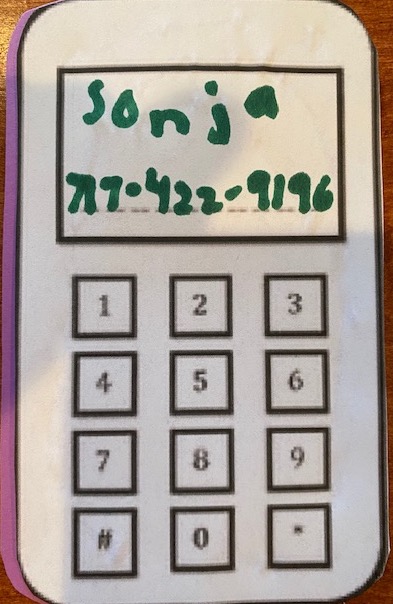
Hint!  Let children make a cell phone so they can practice "dialing" their number.
                                                       

What’s your zip code?
Learn zip codes by singing them to the tune of “BINGO.”
There is a zip code where I live and I know my zip code.
54892, 54892, 54892 is my zip code.

When is your birthday?
Birthdays can be sung to “Happy Birthday to You.”
September 24th, September 24th,
That is my birthday, September 24th.

Crafty Idea
Want a "crafty" idea to help children learn their addresses? Let children decorate a lunch bag to look like their house. Give them newspaper to stuff inside, fold down the top, and staple on a roof. Let them write (or you can write for the younger children) their name and street address at the top.


Line Up Rhymes
These are good rhymes to transition children, as well as to reinforce birthdays, phone numbers, and addresses.

Apples, pears, peaches, plums,
Tell me when your birthday comes. (Children say birthday before lining up.)

Candy, candy, ice cream cone.
Tell me the number of your telephone. (Children say phone number before transitioning.)

Rabbit, dog, cat, mouse,
Tell me the number on your house. (Children tell their address.)

Hint! Keep a copy of the children's address, phone number, and birth date so you can prompt the ones who need help.


Tuesday, December 15, 2020

LOOK ON THE BRIGHT SIDE DAY

LOOK ON THE BRIGHT SIDE DAY is December 21st, but keeping optimistic is something that we've all be struggling with under the Covid cloud.


 This Winnie the Pooh cartoon is one of my favorites because for some children, being with YOU every day is the best thing that can happen to them.


How can you help your students LOOK ON THE BRIGHT SIDE?

First, have a class discussion about what it means to look on the bright side. Accept their responses without judging. Ask them for examples of what it means to be optimistic. What does it mean to be pessimistic? What kind of friends do you like to be around?
*Make a T-chart of optimistic and pessimistic behaviors.

Here are three simple behaviors that will encourage children to look on the bright side.

I CAN
Change I CAN’T to I CAN! We are AmeriCANS and so we always need to say I CAN! Teach children this little chant to say to themselves when they have a difficult task or are trying something new.

I Think I Can
(Tune: "If You're Happy and You Know It")
I think I can are words I like to say.
If I try with all my might, in time I'll get it right.
I think I can are words I like to say.


BE THANKFUL
Look around at all the things you have to be grateful for each day. Pencils, books, friends, trees, food, families... If you focus on what you do have then you won’t have time to worry about what you don’t have. Start each day by passing around a smiley face puppet and asking each child to name something that they are thankful for or happy about.


MISTAKES ARE O.K.
Making mistakes is an important part of the “hidden curriculum” that is not in your state standards. If children learn to experience failure in the classroom, they will be much better equipped to handle it in real life and the work force. Losing a game, missing a word when you read, or running down the hall are all opportunities where children can learn and be challenged to try something different the next time.

I make mistakes, you make mistakes, everybody makes mistakes, and that’s O.K.

*As a teacher, model making mistakes and then saying, “I’m sorry.” Model how to clean up your mistakes. Model how to say, “Next time I will….”

*Let children role play making mistakes.

Thursday, November 12, 2020

CHORES FOR KIDS

It can be a "chore" to get children to do chores, but housekeeping jobs help children feel "worthy" and a valuable part of the family unit. Chores can also be a powerful way to develop "task initiation and task completion" (aka the executive function).

One teacher explained that when she had parent conferences she emphasized the importance of having children do chores and take responsibility for helping their family. There are several good websites with ideas for chores children can do:

www.webmd.com/parenting/features/chores-for-children

www.focusonthefamily.com/...kids-to.../age-appropriate-chores

parenting.blogs.nytimes.com/.../age-appropriate-chores-for-children


We often “assume” that children know how to do a task and then we get frustrated when they don’t do it correctly. That’s why it’s important to model expectations and demonstrate specific steps. Here's an activity that would be perfect for a learning center or housekeeping area.

Setting the Table
Bring in some plastic plates, utensils, and cups and demonstrate how to set the table. You might want to trace around the items on a paper placemat so the children can match one to one.


Training Tools
Go to the dollar store and purchase a dustpan, broom, duster, etc. Demonstrate how to use these and then invite children to help you keep the classroom clean.

Teeny Tiny Duties
Let children share the chores that they have at home. Make a list of these tasks on the board. Ask children to choose three or four that they could do to help at home and make a job chart. Tell them to hang it on the refrigerator and keep track for a week. Demonstrate how to make a check mark each day when they complete the task.


         

Wednesday, October 14, 2020

1 - 2 TIE MY SHOES!

It’s pretty amazing what children can do with devices, but many of them lack the ability to tie their shoes.  Here are some ideas that you can share with your families to remind them that in 2020 children still need to be able to tie their own shoes!

Start BIG
When my kids were little I got a big stuffed animal and used an apron to teach them how to tie. The apron strings were much bigger and easier to manipulate than shoestrings.


Here are two poems that might help children with this task.

1-2-3-4 – TYING SHOES
Let’s get ready to tie your shoes.
Over and under. Now, what to do? (Pull strings tight.)
1. Make a loop that looks like a tree. (Make a loop with right string.)
2. The other string is a rabbit you see. (Hold up left string.)
3. The rabbit goes around and in a hole. (Take left string around loop and stick in the hole.)
4. Pull the loops tight and there is your bow! (Take both loops and pull.)

Hint! Take a marker and color one half of the shoe string. It will be easier for children to tell which loop is the "rabbit' and which is the "hole" if they are different colors.

TYING SHOES VERSION 2
Take the 2 strings (Make loops with each string.)
And make two bunny ears.
Over and under
And a knot will appear. (Tie loops in a knot.)
Pull the ears tight
And what do you know? (Pull loops.)
You’ve tied your shoes
And there is your bow!

Shoes on Table Legs
This is an idea that Ashley Swedell shared with me years ago.  She put shoes on table legs and if the children finished their work early they could practice tying.  It might be a fun way to encourage children to practice at home as well.


Janet Cantrell has children practice tying using their own leg!


Passport of Accomplishment
Make an award similar to the one below to distribute to children when they learn to tie their shoes.