photo 3am_dj_home_zps919fb85e.png photo 3am_dj_about_zps7cce4c75.png photo 3am_dj_website_zps73051235.png photo 3am_dj_ss_zps6759ec2a.png photo 3am_dj_bs_zps43e27832.png

Wednesday, August 14, 2013

YOU GOTTA DO WHAT YOU GOTTA DO!


It’s very easy for “experts” to find fault with different discipline approaches.  I’ve been at this rodeo for over 40 years and I’ve seen many behavior management systems come and go.  The bottom line is that YOU have got to do what works for you and your students.  Consistency, love, and making the child responsible for his or her behavior always shine through.

Now, I know some people are opposed to positive reinforcement, but it has certainly worked at our house this week.  Our 8 year old grandson is visiting and I found an old “treasure” box and a bag of fake jewels.  I let K.J. make up his own task card with jobs that he thinks he should be his responsibility.  He makes his own check marks and puts a jewel for each mark in the box at the end of the day.  He’s LOVING this!  I don’t have to remind him to brush his teeth, pick up toys, or put on sunscreen.  He eagerly does it and then rewards himself with a check.  (We haven’t actually decided what the jewels are worth.  He doesn’t seem to care about the reward as much as he does with his accomplishment.)

Several months ago I wrote an article for my website on the “Executive Function.”  Task initiation, task completion, delayed gratification, and self-regulation are all incorporated as K.J. reflects on the natural consequences of his behavior.

Last week when I was in Canada they explained the importance of using the “inquiry approach” in the classroom.  Instead of answering children’s questions and explaining the meaning of words, let them try and figure it out on their own.  It’s the process of getting them to THINK and explain their thoughts that is valued above a test score.  I’ve been experimenting on K.J. this week – poor kid!  When he asked, “What does courageous mean?” I said, “What do you think it means?  Why?”  I’m afraid I’m not very consistent with this, but it could be a powerful strategy for parents and teachers.  Hmmm!  Might be a good blog in the future!

Here’s a cool craft that K.J. made at a pirate exhibit in Charleston last weekend.  (How they get adults to dress up in hot pirate clothes and walk around with parrots on the shoulders in 95 degrees is amazing to me!)  Anyway, I know most of you could NOT do this at school because it would be considered a weapon.  However, if you have kids of your own, grandchildren, or need an idea for a birthday party, it’s really fun.  All it takes is a sheet of newspaper, tape, and an oval with a hole cut out of heavy paper.  Start rolling the newspaper diagonally.  It has to be rolled tightly.  Meanwhile, let the child decorate the oval.  Tape the newspaper and insert one end in the oval.  Bend up the newspaper roll to create a handle as shown.  Touche’!  
My little pirates!
P.S.  We saw SMURFS 2 yesterday and it was ADORABLE!!

Tuesday, August 13, 2013

PINWHEELS AND DOLLAR IDEAS!


Sight Word Game
On large craft sticks write sight words on one end.  Write letters on clothespins.  Children attach the letters on the craft stick to spell the word.

Grouping Game  (Jean Broad)
The children wander about the class and the teacher calls out a number.  They need to form groups with that amount and then sit down together.  If there are children left over that’s O.K.  They remain standing.  The teacher reviews the groups and might say, “I see 1,2,3,4,5 groups of four.  That makes 20.  We have 2 extras so we know that 20 + 2 = 22.”  Then call out another number.
Establish these rules before playing:
*Respect everyone.
*Never exclude anyone from joining your group.
*Be polite.
*Help others who need to find people for their group.
This helps children with problem solving, collaboration, number sense, oral language, etc.

Math Concept Maps  (Louise Gavarkovs)
While children are waiting for the day to begin, let create math concept maps on individual white boards with dry erase markers.   Photograph their completed boards, or select a few to present them to the class.
*Each child chooses what they are able to include.  For example, older children could write number stories and younger children could draw sets.

Share Chair (Caroline, Tina, Megan)
Any special chair will do.  Children sit in the chair and share writing, art, discoveries, Legos, etc.  Their work or a photo of their work gets displayed on the “Wall of Fame.”

Note Tote  (Caroline, Tina, Megan)
Use zippered bags from the dollar store to hold daily work and communicate back and forth with the home.

Top Banana  (Caroline, Tina, Megan)
The special helper of the day is the “top banana.”

Coffee, Tea, and Me  (Donna Petrocco)
Each child invites a guest to school.  Set up coffee, tea, juice, fruit, and desserts.  Eat and then share some classroom poems and songs.  (Students take turns standing up in front of the room to share.)  The teacher then passes out memory books for each child with the following:
Picture drawn by the student
Handprint poem
Santa letter
Writing samples
Poems from the teacher
Photographs of child throughout the year
The children look at their memory books with their adult.
*The teacher can stand back, observe, and smile!


Buddy Sticks for Clever Kids (Terrie Voldimer)
Have as many sticks as kids in a variety of colors.  On the end of sticks put something for the students to match, such as letters, numbers, shapes, stickers, etc.  Each child selects and stick and then the teacher can choose what they should match up.  For example, “Find someone with the same shape and color as you.”   “Find someone with the same sticker as you.”


Four Seasons  (Susan Aide)
Everyone holds up four fingers. 
Point to the index finger and say “autumn” – this is a medium length season.  Not too long and not too short.
Point to the middle finger and say “winter” – winter is sooo long.
Point to the ring finger and say “spring.”
Point to the pinkie finger and say “summer” – it’s too short.
Now everyone touches a finger as they say, “autumn, winter, spring, and summer, autumn, winter, spring, and summer…”  Keep repeating faster and faster until everyone says “POP” and makes an explosion with their hands.
*Remember, this is Canada where winter is LONG!

Class Alphabet Book
Prepare a book with a letter on each page.  Children can write (or paste a copy of their name) on each page that has a letter in their name.

Wooden Kleenex Box Alien  (Terri Anne Gilpin)
Purchase a wooden tissue box at the dollar store.  Decorate it to look like an alien.  Children can put rhyming words in its mouth, upper/lowercase letters, numerals, words, etc. 
*The back slides out so you can collect your things again.

Wash Mitt Monster  (Terri Anne Gilpin)
Put two Styrofoam eyes on the wash mitt so it can eat letters, numbers, compound words, etc.

Hello Song  (Laura Quinton)
Hello (clap, clap),
And how are you?  (clap, clap)
Hello (clap, clap)
And how are you?  (clap, clap)
Well, I’m feeling child names a feeling word and makes an action.
I’m doing action word,
Doing action word today.

Pinwheel  (Laura Quinton)
To make a square, fold a sheet of paper diagonally and cut off the end.  Fold in half diagonally again.  Cut in on diagonal lines stopping 1” from the center.  Hole punch every other corner and in the middle.  Insert holes on a pencil or straw and put a little play dough on the end. 
*Use for a review by writing vocabulary words, spelling words, math facts, etc. on the pinwheel.

Mrs. G’s Magic Spray  (Misty Martin Gigliotti)
Spray “magic dust” around the room daily as needed to bring happiness, brain power, etc.
*To make magic dust decorate the front of an empty spray bottle.

Justin Beiber Cheer (Misty Martin Gigliotti)
Make a heart with your hands and then pump and move in a circle as you sing, “Baby, baby, ooooo.”

Parent Observation  (Misty Martin Gigliotti)
Prepare an observation sheet for parents who visit the classroom with the following:
-Is your child engaged in singing?  Dancing?  Listening?  Hand movements?
-Does your child participate in activities?  Centers?  Are they playing alone, with a friend, friends?  Are they watching other children play?
-Are they rushing through their work?  Are they taking their time?
-What center did they visit first?
-Do you have questions about centers, the classroom, etc.?

Lego Table (Misty Martin Gigliotti)
Get a lack table from Ikea and glue several large Lego sheets to it to make a permanent Lego table.  Build a wall with Lego/base on one end for building.

I Love to Read
Provide for the different reading levels in your classroom with individualized take home book bags and activities.

Alphabet Shake


Put letters in the bottom of an egg carton.  Insert a pompom and shake.  The child opens and names the letter, sound, and a word that starts with that sound.
*You can make a similar game with numerals, shapes, words, etc.

WHEW!  Writing up all these ideas is a lot of work!  I’m off for a bike ride!

Monday, August 12, 2013

DOING THE MAPLE LEAF RAG


Something old...something new...I bet you'll find another idea or two!

Pass the Letters!  (Danielle Montage)
(Tune:  “Muffin Man”)
Oh, look who has the letter bag,
The letter bag, the letter bag.
Oh, look who has the letter bag.
Now please take a letter!
*Fill a bag with letters.  When the song stops, have the child holding the bag pull out a letter and identify it.

Letter Shop  (Chrissy Johnston)
(Tune:  “Five Little Ducks “)
Down around the corner at the “S” shop.  (Insert letter you are studying.)
There were all kinds of letters just waiting to be bought.
Along came (child’s name) with a penny in her hand.
She bought a (name object) and away she ran.
*Place objects that begin with the sound in your “store” on a table.  Before singing describe an object that begins with the sound for the students to buy.

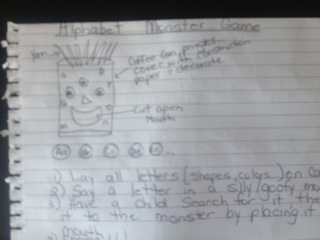
Alphabet Monster Game  (Danielle Montage)
Decorate a coffee can or Pringles can with construction paper and decorate to look like the “Alphabet Monster.”  Cut a hole for the mouth.  Lay all the letters (shapes, colors…) on the carpet/table.  Say a letter in a silly/goofy monster voice.  Have the child search for it, and then feed it to the monster by placing it in his mouth.  CHOMP!!


Name Song 
(Tune:  “Where Is Thumbkin?”)
All:                              Where is Sam?
                                    Where is Kim?
Sam and Kim sing:  Here we are.  Here we are.
All:                              How are you today?
Sam and Kim:          Very well, we thank you.
All:                             Run around, then switch spots.
                                  (Sam and Kim run in a circle and switch seats.)

Gift Bag Battleship  (Donna)
This game is good for oral language and following directions.  You will need a gift bag that is the same on both sides, as well as counters.  (Erasers from the dollar store work well.)  Two students take a bag and face each other.  Put a file folder as a barrier between them.  One student is the teacher and gives directions for covering up objects on the bag.  When all the markers are placed on the bags the folders goes down and the students look to see if both sides match.
*This helps students understand the importance of positional words and the need to be specific with directions.  In the beginning you can do this with partners or as a fishbowl for everyone to see.

Peace and Quiet  (Maria Bell)
To focus children’s attention say “peace” as you make the peace signal with your two fingers in the air and “quiet” as you put your index finger from the other hand over your lips.

Question of the Day (Maria Bell)
Use a five frame or tens frame to answer the question of the day.  As children place their picture in the frame it will help their understanding of tens and ones.

Flip Book  (Linda Thomas)
These flip books can be useful for developing oral language, vocabulary, math (sequence, ordinals), and science (life cycle, procedure).  Take construction paper and make a hotdog.  Cut from the edge to the fold to make equal flaps.  Glue items under the flaps in “correct” order.  Have children describe their flip books in front of the class.
*The teacher who shared this activity taught in a French immersion school.  She said this was a great tool for engaging her students in oral conversation.

Light and Write (Caroline, Tina, Megan)
Use small finger lights from the dollar store to read and write around the room.

Beanie Baby Reading Strategies (Caroline, Tina, Megan)
You can google this to get ideas for helping children decode words using Beanie Babies as clues.  “Stretchy Snake” reminds them to stretch out words.  “Chunky Money” tells them to look for smaller chunks they can read…

Zap It  (Mary Katherine Leighton)
Place sight words on the end of craft sticks.  Have a few that say, “Zap it!”  Students pull sticks out of the can with friends and say the word.  If they get “Zap It!” they have to put all their sticks back in the can.  Keep a tally of the score.  The fifth stroke is the seatbelt.
*Use for numerals, letters, colors, shapes, etc.

Counting Game  (Ellen Raymond)
Children stand in a circle.  Determine how to count – 1’s, 2’s, 5’s, 10’s - and pick an ending number.  Go around the circle and each child says the next number.  The student who says the ending number must sit down.  Continue until only one person is left standing.
*Cheer for the winner and for the first person who sits down.

Writing Center  (Sarah Risk)
Use a small science board (available at dollar stores) with Velcro dots attached.  This way you can easily exchange the word cards based on the subject you are studying.  The science board stands easily on a table and gives everyone the opportunity to see the words.

Jazzy Word  (Caroline, Tina, Megan)
Decorate two lanyard nametags with stickers and jewels.  Insert sight words.  The teacher and helper wear the word as you sing and spell to “BINGO”:
There was a jazzy word of the day
and like was the word-o. 
L-i-k-e, l-i-k-e, l-i-k-e,
Like was the word-o.


Super Cleaner Necklaces (Sarah)
Make 6 necklaces with “Super Cleaner” medals.  During clean up time, hand out the necklaces to the students who are “caught” doing a super job leaning up.  Have them come to the front of the room and give them a group cheer.

Sunday, August 11, 2013

OH! OH! OH! O-CANADA IDEAS!!


Oh, my goodness!  Did I LOVE those teachers in Canada!!!  What an awesome two days!  Hope you’ll enjoy reading ideas from our “show and share” over the next few days!

Kinderoos, Kindies, and Chikcadees
Aren’t these cute names for our little ones?

Magic Carpet Ride  (Navtej Mand)
Pretend to go on a magic carpet ride.  Let the children choose the destination and then share things that they see/hear/eat, etc. in that place.  Then get back on the magic carpet and fly to another place.

Comalya  (Roberta Bondar, Kathy and Sandra)
Have a weekly “Comalya” when all the kindergarten students and teachers get together to sing. 
*Comalya means “Come all ye!”

Sock Puppets (Shannon Nelson)
This is a free app where children can record voices with a partner.  Their voices change as the sock puppets speak to each other.
Songify is another app where children can say something and it repeats the poem or nursery rhyme as a rap or song.
 
Rhyme Bag  (Hieke Klapwyk)
Send home a brown “rhyme” bag with each student on Friday.  They fill the bag with two items that rhyme.  At show and tell time, each student removes one item from their bag.  Classmates must guess what the second item in the bag is by naming objects that rhyme.

Stringing Words (Irene Bootsma)
Place pipe cleaners and letter beads in a center with a list of student names or sight words.  Students string the beads on the pipe cleaner and then read the words.

Field Trip Book for Families
Visit your local grocery store, fire department, police station, Canada Post, etc.
Ask parents to attend, but if they can’t because of jobs take a camera and take lots of photos.  Print the pictures when you get back to the classroom and put them in a book.  Children who can write pick out a picture and write about what was happening in the picture.  Those who can’t write dictate to the teacher.  Let the leader of the day take home the book overnight to share with their families so they feel included.

Ring the Chimes (Irene Bootsma)
Ring chimes, a rain stick, or another quiet instrument to focus children’s attention.  When they hear it, they walk to the learning circle.  You don’t need to give instructions because students will automatically go to the carpet.

Mac-Tac Center (Irene Bootsma)
Place the white board on a metal filing cabinet.  (Available at dollar stores.) Students can write on it or use magnetic letters on it.  They can also make patterns with magnetic shapes.

My Teacher’s Name (Dana Kacer)
Sing this song to the tune of “The Wheels on the Bus.”
My teacher’s name is ___, ___, ___.
My teacher’s name is ____
At Name of school school.
My principal’s name is…
My custodian’s name is…
My receptionist’s name is…

Star Word of the Day  (Yvonne Grootenboer)
When the children come in the classroom after recess have them read the password that is written on a paper star by the doorframe. After they read it they can press the “THAT WAS EASY” button from Staples.

Earth Day Song (Jann Curtis)
Tune:  “Mickey Mouse”
(Make headbands with two mouse ears.  The mouse ears are 2 small earths.)
L-O-V-E  T-H-E  E-A-R-T-H
Love the Earth.
We speak from the heart.
Love the Earth.
Please do your part.
We must protect our land and see and air.
Let’s all care!
Now it’s time to love the Earth for future families.
L-O-V-E
It’s time to preserve,
T-H-E
Time to conserve.
E-A-R-T-H

Every Day Is a Special Day  (Rebecca Malo)
Choose a special thing each day of the week to help students learn the sequence of days.
Mystery Monday – Students ask questions about what’s in the mystery box.
Tai Chi Tuesday – Do 10-20 minutes of Tai Chi.
Wonder Wednesday – Go to wonderopolis.org to learn something new.
Use Your Thumbs Thursday – Set up a special craft station where children use their thumbs.
Film Friday – Watch a short movie to extend something they have learned during the week.

Saturday, August 10, 2013

FUNCTIONAL PRINT BOOKS


Here are suggestions for books you can make for your classroom this coming school year.  They are a meaningful way to help children make print connections and develop informative reading and writing skills.  Spiral notebooks and composition books are on sale now, so grab a handful and try these ideas.

New Shoes
Invite children to write a story or draw a picture in this book when they get a new pair of shoes!

The Tooth Book
Have children draw a picture of what they look like after they lose a tooth. 
Remind them to be sure and draw a “window” in their mouth where their tooth used to be!
*You could also take a photo of their new smile and let them write about how they lost their tooth.

Weather Report
Choose a different child each day to be the meteorologist.  Invite the weather person to record the weather with a drawing or sentence.

The Birthday Book
Have children write a story and draw a picture on a special page in this book when it’s their birthday.   (You could also take a photo of them.)

School Rule Book
After discussing school rules, ask each child to come up with a rule that they think is important.  Have them illustrate their rule and write or dictate a sentence to go with it.  Put their rules together to make a class book.  Hang the book in an important spot in your classroom and refer to it when children are behaving inappropriately.  You might add, “You need to do (such and such).  The rule is right here in our book!”

Things the Teacher Needs to Know
When a child comes to you to complain or tattle, hand them the book and say, “Write it all down and don’t leave out a thing.  I’ll read it later on when
I have more time.”


The Boo Boo Book
If a child gets a little scrape or scratch, have them draw a picture of it in this book.  Give them a band aid to put on their “boo boo” so it will feel better.

Acts of Kindness
Create a book where children can record kind deeds their fellow classmates have done. 
Hint!  The teacher can model this by “catching children” in the act of doing something thoughtful and loving for others.

Kiss Your Brain!
When children learn to do something or answer questions creatively, encourage them to sign their name and write about it in this book.

Big News
Record exciting events in children’s lives (like becoming a big brother or sister) with this class book.

Excuse Book
If children forget their homework or have other excuses, let them “write it down” in this book.

Peace Talks
If two children have an argument, have them sit down next to each other at a table.  Open a spiral notebook and ask each of them to draw a picture and write about what happened.  Explain that when they resolve their problem they can let you know.  It won’t take long for them to realize it’s easier to be friends!

Friday, August 9, 2013

PENCIL POWER


Kindergarten teachers always whisper, “Remind the pre-K teachers to teach their children to hold their pencils correctly.”  First grade teachers whisper, “Remind the kindergarten teachers to show their children how to hold their pencils the right way.”  And so it goes…  I don’t have all the answers, but here are some suggestions that might do the trick.

Pompom
Give children a pompom or cotton ball to hold in their hand when they write.  Demonstrate how to put pinky and ring man to “sleep” on the pompom before picking up the pencil.

Bird’s  Beak
Point the pencil away from you.  Make a bird’s beak by opening and closing your index finger and thumb.  Use your beak to pick up the point of the pencil and then flip it back.

Writing Bracelet
String a bead or jingle bell to a piece of yarn or string to make a bracelet.  Make it loose enough so it can slide easily on and off a child’s wrist.  While writing the child wears the bracelet and holds the bead in her hand.

Silly Band
Have the child put a silly band or rubber band around their wrist and pick up the pencil.  Explain that when you go in the car you have to wear a seatbelt.  When you write you have to put a seat belt on the pencil (slide the band around the pencil).  Mom and dad are in the front (pointer and thumb) and the kids are in the back (middle, ring, and pinky). 

Pencil Grip
(Tune:  “Where Is Thumbkin?”  ALL DAY LONG CD)
Where is Pointer? 
On the top. 
Ready to write. 
Start at the top.

Where is Thumbkin? 
On the side. 
Ready to help
Your pencil glide.

Where is Tallman? 
On the bottom. 
Keeps the letters
Where you want ‘em.

Thursday, August 8, 2013

A COLORING WE'LL GO!


One of the sweetest memories I have as a child was getting a box of NEW crayons!  There was always a lot of “hope” in those sharp, new crayons.  I was never a great artist, but my joy was just the same as children in 2013!

A Coloring We’ll Go
(Tune:  “A Hunting We Will Go” – ALL DAY LONG CD)
A coloring we’ll go.
Hi ho, it’s fun you know,
A coloring we’ll go.

Use straight and curvy lines.
With yellow, purple, green, and orange,
We’ll make our picture fine.           (Chorus)

The details we will draw.
Imagine all the little things.
The details we will draw.                (Chorus)

We’ll fill in the page.
Use as many colors
As you are in age.

A coloring we’ll go.
We’ll put them in the box and close the top
When we’re through, you know.

*A good rule of thumb for encouraging children to use many colors in their drawings is to ask them to use as many colors as they are in age.  If they are four years old they should use at least 4 different crayons; if they are five years old they should use five colors, etc.

*As you read books to the class, explain the illustrator’s name.  Have children notice details in illustrations.  Why is it important to add details?  Remind them when they draw pictures they are illustrators, too, and they should add lots of details to make their pictures more interesting.

*Encourage children to close their eyes and think about what they want to draw before they begin coloring.  “Get a picture in your brain and then you’ll know what you want your picture to look like.  It’s like telling a story with your crayons.”

*Keep a box for “lost crayons” on a shelf so children have a place to put crayons that get misplaced.

*Use mint tins to store crayons when boxes fall apart.

Color Box
(Tune:  “Happy Birthday” MOVE IT!  LEARN IT! CD)
Here’s a crayon for you.  (Pretend to hold a present in your hand.)
It’s a blue one for you.        (Hold up a blue crayon.)
B – l – u – e.
Here’s blue for you.
Red, yellow, orange, green, purple, brown, black, white.

*Have children take their box of crayons and hold up the appropriate color as you sing.
*Let children walk around the room and touch objects that are the color you are singing about.

*Have children stand up when the color that they are wearing is sung in the song.