photo 3am_dj_home_zps919fb85e.png photo 3am_dj_about_zps7cce4c75.png photo 3am_dj_website_zps73051235.png photo 3am_dj_ss_zps6759ec2a.png photo 3am_dj_bs_zps43e27832.png
Showing posts with label Engagement. Show all posts

Sunday, January 5, 2025

LEARNING ALIVE IN 2025

Enough tap, swipe, sit and listen! It's time to get those kids moving, thinking, talking, and engaged!  Energize your students in 2025 with the tips and strategies you'll find on my blog this coming month. I hope you’ll join me each day to discover how you can take what you HAVE to do and turn it into something your students WANT to do!


What is ACTIVE LEARNING?

Active learning involves students in the learning process more directly than in other methods. Bonwell (1991) "states that in active learning, students participate in the process and students participate when they are doing something besides passively listening."

Teaching is what the teacher does. Learning is what the student does! Key elements of active learning include:

Students build on their interests and make choices

Students communicate in a wide range of ways

Students problem solve

Students make connections across learning

Students collaborate with others

Students develop creativity and use their imaginations

Students engage in a wide range of learning activities

Students move and use multiple senses

In short, students are not passive, but are “doing things” and are excited about learning. Good teachers have always focused on active learning because they know the more engaged and excited their students are, the more they will learn.

For years I have shared Edgar Dale’s “Learning Cone.” Although his research was done decades ago, more recent research validates the value of his findings. It’s a powerful visual to support active learning and engaging multiple senses.


Bonwell, C.C. and Eisen, J.A. (1991). Active learning: Creating excitement in the classroom. School of Education and Human Development, George Washington University: Washington DC.


Active Learning #1 STATE CHANGES

Wake up the brain by having children do one of the following to read, count, or practice other skills. It’s so easy and can add an element of fun to any lesson.

Sit Like a Boss– Children cross arms, lean back, and put feet up on their desk.


Cowboy and Cowgirl– Children turn chair around and straddle it as if riding a horse.

Change Seats– Children exchange seats with a classmate.

Backwards– Turn chairs around and face the back of the room.

Tummy Time– Lay on the floor and read, write, and work.

Stand– Have children stand as they read or do other work.

Easy Chair – Turn chairs upside down, put backpacks between the legs, and sit back and relax.  


Silly Me! 
Teacher puts on a hat, silly nose, glasses, etc.


Lighting
Turn on twinkle lights or a special lamp.

More!  Invite the children to suggest other state changes.

Saturday, July 13, 2024

PD at Home - TELL ME A STORY

Make students beg, "Do it again!" with these quick engaging stories. 


NOTE!  If you want copies of these stories, put the title of the story in the search engine near the top of this page.

Hint!  Before telling your story you need to focus children’s attention with a chant or rhyme similar to the ones below:

If you want to hear a story, (Snap fingers to the beat.)
This is what to do.
Sit down quietly
And I’ll tell one to you!
That’s right, that’s right, (Point to children sitting quietly.)
That’s right, that’s right!


Two Little Hands

Two little hands go clap, clap, clap. (Clap hands 3 times.)
Two little fingers go snap, snap, snap. (Snap fingers 3 times.)
Two little eyes go blink, blink, blink. (Blink eyes.)
If you want to hear a story go wink, wink, wink. (Wink eyes.)
(Lower your voice as you say each line.)

Hands Up High

Hands up high. (Hands in the air.)
Hands down low. (Hands down.)
Hide those hands, now. (Hands behind your back.)
Where did they go? (Shrug shoulders.)
One hand up. (Right hand up.)
The other hand, too. (Left hand up.)
Clap them, (Clap.)
Fold them, (Fold in lap.)
Here’s a story for you!


Wednesday, May 18, 2022

MEMORY ROCK GARDEN

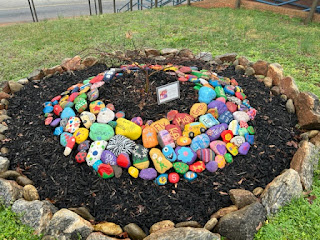
Several weeks ago when I visited a school in Greenville I saw this garden and it captured my interest. The principal explained that her son had died and the children and staff painted rocks and created this beautiful memory garden for her.


I was so intrigued by the project that I did a little more research and found this fabulous website:

Click here to visit Kids Gardening

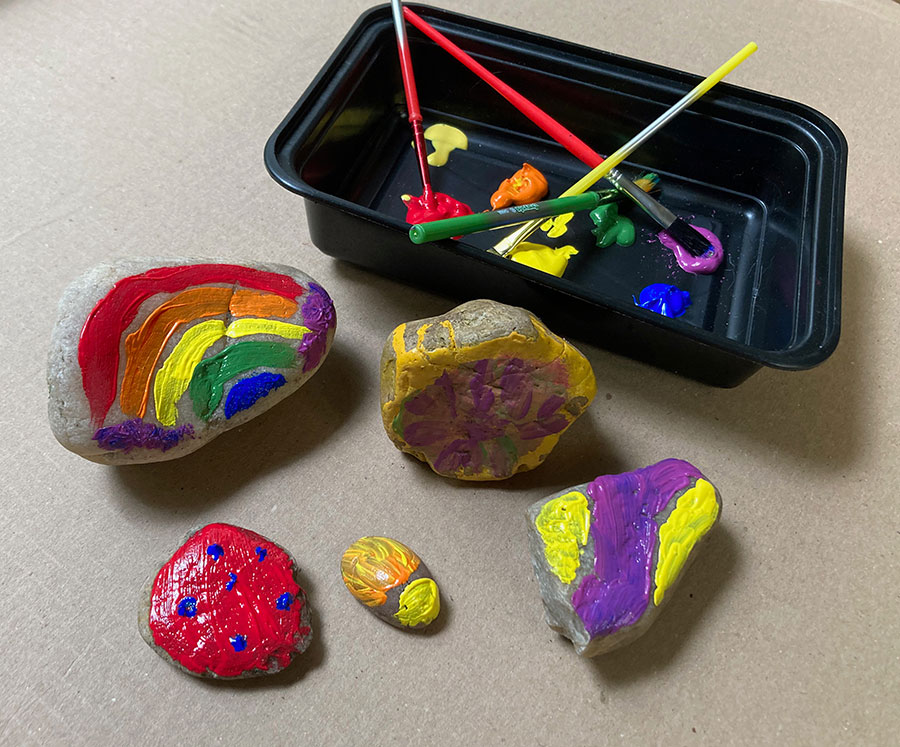
Just think how you could adapt this to an end of year project. The children could paint rocks with their names, kind words, a welcome message, etc. You could even make a letter garden where children choose a letter, sight word, or other skill and paint a rock. 

Hint!  Rocks can also be a bridge to talking about diversity.  Go on a rock hunt and let each child find a rock.  Have the children sit in a circle and take turns describing their rocks and passing them around for other to hold.  How their rocks alike? How are they different?  How are people alike?  How are they different?  Wouldn't it be a boring world if all the rocks and people looked exactly the same?


Here's some background information from kidsgardening.org:

The American Journal of Public Health published a literature review on The Connection Between Art, Healing and Public Health examining the health benefits of visual arts therapy, movement-based creative expression, and expressive writing. The Children and Nature Network’s Research Library is full of studies looking at the social and emotional benefits of spending time in nature. What if you combine the two by engaging in creative activities that encourage self-expression in a natural setting?

In an ideal youth garden setting, kids would have the opportunity to help design the garden and select the plants and special features included. However, when there are a large number of kids utilizing a garden (such as at a school or public space), this level of involvement can be challenging due to cost and available space. Educators can turn to simpler crafts using inexpensive or repurposed materials as an alternative for allowing students to help decorate the garden space and make it their own. This lesson lays out ideas for using painted rocks in your garden to allow young gardeners to express themselves, to communicate with each other, and to contribute to the garden in a personal way.


Note!  They stressed the importance of working together to create guidelines so it's a positive experience for everyone.  

*Acrylic paints/pens and sealant were recommended.

Branching Out
Use KidsGardening’s Growing Poems lesson to encourage more ways of using the garden as inspiration for self-expression.

Check out the Kindness in the Garden lesson for more ideas for incorporating kind acts in garden spaces. Additional ideas can be found through the Compassion Flower Project developed in partnership with Mrs. Meyer’s Clean Day.

Thursday, May 14, 2020

LITTLE LESSONS FOR ONLINE LEARNING PART 7

Wakey!  Wakey!
It's going to be a great day!
I can't wait to demonstrate 
these attention grabbers
on Facebook Live at ten!!

ATTENTION GRABBERS FOR DISTANCE LEARNING!

We all know that YOU HAVE TO REACH THEM BEFORE YOU CAN TEACH THEM!  However, reaching them on a screen is a new challenge.  Here are a few tips I'll demonstrate today.

Surprise Them!
 
Brain Research 101 says the brain likes anything that is novel, challenging, and new. Wear a hat, silly pair of glasses, or use a strange voice.
 
Cut the top and bottom off a food box, insert the puppet on your hand, and then let the puppet pop out the box and sing a song, talk about an event, or say a rhyme.


Attention Grabbers
Teacher says:
“Hocus Pocus!” (Stick out index finger and circle around like a wand.)
Children respond:
“Everybody focus!” (Make circles around eyes like spectacles.)
*Practice this several times until it becomes automatic.

Finger Play

Do a finger play to focus those busy hands. As you end the "Finger Band" quietly and slowly it will pull them in.

The finger band is (Start with your hands behind your back
Coming to town, and wiggle them as you slowly bring
Coming to town, them in front.)
Coming to town.
The finger band is
Coming to town so early in the morning.

This is the way (Pretend to play drums.)
They play their drums…
This is the way
They twirl their hats… (Twirl hands around your head.)
This is the way (Pretend to play a horn.)
They play their horns…
(Let children suggest other instruments and motions.)

The finger band (Slowly wiggle fingers behind you
Is going away, as you lower your voice to a whisper.)
Going away, going away.
The finger band
Is going away so early in the morning.


Give Me a Clap
Lead children in a cheer or a clapping pattern.  Make it a game and challenge by saying, "Can you do this?"
 
If you can hear my voice, clap your hands one time.
In a softer voice say:
If you can hear my voice, clap your hands two times.
In a whisper voice say:
If you can hear my voice, please look at me.
Continue lowering your voice until children are focused on you.Puppet


Use callbacks

Teacher says: Hands on top.
Children respond: Everybody stop! (Put hands on head and freeze.)


Teacher says: Macaroni and cheese.
Children respond: Freeze please! (Freeze and look at the teacher.)


Teacher says: Ready?
Children respond: Spaghetti! (Stand up straight.)

Teacher: Okeedookee
Children: Artichokee

Teacher: Peanut butter
Children: Jelly

Teacher says: All set? (Snap fingers twice.)
Children respond: You bet! (Snap fingers twice.)

Teacher: Da da da da da...
Children: I'm loving it! (MacDonald's advertisement)

Teacher says: How do you feel?
Children respond: We feel good! Yeah! (Stick up thumbs.)


Use Their Name
If you have a child floating away simply saying their name will bring them back to reality.
You can sing, "If your name is (child's name) wave to me...If your name is (child's name) smile at me..."

Do a Cheer
Pretend to make a hamburger by patting your palms together. Make a sizzling sound and say, “Is it done yet?” Turn your hand over and say, “Not yet.” Repeat twice. After the third “Is it done?” give a thumbs up and say, “Well done!” 

                                          
Give yourself sparkles (open and close fits) and a rainbow (move palms like a rainbow across your body).

You’re the Best!
(Children repeat after the teacher. You could change the words to “I’m the best!” or “We’re the best!”)
Thumbs up. (Stick out right thumb.)
Across the chest. (Bring across to the left shoulder.)
Pat on the back. (Pat self on the back.)
Cause you’re the best! (Wrap arms around self and hug.)


Play a Game 
Simon says...
Put your hands on your knees.
Wiggle your nose.
Touch your toes...

Palm Writing
Children take their "magic finger" write on the opposite palm.  They can make shapes, letters, numbers, or even write words.  Make sure they "erase" (rub palm) in between.
                                                          

P.S.  I found this idea when I was looking at some old blogs.  Wouldn't this work for your class meetings online?

Sharing Good News (Jessica Williams)
Write children’s names on craft sticks and place in a jar that says “Good News.” The teacher starts every morning by sharing her own “good news.” The children clap or cheer for her. Next, she pulls a stick and the class sings, "Tell me something good!" That child shares their good news and then the class does a cheer. The teacher pulls the second stick and they sing, "Tell me something good" and then cheer. Do three children each day and then put those who have had a turn in an envelope and start all over again when everyone 

has had a turn.                                                                  


Wednesday, December 18, 2019

CHEERS FOR WINTER HOLIDAYS

2 BITS, 4 BITS, 6 BITS A DOLLAR.

ALL FOR WINTER BREAK

STAND UP AND HOLLAR!
 

I bet most of y'all don't even remember that cheer.  It was a big one when I was a cheerleader back in the 60's.  Cheers may change, but some things never change, just like your excitement about your upcoming vacation.  

I looked through past blogs and found a few cheers for you to do today.  Let out some energy and keep on the sunny side!

Popcorn Cheer (Kristen Reed) 
The popcorn cheer is the perfect way to release wiggles before they explode. The teacher says, “Assume the position,” as all the children squat down on the floor. The teacher points quickly to each student and she/he jumps up and yells “POP” and then squats back down. After pointing to every child the teacher says, “EVERYBODY!” and they all jump up and say, “POP!”


Mitten Cheer
This is a quiet way to teach the children to cheer.  Thumbs up and palms open facing each other.  Pretend to clap stopping about 2" from each palm as if wearing mittens.


Cheer! (Debbi Smith)
Pat yourself on the back.
Shake your own hand.
Point to yourself and say, “Very good job!”


Three Cheers
Give me cheer number one! (Children yell and cheer in a regular voice.)
Give me cheer number two! (Children cheer a little softer.)
Give me cheer number three! (Children wave their arms and do the silent cheer with their mouth wide open but not making a sound.)

Super Star (Teresa Palmer)
Reach for the stars. (Reach up in the air.)
Catch it! Grab it! (Pretend to grab something.)
Stick it! (Pretend to lick and stick to forehead.)
Super star!


Animal Cheers
Seal of Approval – Extend arms in front of you and cross them over each other. Clap as you make a barking noise.
 

Elephant Cheer - Stick one arm out straight from under your chin. Put top lips over bottom lip as you blow and make a trumpeting sound.
                                                                                    
Snake Cheer – Palms folded together next to your chest. Keeping them together wiggle them out as you make a “Ssssss” sound. Stick your tongue quickly in and out of your mouth.


Tiger Cheer – You’re GGGRRREEEAAATTT! (Stick fist in the air.)


Rocket Cheer (Aurora Sta Ana)
Clap up. (Clap up.)
Clap down. (Clap down.)
Clap left. (Clap to your left.)
Clap right. (Clap to your right.)
Up. (Thumb up make a hissing sound.)
Down. (Thumb down make a hissing sound.)
Left. (Thumb left make a hissing sound.)
Right. (Thumb right make a hissing sound.)
BOOM!!! (Both hands in the air as you shout boom!)


Tuesday, November 12, 2019

GENIUS HOUR

                                  
Genius hour is an exciting movement that might actually help children develop meaningful job skills that I discussed yesterday. It’s based on Google’s 20% policy which allows engineers to spend 20% of their time on any project they are interested in. It’s estimated that half of Google’s projects (such as Gmail) have been created during this time period. Other corporations are discovering that giving employees one hour a week really does increase creativity.

I know that many of you are frustrated by cookie cutter curriculums and time schedules, but this might be a way to help your administration support a little creativity and exploration in your classroom. Can't we give kids at least one hour a week to find some joy in learning what they WANT to learn?

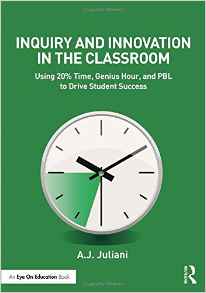
A.J. Juliani wrote this book that explains the goals and success of INQUIRY AND INNOVATION IN THE CLASSROOM. The three pillars of genius hour are:

     1. You have to research something.
     2. You have to create something.
     3. You have to present something.


Here's what Kid President says:

https://www.youtube.com/watch?v=l-gQLqv9f4o

Here’s another video introduction to genius hour:
https://www.youtube.com/watch?v=NMFQUtHsWhc

You might also want to check out this website:

geniushour.com


My idea of genius hour in kindergarten would be an hour of open-ended learning centers every Friday afternoon. Wouldn’t it be wonderful to just let kids play and explore for one hour a week?  That one hour could truly make a difference in a child’s learning, sense of self worth, attitude about school, and their life!!!!

Wednesday, September 11, 2019

ARE YOU LISTENING?

When most teachers are asked what they look for in good students, they will respond, “I want students who can listen and follow directions.”  As children spend more time in front of a screen, it’s important to slow down at the beginning of the school year to develop positive listening skills.

Turn it off! Turn off the big screen and get down at the children’s eye level and look at them.


Engage them! Get their attention with a finger play or a cheer.
*Teacher: Hocus pocus. (Pretend to wave a magic wand.)
Children: Everybody focus. (Children make imaginary goggles and put them around their eyes.)

Wait. Sit quietly and smile and wait.
*Close your eyes and pretend to wave a magic wand. Say, “Abracadabra. I will open my eyes when all my friends are sitting quietly.”

Lower your voice. By simply talking slowly with a quiet voice you will remind the children that it’s time to listen.
*Lip sinc a song or finger play like “Itsy Bitsy Spider.” Anything different or original will give children “pause.”

Busy Hands - Give them something to do with their hands. Demonstrate how to cross your fingers and put your “listening hands” in your lap.


Pretzels and Applesauce – If children are sitting on their bottoms they will be less likely to squirm around. Remind them that their legs should look like pretzels and they should make a bowl of applesauce with their hands.


Hint! I explain that the doctor said it’s important to sit with their legs like pretzels. If the “doctor says” they are more likely to respond. (This is true because orthopedists warn sitting on the knees can be harmful.)


Body Check. Remind children to listen with their eyes, ears, and bodies.
*Teacher: Are your eyes looking at me?
Children: Check!
Teacher: Are your ears ready to listen?
Children: Check!
Teacher: Are your bodies sitting quietly?
Children: Check!
Teacher: Are you ready to learn?
Children: Check!

Breath – Tell children to slowly breath in and out their noses. It’s surprising how this will calm them – and they won’t be able to talk!

Signs - Run off a copy of a giant ear and tape it to a stick. When you hold up the ear children know they need to listen with big ears!


Repeat - Practice giving directions ONE time. Invite another student to repeat what you have said.

Close Your Eyes – Have children close their eyes as you give directions. Who can open their eyes and repeat what you said?


*Occasionally, have children close their eyes when you read a story. Can they make pictures in their brain?
*Invite children to sing songs or say nursery rhymes with their eyes closed.

Tuesday, July 30, 2019

DIY POINTERS

I’ll get to the POINT! Pointers are a fun way to engage students’ attention. Make some of these before the school year begins and you can pull them out of your “bag of tricks” when needed.

What? craft sticks, chop sticks, googly eyes, fake jewels and fingernails, E6000 (or other craft glue)

Why? Children love anything novel and different. These pointers just add some “hands-on” to the task at hand.

When? Small group, independent

How? Take a look at the list below and choose your favorite.

*Use to track print from left to right.

*Identify key details in a picture.

*Point out letters, words, punctuation, etc. in print.

*Touch shapes, numbers, etc.

*Space between words with pointers.


Magic wand – dip the end of a chopstick in glue and roll in glitter

Finger nail
– glue a fake fingernail to a craft stick

I Spy – glue a googly eye to a craft stick

Jewel – glue a fake jewel to a craft stick

Witches’ finger – great fun

Magnifying glass - pipe cleaner formed in a circle


Swizzle stick – buy these at a dollar store

Pretzel stick – point and then eat

Seasonal – glue small seasonal toys or stickers to craft sticks or purchase seasonal pencils

Bugles - point, read, and eat!!!
                                                       
Giant Pointers

Glue a toy to the end of a cardboard pants hanger or decorate a butterfly net.


Smart Center

This was one of those simple, yet clever ideas that a teacher shared years ago. She said she had a center called the "smart center" with an old pair of glasses and a hand pointer. Children wore the glasses and walked around the room and pointed to words, shapes, colors, letters, etc. to show how "smart" they were. The only rule was you had to use a whisper voice. The teacher who shared this said the kids LOVED this center. She said nobody paid any attention to them, but they thought they were smart just the same!


Sunday, February 3, 2019

FINGER PLAYS ON THE BIG SCREEN

An oxymoron is defined as "a figure of speech in which two opposite ideas are joined to create an effect."  Well, yesterday I preached about the "authenticity" of finger plays because they are "unplugged" and today I'm going to give you some links to "plug into" finger plays. I think that's what you'd call an oxymoron.  Let me explain...

Several years ago I made these five videos with my daughter to demonstrate some of my finger plays for teachers. I did not make them to show the children, but I thought it would be helpful for teacher to see my movements. It's funny, but some teachers have told me that they show these directly to their students when they have a few minutes at the end of the day. Surprisingly, the children seem to enjoy them. And although it means more screen time, at least the children are active and doing something with me.

Here they are! Use them however you'd like!


https://www.youtube.com/watch?v=4f2d7BW3CzI

Part 1

     Here is a Turtle
     This Little Girl
     Me
     Grandma's Glasses
     Where Is My Bunny
     Monkeys and Alligator


https://www.youtube.com/watch?v=H8XqpPYpNCg

Part 2
     King Kong
     Cup of Tea
     Mr. Turkey and Mr. Duck
     Mousie Brown
     Ten Little Friends
     I Caught a Fish

https://www.youtube.com/watch?v=PJZGoFWzPA8

Part 3

     Two Little Blackbirds
     Here Is a Bunny
     Miss Molly
     Apple Tree
     Johnny, Johnny
         

https://www.youtube.com/watch?v=WrIxnH8LXNQ

Part 4
     The Finger Band
     A Little Mouse
     Here Is a Church
     Dig a Hole
     Caterpillar
     Five Little Hotdogs


https://www.youtube.com/watch?v=gC-r_pajb6I


Part 5
     Heidi Hi and Louie Lo
     Five Little Monkeys
     Choo Choo Train
     Jack O' Happy
     I Have a Cat
     Which Is My Left?
     Bees
     
Here's the video I did yesterday on finger plays.  Sorry, I'm a little sideways!!!

 https://youtu.be/40PuLzVmFYk

Saturday, February 2, 2019

FINGER PLAYS FOREVER!

FACEBOOK LIVE
TODAY AT 1 (Eastern Time Zone)
WELCOME TO MY FINGER PLAY WORLD!

One of my new "missions" is to encourage AUTHENTICITY with young children.  Finger plays are REAL!  There is no screen or music or clown costumes or puppets or polka dots!  It's just YOU looking in children's eyes and connecting with them visually, auditorially, kinesthetically, and emotionally.  Oh, and they are FREE!  It doesn't get much better than that!  

I've  heard people say, "Finger plays are old fashion." Well, you might call them that, but then you'd have to call chocolate chip cookies and mashed potatoes and BINGO and swings and hugs...old fashion as well. Let me share just a few things children can learn when you do a finger play. (You might want to enlighten some administrators or supervisors or parents with this information. Sometimes they just don't "get" what we do!)


Engagement 
– Doing a finger play is a natural way to engage children’s attention and help them focus.

Oral language – Repetition of finger plays builds oral language skills.

Auditory memory – Children activate their short term memory as they memorize finger plays.

Comprehension – Most finger plays have a simple story plot for children to follow.

Imagination – With so much time spent in front of a screen, finger plays encourage children to make pictures in their brains.

Sequence – Remembering the sequence in finger plays can help children retell stories.

Phonological awareness – Finger plays build a foundation for rhyme, rhythm and alliteration.

Eye-hand coordination – Visual connections with finger plays are important for writing and reading.

Small motor skills – Doing finger plays is like sending the fingers to the gym to exercise.

Active Learning - Multiple senses are engaged as children watch and wiggle their fingers and repeat rhymes.

Purposeful Practice for Automaticity (aka repetition) - Children will enjoy saying these rhymes over and over.

Brain Breaks - Children will be oxygenating the brain and crossing the midline as they do finger plays. Memorizing poems and rhymes is also good for short term memory.

Executive function – Children develop self-regulation and impulse control when they participate in finger plays.

Social skills – All children can be successful with finger plays with this group experience.

State Standards – You got it! Speaking, listening, comprehension, phonological awareness all rolled into one!

Skills for the 21st Century – You’ve got those, too, with communication and cooperation.

Transitions - Finger Plays can be used to entertain children during transitions or any time you’ve got a minute or two.


Sweet memories of doing finger plays with Kalina and K.J. 

There's one chance in a lifetime to do these activities with children 
because they grow up so fast!

Wednesday, July 25, 2018

#25 RULES OF ENGAGEMENT - GIVE ME A CHEER

Give me a cheer! Why? They are a positive way to activate the brain and put a smile on children's faces. I can have a gym full of kids and I can quickly get their attention with a cheer. The great thing about these cheers is that every child gets one - you don't have to be smart or wear cool clothes. These are some of the ones that work best for me:

Bubblegum Cheer
Pretend to open a piece of bubblegum and put it in your mouth. Start chewing as you wiggle your head from side to side. Place your palms by your mouth and extend as you slowly blow…one, two, three, four, POP!

Firecracker
Hold your palms together in front of you as if praying. Make a sizzling sound (ssssss) as you wiggle your palms up in the air like a firecracker going off. Clap them above your head, and then wiggle your fingers around and down like sparkles from a firecracker. Finish by making an “Ahhhh!” sound like the crowd watching a firecracker go off.

Hamburger
Pretend to make a hamburger by patting your palms together. Stick out your right hand as if placing a hamburger on a skillet. Make a sizzling sound and say, “Is it done yet?” Turn your hand over and say, “Not yet.” Repeat twice. After the third “Is it done?” give a thumbs up and say, “Well done!”

Roller Coaster
Start by pretending to go up the roller coaster with your hands in front as you make the “ch, ch, ch” sound. Pause at the top and then make three imaginary hills with your hands going up and down as you say, “Whooooo!” Finish by wiggling your hands in the air.

Three Cheers
Give me cheer number one! (Children yell and cheer in a regular voice.)
Give me cheer number two! (Children cheer a little softer.)
Give me cheer number three! (Children wave their arms and do the silent cheer with their mouth wide open but not making a sound.)

This is where you can download the cheer cards. Introduce one each day and then put it in the box. When you need a cheer, just pull one out.
        

http://www.drjean.org/html/monthly_act/act_2004/06_june/06_2004_pdf.html

I've got several videos where I demonstrate the cheers.

https://www.youtube.com/watch?v=mtNGH_1l6JI


https://www.youtube.com/watch?v=iWPA-jYdWe8

Tuesday, July 24, 2018

#24 RULES OF ENGAGEMENT - FINGER STORIES

Many finger plays tell simple stories.  They engage children's hands, eyes, mouths and minds.  They are a natural way to develop comprehension, sequence, and children's imaginations.

THIS LITTLE GIRL
This little girl is
Ready for bed. (Hold up index finger and wiggle.)
On the pillow
She lays her head. (Open palm and lay finger down.)
Wrap the covers
Around her tight. (Wrap fist around finger.)
That’s the way
She spends the night. (Rock hand.)
Morning comes,
She opens her eyes.
Off with a toss
The covers fly. (Open fist.)
She jumps out of bed, (Hold up finger.)
Eats her breakfast, (Pretend to feed finger some food.)
And brushes her teeth. (Pretend to brush teeth on finger.)
She gets dressed and (Pretend to dress finger.)
Brushes her hair. (Pretend to brush hair.)
Now she’s ready
And on her way, (Dance finger around.)
To work and play
At school all day.  (Insert the name of your school.)

This little boy… (Do similar motions with the
opposite index finger.)


MISS MOLLY
Miss Molly had a dolly (Cradle arms and rock.)
Who was sick, sick, sick.
So she called for the doctor (Pretend to hold a phone next to your ear.)
To come quick, quick, quick.
The doctor came (Pretend to hold up bag.)
With his bag and his hat. (Touch head.)
And he knocked on the door
With a rat-a-tat-tat. (Pretend to knock.)
He looked at the dolly
And he shook his head. (Shake head.)
He said, “Miss Molly
Put her straight to bed.” (Point finger.)
He wrote on some paper
For some pills, pills, pills. (Pretend to write.)
“I’ll be back in the morning
With the bills, bills, bills.” (Wave good-bye.)


CATERPILLAR
A caterpillar crawled (Hold up right arm like a tree branch.)
To the top of a tree. (Crawl left pointer up right arm.
I think I’ll take a nap said he. (Wiggle left pointer.)
So under the leaf (Pretend to crawl left pointer
He began to creep. under right palm.)
He spun a cocoon, (Wrap right hand around left pointer.)
And he fell asleep. (Hold hands very still.)
For six long months
He slept in that cocoon bed.
Til spring came along and said,
Wake up, wake up,
You sleep head. (Shake pointer.)
Out of the leaf he did cry, (Clasp thumbs and open palms.)
Lo, I am a butterfly! (Fly hands around like a butterfly.)

         
PUT THE BABY TO BED
Now it’s time to go to sleep (Hold up right index finger.)
Put the baby to bed. (Place index finger on left palm)
Cover the baby in the bed. (Wrap left fingers around right index.)
Kiss the baby good-night. (Pretend to kiss finger.)
Waaa! Waaa! (Hold up right index finger and cry.)
The baby’s awake!
What can we do?
(Insert children’s suggestions and continue the rhyme. For example, give it a bottle, change its diapers, give it a toy, read a book, etc.)


HEIDI HI AND LOUIE LOW
Every time Heidi High speaks use a high, soft voice. Every time Louie Low
talks use a deep, loud voice. Begin by sticking up your thumbs. Wiggle
your right thumb and say, “This is Heidi High.” Wiggle your left thumb and
say, “This is Louie Low.” Tuck your thumbs in your hands and extend them
to either side of you as you begin telling the story below.

One day Heidi Highopened her door (open fingers), went outside (stick out right thumb), and closed her door (close fingers). She said (wiggle right thumb), “What a beautiful day! I’m going to visit my friend Louie Low.” So Heidiwent up the hill and down the hill and up the hill and down the hill (move right thumb up and down in front of body until it reaches your left fist). She knocked on the front door and said (pretend to knock on left fist with right hand), “Oh, Louie Low. Oh, Louie Low. Let me try the back door. (Knock on opposite side of left fist.) Oh, Louie Low. Oh, Louie Low. I guess he’s not home.” So Heidiwent up the hill and down the hill and up the hill and down the hill (move right thumb up and down back in front of your body). When she got home, she opened her door, went inside, and shut her door (open fingers, tuck in thumb, then close fingers to make a fist                                     


The next day Louie Low opened his door (open fingers), went outside (stick out left thumb), and closed his door (close fingers). He said (wiggle left thumb), “What abeautiful day! I’m going to go visit my friend Heidi High.” Continue same as Heidi did on the previous day…

The next day both Heidi Highand Louie Low opened their doors (open fingers), went outside (stick out thumbs), and closed their doors (close fingers). Heidisaid (wiggle right thumb), “What a beautiful day! I’m going to go visit my friend Louie Low.” And Louie said (wiggle left thumb), “What a beautiful day! I’m going to visit my friend HeidiHigh.” So they both went up the hill and down the hill (move thumbs toward each other until they meet in front of your body) until they ran into each other. They danced and played and had the best time (wiggle thumbs). After a while Heidisaid, “Well, Louie, I better go home.” And Louie said, “Well, Heidi, I better go home.” So they gave each other a hug (hug thumbs), and they both went up the hill and down the hill (wiggle thumbs apart to opposite sides of the body). When they got home they opened their doors (open fingers), went inside (tuck in thumbs), closed their doors (close fingers), and went to sleep (quietly put hands together and lay your head on them).

Here are some videos where you can watch me demonstrate the finger plays and finger stories.


https://www.youtube.com/watch?v=4f2d7BW3CzI

https://www.youtube.com/watch?v=H8XqpPYpNCg

https://www.youtube.com/watch?v=PJZGoFWzPA8

https://www.youtube.com/watch?v=WrIxnH8LXNQ

https://www.youtube.com/watch?v=gC-r_pajb6I