photo 3am_dj_home_zps919fb85e.png photo 3am_dj_about_zps7cce4c75.png photo 3am_dj_website_zps73051235.png photo 3am_dj_ss_zps6759ec2a.png photo 3am_dj_bs_zps43e27832.png

Friday, March 25, 2016

COMPARING CENTERS

Here are some activities where children can practice comparing groups.

More, Less, Equal
Write “more,” “less,” “equal” on three index cards and place in a bag. Children roll a die and then choose a card and make a set that is more, less, or equal to the amount on the die. You can use counters or play dough for this activity.

                                           
Dealer’s Choice
Remove the face cards from a deck of playing cards. Draw three sections on a sheet of construction paper and write “high,” “low,” and “equal.” Children turn over two cards at a time and place the cards in the appropriate pile.  
               
              
*This is a fun game to play with a friend.


Seriate Snakes
To make “snakes” cut yarn or straws into varying lengths from 1” – 12”. Children seriate the snakes from shortest to longest.

Play Dough

Give children play dough and ask them to make three balls - small, medium, and large.
*Can they make different sizes of pancakes or hotdogs from the play dough?

                                    
Block Measurement
Have children measure different classroom objects using unit blocks. How many blocks tall is the table? The chair? The bookshelf?

Bean Counter

Place a 14” piece of clear packaging tape sticky side up on a table. Lay ten lima beans end to end. Fold the tape up, down, seal, and then trim off the ends. Have a box of small items that the children can measure with a bean counter.

*Give them an answer sheet where they have to walk around the room and find something 2 beans long, 5 beans long, 7 beans long, etc.

Thursday, March 24, 2016

IT ADDS UP IN CENTERS

Hands Up Math
Cut two hands out of construction paper. Glue the palms to a sheet of construction paper so the fingers can bend. Children bend down the fingers to demonstrate addition and subtraction.
                                    
Math Mat
You will need a file folder or heavy sheet of paper to make a math mat. Fold it in half and trace over the creased line. Draw a line to divide the top section in half. Children use counters to make two sets in the top sections. They bring the objects together in the bottom section to demonstrate addition/joining them together.
*Use math mats as a concrete way to demonstrate the missing addend.

Ten Frame Rock and Roll
Children take two dice, roll them, build that amount on their frame, and then tell how many altogether.

Flippers
Cut 3” circles out of corrugated cardboard or fun foam. Write addition and subtraction facts on the front of the circles. Write the answer on the back. Children place the circles on the table (with the problem facing up). They add or subtract, say the answer, and then flip over to self-check.

                                                                
Math Bags
You will need zip sandwich bags and small, flat objects such as buttons or glass pebbles for this activity. Draw a line down the middle of a bag with a permanent marker. Insert objects in the bag. Children slide the items from one side to the other to make different combinations. Can they write down the different combinations?

                         
Spiders in a Cave
You will need plastic spider rings (or a similar item) and a bowl. Count out ten spiders and turn the bowl upside down to make a “cave” for the spiders. Children take turns hiding spiders in the cave. Friends try and guess how many spiders are in the cave. 


Wednesday, March 23, 2016

MARCH MATHNESS MADNESS

It's "March Madness" for you basketball fans, and this week I hope your students will become "March Mathness" fans with these hands-on center activities!!

Count the Room
This is similar to "write the room" except children will be counting.  Make a list of common classroom objects (chairs, boys, girls, teachers, computers, puppets, noses, shoes, monkeys, tigers – you can make this funny and challenging!) Children walk around the room, count the objects, and write their response on the line.

*It's always more fun with a silly pair of glasses!

Clip Cards

Write numerals 0-10 on index cards. Children take paper clips and put the appropriate amount on each card.

Math Concept Maps

Prepare blank math concept maps with 4-8 sections. Children write a numeral in the middle section and then draw/write different ways to show that number.

Ten Frame Rock and Roll
Children take one or two dice, roll them, and build that amount on their frame.

Pencil Pocket Book
Take five pencil pockets and make a book with book rings. Write numerals on sticky notes and attach to the pockets. Children take small erasers, popsicle sticks, coins, and other flat objects and make appropriate sets in the pockets.

                                      
Math Cups
Write numerals 1-20 on plastic bathroom cups. Trace around the bottom of a cup 20 times on a file folder. Write numerals 1-20 in the circles. Mix up the bathroom cups and then ask children to match them up with the file folder. 


*Can the children stack up the cups from 1-20?

Tuesday, March 22, 2016

VIRGINIA IS FOR LOVERS OF CHILDREN!

Lucky me to get to present at the VAECE Conference in Richmond last week!
                              

Art, creativity, problem-solving, exploring, open-ended activities, and messy fun are alive and well as you can tell from some of the art projects that were on display. From sewing, to clay, to nature art, to recycled sculptures, to craft sticks – STEAM is having a positive influence!


Here are some other fantastic ideas that teachers shared.


Book Party (Carla Moody)
Every day wrap up a book for circle time in a gift bag. Change circle time to a “book party” and unwrap the book and read it to the class.

Mr. Red and Mr. Blue (Jen Miller)
Adapt the finger play about Heidi Hi and Louie Low to demonstrate color mixing. “Mr. Red and Mr. Blue go up the hill and down the hill…When they meet in the middle they hug and make purple!”
*You could also do this for diagraphs. “When Miss S and Mr. H meet in the middle they go ‘SH!’”

Recycling Bill Envelopes (Janice Bass)
Use the windows in envelopes bills come in for letters and sight words.

Superhero Yoga (Charley Schillinger)
Superman – Do a plank.
Wonder Woman – Sit in an invisible chair.
Spiderman – Feet together and squat.
Batman – Arms out and one leg up.

Struggling Writers (Alex Simms Male Kindergarten Teacher)
Whisper to kids who are struggling with writing:
“It’s O.K. Most geniuses can’t write and I’m a genius, too!”

Monday, March 21, 2016

SWING AND SEESAW!

We didn't have many books in our home when I was a little girl, but we did have this well-loved copy of A CHILD'S GARDEN OF VERSES. "The Swing" was always my favorite because I loved to swing and the rhythm of the poem made me feel like I was actually swinging.  Some things never go out of style, such as this poem.  I recited it to Kalina one day as I was swinging her and she said, "I like that.  Say it again."
Children don't visualize much any more because they are always sitting in front of a screen.  This poem would be a wonderful opportunity for them to close their eyes, use their imaginations, and make pictures in their brains.

The Swing
By Robert Louis Stevenson

How do you like to go up in a swing,
Up in the air so blue?
Oh, I do think it the pleasantest thing
Ever a child can do!

Up in the air and over the wall,
Till I can see so wide,
Rivers and trees and cattle and all
Over the countryside—

Till I look down on the garden green,
Down on the roof so brown—
Up in the air I go flying again,
Up in the air and down!                                   

 
Since we are at the park today I wanted to share this movement activity about a seesaw.  
Ask your students if they know what a seesaw is? Some people call a seesaw a teeter-totter. Can they make a seesaw with their body? Do the chant slowly several times with a syncopated beat. Be sure and be a little dramatic with the “boo-hoo.”

I'm A Seesaw
I’m a seesaw    (Spread legs apart. Arms stretched out horizontal.)
In the park.
Children ride me   (Right arm down to right leg and left arm in air.)
Until dark.   (Left arm down to left leg and right arm in air.)
Then off the jump   (Jump feet together.)
And home they run.   (Run in place.)
While I stay in the park   (Arms stretched out again.)
All alone…boo hoo!   (Bend head sadly to right and then left.)

Have children stand like a seesaw. Explain that a seesaw is similar to the balance scale in the math center. When you put something heavy on one side, it goes down and the other side goes up. Let’s pretend you are a balance scale. If I put a brick in your right hand, what will happen? I’ll take the brick away from your right hand and put it in your left hand. What will happen now? Give other examples for children to demonstrate with their arms. Put pretend amounts of numbers in the children’s hands and have them show you with their arms. Here are 6 apples for your right hand and 3 apples for your left hand. Here are two books for your right hand and two books for your left hand…etc.


Sunday, March 20, 2016

JUMP INTO SPRING!

Happy first day of spring!!  You can't help but smile and have a spring in your step. And speaking of steps and springs reminds me of how much fun I had jumping rope as a child…and then teaching my students to jump rope. For some of the children it was easy, but other children really had to work at it. Being persistent and not giving up is a good thing to learn. Jumping rope also encourages social skills, motor skills, counting, and oral language. It’s good for the body and the brain!

Here are some chants we used to say, but you can adapt them if you don’t like the words. You could also use these on a rainy day. Just have the children get a pretend jump rope and jump along as you say the rhymes.  What a perfect brain break for kids from pre-k through the primary grades.
*You can jump on two feet or alternate hopping on one foot at a time.

Bubble Gum 
Bubble gum,              
Bubble gum in a dish.
How many pieces
Do you wish?
1, 2, 3, 4, 5…(How high can you count?)

Bathing Beauty
Bathing Beauty
Thinks she’s a cutie
All she wears is bathing suities.
If you jump to 24, you will get an extra turn.
1, 2, 3…24

Cinderella 
Cinderella dressed in yella.
Went upstairs to kiss her fella.
Made a mistake and kissed a snake.
How many doctors did it take?
1, 2, 3…8 

Engine No. 9 
Engine, engine number nine
Going down the railroad line.
If the train jumps off the track
You will get your money back.
How much money will you get?
1, 2, 3, …10

Teddy Bear, Teddy Bear 
Teddy Bear, Teddy Bear, turn around.
Teddy Bear, Teddy Bear, touch the ground.
Teddy Bear, Teddy Bear, read the news.
Teddy Bear, Teddy Bear, tie your shoes.
Teddy Bear, Teddy Bear, go upstairs.
Teddy Bear, Teddy Bear, sit down in your chair!

Blue Bells 
Blue bells, cockle shells, eevie, ivy, over.
I like coffee. I like tea. I like you to jump with me.


Here's my "Jump Rope Rally" video so we can jump together!
https://www.youtube.com/watch?v=6Y1UBTOFEzA

Jump Rope Rhyme Book 
It might be fun to give children copies of the rhymes and let them make a book of jump rope rhymes. They could illustrate these and use them for independent reading.


Do you remember any jump rope rhymes from your childhood? I’m sure your students would enjoy learning them.
                                                       

Saturday, March 19, 2016

EGG - SPERIMENTS

Sometimes my brain is like scrambled eggs! Just like today when I thought of all these experiments using eggs.
                                     
Rubber Egg
Materials: clear jar with lid
vinegar
raw egg in its shell

1. Put a raw egg in a jar and then cover it with vinegar. Screw on the lid and set it aside for 3-5 days.
2. Observe the egg each day and describe what is happening to it.
3. After 3-5 days, the eggshell should be almost invisible. Remove the egg, rinse it off, and hold it up to the light. How does the shell feel? Hold the egg several inches from the table and drop it. Does it break?

*I can't wait to do some of these with K.J. and Kalina when they visit next week.

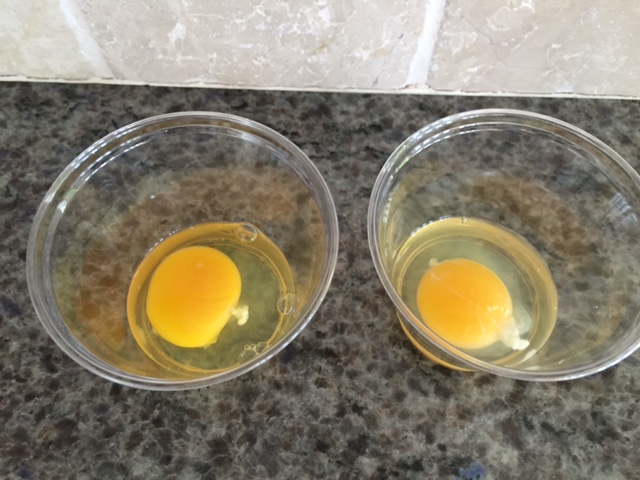
EggStra Special
Materials: 2 clear cups
1 brown egg
1 white egg

      
1. Pass around the eggs for the children to gently hold and observe.
2. Discuss how the eggs are alike and how they are different.
3. Ask the children to predict if they are alike or different on the inside.
4. Break each egg into a different cup and compare.
5. How are people like the eggs? Do people look alike on the outside? Are people the same on the inside?

*They made good scrambled eggs, too!

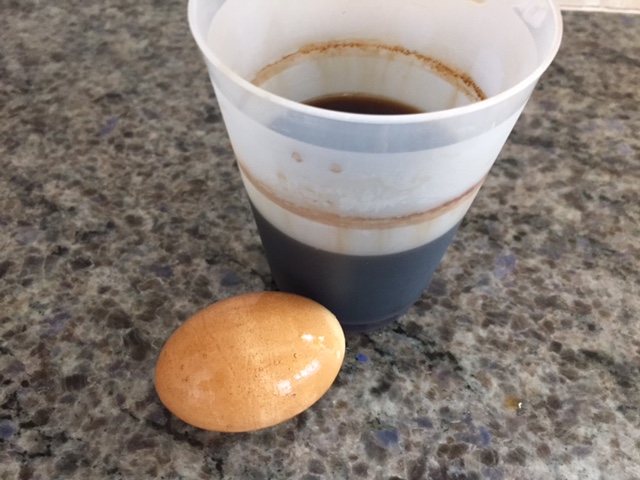
Happy Teeth
Materials: 4 raw white eggs
4 clear cups
tea, coffee, cola, water

1. Place each egg in a different cup and cover with one of the liquids.
2. Observe the eggs for several days to see what happens.
3. Remove the eggs and encourage the children to describe what happened to each egg and why.
4. How are teeth like the eggs? What will happen to your teeth of you drink tea and coffee all the time?
*Brush the eggs gently with toothbrush and toothpaste and see what happens.
                
Note!  Brushing the egg with toothpaste didn't work too well.  I might have left the egg in the coffee too many days.  Or, maybe it was the toothpaste???  It's science!!!!


What’s in an Egg?
Materials: plastic egg
small toy animal that would hatch from an egg (fish, bird, alligator, frog, spider, snake, etc.)


1. Put the toy in the egg? Let the children shake it and try and guess what it is.
2. Have them make a list of all the animals they can think of that hatch from eggs.
3. Open the egg to confirm their guess.
*Make a t-chart of animals that come from eggs and animals that do not hatch from eggs.