photo 3am_dj_home_zps919fb85e.png photo 3am_dj_about_zps7cce4c75.png photo 3am_dj_website_zps73051235.png photo 3am_dj_ss_zps6759ec2a.png photo 3am_dj_bs_zps43e27832.png

Thursday, July 14, 2022

PD #28 FLANNEL BOARDS


Yes, flannel boards are “old fashion,” but children today enjoy them just as much as children did 45 years ago. To make a simple flannel board, staple the sides of a file folder and glue felt to the front. You can glue words to stories and finger plays on the back and then store the pieces inside.

*Make simple story characters from felt so children can practice retelling stories.

*Make simple objects or shapes from felt for math activities.
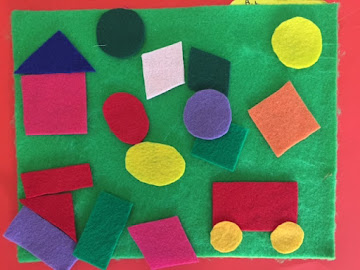


*Cut out children’s photos and attach Velcro to the back. Children can use the characters to create original stories.


*Use felt pieces as visuals for finger plays like "Five Little Hotdogs."


*Here's a pattern just for you!


Wednesday, July 13, 2022

PD #27 HIGHWAY NUMERALS AND SHAPES

Click to View Video

Well, now that you’ve got your highway letters, let’s see what you can do with highway numbers. WOW! Look at all the standards you can teach in a playful and active way!


Writing Numerals – Children can trace over numerals with toy cars or they can roll play dough and place it on top of the numerals. They can also trace over numerals with a dry erase marker and erase.

Counting – Have children get in numerical order according to the number they are wearing.

Songs – Wear number vests as you sing “Five Little Monkeys,” “I Know An Old Lady Who Swallowed a One,” and other songs.

Inequalities - Put up two numbers and have children choose “<” or “>” to go between them.

Addition and Subtraction – Have children make number sentences using the numbers and signs on the vests.

Fact Families – Move numbers around to demonstrate different fact families.

Decomposing Numbers – Call out a number. Children find a friend to equal that amount.

Tens and Ones – Let children demonstrate tens and ones with vests.

Word Problems – Use number vests to engage children in solving word problems.

Dot to Dot - Pass out numbers and have children scatter around the room. Give one child a large pointer. That child takes the pointer and goes from “0” through “10” by “connecting the dots.”


Highway Shapes – Do similar activities by putting highway shapes in clear sheet protectors.

Note! I’d suggest making some additional cards with math signs, such as “+” “-“ “=” “<” “>” and so forth.

Tuesday, July 12, 2022

PD #26 HIGHWAY LETTERS


Highway letters are a "rabbit trap" to engage kids and reinforce a variety of skills and different age levels.  You can purchase a book with these or download them free at makinglearningfun.com. I put mine in clear sheet protectors because it’s cheaper and easier than laminating. You can also punch holes at the top and tie on string so the children can wear them like letter vests. 


Here are just a few ways you can use the highway letters with different age levels throughout the school year.

Toy Cars - Let children drive over letters with toy cars.


Writing - Trace over the letters with dry erase markers. Erase and use again and again.

Hint! Put a green dot where they start and a red dot where they stop.


Play Dough - Roll play dough and place on top of the letters.

Songs - Pass out letter vests to children. Let them stand up when their letter is sung in the song.

Phonics - Practice blending C V C words. (consonant, vowel, consonant) with vests. Add the “silent e” to words to change the vowel sound.

Chunking - Start by asking children who are wearing “a” and “t” to stand. What does that say? Ask “m” to stand in front of “at.” What does that say? Tell “m” to go away and have “r” stand in front of “at.” Have children suggest other letters to stand in front of “at.” Reinforce other word families with this strategy.

Spelling Words - Slowly call out sight words or spelling words. (Stretch out the sounds.) Children come up if they are wearing that sound and make the word.

ABC Order- Children arrange themselves in alphabetical order according to the letter that they are wearing.

Hint! You can also play “I Have – Who Has?” with the letters. For example: “I have A. Who has B?” “I have B. Who has C?”


Monday, July 11, 2022

PD #25 STINKY CHEESE


You definitely want a stinky cheese game in your hip pocket when school begins. This game is the perfect way to nurture social skills and the executive function (self-regulation, task initiation and completion). Children will learn to take turns and practice “losing.” (Your silly reaction to “stinky cheese” will encourage the children to laugh along with you.


Stinky Cheese

What? lunch bag, yellow construction paper or poster board, marker

*Hint! An empty cheese cracker box will make a more durable container for the game.

Why? sight words, fluency phrases, letters, math facts, shapes, etc.


When? Large group or small group

How? Cut cheese slices out of poster board or construction paper. Write letters, words, numbers, etc. or any skill you want to reinforce on the cheese slices. On two slices write “Stinky Cheese!” Place the cheese slices in the lunch sack. Children pass around the sack drawing out one slice at a time. If they can identify the information on the slice they get to keep it. If they get “Stinky Cheese!” everyone holds their noses and says, “Stinky Cheese!” That person must then put all her slices back in the bag.

Hint! If children can’t identify what is on their cheese slice invite them to “phone a friend” (ask a friend) or “ask the audience” (ask the group).


Role Model

Some children need to learn how to “lose.” Explain that when something doesn’t go your way you just say, “OH, WELL!” as you open your palms and shrug your shoulders. Have children practice saying, “Oh, well!” when they lose.


*How about a game of “stinky feet” or “stinky socks”?


Sunday, July 10, 2022

PD #24 SIGN TO LEARN


PD #24 SIGN TO LEARN

Click to View Video


Sign language is quiet, free, provides another pathway to the brain, and keeps those little hands busy! Here are a few simple songs you can use to introduce manual signs for alphabet letters.

Sing and Sign
(“Where Is Thumbkin?” – Children repeat each line.)
Where is A? (Hands behind back.)
Here I am. (Make sign for “a.”)
What do you say, A?
/a/, /a/, /a/.
Continue using other letters and making the manual signs.

The Alphabet in My Hands

(“He’s Got the Whole World in His Hands”)
I’ve got A /a/ /a/ in my hands. (Sign the letter “a.”)
I’ve got A /a/ /a/ in my hands.
I’ve got A /a/ /a/ in my hands
And I can read.
Continue signing and singing other letters.

Hint! Encourage the children to make “strong” letters. As children tighten up muscles in their hands, they will also be strengthening small motor skills.

Sign Language Center

Make a SIGN LANGUAGE CENTER with a pocket folder. Glue a copy of manual signs for letters on the inside of the folder. Write alphabet letters on index cards and place in the pocket. Children choose a card and then try to reproduce that sign. For older children, write sight words or spelling words on index cards for them to practice spelling manually. 


Classroom Management 
Learn signs for classroom transitions, such as “pay attention,” “sit down,” “water,” or “restroom.”


Sign and Spell 
Use sign language to spell children’s names and other words.
*For older children fingerspell words and see who can decode them.


Word Wall Words 
Learn signs for high frequency words. Visit aslpro.com and click on “dictionary” to see signs demonstrated.


Saturday, July 9, 2022

PD #23 TOOLS AND TIPS

Click to view video

How about a few "tools" for your bag of tricks!

You Knock My Socks Off! 

You will need an old pair of socks, a stick, and a piece of string 18” long for this project. Tie a sock to each end of the string. Tie the middle of the string to the stick. When children do something outstanding, take the stick and wave it in the air as you say, “You knock my socks off!”


Mr. Good for You! 
 
A cloth glove, markers, fiberfill, and pipe cleaner are all you need to make a “good for you hand.” First, draw a happy face on one side of the glove with the markers. Fill the glove tightly with fiberfill or another stuffing. Gather the bottom of the glove and secure with a pipe cleaner. Children get “Mr. Good for You” and pat themselves on the back when they accomplish a new task.


Magic Lotion
 
Take an empty pump dispenser of hand lotion and remove the label. Make a new label for the lotion that says, “Mr./Mrs. (your name)’s Magic Lotion” and tape it to the bottle. When children are upset, frustrated, get a boo boo, or have hurt feelings, give them a “squirt” of magic lotion. 


Friday, July 8, 2022

PD #22 READING CALENDARS


 Click to view video for PD #22


In the book THE SMARTEST KIDS IN THE WORLD, one key finding was the impact parents have on their child’s academic success. When parents are interested in what their children are learning at school and talk to them about it, the results are amazing. Parents who model reading and read to their children also contribute to school success.

One teacher said she tells her parents, “All the children in my classroom need a laptop this year. Two laptops would be even better. These are not the kind of laptops that you plug in. They are the kind that come with two knees and are just right for talking and reading and loving!”

Check out these monthly reading calendars that will engage families at home. Run them off and you’ll be set for the year.


Hint! Save these to review with your parents at conference time.


Brown Bag Special
Many parents work and can’t volunteer in the classroom so this is a perfect opportunity to get them involved. When you have things that need to be cut out or if there is something you’d like downloaded from the internet, put it in a large grocery bag that says “Brown Bag Special.” Children whose parents agree to help take the bag home for their parents to do the project.