photo 3am_dj_home_zps919fb85e.png photo 3am_dj_about_zps7cce4c75.png photo 3am_dj_website_zps73051235.png photo 3am_dj_ss_zps6759ec2a.png photo 3am_dj_bs_zps43e27832.png

Sunday, July 17, 2022

WILLY WORM

You can call this worm Willy or Wanda or Wilbur or Winnie, but whatever you name it your kids will call it FUN! It's simple to make and can be adapted for many different skills.


What? paper plates, markers, construction paper, scissors, glue

Why? letters, numbers, sight words, shapes, etc.

When? large group

How? Decorate one plate to look like a silly worm. On the other plates write letters with a marker. Place the worm’s head down on the floor. Pass a plate to each child. (You can do this in alphabetical order or randomly.) The first child comes up, puts her plate next to the worm’s head and says the letter. The second child says the letter on the first plate and then says her letter and adds it to the worm’s body. The game continues as children say previous letters and then add their letter to the worm.


More? Challenge children to add the letters in alphabetical order.

Sight words – Write sight words on plates and add to the worm as children read the words.


Numbers – Write numbers on the plates and put in order.

Second Language – Write words from a second language you want the children to learn. You could put English on the front and the translation on the back.


Musical Plates
Scatter the plates on the floor. Play some catchy music for the children to dance to. When the music stops each child finds a paper plate and picks it up. The teacher randomly points to various children to identify the information on their plate. Put the plates back down on the floor and continue dancing and picking up plates.

 

Saturday, July 16, 2022

ZAP! BOOM! WIGGLE WORMS! STARS!

ZAP, BOOM, WIGGLE WORMS, AND STARS? 

Believe it or not, these are all adaptions of a classroom game that your students will love (and learn from) when you've got a few extra minutes.

SKILLS: letters; words; phrase cards; math facts; shapes, etc.


ZAP!

MATERIALS small can with a smooth edge (such as one from chips,
frosting, etc.), large craft sticks, markers, wrapping paper

DIRECTIONS Cover the can with paper and write ZAP! on it as shown.

On the bottom of sticks print words or other skills. On several sticks write “ZAP!” Place all the sticks in the can with the words towards the bottom of the can. Have the children sit in a circle. One at a time, children hold the can and pull out a stick and identify the word on it. When a child chooses a stick with “Zap!” on it, they return all their sticks to the can. Continue passing the can until there is one person left. 


Hint! If children can’t identify the information on their stick, let them “phone a friend” for the answer.

More! For older students, add sticks that say, “You get two turns.” “Take a peek.” “Loose a turn.” “Skip.”


BOOM! 
Write "Boom!" on several sticks and when children choose that stick they jump up and shout, "BOOM!


WIGGLE WORMS 
Write "Wiggle Worms!" on several sticks. Children stand and wiggle like a worm if they pull this stick.


STARS 
Glue stars to several sticks. If children choose this stick they get to keep it.


*You can also adapt this game for different holidays or units of study. For example, in October you could use skeleton stickers and the children could “shake their bones.” In January glue a snowman and they have to shiver.

Friday, July 15, 2022

IT'S JUST A GAME!


WHY PLAY GAMES?
All you have to say is, “Let’s play a game!” and you will naturally engage your students. But there’s more than PLAY going on with these games!

Standards – Sugar coat those standards by developing a game around the skills you want to reinforce.

Executive Function – Through games children can develop task initiation and completion because there is a beginning and an end. They also learn self- regulation and delayed gratification.

Active Learning – With games children can talk, interact with friends, and use multi-sensory materials.

Purposeful Practice for Automaticity – In order to master skills children need to repeat and practice them. Clearly, kids would rather do that with a game than with a worksheet.

Intentional Teaching – Teachers can create flashcard games, board games, or a variety of games based on any skill (letters, numbers, sight words, vocabulary, math facts, science or social studies, etc.) Think about skills in your curriculum and there’s the content for your game.

21st Century Skills – Children will naturally develop cooperation, collaboration, and communication as they share and play games.

Brain Research – The brain likes anything that is novel and challenging. Games add that element of fun and motivation to academic content.

Differentiated Instruction – Games can be adapted for specific needs and used for small group, independent, or take home practice.

Limited English Learners – Games can provide that visual and auditory connection in a non-threatening way.

Instructional Time – Take advantage of transitions and those few extra minutes during the school day by playing games.


HOW?
Look at your standards. What skills do your students need to master?
Are they struggling with any letters, sight words, shapes, math facts?
Be specific with the content you choose. Start simple and make the games increasingly complex. Remember, nothing succeeds like success.

WHAT?
construction paper, poster board, fun foam, file folders, scissors, tape, glue, hole punch, jumbo craft sticks, magnetic letters, markers, recycled materials, small toys and inexpensive items you can find in a dollar store

Tip!
You can make games yourself.
You can ask parents to make games for you.
You can share games and rotate them with other teachers.

WHERE?
Store games in zip bags, manila envelopes, pencil boxes, plastic tubs, or other containers. *Hint! Color code with stickers to indicate content area.

WHEN?
Demonstrate how to play the games and keep the rules simple. It often takes several times for the children to “get” a game. Model how to care for the materials and clean up.

Games can be used for large group instruction during transitions. They can be used with small skill based instructional groups. And, they can be used for independent practice.

Tip! Use games to motivate your students by saying, “If you work hard we will have time to play a game.”

*Try using “Brain Lotion” before playing games with pieces. (Take the label off a bottle of hand sanitizer and replace it with a label that says “Brian Lotion.” This will keep your games clean and germ free.)


ONLY YOU!
I can't do anything about the skills you have to teach, the checklists you have to complete, or the tests you have to administer, but over the next few days I can share some of my favorite games to make those standards "taste" better.  Remember that YOU add the magic!

Thursday, July 14, 2022

PD #28 FLANNEL BOARDS


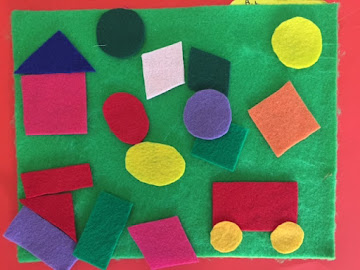
Yes, flannel boards are “old fashion,” but children today enjoy them just as much as children did 45 years ago. To make a simple flannel board, staple the sides of a file folder and glue felt to the front. You can glue words to stories and finger plays on the back and then store the pieces inside.

*Make simple story characters from felt so children can practice retelling stories.

*Make simple objects or shapes from felt for math activities.


*Cut out children’s photos and attach Velcro to the back. Children can use the characters to create original stories.


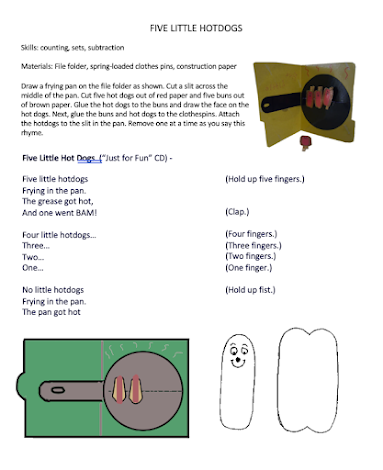
*Use felt pieces as visuals for finger plays like "Five Little Hotdogs."


*Here's a pattern just for you!


Wednesday, July 13, 2022

PD #27 HIGHWAY NUMERALS AND SHAPES

Click to View Video

Well, now that you’ve got your highway letters, let’s see what you can do with highway numbers. WOW! Look at all the standards you can teach in a playful and active way!


Writing Numerals – Children can trace over numerals with toy cars or they can roll play dough and place it on top of the numerals. They can also trace over numerals with a dry erase marker and erase.

Counting – Have children get in numerical order according to the number they are wearing.

Songs – Wear number vests as you sing “Five Little Monkeys,” “I Know An Old Lady Who Swallowed a One,” and other songs.

Inequalities - Put up two numbers and have children choose “<” or “>” to go between them.

Addition and Subtraction – Have children make number sentences using the numbers and signs on the vests.

Fact Families – Move numbers around to demonstrate different fact families.

Decomposing Numbers – Call out a number. Children find a friend to equal that amount.

Tens and Ones – Let children demonstrate tens and ones with vests.

Word Problems – Use number vests to engage children in solving word problems.

Dot to Dot - Pass out numbers and have children scatter around the room. Give one child a large pointer. That child takes the pointer and goes from “0” through “10” by “connecting the dots.”


Highway Shapes – Do similar activities by putting highway shapes in clear sheet protectors.

Note! I’d suggest making some additional cards with math signs, such as “+” “-“ “=” “<” “>” and so forth.

Tuesday, July 12, 2022

PD #26 HIGHWAY LETTERS


Highway letters are a "rabbit trap" to engage kids and reinforce a variety of skills and different age levels.  You can purchase a book with these or download them free at makinglearningfun.com. I put mine in clear sheet protectors because it’s cheaper and easier than laminating. You can also punch holes at the top and tie on string so the children can wear them like letter vests. 


Here are just a few ways you can use the highway letters with different age levels throughout the school year.

Toy Cars - Let children drive over letters with toy cars.


Writing - Trace over the letters with dry erase markers. Erase and use again and again.

Hint! Put a green dot where they start and a red dot where they stop.


Play Dough - Roll play dough and place on top of the letters.

Songs - Pass out letter vests to children. Let them stand up when their letter is sung in the song.

Phonics - Practice blending C V C words. (consonant, vowel, consonant) with vests. Add the “silent e” to words to change the vowel sound.

Chunking - Start by asking children who are wearing “a” and “t” to stand. What does that say? Ask “m” to stand in front of “at.” What does that say? Tell “m” to go away and have “r” stand in front of “at.” Have children suggest other letters to stand in front of “at.” Reinforce other word families with this strategy.

Spelling Words - Slowly call out sight words or spelling words. (Stretch out the sounds.) Children come up if they are wearing that sound and make the word.

ABC Order- Children arrange themselves in alphabetical order according to the letter that they are wearing.

Hint! You can also play “I Have – Who Has?” with the letters. For example: “I have A. Who has B?” “I have B. Who has C?”


Monday, July 11, 2022

PD #25 STINKY CHEESE


You definitely want a stinky cheese game in your hip pocket when school begins. This game is the perfect way to nurture social skills and the executive function (self-regulation, task initiation and completion). Children will learn to take turns and practice “losing.” (Your silly reaction to “stinky cheese” will encourage the children to laugh along with you.


Stinky Cheese

What? lunch bag, yellow construction paper or poster board, marker

*Hint! An empty cheese cracker box will make a more durable container for the game.

Why? sight words, fluency phrases, letters, math facts, shapes, etc.


When? Large group or small group

How? Cut cheese slices out of poster board or construction paper. Write letters, words, numbers, etc. or any skill you want to reinforce on the cheese slices. On two slices write “Stinky Cheese!” Place the cheese slices in the lunch sack. Children pass around the sack drawing out one slice at a time. If they can identify the information on the slice they get to keep it. If they get “Stinky Cheese!” everyone holds their noses and says, “Stinky Cheese!” That person must then put all her slices back in the bag.

Hint! If children can’t identify what is on their cheese slice invite them to “phone a friend” (ask a friend) or “ask the audience” (ask the group).


Role Model

Some children need to learn how to “lose.” Explain that when something doesn’t go your way you just say, “OH, WELL!” as you open your palms and shrug your shoulders. Have children practice saying, “Oh, well!” when they lose.


*How about a game of “stinky feet” or “stinky socks”?