photo 3am_dj_home_zps919fb85e.png photo 3am_dj_about_zps7cce4c75.png photo 3am_dj_website_zps73051235.png photo 3am_dj_ss_zps6759ec2a.png photo 3am_dj_bs_zps43e27832.png
Showing posts with label Spelling Words. Show all posts

Wednesday, October 16, 2024

DICTIONARY DAY

October 16th is Dictionary Day because it's Noah Webster's birthday. However, any day would be a great day to let your kids make their own "personal dictionaries." OWNING their own dictionary would be a meaningful way to reinforce vocabulary, sight words, and spelling words.


MY PERSONAL DICTIONARY
Materials: pocket folder, prepared pages with alphabet letters, markers

Directions: Ask students to tell you what they know about dictionaries. Brainstorm the many uses of dictionaries. Model looking up words and reading definitions. Explain that each of them will get to create their own dictionary that they can use to help them the rest of the school year. First, let the children decorate the outside of their pocket folder. Insert the alphabet pages. As you add new words to the word wall or have new spelling words, ask the children to write them in their dictionary. Encourage students to use their dictionaries when they write independently.

Hint! You might want to go ahead and type your core sight words on the pages before running them off.


Here are some other activities you can play with their dictionaries.


*Play “mystery word” where you give clues about words. 
 Can you find a word that starts with /m/ and ends with /d/? 
 Can you find a word that is the opposite of “fast”?


*Play the “rhyme” game. 
 Can you find a word that rhymes with “bike”? 
 Can you find a word that rhymes with “log” and is a pet?


*How many one letter words can you find? How many two letter words? Three letter words? 


*Ask children to clap out the syllables in words. 


*Can they match up words in their dictionaries with words in the classroom? 


*Sort words that refer to people, things we do, describing words, etc. 


*Have children find a word that starts with each letter in their name. 


*Have children make up sentences (oral or written) with the words. 


*Ask children to illustrate words or find magazine pictures that match the words.

*Demonstrate how to use the dictionary on the internet. How is it like their dictionary? How is it different?


SEASONAL DICTIONARY
Add a separate page each month with seasonal and holiday words children might want to use in their stories and journals.

Saturday, June 22, 2024

COLOR WORDS AND HAPPY BIRTHDAY LETERS

Children can learn to recognize, read, and spell color words with this song.

Color Train
R – e – d - red
R – e – d - red.
Red bird, red head,Red heart, red bed
R – e- d - red.

B-l-u-e - Blue berries, blue eyesBlue bird, blue sky
Y-e-l-l-o-w - Yellow flowers, yellow sun,Lemon pie, bananas – yum!
G-r-e-e-n - Green grass, green grapes,Cucumbers, lizards, snakes
P-u-r-p-l-e - Purple balls, purple plumsPurple shirts, purple gum
O-r-a-n-g-e - Orange pumpkins, orange leavesOrange juice, orange trees
B –l-a-c-k - Black night, black catBlack panther, black hat
B-r-o-w-n - Brown cow, chocolate cake Brown leaves, brown rake
W-h-i-t-e - White cloud, white snowWhite rabbit, white bow
P-i-n-k - Pink ribbon, pink nose,Pink flamingo, pink rose.
T-a-n - Tan pants, tan shoesTan deer, and pancakes, too.
G-r-a-y - Gray clouds, gray house,Gray hair, gray mouse

*Make a book illustrating the different colors in the song.
*Have children hold up crayons or touch something of the appropriate color as you sing.of the *Teach children ASL signs for the colors.


Word Puzzles
Materials: sentence strips, envelopes, markers


Directions: Write sight words on sentence strips. Cut between the letters to make a puzzle. Place the puzzle pieces in an envelope. Make a balloon the appropriate color on the front of the envelope. Children remove the letters and try to put them together to make the word.
Hint! Write the word on the back of the envelope so children can self-check.

Pull and Read
Materials: sentence strips, envelopes, markers


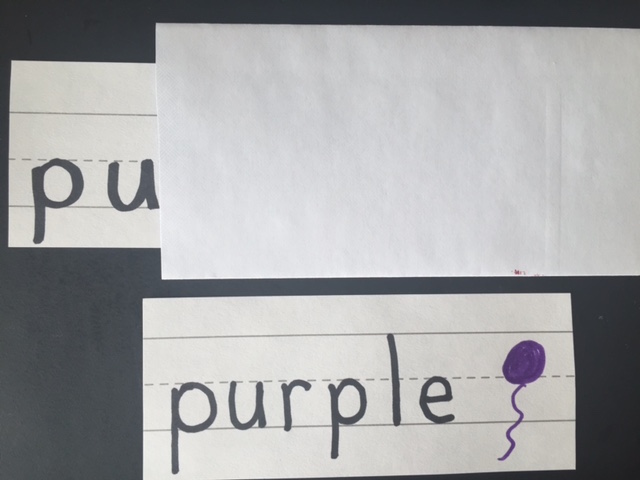
Directions: Write sight words on 10” sections of sentence strips with a black marker. Draw a small balloon the appropriate color at the right end of each word. Seal a letter size envelope and then trim off the left end. Insert the sight words in the envelope. Children pull out one letter at a time and try to blend the sounds and identify the color word. They can self-check with the balloon at the end.


Happy Birthday Letters

Yo, A, (Hands like a rapper and dance to the beat.)
It’s your birthday.
Let’s all read
Like your birthday.
/a/ /a/ /a/ /a/ /a/ /a/ (Circle hands around as you make the sound.)
/a/ /a/ /a/ /a/ /a/ /a/
Yo, B…etc.

*Have children stand in a circle. When the letter that their name starts with comes up in the song they get in the middle of the circle and break dance.

*Make sign language letters as you sing.


*Cut out this birthday cake and add magnetic tape to the back. Place on a magnetic board and spread magnetic letters around the cake. Children take turns choosing a letter, putting it in the cake, and leading their friends in the song.

https://drive.google.com/file/d/0B1SnEagA4jljNTdjZWVlZzR5Zmc/view?usp=sharing


Thursday, March 7, 2024

WHAT'S IN YOUR WALLET?

This is a perfect project for any skill because children love to make things and they also enjoy collecting things. They’ll feel “richer” as they learn new words and add the dollars to their wallets.

Materials: construction paper 9” x 12”, markers, green paper cut 4” x 2”

Directions: First let each child make a wallet where they can “save” their sight words. Lay a sheet of construction paper horizontally. Fold up the bottom within one inch of the top. Glue the two sides and then fold in half. Let children decorate their wallets with their name and drawingss. As you introduce new words let the children write them on the green rectangles/dollars and then store them in their wallets.


*Use these at small group time to play “mystery word” as you call out clues. For example, “This word starts with ‘t’ and ends with ‘e.’” This word is the opposite of ‘sad.’”

*Children can use their words to make sentences, sort parts of speech, etc.

*Let children take their word wallets home and practice them with their parents.

*If you have a few extra minutes in the day have children get out their dollar words and read them independently or with a partner.

*Challenge children to learn to spell their dollar words.


Letter Wallets - Younger children could save letters, numbers, or shapes in their wallets.


Math Wallets - Write addition and subtraction facts on dollars and save them in math wallets.

Vocabulary - Have children write vocabulary words on dollars and store them in their wallets.

Word Families - Use wallets to reinforce word families.