photo 3am_dj_home_zps919fb85e.png photo 3am_dj_about_zps7cce4c75.png photo 3am_dj_website_zps73051235.png photo 3am_dj_ss_zps6759ec2a.png photo 3am_dj_bs_zps43e27832.png

Saturday, February 23, 2013

CLIPPING ALONG!


You can buy clipboards or make your own from corrugated cardboard and butterfly clips.  Here are a few quick and easy centers you can do with clipboards.
Word Search
Standard:    RF 3c
Materials:    list of words found in the classroom, clipboard, pencil
Directions:   Children walk around the room searching for the words on the 
                    list.  They can cross through the words as they find them.
Hint!           A pair of empty glass frames makes this more fun.
More!          Write a seasonal word vertically down the left side of a sheet 
                   of paper.  Can children find a word in the room for each letter?

Remember Doodles
Standard:    RL 10
Materials:    listening center, story tape, clipboard, pencil
Directions:   Children use the clipboard for “remember doodles.”  Encourage 
                   them to draw or write all the things they remember as they  
                   listen to the story.

Writing to a “T”
Standard:    L 5a, W 2
Materials:    paper, crayons, pencils, clipboard
Directions:   Demonstrate how to make a “T” down the middle of the page
                   with a crayon.  Have children write words or draw pictures
                   for things they “like” or “dislike”; things found “inside” or
“outside”;  “big” and “little”; “real” and “pretend” etc.
More!          Relate to science or social studies by having children write
                  “wants” and “needs” or “plants” and “animals.”

Four Square Writing
Standard:    L 2d, RF 2b
Materials:    paper, pencils, clipboard, word wall or dictionary
Directions:   Have children draw a line down the middle of their paper
                   horizontally and vertically to make four sections.  Number
                   the sections “1,” “2,” “3,” “4.”  Ask children to write
                   one letter words in the section numbered “l.”  Write
                   2 letter words in the second section, etc.
More!          Write one syllable words, two syllable words, etc.

Out the Window
Standard:    W 2
Materials:    clipboard, paper, pencils, crayons or markers
Directions:   Children look out the window and describe what they see.
                   I see…
                   I hear…
                   I smell…
                   I feel…
                  After writing, they can illustrate their observations.

Count the Room
Standard:    Counting
Materials:    list of common classroom objects (chairs, boys, girls, 
                   teachers, computers, puppets, noses, shoes – you can make this
                   funny and challenging!)
Directions:   Children walk around the room, count the objects, and write
                   their response on the line.

Shape Hunt
Standard:    Geometry
Materials:    list of two and three dimensional shapes
Directions:   Children walk around the room and hunt for the shapes on their 
                   list.  They can draw or write a description of the shape when  
                   they find it.

Friday, February 22, 2013

PLAY DOUGH DAY!


It’s Play Dough Day!

Play Dough
Standards:   L 1a (letters), L 2d (words), geometry
Materials:    clear sheet protectors, play dough, paper, markers
Directions:   Purchase play dough or make your own using the recipe below.  
                    Draw letters, words, lines, curves, shapes, etc. on the paper and 
                    insert in the sheet protector.  Children take the play dough and  
                    roll to make snakes.  Next, they use the play dough to trace  
                    over the lines on top of sheet protector.

Phonics        RF 3a
                  After tracing letters, have children make objects that begin
                  with that sound.


Counting and Cardinality
                  After tracing numerals, children make the appropriate set with 
                  play dough.
Geometry
                  Have children make three-dimensional shapes with play dough.

Recipe for homemade play dough:                                                    
1 cup salt                  2 cups water                                                 
2 cups flour               2 Tb. cream of tartar                                    
2 Tb. vegetable oil     food coloring
Mix all ingredients together until smooth.  Cook over medium heat stirring   
constantly until a ball forms and sticks to the spoon.   Cool, knead, and store in a zip bag.  
Hint!  Substitute massage oil for vegetable oil to make “aroma therapy” dough.
Use unsweetened Kool-aid for color and fragrance.
Omit food coloring and knead dough in cocoa to make “chocolate dough.”

Thursday, February 21, 2013

AUTHORS, ART, AND TECHNOLOGY


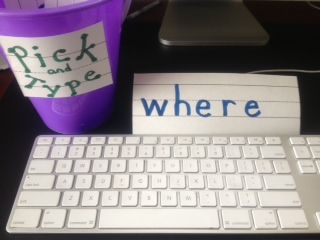
Pick and Type
Standard:    W 6, L 2d
Materials:    plastic pail or basket, index cards with letters or words, 
computer
Directions:   Children “pick” a letter or word from the pail and type it.              
More!          Use a minute timer so children can see how many words they
                  can type in five minutes.
Author Study
Standard:    RL 6, RL 9
Materials:    several books by the same author, bag, scavenger hunt list
Directions:   Choose several books by one of the children’s favorite authors.  
                    Put them in a bag along with a list similar to the one below:
1.     The author of these books is__________.
2.    My favorite book is__________.
3.    The funniest picture is__________.
4.    The book about a bully is_________.
5.    The book about a party is_________.
6.    I wish the author would write another book about____.

Shape Art
Standard:    Geometry – compose shapes
Materials:    geometric shapes cut out of scrap construction paper, glue, markers
Directions:   You could prepare the shapes ahead of time or let children trace around patterns and cut them out.  Children arrange the shapes on a sheet of paper to make new designs and objects.  Can they identify the shapes they used?  Encourage them to give a title to their artwork.    


Wednesday, February 20, 2013

INVISIBLE WRITING AND PUZZLE MATH


Invisible Writing
Standard:    L 1a (letters), L 2d (words)
Materials:    small paper cups, Q-tips, paper towels, word cards
Directions:   Children fill a cup ¼ full with water.  Next, they dip
                  the Q-tip in water and use it to write letters or words on the
                  paper towel.  As the water evaporates, they’ll have “invisible”
                  writing!
More!          Children can also do invisible writing on the chalkboard with a
sponge dipped in water.

Picture Talks
Standard:    RL 7,  L 2d
Materials:    magazines, paper, pencil, scissors, glue
Directions:   Have children select a picture from a magazine and glue it
                  to a sheet of paper.  Ask them to write words (or sentences)
                  for five things they see in the picture.
More!          Ask children to write what they think the people in the picture
                  are saying.  What happened before?  What will happen next?
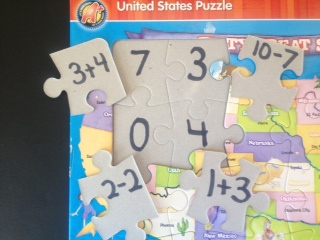
Puzzle Math
Standard:    Operations
Materials:    old cardboard puzzles, marker
Directions:   Dump out the puzzle pieces.  On the frame write numerals 0-10
                   (or higher).  On the appropriate piece write a fact that will 
                   equal the number on the frame.  As children solve the problems 
                   they will be completing the puzzle.
More!          Use puzzles to match upper and lowercase letters, antonyms,
                   etc.

Tuesday, February 19, 2013

TOUCH, TELL, AND I "TIN"


Touch and Tell
Standard:    W 2
Materials:    socks, paper, pencils, small unusual items (Scruffy, dry dog 
                   food, hair bow, baby toy, bubble wrap, seasonal objects, etc.)
Directions:   Place small objects in the socks.  Children choose a sock, feel it, 
                   and then write a description of what they think is in the sock.
Hint!            Use one sock for younger children.  Number socks for older 
                    students so they can write down what they think is in each sock.

I “Tin” Make Words
Standard:    RF 2c, L 2d
Materials:    magnetic letters, mint tin or cookie tin, paper, pencils
Directions:   Place magnetic letters that can be used to make a word family
                   in the tin.  For example: o, p, t, m, h, c, b.  Add a list of words 
                   that can be made from the letters in the tin.  (hop, mop, top, 
                   cop, pop, bop)   Children reproduce the words on the lid of
                   the tin and read them.  You could also ask them to write the
                   words.
More!          Put several vowels and consonants in the tin and challenge the 
                   children to make all the words they can with the letters.
Little to Large
Standard:    Geometry – compose shapes
Materials:    crayons, paper
Directions:   Make a very small shape (triangle, square, trapezoid, half-circle, etc.) in the center of the paper.  Children take a different color of crayon and go around it, making it a little larger.  Continue using different colors of crayons and making the object a little larger until it completely fills the page.
                   Hint!  You could prepare these ahead or let the children create their own small shapes in the middle of the paper.

Monday, February 18, 2013

BOOK BROWSING AND MATH BAGS


Book Browsing
Standard:    RL 5
Materials:    5-10 book jackets or library books on different topics, paper,
pencil, file folder
Directions:   Put letters on the books A, B, C, D, etc. using sticky notes.                         Write questions about the books on the file folder.  For
                  Example:
                           1.  “If you wanted to read a book about a dog, which one
                           would you choose?”
                           2.  “Which book do you think would have a story about a
giant?”
3.  “Which book would help you learn more about space?”
                           4.  “Where could you find a poem?”
                  Children number their papers and then write the letter for
                  the book that would answer each question.
Letter Necklace
Standard:    RF 1d
Materials:    construction paper, pencils, letter stencils, scissors, hole punch,
                  yarn cut in 22” pieces
Directions:   Children place the letters on the construction paper and trace
                  around them.  Punch a hole in each letter and string it on
                  the yarn.  Tie the ends and wear like a necklace.
More!          Children can make necklaces using the letters in their name, their initials, vocabulary words, etc.

Math Bags
Standard:    Operations and Algebraic Thinking
Materials:    zip bags, permanent marker, small flat objects, pencils, paper
Directions:   Draw a line down the middle of a bag with a permanent marker.  
                   Insert objects in the bag.  Children slide the items from one side to 
                   the other to make different combinations.   Ask them to write down 
                   the equations.
More!          Vary the number of bags and amount to make this increasingly 
                   challenging.

Sunday, February 17, 2013

WIN! WIN! WIN!


Do you need a little “BAM” in your classroom right now?  Every day this coming week on my blog you’ll find simple (and inexpensive) learning centers that you can create.   My goal was to come up with centers that would engage children and that teachers could make in less than 15 minutes.  

One of the best things about learning centers is that you can integrate Core Standards with 21st Century Skills.  As children practice cognitive skills they will also be collaborating, communicating, problem-solving - and developing the executive function (task initiation, self-regulation, delayed gratification)!  Win!  Win! Win!

Tips!
*Use these centers for independent, small group, or take home activities.
These could also be available for students who finish their work early.

*Store centers in zip bags, manila envelopes, pencil boxes, plastic tubs, baskets, etc.
Hint!  Color code with stickers to indicate content area and standard.

*”Invite” parents to be game makers and collect the materials and put the centers together for you.

*Share centers and rotate them with other teachers.  If there are 4 teachers on your grade level and you each made five, then you could rotate them a week in each class.  You’ve got centers for a month!

*Number centers 1-5 and ask children to do one each day.  You could also put a checklist with each center so children could cross through their name when they complete an activity.

*Adapt these games to specific skills and the needs of your students.  For example, with “In the News” pre-k children could highlight letters.  Kindergarten children could highlight word wall words.  First graders could find nouns or verbs.  Second graders could find a word for each letter of the alphabet and write them in alphabetical order.
          
In the News
Standard:    RF 3c, RF 1d
Materials:    newspaper, highlighter, paper, pencils
Directions:   Each child takes a section of the newspaper and highlights ten
                  words (or letters) they can read.  Next, ask them to write
                  the words (or letters)  on a sheet of paper.

Secret Code
Standard:    Counting, Operations
Materials:    old cell phone, paper, pencil, envelopes, index cards
Directions:   Write “secret codes” (words) on index cards and place them
                  in the envelopes.  Children choose an envelope and find the
                  numbers on the key pad that match the letters. 
                  Children write down the numbers and then add them up.
                  Hint!  Write the answer under the lid of the envelope.
                  *Use a single letter for pre-K, a two letter word for K, a three
                  or four letter word for first, and so forth.
Magazine Puppets
Standard:    SL 4, W 3
Materials:    magazines (sports), newspapers, catalogs, scissors, tape, straws
Directions:   Let children cut sports figures and other famous people out of
newspapers or magazines.  Tape to a straw to make a puppet.  What
would your puppet say if it could talk?  What questions
would you like to ask your puppet?
More!          Have students write a story about their puppets.