photo 3am_dj_home_zps919fb85e.png photo 3am_dj_about_zps7cce4c75.png photo 3am_dj_website_zps73051235.png photo 3am_dj_ss_zps6759ec2a.png photo 3am_dj_bs_zps43e27832.png

Thursday, January 20, 2022

INDOOR GAMES FOR A WINTER DAY

The weather outside is frightful,
But inside our game is delightful.
And since we can’t go out to play
Here are some indoor games for today.

Silent Touch
This is a great game to quiet children and build memory skills. The first child gets up and touches an object and then sits down. The second child gets up, touches the first object, then touches an additional object. The third child touches the first object, second object, and adds a third object. The game continues as classmates touch what the previous children have touched in sequential order and then add a new item. When a child forgets, simply begin the game all over again.


Four Corners (This is the BEST indoor game ever!)
Number each of the corners in the room ~ 1, 2, 3, 4. (You can write the numerals on paper and hang them up if you want.) Choose one person to be “it.” “It” hides their eyes and slowly counts from one to ten as the rest of the class tiptoes to a corner in the room. When “it” says “freeze,” everyone must be in a corner. “It” then calls out a number (1, 2, 3, or 4) and the children in that corner are out of the game. They sit down in the “stew pot” in the middle of the room. “It” counts to ten again as everyone moves to a new corner. The game continues until there is one person left. That person becomes the new “it.”
Hint! Shorten the game by having “it” call out two corners at a time.

*If there is no one in the corner, ask “it” to call out another number.

*Label the corners with letters, numbers, sight words, vocabulary words, etc.


Detective
One child is the “detective.” The detective describes a “missing child” (classmate), giving their eye color, hair color, description of clothing, likes, etc. The first person to identify the missing child gets to be the new detective.

Hint! Here is another variation of this game. Send the detective out in the hall. Select one child and hide him or her under your desk or behind a shelf. The detective returns to the classroom and tries to identify the missing child. (You can also let two children exchange seats and see if the detective can spot the switch.)


Hot Potato
You can use a small ball, bean bag, or stuffed animal for this game. Children sit or stand in a circle. Children begin passing the “hot potato” (ball or bean bag) around the room when the music starts. Explain that it is a “hot potato” and they need to pass it quickly to the next friend. When the music stops, the one holding the “hot potato” is out of the game and must leave the circle. If two children are holding it they are both out. The last child remaining is the winner. Begin the game again.


Silent Ball
You will need a small, soft ball for this game. Explain that the object of the game is to see how many times you can toss the ball without talking. Look at the person you are throwing the ball to so they will be ready. Silently count how many times we can throw the ball without talking or dropping it. If someone talks or drops the ball, then the game begins all over again.
                                                                     

Tower Topple
This game is similar to Jenga. Have children get a block and then sit in a circle. The first child begins building the tower by placing her block in the middle of the circle. The second child places his block on top of hers...The game continues as children try to build the tower higher and higher. When it falls over every shouts "tower topple" and the game begins again.

Wednesday, January 19, 2022

WINTER RIDDLES AND JOKES

If you want a joke today, I’ve got some winter riddles and knock knocks for you. If you don’t want to hear a joke, just delete this and I’ll be back tomorrow.

Note! Telling jokes to your class is a fun way to develop language skills (double meanings and phonological awareness) and help your students "think outside the box." A good idea is to ask students who "get" the jokes to "think out loud" and explain their thought process to classmates. It's a natural way to help slower students scaffold to a higher level.


What did the snowman have for breakfast?
Frosted Snowflakes

What is a snowman’s favorite snack?
Ice Krispy treats.

What’s it called when a snowman has a temper tantrum?
A meltdown.


What do snowmen wear on their heads?
Ice caps.

Where do snowmen go to dance?
The snowball.


Where do snowmen keep their money?
In a snow bank.


What do snowmen like to do on the weekend?
Chill out.


How do you scare a snowman?
Pull out a hairdryer.


How do you know that a snowman crawled into your bed with you?
You wake up wet and there’s a carrot on your pillow.

           
What do you call a snowman in the summer?
A puddle!


What does Jack Frost like best about school?
Snow and tell.
                                                     
How did Jack Frost get to work?
By icicle.


Why did the boy keep his trumpet out in the snow?
Because he liked cool music.


Knock!  Knock!
Who's there?
Snow.
Snow who?
Snow one at home at my house.


Knock, knock!
Who's there?
Emma.
Emma who?
Emma bit cold out here - let me in!

Knock, knock!
Who's There?
Accordian.
Accordian who?
Accordian to the weather channel, its going to snow tomorrow!

Knock, Knock!
Who’s there?
Ken
Ken who?
Ken I come in? It’s cold out here.

Knock, knock
Who's there?
Atch
Atch who?
Bless you!


Knock, knock
Who's there?
Icy
Icy who?
Icy you!

Tuesday, January 18, 2022

WHEN I GROW UP!

It's never too early to have children start thinking about careers and what they might want to do one day.  In early childhood play encourages children to explore and pretend different roles and occupations.

Jonie Watanabe Tsuji (a National Certified Counselor) defines career readiness simply:
     It’s about being able to have conversations, well-spoken ones, on jobs and your place in a      world filled with them.

Questions she suggests you ask at all ages:

AWARENESS OF OCCUPATIONS

Encourage children to think about different occupations in their family, your school, community, city, and around the world.

*block play - build a farm, restaurant, airport, hospital, and so forth

*dramatic play - set up a grocery store, veterinarian's office, bank, art studio, and so forth


*field trips - when you take field trips talk about the people that work in different locations

*books - as you read point out occupations of characters in the book

OCCUPATIONS FROM A TO Z

Take turns in identifying an occupation that begins with each letter of the alphabet. 

*Discuss skills or tools that someone who chose this occupation would need. 

Bounce Patrol - "Alphabet Occupations"
https://www.youtube.com/watch?v=r6Oxqyd5qUw


Rapper Sam - "You Can Be ABC's"
https://www.youtube.com/watch?v=U9TLZBZ3eo8 


GUEST SPEAKERS 

Invite parents and members of your community to come and speak in your class about their careers.

WHAT'S YOUR BAG?

Give each child a brown paper bag and ask them to interview their parents about their jobs.  What do they like best about their job?  How did they train for their job?  
Put a tool, picture, or other object that represents what they do in the bag and share it with classmates.

WHEN I GROW UP!

Have a special day where children dress for the job they'd like to have one day.  Ask them why they chose that job, how they will prepare for it, and so forth.


Monday, January 17, 2022

KID INVENTOR'S DAY


Television. Water skis. Earmuffs. The Popsicle.

What do they have in common?

All were invented by kids!

500,000 children and teens invent gadgets and games each year.
These innovations help make our lives easier – and more fun!

Celebrate the ingenuity and value of young brainstormers on
KID INVENTORS’ DAY!

kidinventorsday.com

Planning an Inventor's Day would be great fun, but encouraging children to be creative and think outside the box is important every day!


Junk Box – Recycle cardboard rollers, bubble wrap, catalogs, junk mail, bottle caps, etc. for children to create into artwork, games, inventions, and toys.

Brainstorm – Provide children with opportunities to brainstorm in groups and independently. Use attribute webs, time lines, shapes, and other graphic organizers.

Literature – Creative writing enhances literacy skills as well as original thoughts. Children can write stories, poems, songs, plays, and so forth.

Learning Centers – Blocks, construction toys, play dough, puppets, art media, and musical instruments all provide children with the opportunity to explore their talents and interests.

Outdoor Explorations – Nature is the perfect prescription to clear the mind and open creative thought. Children need to spend as much time as possible on the playground, at the park, or in their own backyard.

Assessment Show and Tell – Instead of filling in bubbles, challenge children to demonstrate what they have learned in a creative way. They can sing a song, dress up, cook something, make a mural, etc.

Sunday, January 16, 2022

ZERO THE HERO

Zero the Hero Number Stomp 
I am Zero the Hero and I’m here to say,
I love to do numbers every 10th day.
When we make sets of ten we’ll stomp the ground.
And when we reach 100, we’ll sit back down!

1, 2, 3, 4, 5, 6, 7, 8, 9, 10 (Stomp!).
Let’s count another ten.
11, 12, 13, 14, 15, 16, 17, 18, 19, 20 (Stomp!)
Two tens, let’s go some more…
Three tens, you’re catching on.
Four tens, you’re doing fine.
Five tens, you’re half way there.
Six tens, you’re on a roll.
Seven tens, what a cool game.
Eight tens, you’re doing great.
Nine tens, we’re near the end.
Ten tens is 100, now it’s time to sit down!

https://www.youtube.com/watch?v=AJjHpVo6udU


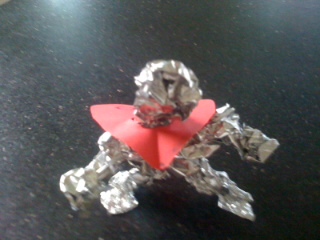
Children can make their own Zero the Hero with a sheet of heavy duty aluminum foil. (They’ll need some assistance so work with a small group at a time.) Make two tears from the top about 1/3 of the way down. Make one tear from the bottom as shown. Squeeze the top side sections to create arms. The center section can be molded into a head. The bottom strips can be molded into legs. Make a cape for your hero from paper or fabric. 


*Let children write or tell stories about what they would do if they were Zero the Hero.


100 Days (Tune: "When Johnny Comes Marching Home")
We’ve been in school 100 days. (Children stand and march.)
Hoorah! Hoorah! (Fist in air as if cheering.)
We’ve worked and played 100 days.  
Hoorah! Hoorah!
Zero is our Hero today.
Now let’s all count to celebrate!
We’ve been in school 100 days,
And it’s been great!

1, 2, 3,…..100! (Hold up fingers as you count.)
Hoorah!


100 Exercise
Do ten sets of the following exercises: toe touches, jumping jacks, arm circles, hops (on one foot), waist twists, squats, scissor jumps, hops (on the other foot), jog (in place), windmills. *"Pump Up to 100" and "Macarena Count to 100" are two youtube videos where children can exercise and count!

https://www.youtube.com/watch?v=TqqqcA9lBvw
https://www.youtube.com/watch?v=iGKXZVxAffM


Saturday, January 15, 2022

100th DAY CELEBRATION

Some of you are probably days away from the 100th day of school, while some of you won't get there for weeks. One thing for sure is that sooner or later you'll want these ideas to celebrate this special day.


100 Day Book
Fold 5 sheets of paper in half. Punch holes about 1 1/2" from the top and the bottom on the fold. String 10 beads on a wooden skewer. (I bought the thinnest ones I could find and cut them to 8"). Insert a rubber band (long and thin) in one hole and slide one end of the skewer through the loop. Insert the other end of the rubber band through the other hole and slide the other end of the skewer through that loop as shown. Children can make a set of ten on each page with markers, stamps, words, etc.


*Use 5 red beads and 5 white beads similar to rekenrek and challenge children to make different combinations of ten in their book.


Cover Up

Make 2 copies of a 100 grid. (You can download these online.) Cut up one set and put the numbers in a zip bag. Children can play this game by themselves or with a partner. Give them a 3 minute timer and challenge them to cover up as many spaces as they can in the time limit. Have them record the amount and try to beat their score each time they play.


Hint! Adapt this game for younger children by giving them a grid with 10 or 25 spaces.

*Use the grid to practice writing numbers.
*Use the grid for graphing or for making patterns.
*Color even numbers one color and odd numbers another color.


Buzz
All children stand. Go around the room and have each child say a number. When they get to a set of ten they must say “buzz.” If they don’t say “buzz” they are out of the game and must sit down. The game continues until there is one person left or you reach 100.


100 Bottles
Have each child take an empty plastic water bottle and fill it with 100 items.


100 Art
Cut a “1” and two “0’s” out of construction paper. Children glue them on a sheet of paper to create a “critter.” They can decorate it with crayons, markers, or paint.


100 Exercise
Do ten sets of the following exercises: toe touches, jumping jacks, arm circles, hops (on one foot), waist twists, squats, scissor jumps, hops (on the other foot), jog (in place), windmills.


100 Snack
Children count out ten each of each snack food (such as Cheerios, pretzels, Gold Fish, raisins, m&m’s, miniature marshmallows, cheese crackers, wheat squares, Rice Chex, peanuts, etc.) and put them in a zip bag. Shake and eat.
*Adapt to the dietary needs of your class.


Math Challenge
How many ways can you think of to make 100? Children could do this independently or with a partner.


Self Portraits at 100
 
Have children draw pictures of what they think they will look like when they are 100. 

*One teacher even had them use the brown paper towels from the restroom. They wadded them and wrinkled them before drawing on them. Too funny!

Friday, January 14, 2022

A PICNIC BOOK!

Sometimes children like big books and sometimes they like little books. This book is so much easier to make when you tell the story about going on a picnic.


Make a picnic book by telling this story:

Let’s go on a picnic. First we need a picnic basket.
(Fold the paper in half.)

Next, we need hotdogs.
(Fold the paper in fourths.)

We also need hamburgers.
(Fold the paper into eighths.)

We’ll need a picnic bench to sit at.
(Open so it’s folded in half. Bring one bottom flap to the fold. Turn
over and bring the other bottom flap to the fold.)

A picnic is more fun if we share it with a friend. (Tear down middle crease
until you reach the fold.)

Now all we need is a book to write a story about our adventures on our picnic.
(Hands on top of bench, bend down, and fold around to make a book.)


Use for: letter books, word families
reading the room, writing the room
fact families
shape or color books
unit or theme
spelling words (picture/sentence)
friends’ names and phone numbers
opposites, story elements
original stories

Hint! Let children decorate an individual cereal box to store their picnic books.


Picnic Book with a Window

Cut a “window” out of one section of a picnic book and children can draw a secret picture inside.