photo 3am_dj_home_zps919fb85e.png photo 3am_dj_about_zps7cce4c75.png photo 3am_dj_website_zps73051235.png photo 3am_dj_ss_zps6759ec2a.png photo 3am_dj_bs_zps43e27832.png
Showing posts with label Reading Meeting. Show all posts

Thursday, September 13, 2018

READING MEETING - WACKY WORDS

SIGHT WORDS
Choose 4 to 5 words each week to practice daily with one of these strategies.

Sign Language - As you introduce new words, teach children the signs for the words by using the dictionary at aslpro.com.
                             

Karate Writing
Spell out words with karate writing.  For letters that start at the top dotted line punch up high. For letters that start at the middle dotted line punch out in front of your waist. For letters with a tail that go below the line give a little kick.
                  A – punch from waist
                  B – punch up in the air
                  C – punch from waist
                  D – punch up in the air
                  E – punch from the waist
                  F – punch up in the air
                  G – give a little kick…etc.

Sports Spell - Pretend to be athletes and spell out words.
Basketball – bounce on letters and make a basket as you say the word.
Baseball – swing on letters and twirl around and hit a home run as you say the word
Soccer – small kicks on the letters and kick a goal as you say the word
Let children make up motions for other sports, such as swimming, fishing, etc.


High Five Words
Cut hands out of construction paper and write the words you want to practice on the hands.  Tape to your classroom door.  Every time you leave the classroom stand at the door and call words out to the students.  They must high five that hand before exiting.


Sing to Cadence
Children echo each line as you sing, march, and slap your thighs.
     There are some words you need
     If you want to learn to read
     ___ ____ ____ ____
     ___ ____ ____ ____

Mystery Word
Play a game where you give clues about the words. For example: “I start with “L” and rhyme with “book.”

Sentences
Encourage children to make up sentences using sight words.


VOCABULARY WORDS
Each week choose a word (or two) from a book, unit of study, or of personal interest to your students.  Call them POWER WORDS or SPARKLE WORDS.  Make a big deal of introducing the words by saying:

     Give a drum roll….(pat knees and make a sound).

     Give a Beethoven…(pretend to hold a violin and hum the first few notes of Beethoven’s 5th Symphony).
     Give me a trumpet…(pretend to hold a horn and toot).

*Dramatize the words.

*Invite students to make up sentences using the words.

*Put the word in a name badge and wear it throughout the day.  At random times in the day say, “If you know my special word smile at me.” “If you can read my word shout it out!” “If you can read my word whisper it out.”

*Give children a cheer when they use a power word.

Wednesday, September 12, 2018

READING MEETING - PHONO FUN AND ABC'S

PHONOLOGICAL AWARENESS
Choose a rime (aka word family) from the poem of the week. As children identify rhyming words from the poem write them on the board. Circle the letters that are the same in each word. Can they add other words to the list? 

Word Family Song
Sing this song to the tune of “Bingo.” For example, if you read "Jack and Jill" you could sing:
         There is a word family you should know
         And “ill” is it’s name-o.
         J – I – L – L Jill
         H – I – L – L hill
         W – I – L – L will
         They end in “ill” you know.

                               
*Write the word family in a large house and encourage the children to add rhyming words throughout the week.

Rhyme Ball 
You will need a ball, beanbag, or other object to toss for this game. Children sit or stand in a circle. The teacher says a word and then tosses the ball to a child. As the child catches the ball, she must say a word that rhymes.

Syllabication
Clap, snap, hop or make other movements to words in the rhyme.

Instruments 
Have children beat out syllables with instruments.
*You could also use cardboard rollers, straws, pencils, etc. like drum sticks to tap out rhythms and syllables.

Sound Sack

Take a small sack and fill it with common objects or small toys. Capture children’s interest with this song to the tune of “I’m a Little Teapot.”
            What’s in the sound sack, who can tell?
            Maybe it’s a book or maybe it’s a shell?
            What’s in the sound sack, who can say?
            Blend the sounds, you’ll know right away!

Choose and object and stretch out the sounds. When children can blend the sounds and say the word, remove It from the sack and place it on the floor. Before putting each item back in the bag, segment the sounds again.


Body Letters
Choose letters from the poem of the week and challenge the children to make the letters with their bodies.
                                                       
Air Writing

Write letters in the air with your index finger or another body part.

Sign Language
Teach manual signs for letters as you introduce them.

Pinkies UP
Children listen as you say a group of words. If a word begins with the letter sound you are working on they put up their pinky finger.

Tuesday, September 11, 2018

READING MEETING - MORNING MESSAGE AND RHYME A WEEK

MORNING MESSAGE
The morning message is a powerful way to demonstrate the importance of reading and writing. When a class mascot (stuffed animal or puppet) has a message waiting for the children it will give them something to anticipate each day.

Here's a song to the tune of “My Darlin Clementine” to focus children’s attention for the 
morning meeting:
         We are readers.
         We are writers.
         And we like to learn it’s true.
         We will read the morning message
         So we’ll know just what to do.


Hocus – Pocus – Focus
Did you know that if you tell your brain that something is important it’s more likely to remember it? If you have your children put on their focus goggles before you call their attention to something on the morning message it just might work. Say, “Hocus, pocus, goggles, focus!” as you demonstrate making circles with your thumbs and index fingers and placing them around your eyes.

To the Point
You probably already have some pointers, but it’s easy to make seasonal ones by placing finger puppets on the end of a cardboard pants roller.

Cut out the center of a butterfly net and add some fancy ribbon and you’ll be able to frame letters, words, and other key details.

Correct the Teacher
As the year goes along you can make spelling and punctuation errors so the children can “correct” you.


RHYME A WEEK


Each week write a poem on a chart and introduce it on Monday. Read over the rhyme using different strategies suggested below. Review the rhyme each day and then on Friday read and review rhymes from previous weeks.

Try choral reading with these strategies:

Shadow Reading– Teacher reads a line and then students repeat.

Magic Word– Choose a “magic word” (high frequency word) in the text. Every time you come to that word, the children get to clap, jump, snap, etc.

Say What?Read the wrong way and have children correct you by shouting out, “Say what?”

Missing Word – Omit a word and have the children fill it in.

Read with me IF you…like chocolate ice cream
      like broccoli         have a dog
      can ride a bike     are wearing red

Stand and Read – Children stand and take a small step to the right for each word. At end of the line jump “down” to the next line. Everyone moves back to the left and quickly moves to the right with every word until the end of the next line. Repeat until the end of the poem.

Take a Turn
- Divide children into groups and each section reads a different line. For example: Let boys and girls alternate reading lines.


Got Cha!– Whenever the teacher yells, “Got Cha!,” the students must pick up reading.

Voice Box– Go to my website and download “fluency cards.” Place these in a small box and let students choose a voice and then lead classmates in reading the rhyme.


Monday, September 10, 2018

WHAT IS THE READING CALENDAR?


Several years ago I met Lindsey Gates (K Teacher, Crittenden - Mt. Zion Elementary) who told me about her reading calendar. I thought it was a BRILLIANT way to organize skills and reinforce standards each day.  Lindsey claims the results in her classroom have been amazing!  I hope you'll all get some tips on integrating reading skills into your morning meeting over the next few days.  I'll let Lindsey tell you more about it...


Here is a picture of my reading calendar. Since I started this part way through the school year it will look a little different to start the year and transition as the students learn new skills and as the teacher realizes what skills the kiddos most need to work on. I have set aside about 20-30 minutes for this every morning, but it doesn't always take us that long.

1- Beginning sounds
I show 4 pictures with 2 of the 4 starting with the same sound. On the first day we identify the sound at the beginning and decide which 2 start the same. On the second day we come up with other words that begin the same. On the third and fourth days the kiddos come up with words that begin like the other two pictures. On the fifth day I give them a word and they have to decide which picture it sounds like at the beginning.

2- Ending sounds
I have a list of five pictures and the beginning and middle sounds written next to them. Each day we do one picture. We decide what sound we hear at the end by catching it and then coming up with a few words that end like that as well.

3- Word families
I give the class the word family and they come up with some. If they have trouble I will give them options between a few words to decide which one belongs.

4- Phoneme substitution
I give them a starting word and they help me spell it. I pick a sound to change and they tell me the new word. This is basically a word ladder without the ladder.

5- Onset and rimes
I give them an onset and a rime and have them tell me my word. Then we take away the onset and they tell me what is left and then we do the same thing with the rime and then we put it all together again.

6- Syllables
Kiddos put their hand under their chin and count the number of times their chin hits their hand to count the syllables. We sort the pictures by the number of syllables they have.

7- Medial vowel sound
We sort the pictures by their medial vowel sound. I use baggies so that the kiddos can still see the pictures if they need help.

8- High frequency words/ sight words
I have all 100 of our sight words in the blue container and we go through about 10 or 15 everyday.

9- Fix-a-sentence
I write a sentence incorrectly and the students have to tell me how to fix it. I start with a lower case letter, leave out spaces, spell things incorrectly, use the wrong form of the word and leave off end punctuation.

10- Nursery rhymes
We start off with them repeating it after me, we pat out the rhythm, make up motions and by the end of the week they have it memorized and can act it out on their own. (We sometimes do a finger play with this too!)

11- Rhyming
I show them 6 pictures and they help me organize them into rhyming sets. During the week we come up with other words that could also go in each group and I give them words to decide if they belong or don't belong.

*I found all of the pictures online using Bing or Google. Everything can be done without pictures, but so many of my kids are visual learners and seeing the pictures helps them focus on the sound and not trying to remember what word I said.
Come back tomorrow and I'll share more ideas for a reading calendar.


Lucky me to get to present at the SPARKLE Conference for Creative World
 Schools in Tampa last Saturday.  You've never seen so many 
sparkles, sequins, glitter, and FUN teachers!

Sunday, November 13, 2016

RIME ALONG

JOIN ME FOR LIVE AT FIVE TODAY WHERE I WILL DEMONSTRATE THESE ACTIVITIES.
                                        
Nursery rhymes have been kept alive by children for hundreds of years. That is certainly testimony to their appealing quality to children. Nursery rhymes are short, simple, and are part of our literary heritage. Nursery rhymes are also FREE and can be integrated throughout the day to engage children.

What skills can children develop by saying nursery rhymes?
     *oral language,
     *auditory memory
     *phonological awareness (rhyme, rhythm, alliteration)
     *concepts about print (left to right, words)
     *story elements (characters, setting, problem and resolution)
     *motivation to read

Hint! Although some claim nursery rhymes are stereotypic, the children only hear the surface level and the music of the language.

Piggy Back Tunes
You can sing traditional nursery rhymes to tunes such as “100 Bottles
of Pop on the Wall,” “Yankee Doodle,” and ”Gilligan’s Island.”

Story Elements
Discuss the characters, setting, problem, resolution, etc. in nursery rhymes.

Rhyme of the Week
Select a rhyme each week and write it on a poster or language experience chart. Reread the rhyme each day.
     *Clap the syllables.
     *Find words that rhyme.
     *Listen for words that start the same.
     *Look up unusual words in the dictionary.
     *Dramatize the rhyme.
     *Say the rhyme the wrong way and let children correct you.
     *Leave out a word and let the children fill in the missing word.
     *Connect with art by letting children make puppets, play dough characters, etc.


Rhyme Pops
Cut 3 1/2" circles out of heavy paper and glue them to jumbo craft sticks.  As you learn new rhymes write them on the circles and save them in a can.  When you have a few extra minutes children can pull out a "rhyme pop" and lead their classmates in saying the nursery rhyme.


Puzzles
Write rhymes on sentence strips. Cut between the words and let children put them in the correct order in a pocket chart.


My Nursery Rhyme Book
Every child will need a spiral notebook or composition book for this project. Each week run off a copy of a rhyme you want to focus on. (Be sure and increase the font for little eyes.)  Children cut out the rhyme and glue it on the left and then illustrate the rhyme on the right.  Use the rhyme for choral reading and to reinforce specific skills (letters, left to right, sight words, punctuation, etc.) throughout the week.  On Friday children take home their books and read the rhyme to their parents. Encourage parents to write their "comments and compliments" in the book.
                        
               
Note! I would not give them pictures to color for this book. Let them use their imaginations to create original illustrations.

Vanessa Levin (pre-kpages.com) and I have created some printable books, posters, and song downloads for nursery rhymes. Click the links below for more information.

http://drjean.org/html/songs/songStoreRhymingReaders.php
                          
http://drjean.org/html/songs/songStoreRhymingReadersVol2.php

Monday, March 14, 2016

LITERACY STICKS

"Stick" those literacy standards with these props.

Pointers - Glue a large googly eye to the end of a stick. Tell children to “keep their eye” on the word as they track a line of print.
*Can their eye find the capital letter at the beginning of the sentence?
A word wall word they can read? A noun?
*Fake jewels and other small objects can also be used to make pointers.

*Children can "kiss their brains" with the heart.
                      
Space Man - Glue a picture of a space man on a stick. Children can use “space man” between their words as they write.

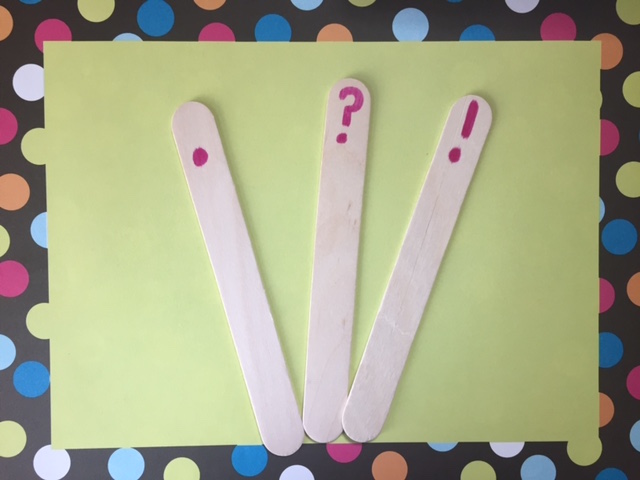
Punctuation Sticks - Draw a large period, question mark, and exclamation mark on the ends of three sticks. Write a sentence on the board. Put sticks one at a time at the end of the sentence for the children to read.
*Write the ABC’s or numbers on the board in sets of 3. Can children read
these with appropriate expressions?
*Let children use the sticks as they read with a buddy.
                                   
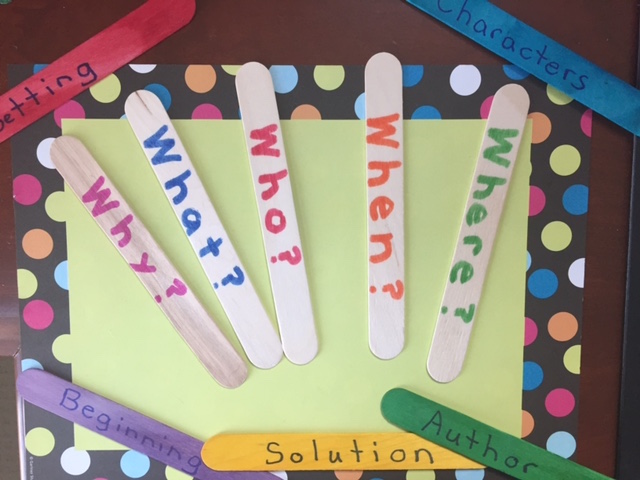
Comprehension Sticks – Write “Who?” “What?” “Where?” “When?” “Why?” on sticks and insert them in a sock. Throw the sock over your shoulder before reading to prompt the children to be active listeners. After reading the story, let children choose a stick and tell that part.
*You could also write “author, illustrator, title, beginning, middle, end” or “characters, setting, problem, resolution.”
                                                   
Letter Pops - Glue magnetic letters to the end of craft sticks. Children can use these to match letters with print in the classroom.
*Children can get together with friends and make words.
*Match uppercase and lowercase letters.
*Pass these out for children to hold up as you sing alphabet songs.
*Place in the classroom library. Children choose a letter and then match it up in the book.

*Put letter pops in a can in a center.  Children choose a stick and write the letter.
*Make shape pops or number pops.

Friday, January 8, 2016

STANDARDS FROM A SNOWMAN

There might be a little magic in that old silk hat if you let a snowman help you!

How To – Let children discuss how to make a snowman.  Dramatize making a snowman by rolling a big ball, and then a middle size ball, and then a small ball for the head.  Fold two sheets of paper in half and staple.  Have children write a book about how to make a snowman.

Before and After – Have children fold a sheet of paper in half.  Ask them to draw a picture of a snowman before it melts on the left.  Can they draw a picture of the snowman after it melts on the right?  What makes a snowman melt?
*Give children cartoon frames to illustrate a snowman melting.

Snowman Addition – Draw snowmen on poster board similar to the one shown.  Laminate.  Children make sets (or write addends) in the top two balls and then put the sum in the bottom ball.
Snowball Math – Fill a clear jar with snowballs/cotton balls.  Let each child estimate how many snowballs are in the jar and write their name and answer on a sheet of paper.  At the end of the day count the snowballs.  Who guessed more?  Who guessed less? 
*Let the children use the “snowballs” to make sets or to do addition and subtraction problems.

Science Experiment - Give each child a clear cup with an ice cube in it.  Ask them to draw a picture of what it looks like.  Have them predict how many minutes it will take their ice cube to melt.  Encourage them to draw what it looks like after five minute intervals.

Snowball Reading and Math – Give each child a sheet of scrap paper.  Tie this in with skills you want to reinforce by having them write a letter, vocabulary word, math fact, etc. on the paper.  Wad up the paper to make snowballs.  Divide the class into two teams facing each other.  When the teacher says, “Let it snow!” the children start throwing their snowballs at the opposite team.  Before children can throw the snowball back they must open it up and tell a team member the information on the paper.  (It’s O.K. to ask for help.)  After several minutes the teacher says, “Freeze!” and everyone must stop throwing.  Each team gathers up the snowballs on their side and counts the amount.  Who has more?  Who has less?  In this game, the team with the least amount is the winner.
*Keep throwing snowballs as long as the children are interested.

Frosty’s Magic Hat
Make flashcards for letters, numerals, words, math facts, or other skills.  On several cards draw a black hat.  Explain that when Frosty’s magic hat appears the children get to stand up and dance around.  This is an easy game that you can play during transitions if you only have a few minutes.
Snowman’s Mystery Word
Draw a snowman on the board.  Think of a word or phrase and put blanks for each letter.  Children guess letters (similar to Hangman).  The teacher writes the letters on the appropriate spaces.  If a letter that is not in the word/phrase is called out the teacher erases part of the snowman and puts the letter in the “trash pile.”  Can they decode the word before the snowman is erased?

Snowball Seriate
Cut different sizes snowballs (circles) out of cardstock.  Let children seriate them from largest to smallest.

Counting Snowmen
Cut out 10 or 20 snowmen from heavy paper.  Write the numerals 1-10 (or 20) on their bodies.  Mix up the snowmen and then have the children put them in order.

I’m a Little Snowman
(Tune:  “I’m a Little Teapot”)
I’m a little snowman                  (Bend knees.)
Short and fat.                            (Extend arms in a circle.)
Here is my broom and              (Hold out right hand.)
Here is my hat.                          Touch head with left hand.)
When the sun comes out          (Slowly melt to the ground.)
I’ll melt away.
But I’ll be back another day!

I’m a snow lady,                         (Bend knees.)
White and round.                       (Extend arms in a circle.)
In my hat and apron                  (Touch head and waist.)
I don’t make a sound.                (Index finger on lips.)
When the sun comes out           (Slowly melt to the ground.)
I’ll melt away.
But I’ll be back another day!
*Download this book at drjean.org.

Friday, October 23, 2015

HANDY RHYMES

The ability to rhyme is a key to phonological awareness and learning to read.  Children don't learn to rhyme in a day, but here are some ACTIVE ideas to engage them whenever you have a few extra minutes


Handy Rhymes
Have children extend their arms as they sing a pairs of words that rhyme.  Sing to the tune of “Skip to My Lou.”
            Top (hold out right hand)
            Mop  (hold out left hand
            Those words rhyme.
            Sun (hold out right hand)
            Fun (hold out left hand)
            Those words rhyme.
            Kitten (hold out right hand)
            Mitten (hold out left hand)
            Those words rhyme.
            Now, let’s rhyme some more…(Roll arms around.)
Rhyme Ball
You will need a ball, beanbag, or other object to toss for this game.  Children sit or stand in a circle.  The teacher says a word and then tosses the ball to a child.  As the child catches the ball, she must say a word that rhymes.

Rhyme Detectives
Tell the children that they will get to be detectives and listen for words that rhyme.  You say a word, and they put their pinkies up if they hear a word that rhymes with it.  Pinkies down if the words don’t rhyme.
            Cat - hat (pinkies up)
            run - dog (pinkies down)             

Name Rhymes
Children love silly nonsense words, so make up rhymes with their names.                          Jason – bason – mason – pason
            Mia – bia – ria – chia

Rhyme Bag Homework
Give each child a paper bag and ask them to bring in two objects that rhyme.  (You could even make the bag into a backpack.)
Repeat this chant below as children share their items:
            We’re going on a rhyming hunt and we know what to do.
            We need to listen carefully and rhyme some words with you.
Say the words several times.  Can children think of other words that rhyme?
*As a follow up activity ask children to draw pictures of things their friends shared that rhyme.

And that’s the end - my friends!

Tuesday, September 15, 2015

MAKE A HAT DAY

Whoever heard of Make a Hat Day? Well, it’s today, but here is a simple hat idea that you can adapt for letters, shapes, or other skills any old day. 

Materials: sentence strips or construction paper cut 4” x 24”, markers,
scissors, glue, construction paper scraps, stapler

Directions: Let children choose a favorite letter and write it in the middle of the strip of paper. Have them decorate the strip with pictures of things that begin with that sound. Adjust the headband to the child’s head and staple.

*Sing alphabet songs and let the children do a special dance when their letter is sung.

*Call out three (CVC) sounds and let children come to the front of the room if their letter makes the sound. Have the children hold hands to make the word. 

                         
Book Report
Instead of book reports, let students make headbands about their book and then do a book talk.

Shapes
Let children make shape headbands but cutting out construction paper shapes and gluing them to their headband.

Holiday Hats

Make headbands for Thanksgiving, Valentine's or to celebrate other special days.

Drama
Decorate headbands for characters from a story. Children can wear these and act out the story.

Thursday, September 10, 2015

DOLLAR LETTERS AND WORDS

This is a perfect project for any skill because children love to make things and they also enjoy collecting things. They’ll feel “richer” as they learn new words and add the dollars to their wallets.

Materials: construction paper 9” x 12”, markers, green paper cut 4” x 2”

Directions: First let each child make a wallet where they can “save” their sight words. Lay a sheet of construction paper horizontally. Fold up the bottom within one inch of the top. Glue the two sides and then fold in half. Let children decorate their wallets with their name and drawingss. As you introduce new words let the children write them on the green rectangles/dollars and then store them in their wallets.

                            
*Use these at small group time to play “mystery word” as you call out clues. For example, “This word starts with ‘t’ and ends with ‘e.’” This word is the opposite of ‘sad.’”

*Children can use their words to make sentences, sort parts of speech, etc.

*Let children take their word wallets home and practice them with their parents.

*If you have a few extra minutes in the day have children get out their dollar words and read them independently or with a partner.

*Challenge children to learn to spell their dollar words.


Letter Wallets - Younger children could save letters, numbers, or shapes in their wallets.

Math Wallets - Write addition and subtraction facts on dollars and save them in math wallets.

Vocabulary - Have children write vocabulary words on dollars and store them in their wallets.


Word Families - Use wallets to reinforce word families.

Tuesday, September 8, 2015

WONDERFUL WEDNESDAY SPARKLE WORD


READING MEETING PART 6
Explain that “sparkle” words are power words that make talking and reading more interesting. On Wonderful Wednesday they get to learn a sparkle word. Choose a word from a book, unit of study, or of personal interest to your students. Write the word in glue on a 10" sentence strip and then sprinkle with glitter.  Cut off the left end of an envelope and insert the word in the envelope.  Make a big deal of introducing the word by saying:
     Give a drum roll….(pat knees and make a sound).
     Give a Beethoven…(pretend to hold a violin and hum the first few notes of Beethoven’s 5th Symphony).
     Give me a trumpet…(pretend to hold a horn and toot).
Pull out one letter at a time as you blend the sounds and introduce the sparkle word.

*Dramatize the word.

*Invite students to make up sentences using the word.

*Put the sparkle word in a name badge and wear it throughout the day.  At random times in the day say, “If you know my sparkle word smile at me.” “If you can read my word shout it out!” “If you can read my word whisper it out.”

*Save sparkle words each week and review.  Give children a cheer when they use a sparkle word.


Sunday, September 6, 2015

WACKY WORD WAYS


READING MEETING PART 5
Choose 4 to 5 words each week to practice each day with one of these strategies.

Sign Language - As you introduce new words, teach children the signs for the words by using the dictionary at aslpro.com.

Word Supervisor - Each day choose a different sight word and it on an index card. Tape the word to a visor and choose a child to be the “word supervisor” for the day. Whenever you leave the class, that child stands at the door with their arm extended. Friends must read the word on the visor before exiting the classroom. 

                              
Karate Writing
Spell out words with karate writing.  For letters that start at the top dotted line punch up high. For letters that start at the middle dotted line punch out in front of your waist. For letters with a tail that go below the line give a little kick.
                  A – punch from waist
                  B – punch up in the air
                  C – punch from waist
                  D – punch up in the air
                  E – punch from the waist
                  F – punch up in the air
                  G – give a little kick…etc.

Sports Spell - Pretend to be athletes and spell out words.
Basketball – bounce on letters and make a basket as you say the word.
Baseball – swing on letters and twirl around and hit a home run as you say the word
Soccer – small kicks on the letters and kick a goal as you say the word
Let children make up motions for other sports, such as swimming, fishing, etc.

Sing to Cadence

Children echo each line as you sing, march, and slap your thighs.
     There are some words you need
     If you want to learn to read
     ___ ____ ____ ____
     ___ ____ ____ ____

Mystery Word
Play a game where you give clues about the words. For example: “I start with “L” and rhyme with “book.”

Sentences
Encourage children to make up sentences using sight words.

Saturday, September 5, 2015

A - B - C AND THEN SOME!


READING MEETING PART 4
Children definitely need to stand for this part of morning meeting and begin by doing an alphabet song such as:

Who Let the Letters Out?
Happy Birthday Letters
Alphardy  (You can download this free on my website this month.)
Phonercise  (There is a free youtube video of this song.)
Letter Pops    

Kick Box the ABC’s
Go Letters!
Alphabet Remix


Stop and Touch
A clever way to help children make connections between what they are singing and the printed letter is to play a game similar to “freeze.” Several times during an alphabet song stop the music and have the children touch the letter on classroom print.

Note! I think playing “dance and freeze” is also good for self-regulation and impulse control.

Body Letters
Can the children make the specific letter you are focusing on?

Air Writing

Write letters in the air with your index finger or another body part.

Sign Language
Teach manual signs for letters as you introduce them.

Pop a Word
Make the sound of the letter and challenge children to “pop out” all the words they can think of that begin with that sound.

Pinkies UP
Children listen as you say a group of words. If a word begins with the letter sound you are working on they put up their pinky finger.


Friday, September 4, 2015

PHONO FUN

READING MEETING PART 3
Got cha! Sometimes I like to make up words like poet ee cummings. I’m actually going to be sharing some ideas for phonological awareness that you could integrate into your reading meeting.

Choose a rime (aka word family) from the poem of the week. As children identify rhyming words from the poem write them on the board. Circle the letters that are the same in each word. Can they add other words to the list? 

Word Family Song
Sing this song to the tune of “Bingo.” For example, if you read "Jack and Jill" you could sing:
         There is a word family you should know
         And “ill” is it’s name-o.
         J – I – L – L Jill
         H – I – L – L hill
         W – I – L – L will
         They end in “ill” you know.

                               
*Write the word family in a large house and encourage the children to add rhyming words throughout the week.

Rhyme Ball 
You will need a ball, beanbag, or other object to toss for this game. Children sit or stand in a circle. The teacher says a word and then tosses the ball to a child. As the child catches the ball, she must say a word that rhymes.

Syllabication
Clap, snap, hop or make other movements to words in the rhyme.

Instruments 
Have children beat out syllables with instruments.
*You could also use cardboard rollers, straws, pencils, etc. like drum sticks to tap out rhythms and syllables.

Sound Sack

Take a small sack and fill it with common objects or small toys. Capture children’s interest with this song to the tune of “I’m a Little Teapot.”
            What’s in the sound sack, who can tell?
            Maybe it’s a book or maybe it’s a shell?
            What’s in the sound sack, who can say?
            Blend the sounds, you’ll know right away!

Choose and object and stretch out the sounds. When children can blend the sounds and say the word, remove It from the sack and place it on the floor. Before putting each item back in the bag, segment the sounds again.

Thursday, September 3, 2015

RHYME AROUND THE WEEK


READING MEETING PART 2
Oh, you know how much I love, love, love nursery rhymes and poems. Besides nurturing fluency, brain researchers suggest memorizing poems increases short-term memory. I’ve got dozens of rhymes on my website and the internet is overflowing with one that will be just right for your class.
Each week write a poem on a chart and introduce it on Monday. Read over the rhyme using different strategies suggested below. Review the rhyme each day and then on Friday read and review rhymes from previous weeks.

Give children pocket folders to decorate to make their own “poetry books.” Each week give them a copy of the rhyme to illustrate and save in their books. They can take their books home over the weekend to share with their families.

Try choral reading with these strategies:

Shadow Reading – Teacher reads a line and then students repeat.

Magic Word – Choose a “magic word” (high frequency word) in the text. Every time you come to that word, the children get to clap, jump, snap, etc.

Say What? Read the wrong way and have children correct you by shouting out, “Say what?”

Missing Word – Omit a word and have the children fill it in.

Read with me IF you…like chocolate ice cream
      like broccoli         have a dog
      can ride a bike     are wearing red

Stand and Read – Children stand and take a small step to the right for each word. At end of the line jump “down” to the next line. Everyone moves back to the left and quickly moves to the right with every word until the end of the next line. Repeat until the end of the poem.

Take a Turn
- Divide children into groups and each section reads a different line. For example: Let boys and girls alternate reading lines.

Got Cha! – Whenever the teacher yells, “Got Cha!,” the students must pick up reading.

Voice Box – Go to my website and download “fluency cards.” Place these in a small box and let students choose a voice and then lead classmates in reading the rhyme.


Wednesday, September 2, 2015

EXTRA! EXTRA! READ ALL ABOUT IT!


READING MEETING PART I
The morning message is a powerful way to demonstrate the importance of reading and writing. When a class mascot (stuffed animal or puppet) has a message waiting for the children it will give them something to anticipate each day.

Here's a song to the tune of “My Darlin Clementine” to focus children’s attention for the 
morning meeting:
         We are readers.
         We are writers.
         And we like to learn it’s true.
         We will read the morning message
         So we’ll know just what to do.


Hocus – Pocus – Focus
Did you know that if you tell your brain that something is important it’s more likely to remember it? If you have your children put on their focus goggles before you call their attention to something on the morning message it just might work. Say, “Hocus, pocus, goggles, focus!” as you demonstrate making circles with your thumbs and index fingers and placing them around your eyes.

To the Point
You probably already have some pointers, but it’s easy to make seasonal ones by placing finger puppets on the end of a cardboard pants roller.

Cut out the center of a butterfly net and add some fancy ribbon and you’ll be able to frame letters, words, and other key details.

Correct the Teacher
As the year goes along you can make spelling and punctuation errors so the children can “correct” you.